Tennis Ball Machine Market Size, Share & Demand Report By Type (Electronic Tennis Ball Machines, Battery-Operated Machines, Smart/App-Controlled Machines), By Application (Training & Practice, Personal/Recreational Use), By End-Use (Tennis Clubs & Academies, Individual Users, Sports Facilities), By Distribution Channel (Online, Offline), By Region & Segment Forecasts, 2025–2034
USD 3950
Market Overview
The Tennis Ball Machine Market size was valued at approximately USD 145 million in 2025 and is projected to reach USD 320 million by 2034, expanding at a compound annual growth rate (CAGR) of 9.1% from 2025 to 2034. The market is experiencing steady growth due to increasing participation in tennis as both a recreational and professional sport, along with the rising demand for advanced training equipment.
A key global factor supporting the growth of the Tennis Ball Machine Market is the increasing emphasis on skill development and performance training across all levels of tennis players. From beginners to professionals, players are adopting automated training tools to improve consistency, accuracy, and endurance. Additionally, advancements in machine design, portability, and programmable features have enhanced usability and accessibility, further boosting market expansion.
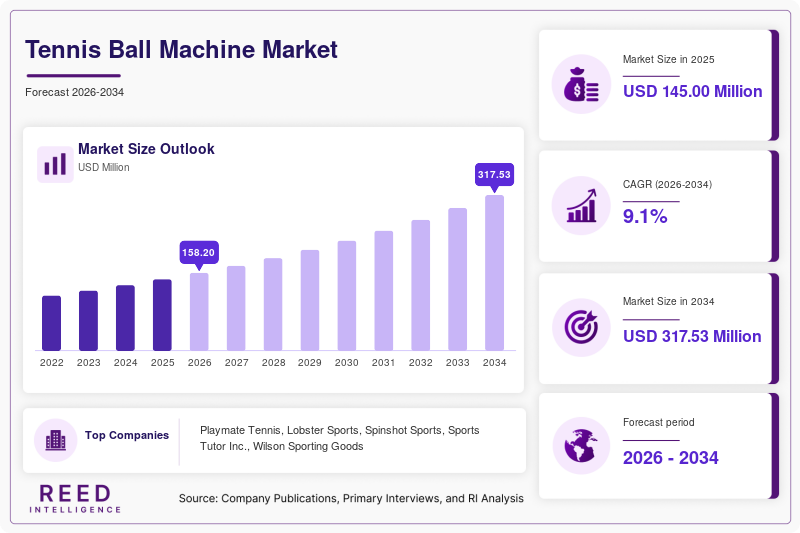
Key Highlights:
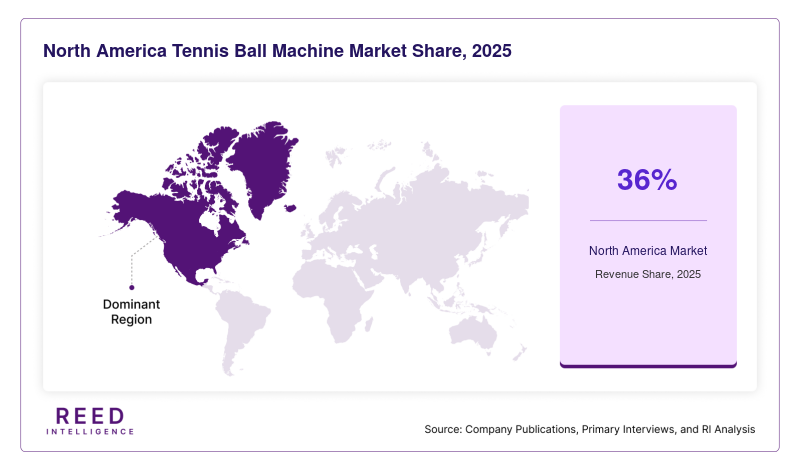
- North America dominated the market with a 36% share in 2025, while Asia Pacific is expected to register the fastest CAGR of 10.6% during the forecast period.
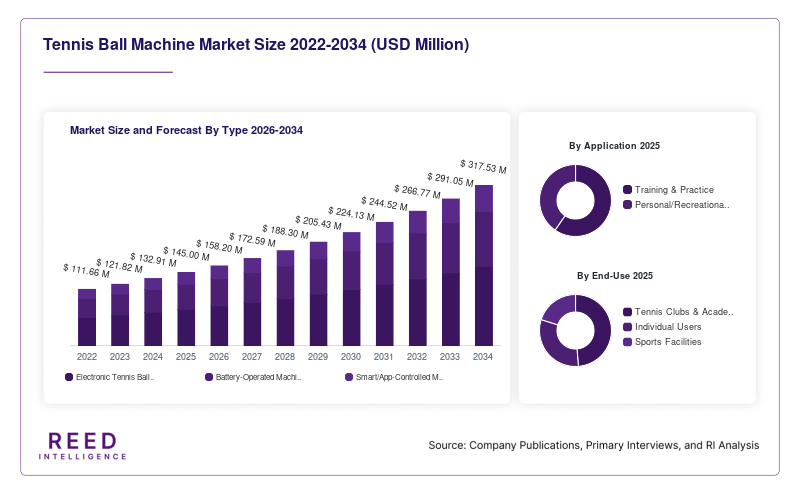
- Electronic tennis ball machines led the type segment with a 60% share, while smart/app-controlled machines are projected to grow at a CAGR of 10.9%.
- By application, training & practice accounted for 70% share, while personal/recreational use is expected to grow at a CAGR of 10.4%.
- The United States remained the dominant country, with market values of USD 52 million in 2025 and USD 56 million in 2026.
Market Trends
Integration of Smart and App-Controlled Features
A major trend shaping the Tennis Ball Machine Market is the integration of smart technologies and app-based controls. Modern tennis ball machines are equipped with Bluetooth or Wi-Fi connectivity, allowing users to customize training sessions through mobile applications. Features such as programmable drills, spin variation, and remote control functionality enhance user experience and training efficiency. This trend is gaining traction among professional players and training academies seeking data-driven performance improvement.
Growing Demand for Portable and Lightweight Machines
Another notable trend is the increasing preference for portable and lightweight tennis ball machines. Manufacturers are focusing on compact designs with improved battery life and easy mobility. These machines cater to recreational players and coaches who require flexibility in training locations. The convenience of transport and setup is driving adoption, particularly among amateur players and tennis clubs.
Market Drivers
Rising Popularity of Tennis as a Recreational Sport
The growing popularity of tennis globally is a key driver of the Tennis Ball Machine Market. Increased participation in tennis for fitness and leisure purposes has created demand for training equipment that supports skill development. Tennis ball machines enable players to practice independently, making them an attractive solution for individuals with limited access to coaching.
Increasing Investments in Sports Training Infrastructure
Investments in sports academies and training facilities have contributed significantly to market growth. Tennis academies and clubs are adopting advanced training equipment to enhance player performance and attract new members. The use of tennis ball machines in structured training programs has become a standard practice, supporting consistent market expansion.
Market Restraint
High Initial Cost and Maintenance Requirements
A major restraint in the Tennis Ball Machine Market is the relatively high initial cost associated with advanced machines. High-end models with smart features, programmable settings, and durable components can be expensive, limiting adoption among individual users and small clubs.
In addition to the purchase cost, maintenance requirements such as battery replacement, servicing, and spare parts add to the overall ownership cost. These factors can deter price-sensitive customers, particularly in emerging markets. As a result, while demand continues to grow, cost-related challenges remain a key barrier to widespread adoption.
Market Opportunities
Expansion in Emerging Sports Markets
Emerging economies present significant growth opportunities for the Tennis Ball Machine Market. Increasing disposable income, urbanization, and growing interest in sports activities are driving the adoption of tennis in countries across Asia Pacific and Latin America. As tennis gains popularity, the demand for training equipment, including ball machines, is expected to rise steadily.
Development of AI-Enabled Training Systems
The integration of artificial intelligence into tennis ball machines offers a promising opportunity for market growth. AI-enabled systems can analyze player performance and adjust training parameters in real time, providing personalized coaching experiences. These advanced features are expected to attract professional players and training institutions, driving innovation and market expansion.
Segmental Analysis
By Type
Electronic tennis ball machines dominated the Tennis Ball Machine Market with a 60% share in 2025. These machines offer advanced features such as adjustable speed, spin control, and programmable drills, making them suitable for both professional and amateur players.
Smart/app-controlled machines are expected to grow at the fastest CAGR of 10.9%. The increasing demand for connected devices and personalized training solutions will drive growth in this segment.
By Application
Training & practice accounted for the largest share of 70% in 2025. The widespread use of tennis ball machines in coaching and skill development programs has supported this segment’s dominance.
Personal/recreational use is projected to grow at a CAGR of 10.4%. The increasing adoption of tennis as a leisure activity will drive demand for user-friendly and portable machines.
By End-Use
Tennis clubs and academies held the largest share of 50% in 2025, as they are primary users of training equipment. The structured training environment supports consistent demand.
Individual users are expected to grow at a CAGR of 10.7%, driven by the rising popularity of home-based training solutions and personal fitness activities.
By Distribution Channel
Offline sales dominated the market with a 65% share in 2025, as customers prefer to evaluate products physically before purchase. Specialty sports stores play a key role in this segment.
Online sales are expected to grow at a CAGR of 10.8%, supported by the increasing adoption of e-commerce platforms and availability of a wide range of products.
Regional Analysis
North America
North America accounted for 36% of the Tennis Ball Machine Market share in 2025 and will grow at a CAGR of 8.7% through 2034. The region benefits from a strong sports culture and well-established tennis infrastructure.
The United States dominated the regional market due to its large base of tennis players and extensive network of training facilities. The presence of professional tournaments and academies has supported the adoption of advanced training equipment.
Europe
Europe held approximately 28% of the market share in 2025 and is expected to expand at a CAGR of 8.9% during the forecast period. The region has a strong tradition of tennis and a high number of active players.
Germany emerged as the leading country due to its well-developed sports infrastructure and focus on player development programs. Tennis clubs and academies in the country are increasingly adopting automated training solutions.
Asia Pacific
Asia Pacific represented 20% of the market share in 2025 and will register the fastest CAGR of 10.6% through 2034. Rapid urbanization and growing interest in sports are driving market growth.
China led the regional market due to its expanding middle class and increasing investment in sports facilities. The rising popularity of tennis among youth is supporting demand for training equipment.
Middle East & Africa
The Middle East & Africa accounted for 8% of the market share in 2025 and is projected to grow at a CAGR of 9.2%. The region is gradually adopting modern sports technologies.
The United Arab Emirates dominated the market, supported by investments in sports infrastructure and hosting international tennis events. The development of premium sports facilities is driving demand for advanced training equipment.
Latin America
Latin America held around 8% of the market share in 2025 and is expected to grow at a CAGR of 9.0% during the forecast period. The region is witnessing increased participation in sports activities.
Brazil emerged as the leading country due to growing interest in tennis and improvements in sports infrastructure. Government initiatives promoting sports participation are supporting market growth.
Competitive Landscape
The Tennis Ball Machine Market is moderately competitive, with several established players focusing on innovation and product differentiation. Companies are investing in advanced features such as smart connectivity, improved battery performance, and enhanced durability.
Playmate Tennis is recognized as a leading player in the market, known for its high-performance machines used in professional training environments. The company recently launched a new line of smart-enabled machines with customizable training programs, strengthening its market presence.
Other key players are focusing on expanding their distribution networks and enhancing product portfolios to cater to a wider customer base. Continuous innovation remains a key strategy for maintaining competitiveness in the market.
Key Players List
- Playmate Tennis
- Lobster Sports
- Spinshot Sports
- Sports Tutor Inc.
- Wilson Sporting Goods
- Slinger Bag Ltd.
- Babolat
- Yonex Co., Ltd.
- Prince Global Sports
- Head NV
- Gamma Sports
- Dunlop Sports
- Tecnifibre
- Volkl Tennis
- ProKennex
Recent Developments
- In 2025, manufacturers introduced smart tennis ball machines with mobile app integration for customized training sessions.
- Several companies launched lightweight and portable machines with extended battery life.
- Partnerships between sports academies and equipment manufacturers increased adoption of advanced training tools.
- New product launches focused on AI-based shot variation and performance tracking features.
- Expansion of e-commerce platforms improved product accessibility across global markets.
Tennis Ball Machine Market Segments
By Type
- Electronic Tennis Ball Machines
- Battery-Operated Machines
- Smart/App-Controlled Machines
By Application
- Training & Practice
- Personal/Recreational Use
By End-Use
- Tennis Clubs & Academies
- Individual Users
- Sports Facilities
By Distribution Channel
- Online
- Offline
By Region
- North America
- Europe
- APAC
- Middle East and Africa
- LATAM