Terracotta Cladding Market Size, Share & Demand Report By Product Type (Ventilated Terracotta Façade Panels, Terracotta Baguettes, Louvers and Screens, Terracotta Tiles, Custom Architectural Shapes), By Application (Commercial Buildings, Residential Buildings, Institutional Infrastructure, Industrial Facilities, Transportation Infrastructure), By End-Use (New Construction, Renovation and Retrofit), By Region & Segment Forecasts, 2026–2034
USD 3950
Market Overview
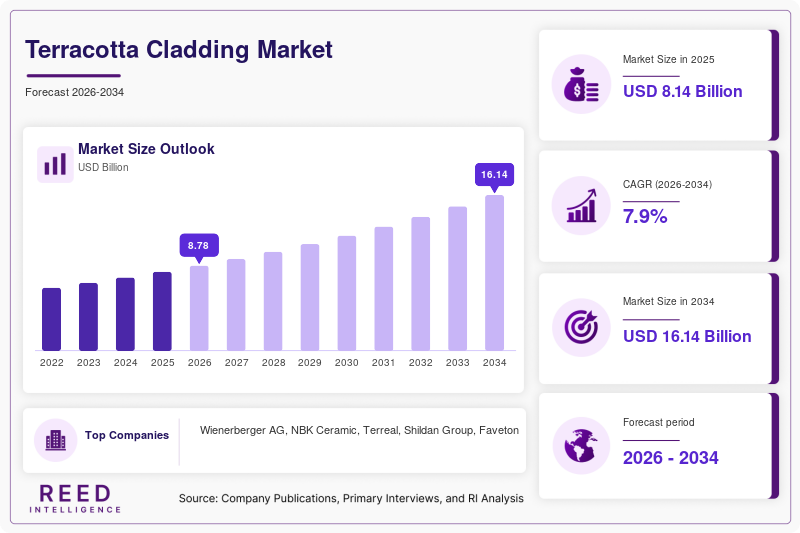
The global Terracotta Cladding Market size was valued at approximately USD 8.14 billion in 2026 and is projected to reach nearly USD 14.96 billion by 2034, expanding at a CAGR of 7.9% during the forecast period from 2026 to 2034. The market is experiencing steady expansion due to the increasing adoption of sustainable façade materials across residential, commercial, and institutional construction projects. Terracotta cladding systems are gaining attention for their thermal insulation properties, durability, low maintenance requirements, and compatibility with green building standards. Architects and developers are increasingly integrating ventilated façade systems into modern building designs, supporting wider adoption of terracotta-based exterior materials.
Rapid urbanization across developing economies and growing investments in commercial infrastructure projects have accelerated demand for advanced façade solutions. Governments in several countries are promoting energy-efficient construction practices to reduce carbon emissions from buildings, creating favorable conditions for terracotta cladding installations. In addition, improvements in manufacturing technology have enabled producers to develop lightweight terracotta panels with improved weather resistance and enhanced aesthetic flexibility. These advancements are helping manufacturers address both functional and architectural requirements in high-rise developments, transportation hubs, educational institutions, healthcare facilities, and mixed-use complexes.
Key Highlights
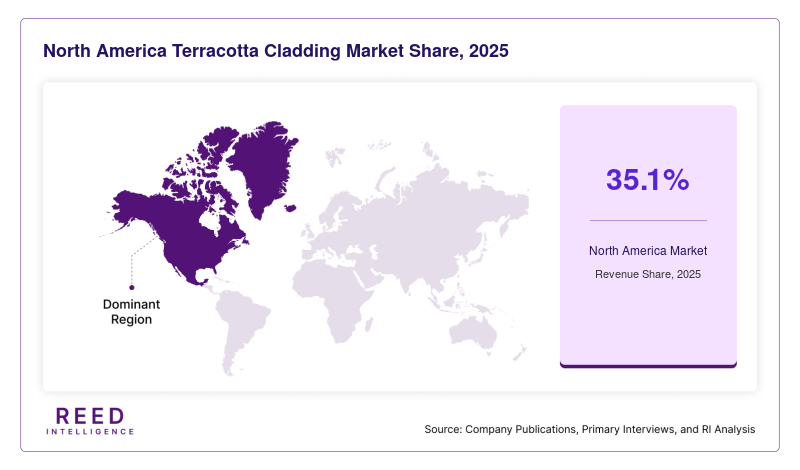
- North America dominated the market with a 35.1% share in 2025.
- Asia Pacific is expected to grow at the fastest CAGR of 9.8% during 2026–2034.
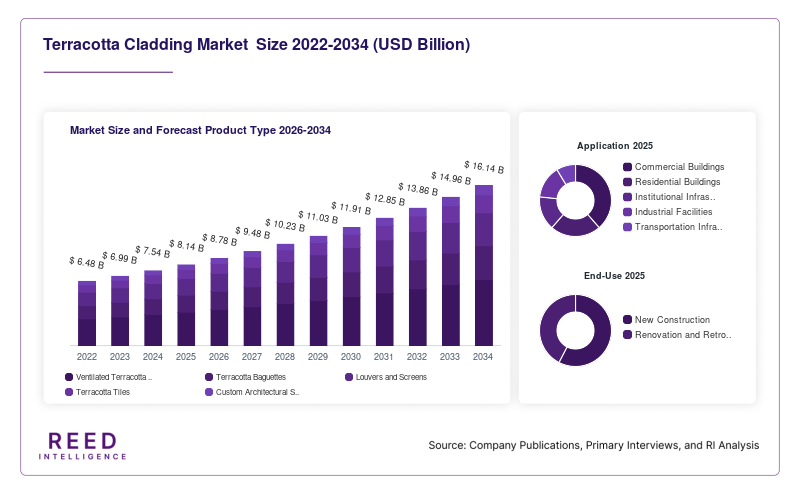
- By product type, ventilated terracotta façade panels accounted for the largest share of 42.6%, while baguette terracotta systems are projected to grow at a CAGR of 10.4%.
- By application, commercial buildings led with a 46.3% share, whereas institutional infrastructure is expected to expand at a CAGR of 9.9%.
- By end-use, new construction accounted for the dominant share of 63.7%, while renovation and retrofit projects are projected to grow at a CAGR of 8.8%.
- The United States remained the dominant country, with market values of USD 1.24 billion in 2024 and USD 1.36 billion in 2025.
Market Trends
Integration of Sustainable Ventilated Façade Systems
The growing adoption of sustainable building envelopes has become a significant trend shaping the terracotta cladding market. Developers are increasingly installing ventilated façade systems that improve thermal performance while reducing energy consumption in large commercial and institutional buildings. Terracotta panels are widely preferred because they support airflow circulation between the building wall and the exterior cladding layer, helping regulate indoor temperatures. This feature is particularly important in regions with stringent environmental standards and rising energy costs. Green building certifications and energy-efficiency regulations are encouraging contractors to select recyclable façade materials with long service life, further increasing demand for terracotta-based solutions.
Architectural firms are also favoring terracotta cladding because it offers design flexibility without compromising sustainability goals. Manufacturers are introducing customized colors, textures, and modular panel systems suitable for modern urban projects. Increasing awareness regarding carbon reduction targets in the construction sector has accelerated the replacement of conventional aluminum and synthetic façade materials with natural clay-based alternatives. This shift toward eco-conscious construction practices is expected to remain a long-term trend across both developed and emerging economies.
Expansion of Smart and Aesthetic Urban Infrastructure
Urban infrastructure projects are increasingly emphasizing architectural aesthetics alongside structural performance, creating strong demand for premium exterior cladding materials. Terracotta cladding systems are becoming common in airports, educational campuses, corporate offices, cultural centers, and luxury residential developments due to their modern appearance and weather resistance. Cities investing in smart infrastructure initiatives are prioritizing façade materials that combine energy efficiency with visual appeal. As a result, architects are integrating terracotta panels into contemporary building designs to create distinctive urban landscapes.
Technological advancements in digital fabrication and precision manufacturing are also influencing product development across the industry. Manufacturers are producing lightweight terracotta panels with improved strength and larger dimensions suitable for high-rise structures. The use of advanced installation systems has reduced construction time and improved façade performance in challenging climatic conditions. Demand for customized façade patterns and textured finishes is rising in metropolitan construction projects, particularly in Asia Pacific and the Middle East. This trend is expected to support continuous innovation and product differentiation within the global terracotta cladding industry.
Market Drivers
Growth in Green Building Construction Activities
The increasing construction of environmentally sustainable buildings is a major factor driving the terracotta cladding market. Governments and private developers are focusing on reducing the environmental impact of urban infrastructure by adopting energy-efficient building materials. Terracotta cladding systems provide natural insulation, moisture control, and enhanced thermal efficiency, making them suitable for green construction projects. Rising implementation of building energy codes and sustainability certifications has accelerated demand for façade materials that support long-term environmental objectives.
Commercial real estate developers are increasingly using terracotta façades in office complexes, educational institutions, healthcare facilities, and retail centers to improve building efficiency and reduce operational costs. In addition, the material’s recyclability and durability align with global sustainability initiatives aimed at lowering lifecycle emissions from buildings. The growing popularity of net-zero construction and environmentally responsible architecture has further strengthened demand for terracotta-based façade systems. As more countries expand investments in sustainable infrastructure, the adoption of terracotta cladding is expected to rise steadily throughout the forecast period.
Rising Investments in Commercial and Institutional Infrastructure
Rapid investments in commercial and institutional construction projects are significantly contributing to market growth. Governments across emerging economies are increasing spending on transportation infrastructure, public institutions, educational facilities, and healthcare complexes, all of which require durable and visually appealing façade systems. Terracotta cladding products are widely used in these projects because they offer weather resistance, low maintenance costs, and long operational life. Their ability to withstand extreme climatic conditions makes them suitable for both urban and coastal infrastructure developments.
Private sector investments in commercial real estate are also supporting market expansion. The growing number of mixed-use developments, luxury hotels, corporate headquarters, and shopping complexes has created strong demand for premium exterior materials. Developers are increasingly selecting terracotta cladding systems to enhance architectural aesthetics while maintaining compliance with environmental building standards. Furthermore, rising urban population density has increased the construction of high-rise buildings requiring lightweight façade systems with improved structural performance. These factors continue to create favorable conditions for market growth across multiple regions.
Market Restraint
High Initial Installation and Maintenance Complexity
The terracotta cladding market faces challenges associated with high initial installation costs and specialized construction requirements. Compared with conventional exterior wall materials, terracotta cladding systems require advanced support structures, precision engineering, and skilled labor for installation. These additional costs can discourage adoption among small and medium-sized construction developers operating with limited project budgets. The transportation and handling of terracotta panels also increase overall project expenses, particularly for large-scale commercial developments requiring customized façade systems.
Installation complexity can further affect project timelines and labor costs. Improper installation may lead to alignment issues, moisture penetration, or structural performance concerns, creating hesitation among contractors unfamiliar with advanced façade technologies. In developing economies, limited availability of trained façade specialists and modern installation equipment can restrict wider adoption of terracotta systems. Additionally, fluctuations in raw material and energy costs may influence manufacturing expenses, affecting product pricing across global markets. These challenges are expected to remain significant barriers, especially in price-sensitive construction sectors where developers prioritize lower-cost alternatives such as metal composite panels or synthetic cladding materials.
Market Opportunities
Increasing Renovation and Retrofit Activities in Mature Economies
The growing renovation of aging commercial and institutional buildings presents a significant opportunity for the terracotta cladding market. Many cities in North America and Europe are upgrading outdated infrastructure to improve energy efficiency and comply with modern environmental standards. Building owners are increasingly replacing traditional façade materials with ventilated terracotta systems that enhance insulation performance and modernize architectural appearance. Retrofit projects are becoming particularly common in office buildings, universities, hospitals, and government facilities constructed several decades ago.
Terracotta cladding solutions are gaining preference in renovation projects because they can improve building performance without requiring complete structural replacement. Developers are using lightweight terracotta panels to upgrade aging exteriors while minimizing additional structural load. Increasing investments in urban redevelopment and smart city modernization programs are expected to create long-term growth opportunities for façade manufacturers. Furthermore, government incentives supporting energy-efficient building renovations are encouraging property owners to adopt sustainable exterior systems, contributing to higher demand across retrofit construction segments.
Expansion of Infrastructure Development Across Emerging Economies
Emerging economies in Asia Pacific, the Middle East, and Latin America are creating substantial growth opportunities for terracotta cladding manufacturers. Rapid urbanization, population growth, and industrial expansion are increasing demand for residential towers, airports, educational institutions, and commercial complexes. Governments are investing heavily in modern infrastructure projects designed to improve urban functionality and attract international investment. These projects frequently require durable and visually appealing façade materials suitable for large-scale developments.
Architectural modernization trends are also contributing to demand for terracotta cladding products in developing urban centers. Developers are seeking exterior materials that provide both aesthetic value and environmental performance. The rising adoption of green building practices in countries such as China, India, Saudi Arabia, and Brazil is expected to support strong market growth during the forecast period. In addition, expanding local manufacturing capabilities and improved supply chain networks are making terracotta products more accessible across emerging markets. These developments are likely to create new revenue opportunities for regional and international façade system suppliers.
Segmental Analysis
By Product Type
Ventilated terracotta façade panels accounted for the dominant share of approximately 42.6% in 2024 due to their widespread adoption in commercial and institutional construction projects. These systems are highly preferred because they improve thermal insulation, moisture management, and energy efficiency in large buildings. Architects and developers increasingly select ventilated panels for office towers, educational campuses, airports, and healthcare facilities where long-term operational efficiency is a priority. Their lightweight structure and compatibility with modern façade engineering systems further contribute to market leadership. Manufacturers are also introducing customized finishes, textures, and color variations that support advanced architectural designs. In addition, the ability of ventilated terracotta systems to reduce building cooling requirements has strengthened their adoption across regions with stringent energy-efficiency regulations. The growing popularity of sustainable construction materials continues to reinforce demand for this product category.
Baguette terracotta systems are projected to witness the fastest CAGR of 10.4% during the forecast period due to increasing demand for decorative and shading façade applications. These elongated terracotta elements are increasingly used in modern architectural designs to enhance exterior aesthetics while improving solar shading performance. Commercial complexes, hospitality infrastructure, transportation hubs, and educational facilities are adopting baguette systems to create visually distinctive building exteriors. Their flexibility in design and installation enables architects to develop customized façade patterns suitable for contemporary urban projects. Rising investments in premium commercial developments and luxury infrastructure are further supporting product demand. Manufacturers are also developing lightweight baguette systems with improved durability and weather resistance to meet evolving construction requirements. The increasing integration of passive cooling solutions in sustainable architecture is expected to continue driving strong growth for this subsegment.
By Application
Commercial buildings represented the largest application segment with a market share of approximately 46.3% in 2024. Demand within this category is driven by increasing construction of office complexes, shopping centers, hotels, airports, and mixed-use developments across major urban regions. Terracotta cladding systems are widely used in commercial projects because they provide an attractive exterior appearance while supporting energy efficiency and durability requirements. Developers are increasingly integrating ventilated façade systems into commercial structures to improve insulation performance and reduce long-term maintenance costs. In addition, growing competition within the commercial real estate sector has encouraged property owners to invest in visually distinctive architectural designs incorporating natural façade materials. Terracotta panels also help commercial buildings comply with green construction standards and sustainability certifications, further strengthening segment growth. Rising investments in urban commercial infrastructure continue to support demand across developed and emerging economies.
Institutional infrastructure is anticipated to register the fastest CAGR of 9.9% during the forecast period due to increasing investments in educational, healthcare, and government facilities. Public sector authorities are emphasizing sustainable construction practices while modernizing institutional infrastructure, creating favorable conditions for terracotta cladding adoption. Universities, hospitals, transportation terminals, and cultural centers are increasingly utilizing terracotta façade systems because they provide durability, weather resistance, and thermal efficiency. Institutional developers are also prioritizing low-maintenance building materials capable of supporting long operational life cycles. Rising public spending on healthcare and education infrastructure in Asia Pacific and the Middle East is expected to significantly contribute to segment expansion. Furthermore, architectural firms are increasingly integrating terracotta façades into institutional projects to achieve contemporary design objectives while maintaining compliance with environmental regulations. These factors are likely to accelerate growth within the institutional infrastructure segment throughout the forecast period.
By End-Use
New construction dominated the market with a share of approximately 63.7% in 2024 due to increasing global investments in residential, commercial, and institutional infrastructure development. Rapid urbanization and population growth have created substantial demand for new buildings incorporating energy-efficient façade systems. Developers are increasingly selecting terracotta cladding materials during the design phase of modern projects because they offer durability, sustainability, and aesthetic flexibility. Large-scale smart city developments, commercial complexes, and transportation infrastructure projects are contributing significantly to demand within this segment. In addition, governments across several countries are encouraging sustainable urban development through stricter building efficiency regulations, further supporting adoption of terracotta façade systems in new construction. The availability of advanced installation technologies and lightweight terracotta panels has also improved construction efficiency and reduced structural load requirements in high-rise developments.
Renovation and retrofit projects are projected to grow at the fastest CAGR of 8.8% during the forecast period due to increasing modernization of aging building infrastructure. Property owners and municipal authorities are upgrading existing buildings to improve energy efficiency, structural performance, and exterior aesthetics. Terracotta cladding systems are increasingly used in retrofit applications because they can enhance insulation and weather resistance without requiring extensive structural modifications. Commercial office buildings, educational facilities, and public institutions represent major areas of demand within this segment. Governments in Europe and North America are also promoting energy-efficient renovation initiatives aimed at reducing carbon emissions from older buildings. Rising awareness regarding lifecycle cost savings and environmental sustainability is encouraging developers to replace outdated façade materials with advanced terracotta systems. These factors are expected to create substantial long-term growth opportunities within the renovation and retrofit segment.
Regional Analysis
North America
North America accounted for approximately 35.1% of the global terracotta cladding market share in 2025 and continues to represent the leading regional market. The region is expected to expand at a CAGR of 7.1% during the forecast period due to sustained investments in commercial real estate and institutional infrastructure. Increasing demand for sustainable construction materials and energy-efficient façade systems has encouraged developers to adopt terracotta cladding across office buildings, educational campuses, healthcare centers, and transportation facilities. Strong regulatory frameworks supporting green building standards are further supporting regional market growth.
The United States remains the dominant country within North America due to high spending on urban redevelopment and commercial renovation projects. Large metropolitan cities are increasingly modernizing aging infrastructure with ventilated façade systems that improve energy efficiency and enhance architectural appearance. Growing adoption of environmentally sustainable construction materials among architects and developers has strengthened demand for terracotta-based façade systems. Canada is also contributing to regional growth through investments in public infrastructure and energy-efficient residential construction projects.
Europe
Europe represented nearly 28.4% of the global terracotta cladding market in 2025 and is projected to maintain stable growth throughout the forecast period at a CAGR of 6.8%. The region benefits from strong environmental regulations encouraging the use of recyclable and energy-efficient construction materials. Countries across Western Europe are increasingly investing in sustainable commercial buildings, educational facilities, and public infrastructure projects requiring advanced façade systems. Demand for ventilated cladding technologies remains particularly strong in urban redevelopment initiatives and modern architectural applications.
Germany emerged as the leading country within the European market due to its focus on energy-efficient construction and sustainable urban planning. The country has witnessed growing adoption of terracotta façade systems in commercial offices, transportation hubs, and cultural institutions. Renovation projects aimed at reducing building energy consumption are also supporting product demand. France and the United Kingdom continue to experience rising installations of terracotta panels in high-end residential and mixed-use developments designed to meet environmental compliance standards.
Asia Pacific
Asia Pacific accounted for approximately 23.7% of the global market in 2025 and is expected to register the fastest CAGR of 9.8% during 2026–2034. Rapid urbanization and expanding infrastructure investments are driving substantial demand for advanced façade systems throughout the region. Governments are increasing spending on commercial complexes, smart cities, airports, educational institutions, and residential high-rise developments. The adoption of terracotta cladding products is growing because developers seek durable, lightweight, and aesthetically appealing exterior materials suitable for dense urban environments.
China dominates the Asia Pacific market due to extensive commercial construction activity and increasing adoption of sustainable building technologies. The country continues to invest heavily in urban infrastructure modernization, supporting strong demand for advanced cladding systems. India is also emerging as a major growth contributor as developers integrate energy-efficient façade materials into commercial and residential projects. Rising awareness regarding environmentally responsible construction practices across Southeast Asia is expected to create additional market expansion opportunities throughout the forecast period.
Middle East & Africa
The Middle East & Africa region held around 7.2% of the global terracotta cladding market share in 2025 and is anticipated to grow at a CAGR of 8.1% during the forecast period. Increasing investments in tourism infrastructure, luxury commercial developments, and smart city projects are supporting regional demand for premium façade materials. Developers in Gulf countries are increasingly adopting terracotta cladding systems because of their thermal insulation properties and ability to withstand harsh climatic conditions. Large-scale urban infrastructure projects continue to create steady opportunities for façade manufacturers.
Saudi Arabia represents the dominant market within the region due to ongoing investments in urban megaprojects, hospitality infrastructure, and commercial real estate development. National initiatives focused on economic diversification are driving construction activity across transportation, tourism, and mixed-use urban projects. The United Arab Emirates is also witnessing growing demand for architecturally advanced façade materials in luxury residential and commercial developments. Increasing awareness of sustainable construction practices is expected to support continued regional growth.
Latin America
Latin America accounted for approximately 5.6% of the global terracotta cladding market in 2025 and is forecast to expand at a CAGR of 7.4% through 2034. Rising urbanization and increasing investments in commercial infrastructure are supporting demand for advanced building façade systems across the region. Governments and private developers are focusing on modernizing urban environments through mixed-use developments, institutional projects, and transportation infrastructure upgrades. Terracotta cladding materials are gaining popularity because of their durability, low maintenance requirements, and compatibility with tropical climatic conditions.
Brazil remains the dominant country in the Latin American market due to ongoing investments in commercial real estate and public infrastructure modernization. The country has experienced increasing adoption of ventilated façade systems in educational institutions, healthcare facilities, and corporate buildings. Mexico is also contributing to market growth through rising industrial and commercial construction activities. Expanding awareness regarding sustainable building materials and energy-efficient architecture is expected to encourage wider use of terracotta cladding systems throughout the region.
Competitive Landscape
The global terracotta cladding market remains moderately fragmented, with several international and regional manufacturers competing through product innovation, customized façade systems, and strategic construction partnerships. Companies are increasingly investing in advanced manufacturing technologies to improve product durability, reduce installation complexity, and expand architectural design capabilities. Market participants are also focusing on sustainable production methods and recyclable construction materials to align with evolving environmental standards across commercial and institutional construction sectors.
Wienerberger AG continues to maintain a strong leadership position due to its extensive façade product portfolio and global distribution network. The company has expanded investments in energy-efficient façade technologies and customized terracotta solutions for large-scale infrastructure projects. NBK Ceramic and Terreal remain prominent competitors with strong presence across Europe and Asia Pacific. Shildan Group has strengthened its position through advanced rainscreen cladding systems designed for commercial buildings. Faveton continues to expand its architectural façade offerings for premium urban developments.
Key Players
- Wienerberger AG
- NBK Ceramic
- Terreal
- Shildan Group
- Faveton
- Moeding Keramikfassaden GmbH
- Boston Valley Terra Cotta
- LOPO China
- Koninklijke Tichelaar
- Cerámica La Escandella
- FAVEMANC
- Jiangsu Paneltek Ceramic
- Palagio Engineering
- Argeton
- Hunter Douglas Architectural
Recent Developments
- In February 2026, Wienerberger AG expanded its terracotta façade manufacturing operations in Europe to increase production capacity for energy-efficient cladding systems used in commercial infrastructure projects.
- In August 2025, NBK Ceramic introduced a lightweight terracotta panel solution designed for high-rise buildings and advanced ventilated façade applications in urban construction environments.
- In November 2025, Shildan Group announced a strategic collaboration with a leading architectural design firm in North America to develop customized terracotta rainscreen systems for institutional infrastructure projects.
- In March 2026, Terreal launched an automated façade installation support platform aimed at improving construction efficiency and reducing installation complexity in large-scale commercial building developments.
Terracotta Cladding Market Segments
Product Type
- Ventilated Terracotta Façade Panels
- Terracotta Baguettes
- Louvers and Screens
- Terracotta Tiles
- Custom Architectural Shapes
Application
- Commercial Buildings
- Residential Buildings
- Institutional Infrastructure
- Industrial Facilities
- Transportation Infrastructure
End-Use
- New Construction
- Renovation and Retrofit
By Region
- North America
- Europe
- APAC
- Middle East and Africa
- LATAM