Terrestrial Trunked Radio (TETRA) And DMR Market Size, Share & Demand Report By Technology (TETRA, DMR Tier I, DMR Tier II, DMR Tier III), By Component (Hardware, Software and Analytics, Services), By End Use (Public Safety, Transportation and Logistics, Utilities, Oil and Gas, Mining, Manufacturing, Defense, Others), By Region & Segment Forecasts, 2026–2034
USD 3950
Market Overview
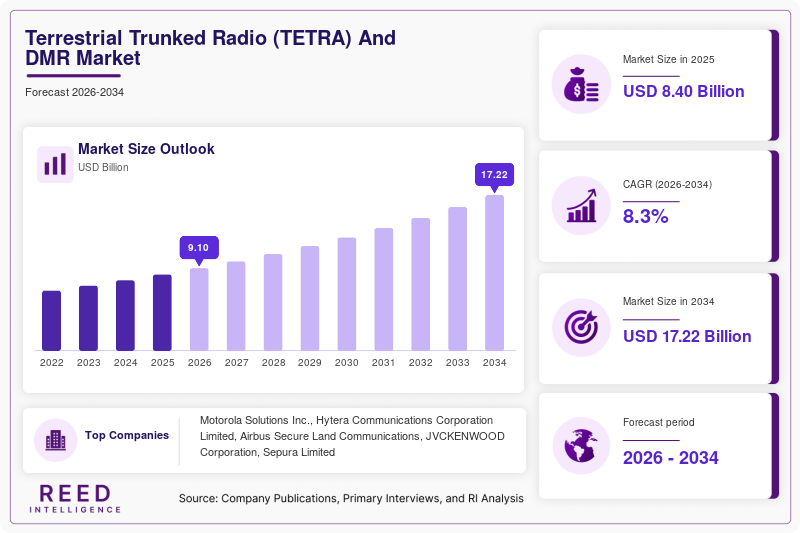
The global Terrestrial Trunked Radio (TETRA) And DMR Market size was valued at USD 8.4 billion in 2026 and is projected to reach USD 15.9 billion by 2034, expanding at a CAGR of 8.3% during the forecast period from 2026 to 2034. The market continues to gain momentum due to rising investments in mission-critical communication systems across transportation, public safety, utilities, defense, mining, and industrial sectors. Governments and enterprise operators are increasingly shifting from analog radio systems toward digital mobile radio platforms that provide secure communication, improved spectrum efficiency, enhanced interoperability, and scalable network management. TETRA and DMR technologies are widely used for emergency response coordination, infrastructure management, and field workforce communication.
One of the major global factors supporting market growth is the increasing focus on public safety modernization projects. Several countries are strengthening emergency communication infrastructure to support disaster response, urban security, border surveillance, and critical utility operations. Digital radio networks are becoming essential for police forces, emergency medical teams, airports, railway authorities, oil and gas operators, and municipal services because they provide encrypted communication, reliable coverage, and uninterrupted connectivity in remote environments. Growing smart city development projects and rising industrial automation are also supporting adoption of advanced radio communication systems.
Key Highlights
- North America dominated the market with a 34.6% share in 2025.
- Asia Pacific is expected to grow at the fastest CAGR of 10.8% during 2026–2034. By technology, TETRA systems accounted for the largest share of 56.4%, while DMR Tier III solutions are projected to grow at a CAGR of 11.1%.
- By component, hardware led with a 61.8% share, whereas software and analytics solutions are expected to expand at a CAGR of 12.2%.
- By end use, public safety agencies held the leading share of 39.7%, while transportation and logistics is projected to grow at a CAGR of 10.5%.
- The United States remained the dominant country, with market values of USD 1.82 billion in 2024 and USD 1.96 billion in 2025.
Market Trends
Integration of Broadband and Critical Communication Networks
The Terrestrial Trunked Radio (TETRA) And DMR Market is experiencing a notable shift toward hybrid communication ecosystems that combine traditional radio infrastructure with LTE and 5G broadband networks. Public safety agencies and industrial operators increasingly require real-time video transmission, location tracking, and high-speed data sharing capabilities alongside voice communication services. As a result, communication providers are introducing integrated systems that support both mission-critical narrowband radio and broadband connectivity within a unified operational platform. These integrated systems improve situational awareness, workforce coordination, and emergency response efficiency.
The growing deployment of smart transportation infrastructure, utility monitoring systems, and industrial automation platforms is further accelerating demand for hybrid communication networks. Railway operators, airport authorities, and oil and gas companies are investing in converged communication solutions that enable seamless interoperability between field teams and centralized command centers. Vendors are also launching cloud-enabled dispatch systems and AI-based network management software to optimize communication traffic, predictive maintenance, and cybersecurity monitoring. This trend is expected to support long-term market expansion as industries prioritize resilient and scalable communication infrastructure.
Growing Adoption of Portable and Rugged Communication Devices
The increasing demand for lightweight, portable, and rugged communication devices is becoming a major trend within the global TETRA and DMR industry. Field personnel operating in hazardous or remote environments require durable radio devices capable of delivering uninterrupted communication under extreme weather and operational conditions. Manufacturers are responding by developing compact handheld radios equipped with extended battery life, noise cancellation features, GPS integration, emergency alert systems, and water-resistant designs. These advancements are improving operational mobility for users in defense, mining, construction, and emergency response sectors.
In addition, organizations are increasingly prioritizing worker safety and operational continuity, which is driving investments in rugged communication technologies. Portable devices allow faster coordination during emergencies and support reliable communication in areas with weak commercial cellular coverage. The adoption of wearable communication devices and body-mounted radios is also increasing among law enforcement and firefighting departments. Furthermore, advancements in semiconductor technology and energy-efficient components are enabling vendors to reduce device size while improving performance and connectivity. This trend is expected to create strong growth opportunities for hardware manufacturers and network solution providers during the forecast period.
Market Drivers
Rising Investments in Public Safety Communication Infrastructure
Increasing investments in public safety communication infrastructure are driving significant growth in the Terrestrial Trunked Radio (TETRA) And DMR Market. Governments across developed and developing economies are prioritizing modernization of emergency response systems to improve coordination among police departments, firefighters, medical responders, and disaster management agencies. Digital radio systems offer encrypted communication, higher voice clarity, group calling functions, and improved network reliability compared to conventional analog systems. These advantages make TETRA and DMR technologies critical for emergency operations and national security.
Urbanization and rising population density are also creating demand for advanced communication systems capable of supporting large-scale public events, transportation management, and crisis response operations. Several countries are increasing budgets for homeland security, border surveillance, and municipal communication projects. Additionally, natural disasters and industrial accidents have highlighted the importance of resilient communication infrastructure during emergencies. Public agencies are increasingly adopting interoperable radio networks that allow seamless communication between different departments and regions. These investments are expected to continue supporting market growth throughout the forecast period.
Expansion of Industrial and Transportation Communication Applications
The growing use of digital mobile radio systems across industrial and transportation sectors is another major factor supporting market growth. Industries such as mining, oil and gas, manufacturing, utilities, and logistics require reliable communication systems for workforce coordination, operational safety, and asset management. TETRA and DMR technologies provide wide-area coverage, secure communication, and low operational latency, making them suitable for industrial environments where continuous connectivity is essential.
Transportation authorities are increasingly deploying digital radio systems across railways, airports, ports, and public transit networks to improve passenger safety and operational efficiency. These systems enable real-time communication between drivers, control centers, maintenance teams, and security personnel. Rising investments in smart transportation infrastructure and intelligent traffic management are also accelerating deployment of advanced radio communication networks. In addition, industrial organizations are adopting integrated communication systems linked with IoT sensors and remote monitoring platforms to improve operational visibility and reduce downtime. This growing industrial adoption is expected to maintain steady demand for TETRA and DMR solutions during the forecast period.
Market Restraint
High Infrastructure Deployment and Migration Costs
High deployment and migration costs remain a major restraint for the Terrestrial Trunked Radio (TETRA) And DMR Market. Establishing a large-scale digital communication network requires significant investment in base stations, repeaters, antennas, software platforms, dispatch centers, and handheld devices. Many small municipalities, utility operators, and industrial enterprises face budget limitations that slow adoption of advanced digital radio infrastructure. In developing economies, public safety agencies often continue using legacy analog communication systems because replacement costs are substantial.
The migration process from analog to digital communication networks can also create operational disruptions and training challenges. Organizations must invest in workforce training, network integration, maintenance support, and interoperability testing to ensure smooth deployment. Compatibility issues between legacy systems and new digital platforms may increase implementation timelines and operational complexity. In addition, spectrum licensing regulations and cybersecurity compliance requirements can add further financial pressure for operators. For example, several regional transportation agencies have delayed full-scale digital migration projects due to funding constraints and integration concerns involving older communication infrastructure. These financial and technical barriers may limit adoption rates among cost-sensitive users during the forecast period.
Market Opportunities
Increasing Demand for Smart City Communication Systems
The rapid expansion of smart city projects is creating substantial opportunities for the Terrestrial Trunked Radio (TETRA) And DMR Market. Urban authorities are investing in intelligent infrastructure solutions to improve public safety, traffic management, utility operations, and emergency response coordination. Digital radio communication systems are becoming an important component of smart city ecosystems because they support secure communication among municipal departments, transportation agencies, and emergency services. These systems also provide reliable connectivity during network congestion or infrastructure disruptions.
As cities adopt advanced surveillance systems, connected transportation networks, and automated public services, demand for interoperable communication infrastructure is expected to increase. TETRA and DMR technologies can integrate with command-and-control centers, IoT platforms, and video surveillance systems to improve urban operational efficiency. Emerging economies are particularly investing in smart city development programs to modernize infrastructure and strengthen disaster preparedness. Vendors that provide scalable communication platforms, cloud-based dispatch systems, and integrated analytics tools are expected to benefit significantly from this trend over the next decade.
Growth Potential in Emerging Industrial Markets
Emerging industrial markets across Asia Pacific, Latin America, and the Middle East are creating new growth opportunities for digital mobile radio providers. Expanding mining operations, energy projects, manufacturing facilities, and transportation infrastructure require dependable communication systems capable of operating in challenging environments. Many industrial operators are transitioning from analog communication platforms to digital radio networks to improve operational efficiency, workforce safety, and infrastructure monitoring capabilities.
The growing adoption of Industry 4.0 technologies is also increasing demand for advanced communication solutions integrated with automation systems and remote asset management tools. Industrial operators increasingly require real-time data transmission, location tracking, and centralized workforce coordination capabilities. Governments in several emerging economies are investing heavily in transportation corridors, industrial zones, and utility modernization projects, which is expected to increase deployment of digital communication networks. Additionally, rising private-sector participation in infrastructure development is creating long-term opportunities for network equipment providers, software developers, and managed communication service companies operating within the TETRA and DMR ecosystem.
Segmental Analysis
By Technology
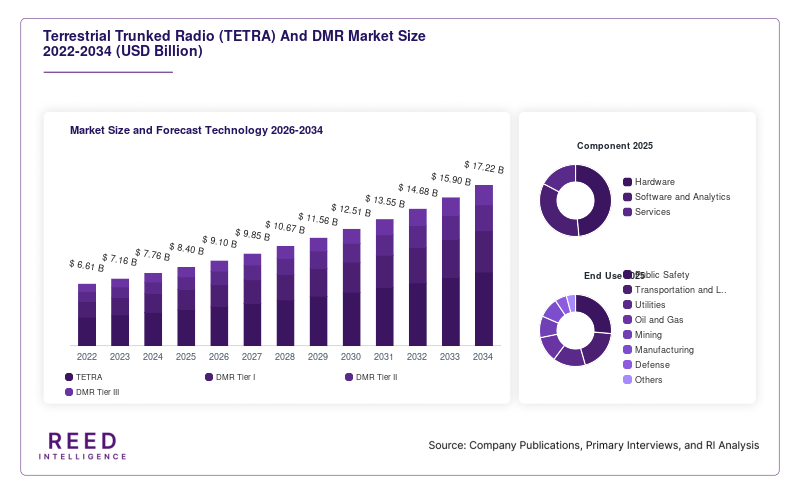
TETRA technology accounted for the largest share of the global Terrestrial Trunked Radio (TETRA) And DMR Market in 2024, representing approximately 56.4% of total revenue. The dominance of this subsegment is largely associated with strong adoption among public safety agencies, transportation authorities, defense organizations, and emergency response teams. TETRA systems provide secure encrypted communication, extensive coverage, high voice clarity, and advanced group communication functions, making them suitable for mission-critical operations. Several governments and municipal agencies continue investing in TETRA infrastructure due to its proven reliability in emergency situations and large-scale urban communication networks. The technology is also widely used in metro rail systems, airports, and utility operations where uninterrupted communication is essential for operational safety and coordination.
DMR Tier III solutions are projected to register the fastest CAGR of 11.1% during the forecast period due to increasing adoption among commercial and industrial users seeking cost-effective digital communication systems. DMR Tier III platforms support trunked communication capabilities, improved spectral efficiency, scalable network deployment, and lower operational costs compared to some traditional communication systems. Small and medium-sized enterprises are increasingly adopting these solutions for manufacturing plants, logistics operations, construction sites, and utility management. The growing preference for flexible communication infrastructure, combined with rising demand for cloud-based dispatch and monitoring platforms, is accelerating deployment of DMR Tier III networks across emerging markets and industrial applications.
By Component
Hardware represented the dominant subsegment within the component category, accounting for 61.8% of the global market share in 2024. This segment includes handheld radios, mobile radios, repeaters, base stations, antennas, and network infrastructure equipment. The continued replacement of analog communication devices with digital systems remains a major driver for hardware demand. Public safety agencies, transportation operators, mining companies, and industrial enterprises continue investing in rugged communication equipment capable of operating under harsh environmental conditions. Manufacturers are focusing on lightweight device designs, longer battery performance, enhanced encryption capabilities, and integrated GPS functionality to meet evolving operational requirements.
Software and analytics solutions are anticipated to expand at the fastest CAGR of 12.2% throughout the forecast period. Organizations are increasingly deploying centralized dispatch systems, workforce tracking software, predictive maintenance tools, and network analytics platforms to improve communication efficiency and operational visibility. Cloud-based communication management solutions are becoming particularly popular among transportation operators and industrial enterprises because they support scalable deployment and remote network management. Artificial intelligence and data analytics integration are also improving communication monitoring, incident response coordination, and cybersecurity management. The growing emphasis on intelligent infrastructure and digital transformation strategies is expected to create substantial opportunities for software developers and communication platform providers.
By End Use
Public safety agencies held the largest share of the Terrestrial Trunked Radio (TETRA) And DMR Market in 2024, accounting for approximately 39.7% of total revenue. Police departments, firefighting units, emergency medical services, disaster management agencies, and border security organizations continue to rely heavily on digital radio systems for mission-critical communication. These systems provide secure voice transmission, emergency alert functions, group communication capabilities, and reliable connectivity during natural disasters and large public events. Increasing investments in national security infrastructure and emergency preparedness programs are supporting continued adoption of TETRA and DMR technologies across public safety applications.
Transportation and logistics is projected to witness the fastest CAGR of 10.5% during the forecast period due to rising investments in railway communication systems, airport operations, urban transit networks, and fleet management infrastructure. Transportation operators require reliable communication systems to coordinate drivers, maintenance teams, dispatch centers, and security personnel in real time. The growing expansion of smart transportation infrastructure and intelligent traffic management systems is increasing demand for integrated communication solutions. Logistics providers are also adopting digital radio systems to improve warehouse coordination, cargo tracking, and supply chain visibility. Increasing urban mobility projects and expansion of public transit systems are expected to accelerate deployment of advanced communication technologies within this subsegment.
Regional Analysis
North America
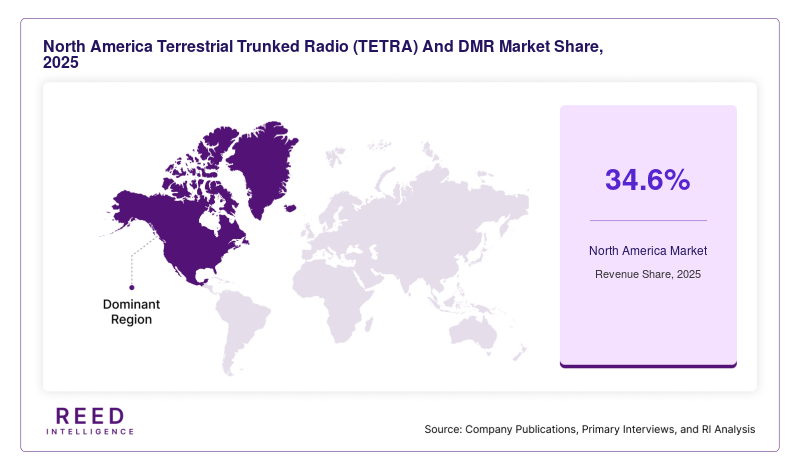
North America accounted for 34.6% of the global Terrestrial Trunked Radio (TETRA) And DMR Market in 2025 and is expected to maintain a stable growth trajectory with a forecast CAGR of 7.4% through 2034. The region benefits from strong investments in public safety modernization, advanced transportation infrastructure, and utility communication systems. Government agencies across the United States and Canada continue to replace aging analog radio systems with secure digital communication networks. The presence of established communication technology providers and growing integration of LTE-enabled radio systems are further supporting regional market expansion.
The United States remains the dominant country within North America due to high spending on homeland security, emergency response infrastructure, and smart transportation systems. Federal and state-level agencies are deploying interoperable communication platforms that improve coordination between law enforcement, firefighting units, and disaster response teams. A unique growth factor in the country is the increasing deployment of communication systems across large-scale industrial and energy operations, particularly in oil and gas fields, utility grids, and transportation corridors where uninterrupted communication is essential for operational continuity.
Europe
Europe represented 27.1% of the global market in 2025 and is projected to register a CAGR of 7.8% during the forecast period. The region has a mature digital radio infrastructure supported by strong public safety regulations and widespread adoption of mission-critical communication systems. European transportation operators, railway networks, airports, and municipal authorities continue investing in TETRA-based communication solutions to improve operational safety and infrastructure management. The region also benefits from high awareness regarding cybersecurity and encrypted communication standards.
Germany remains the leading country in the European market due to extensive deployment of digital communication systems across industrial manufacturing facilities, transportation networks, and emergency services. The country’s strong industrial base and advanced engineering sector continue supporting demand for reliable communication infrastructure. A unique growth factor in Germany is the rapid expansion of smart manufacturing and industrial automation projects, which require secure communication systems capable of supporting real-time coordination between production facilities, logistics centers, and maintenance teams.
Asia Pacific
Asia Pacific is expected to record the fastest CAGR of 10.8% between 2026 and 2034 while accounting for 23.8% of the global market in 2025. Rapid urbanization, infrastructure development, and industrial expansion are driving strong demand for digital communication systems across the region. Governments are investing heavily in public transportation modernization, smart city projects, and emergency response infrastructure. The increasing adoption of digital mobile radio systems by mining companies, utility providers, and manufacturing facilities is also supporting market growth.
China remains the dominant country within Asia Pacific due to extensive infrastructure investments and growing industrial communication requirements. The country continues to expand railway networks, airport infrastructure, and urban transit systems that rely on secure radio communication platforms. A unique growth factor in China is the government’s large-scale smart city development strategy, which integrates surveillance systems, emergency communication networks, and intelligent transportation management platforms. This ongoing digital transformation is expected to create significant demand for TETRA and DMR solutions over the coming years.
Middle East & Africa
The Middle East & Africa region accounted for 8.2% of the global market in 2025 and is projected to expand at a CAGR of 8.7% through 2034. Growth is supported by rising investments in oil and gas infrastructure, transportation projects, and public safety modernization initiatives. Several countries in the Gulf region are deploying advanced communication systems for airport operations, metro rail networks, industrial facilities, and security agencies. The increasing need for reliable communication in remote desert and offshore environments is also contributing to regional market demand.
Saudi Arabia remains the dominant country within the Middle East & Africa market due to major infrastructure development programs and expanding industrial projects. The country is investing heavily in smart city developments, transportation corridors, and energy infrastructure that require secure communication systems. A unique growth factor in Saudi Arabia is the implementation of large-scale urban development initiatives linked to economic diversification programs, which are increasing deployment of integrated communication and security networks across multiple industries.
Latin America
Latin America captured 6.3% of the global Terrestrial Trunked Radio (TETRA) And DMR Market in 2025 and is anticipated to grow at a CAGR of 7.9% during the forecast period. The region is gradually transitioning from analog radio systems toward digital communication infrastructure across transportation, mining, and public safety sectors. Governments are investing in communication modernization projects to improve emergency response coordination and urban security management. Rising industrial activity and expansion of logistics operations are also contributing to market growth.
Brazil remains the dominant country in the Latin American market due to strong demand from transportation operators, mining companies, and public safety agencies. The country continues to invest in communication systems for airports, ports, public transit networks, and large industrial facilities. A unique growth factor in Brazil is the increasing adoption of digital communication solutions within large-scale mining operations located in remote regions where dependable connectivity and workforce coordination are critical for operational safety and productivity.
Competitive Landscape
The Terrestrial Trunked Radio (TETRA) And DMR Market remains moderately consolidated, with global and regional companies competing based on product innovation, network reliability, interoperability, and long-term service contracts. Leading vendors are focusing on expanding mission-critical communication capabilities by integrating broadband connectivity, cloud-based dispatch systems, and AI-driven network analytics into their product portfolios. Companies are also strengthening partnerships with government agencies, transportation operators, and industrial enterprises to secure long-term infrastructure projects.
Motorola Solutions remains one of the leading participants in the market due to its extensive digital radio portfolio, strong public safety presence, and global distribution network. The company recently introduced upgraded mission-critical communication platforms supporting integrated LTE and digital radio connectivity for emergency response operations. Other major companies such as Hytera Communications, Airbus Secure Land Communications, JVCKENWOOD, and Sepura continue investing in rugged handheld devices, scalable network infrastructure, and advanced cybersecurity features. Market participants are increasingly prioritizing product interoperability and remote network management capabilities to support growing demand from transportation, industrial, and municipal communication sectors.
Key Players
- Motorola Solutions Inc.
- Hytera Communications Corporation Limited
- Airbus Secure Land Communications
- JVCKENWOOD Corporation
- Sepura Limited
- Simoco Wireless Solutions
- Tait Communications
- Leonardo S.p.A.
- BK Technologies Corporation
- Kirisun Communications Co., Ltd.
- Codan Communications
- L3Harris Technologies Inc.
- Icom Incorporated
- Cisco Systems Inc.
- Nokia Corporation
Recent Developments
- Motorola Solutions introduced an upgraded hybrid communication platform in 2025 that combines broadband LTE connectivity with secure digital mobile radio capabilities for emergency response agencies.
- Hytera Communications expanded its rugged handheld radio portfolio in 2024 with advanced GPS tracking and AI-enabled noise cancellation features designed for mining and transportation applications.
- Airbus Secure Land Communications partnered with several European transportation authorities in 2025 to deploy interoperable TETRA communication systems across regional railway networks.
- Sepura launched a new generation of compact DMR radios in 2024 focused on improving battery efficiency and secure communication performance for industrial users.
- JVCKENWOOD expanded its cloud-based dispatch management services in 2025 to support remote workforce coordination and communication analytics for utility operators and logistics companies.
Terrestrial Trunked Radio (TETRA) And DMR Market Segments
Technology
- TETRA
- DMR Tier I
- DMR Tier II
- DMR Tier III
Component
- Hardware
- Software and Analytics
- Services
End Use
- Public Safety
- Transportation and Logistics
- Utilities
- Oil and Gas
- Mining
- Manufacturing
- Defense
- Others
By Region
- North America
- Europe
- APAC
- Middle East and Africa
- LATAM