Tert Amylbenzene Market Size, Share & Demand Report By Type (Industrial Grade, High-Purity Grade), By Application (Fuel Additives, Industrial Solvents, Specialty Chemical Intermediates, Lubricant Additives, Coatings and Resins), By End-Use Industry (Petrochemicals, Automotive, Pharmaceuticals, Electronics, Industrial Manufacturing), By Region & Segment Forecasts, 2026–2034
USD 3950
Market Overview
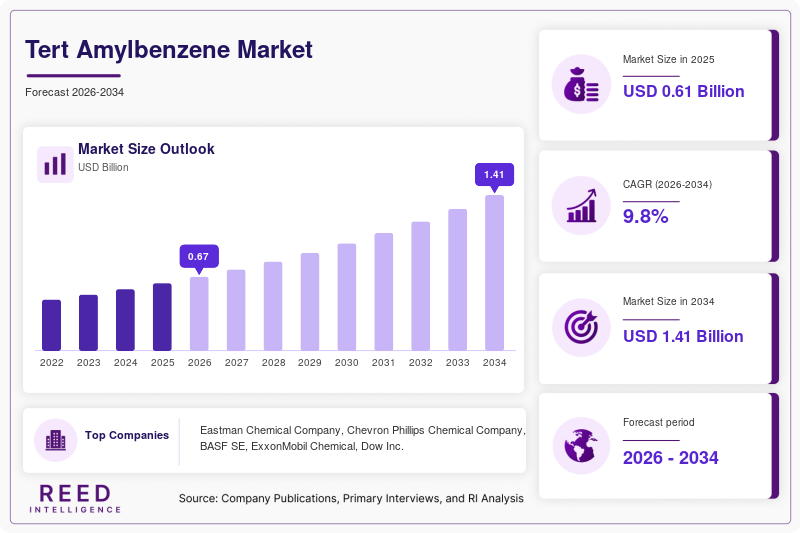
The global Tert Amylbenzene Market size was valued at USD 0.612 billion in 2026 and is projected to reach USD 1.29 billion by 2034, expanding at a CAGR of 9.8% during the forecast period. The market continues to gain momentum due to increasing demand for specialty intermediates in petrochemical processing, fuel additives, and industrial solvent applications. Tert amylbenzene is widely used in chemical synthesis because of its stability, compatibility with hydrocarbon compounds, and performance advantages in high-temperature industrial environments. Growing investment in advanced refining technologies and specialty chemical production has further accelerated product consumption across developed and emerging economies.
The expansion of global chemical manufacturing activity has remained a major factor supporting market growth. Several countries are increasing domestic petrochemical output to reduce import dependence and strengthen industrial supply chains. This trend has increased the requirement for aromatic hydrocarbon derivatives such as tert amylbenzene in downstream production processes. Demand from the fuel additives industry has also improved steadily as refiners focus on improving fuel efficiency and emission performance. In addition, rising industrialization in Asia Pacific and the Middle East has created favorable conditions for long-term market expansion.
Key Highlights
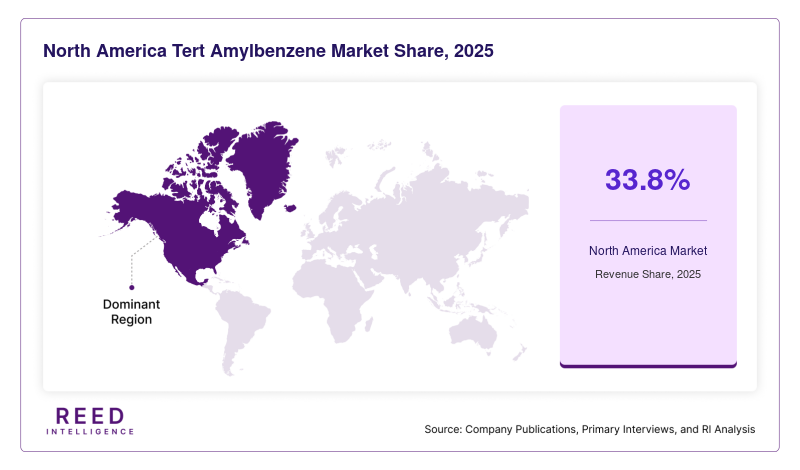
- North America dominated the market with a 33.8% share in 2025, while Asia Pacific is expected to grow at the fastest CAGR of 11.4% during 2026–2034.
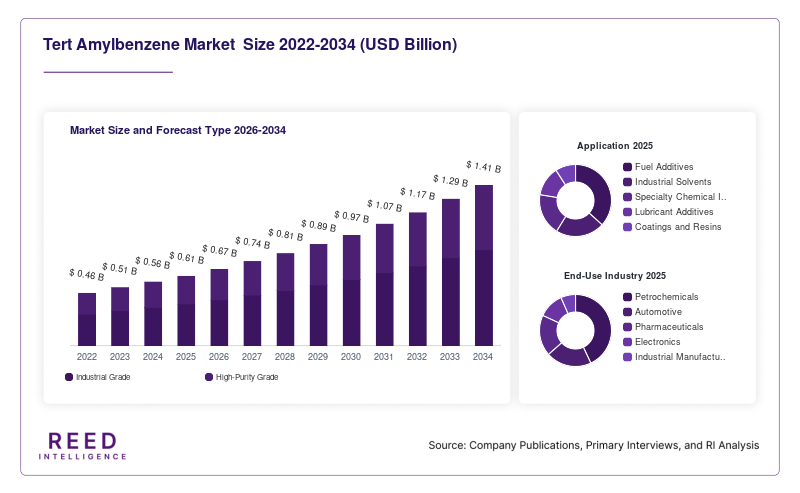
- By type, industrial grade tert amylbenzene accounted for the largest share of 61.5%, while high-purity grade is projected to grow at a CAGR of 10.9%.
- By application, fuel additives led with a 39.6% share, whereas specialty chemical intermediates are expected to expand at a CAGR of 11.6%.
- By end-use industry, petrochemicals accounted for the highest share of 42.3%, while pharmaceuticals are anticipated to grow at a CAGR of 10.7%.
- The United States remained the dominant country, with market values of USD 142 million in 2024 and USD 156 million in 2025.
Market Trends
Rising Integration of High-Purity Aromatic Compounds in Specialty Chemical Manufacturing
The increasing adoption of high-purity aromatic compounds across specialty chemical production has become a notable trend in the Tert Amylbenzene Market. Chemical manufacturers are emphasizing consistent molecular stability and higher formulation efficiency, which has encouraged the use of tert amylbenzene in advanced synthesis applications. The product is increasingly incorporated into industrial formulations requiring strong thermal resistance and solvent compatibility. Producers are also investing in purification technologies to meet strict quality standards across electronics chemicals, coatings, and engineered materials. This transition toward higher-quality chemical intermediates is supporting premium product demand and improving profit margins for manufacturers. In addition, long-term procurement agreements between specialty chemical producers and raw material suppliers are contributing to market stability and improved production planning.
Growing Focus on Fuel Performance Enhancement and Emission Reduction
The fuel and refining sector is witnessing increasing use of tert amylbenzene in additive formulations aimed at improving combustion efficiency and reducing operational losses. Refineries are under pressure to optimize fuel quality while complying with environmental standards related to emissions and energy efficiency. As a result, demand for stable aromatic hydrocarbon compounds has increased across gasoline blending and industrial fuel applications. Market participants are introducing advanced formulations that improve oxidation resistance and storage stability. The growing use of cleaner fuel technologies in transportation and industrial machinery is further strengthening product adoption. Emerging economies are also modernizing refinery infrastructure, creating additional opportunities for tert amylbenzene suppliers to expand production capacity and regional distribution operations.
Market Drivers
Expansion of Petrochemical Production Capacity Across Emerging Economies
Rapid industrialization across Asia Pacific, the Middle East, and parts of Latin America has significantly increased investment in petrochemical manufacturing facilities. Governments and private investors are prioritizing domestic chemical production to reduce reliance on imported intermediates and strengthen regional industrial output. This development has directly benefited the Tert Amylbenzene Market because the compound is widely used in downstream synthesis and industrial blending processes. New refinery projects and integrated petrochemical complexes are increasing the consumption of aromatic hydrocarbon derivatives. Manufacturers are also expanding operational capacity to meet rising industrial demand from sectors such as plastics, coatings, adhesives, and specialty chemicals. The consistent growth of industrial infrastructure and refining activity is expected to maintain stable demand for tert amylbenzene throughout the forecast period.
Increasing Demand for High-Performance Industrial Solvents and Additives
Industrial manufacturers are focusing on improving operational efficiency and chemical performance, which has accelerated the use of advanced solvents and additives across multiple applications. Tert amylbenzene is gaining preference because of its chemical stability, compatibility with hydrocarbon systems, and effectiveness under demanding processing conditions. Demand has increased in fuel additives, lubricants, coatings, and process chemicals where stable aromatic compounds are essential for maintaining performance quality. In addition, growth in automotive manufacturing and industrial equipment production has supported broader adoption of specialty chemical formulations. Producers are introducing improved formulations designed for enhanced thermal stability and lower contamination levels. These developments are helping suppliers expand their customer base and strengthen long-term market demand across industrial sectors.
Market Restraint
Volatility in Raw Material Prices and Environmental Compliance Costs
Fluctuating crude oil prices and changing feedstock availability continue to create operational challenges for participants in the Tert Amylbenzene Market. Since tert amylbenzene production depends heavily on petrochemical raw materials, manufacturers often face unpredictable cost structures that affect profitability and pricing strategies. Sudden changes in benzene and hydrocarbon feedstock pricing can increase production expenses and reduce competitiveness, particularly for smaller producers with limited supply flexibility. In addition, strict environmental regulations related to chemical processing emissions and industrial waste management are increasing compliance costs across major manufacturing regions. Companies are required to invest in cleaner technologies, monitoring systems, and upgraded production facilities to meet regulatory standards. These additional expenditures may limit expansion plans and delay capacity development projects, especially in price-sensitive markets where industrial buyers prioritize cost efficiency over premium-grade specialty chemicals.
Market Opportunities
Expansion of Specialty Chemical Applications in Pharmaceutical and Electronics Industries
The growing use of specialty aromatic compounds in pharmaceutical synthesis and electronics manufacturing presents strong growth opportunities for the Tert Amylbenzene Market. Pharmaceutical companies are increasingly using advanced intermediates to improve formulation stability and production consistency. Tert amylbenzene is gaining attention in chemical synthesis processes because of its compatibility with complex manufacturing systems and controlled reaction environments. In the electronics sector, demand for high-purity chemicals used in coatings, insulation materials, and semiconductor processing continues to rise. Manufacturers are responding by introducing refined product grades designed for precision industrial applications. The expansion of research and development investments in specialty materials is expected to create long-term opportunities for suppliers operating in high-value industrial segments.
Rising Industrial Development in Southeast Asia and the Middle East
Emerging industrial economies are creating favorable conditions for the expansion of tert amylbenzene production and consumption. Countries across Southeast Asia and the Middle East are investing heavily in petrochemical infrastructure, industrial parks, and export-oriented manufacturing facilities. This industrial growth is increasing the need for specialty intermediates and hydrocarbon compounds used in refining and chemical processing. Governments are also introducing incentives to attract foreign investment in advanced manufacturing industries, which is expected to improve regional production capacity. Local chemical producers are forming partnerships with international suppliers to strengthen technology transfer and improve operational efficiency. The combination of industrial expansion, infrastructure development, and growing export activity is expected to create substantial opportunities for market participants over the coming years.
Segmental Analysis
By Type
Industrial grade tert amylbenzene dominated the Tert Amylbenzene Market in 2024 and accounted for 61.5% of the total market share. The segment maintained strong demand due to widespread use in petrochemical processing, industrial solvents, and fuel additive applications. Industrial-grade products are preferred because they provide cost-effective performance for large-scale manufacturing operations where ultra-high purity is not always required. Refineries and chemical manufacturers continue to rely on industrial-grade tert amylbenzene for blending and synthesis processes because of its compatibility with hydrocarbon systems and operational stability. Increasing investment in industrial chemical production across developing economies has also strengthened demand for this segment. Manufacturers are improving production efficiency and supply availability to support rising industrial consumption across automotive, coatings, and process chemical industries.
High-purity grade tert amylbenzene is projected to register the fastest CAGR of 10.9% during the forecast period. Demand for high-purity products is increasing across pharmaceutical, electronics, and specialty chemical applications where strict quality standards are essential. Advanced manufacturing industries are emphasizing precision processing and contamination control, which has increased the adoption of refined aromatic compounds. Producers are investing in purification technologies and quality assurance systems to meet evolving industrial requirements. The expansion of semiconductor manufacturing and advanced coatings production is expected to create additional opportunities for high-purity grade suppliers. Furthermore, increasing research and development activity focused on specialty formulations and engineered materials is supporting the long-term growth potential of this segment across developed and emerging industrial economies.
By Application
Fuel additives represented the dominant application segment in the Tert Amylbenzene Market and accounted for 39.6% of total revenue in 2024. The segment benefits from growing demand for improved fuel performance, enhanced combustion efficiency, and better storage stability across transportation and industrial sectors. Refining companies are increasingly using aromatic hydrocarbon compounds in additive formulations to improve fuel quality and reduce operational inefficiencies. Expanding automotive production and rising industrial fuel consumption have also supported segment growth. In addition, stricter environmental regulations encouraging cleaner fuel technologies are driving investment in advanced additive solutions. Market participants are introducing improved formulations that provide enhanced oxidation resistance and thermal stability, further strengthening demand across gasoline blending and industrial fuel applications.
Specialty chemical intermediates are expected to expand at the fastest CAGR of 11.6% during the forecast period due to rising demand from pharmaceuticals, coatings, and engineered materials industries. Manufacturers are increasingly adopting advanced intermediates to improve formulation consistency and production performance in high-value applications. Tert amylbenzene is gaining attention because of its stable chemical structure and compatibility with complex synthesis processes. The expansion of specialty materials manufacturing in Asia Pacific and Europe is also contributing to segment growth. Chemical producers are focusing on customized formulations designed for specific industrial requirements, improving market opportunities for specialty intermediates. Growing research activity related to advanced industrial compounds and high-performance materials is expected to further strengthen demand during the forecast period.
By End-Use Industry
The petrochemicals segment held the largest share of the Tert Amylbenzene Market in 2024, accounting for 42.3% of overall revenue. The dominance of this segment is supported by increasing global petrochemical production and rising demand for downstream hydrocarbon derivatives. Tert amylbenzene is widely used in synthesis processes, blending operations, and industrial formulations across petrochemical facilities. Expanding refinery infrastructure in North America, Asia Pacific, and the Middle East has significantly contributed to product demand. Large-scale industrial operations continue to prioritize stable and cost-efficient aromatic compounds for process optimization and operational reliability. Furthermore, growing investment in integrated refining and chemical manufacturing projects is expected to maintain strong demand from the petrochemical sector throughout the forecast period.
The pharmaceutical industry is anticipated to witness the fastest CAGR of 10.7% during the forecast period due to increasing demand for specialty intermediates used in advanced synthesis applications. Pharmaceutical manufacturers are focusing on high-quality chemical compounds that support formulation stability and consistent production performance. Tert amylbenzene is increasingly being evaluated for use in controlled chemical reactions and specialty processing systems. Rising investment in pharmaceutical manufacturing facilities across emerging economies is creating favorable conditions for segment growth. In addition, expanding research activities related to specialty therapeutics and advanced drug delivery technologies are encouraging the adoption of high-purity aromatic compounds. This trend is expected to support sustained demand for tert amylbenzene in pharmaceutical applications over the coming years.
Regional Analysis
North America
North America accounted for 33.8% of the global Tert Amylbenzene Market in 2025 and maintained its position as the leading regional market. The region is expected to expand at a CAGR of 8.6% during the forecast period due to strong demand from petrochemical processing, fuel additives, and specialty chemical manufacturing industries. The presence of advanced refining infrastructure and established chemical companies continues to support regional market growth. Stable industrial production and consistent investment in research activities have also contributed to higher consumption of aromatic hydrocarbon compounds across industrial applications.
The United States remained the dominant country in North America because of its extensive refining network and large-scale specialty chemical production capacity. Domestic manufacturers are increasingly investing in advanced processing technologies to improve product quality and reduce environmental impact. Growth in industrial solvent applications and rising demand for performance-enhancing fuel additives are supporting continued market expansion. In addition, the availability of feedstock resources and efficient transportation infrastructure has strengthened supply chain reliability across the country, helping suppliers maintain competitive production and distribution capabilities.
Europe
Europe represented 24.6% of the global Tert Amylbenzene Market in 2025 and is projected to grow at a CAGR of 8.1% through 2034. The region continues to benefit from a strong industrial manufacturing base and rising demand for high-performance specialty chemicals. European chemical companies are emphasizing sustainable production methods and advanced process efficiency, which has increased the adoption of refined aromatic compounds in industrial applications. Demand from coatings, adhesives, and engineered materials industries is also supporting market expansion across major economies.
Germany remained the leading country within the European market due to its advanced chemical manufacturing ecosystem and strong automotive production sector. Industrial manufacturers are focusing on improving fuel efficiency and reducing operational emissions, increasing the use of specialty additives and intermediates. The country also benefits from extensive research and development investment in advanced materials and industrial chemicals. In addition, strategic partnerships between regional suppliers and industrial users are supporting product innovation and improving long-term market competitiveness.
Asia Pacific
Asia Pacific held 22.9% of the global Tert Amylbenzene Market in 2025 and is anticipated to register the fastest CAGR of 11.4% during the forecast period. Rapid industrialization, expanding petrochemical production, and rising demand for specialty chemicals are driving strong regional growth. Countries across the region are increasing investments in refinery infrastructure and downstream chemical processing facilities. Growing manufacturing activity in automotive, electronics, and industrial equipment sectors is also supporting higher consumption of aromatic hydrocarbon compounds.
China remained the dominant country in the Asia Pacific market because of its large-scale petrochemical manufacturing capacity and expanding industrial economy. Domestic producers are increasing investments in high-value specialty chemical production to meet rising local and export demand. Government initiatives promoting industrial modernization and energy efficiency are also encouraging the adoption of advanced chemical intermediates. Furthermore, the rapid growth of electronics manufacturing and infrastructure development projects continues to create favorable conditions for long-term market expansion across the country.
Middle East & Africa
The Middle East & Africa region accounted for 10.2% of the global Tert Amylbenzene Market in 2025 and is expected to grow at a CAGR of 9.3% during the forecast period. Increasing investments in refining and petrochemical industries are contributing to regional demand growth. Countries within the Gulf region are expanding industrial diversification strategies to reduce dependence on crude oil exports. This shift is increasing production of downstream chemical products, including aromatic hydrocarbon derivatives used in industrial processing and specialty applications.
Saudi Arabia emerged as the dominant country in the regional market due to its large petrochemical infrastructure and strong government support for industrial expansion. The country continues to invest in integrated refining and specialty chemical projects aimed at strengthening export capabilities and industrial diversification. Rising collaboration between domestic producers and international chemical companies is improving technological capabilities and product quality. In addition, industrial development initiatives under long-term economic transformation programs are expected to support continued growth in specialty chemical demand.
Latin America
Latin America captured 8.5% of the global Tert Amylbenzene Market in 2025 and is projected to expand at a CAGR of 8.8% through 2034. The region is witnessing gradual growth in industrial manufacturing and petrochemical processing activities. Increasing investment in refinery modernization and industrial infrastructure has improved the demand outlook for specialty hydrocarbon compounds. Countries across the region are also focusing on strengthening domestic chemical production to support local manufacturing industries and reduce reliance on imports.
Brazil remained the leading country within the Latin American market because of its established industrial base and expanding petrochemical sector. Domestic demand for industrial solvents, fuel additives, and specialty intermediates continues to rise alongside manufacturing growth. Government support for industrial development and infrastructure modernization is encouraging additional investment in chemical processing facilities. Moreover, the increasing presence of multinational chemical companies in Brazil is improving access to advanced production technologies and strengthening regional supply chain efficiency.
Competitive Landscape
The Tert Amylbenzene Market is moderately consolidated, with leading companies focusing on production expansion, product quality improvement, and long-term supply agreements to strengthen their competitive position. Major participants are investing in advanced refining technologies and specialty chemical processing capabilities to improve operational efficiency and meet evolving industrial requirements. Companies are also expanding regional distribution networks to improve supply reliability across high-growth markets in Asia Pacific and the Middle East.
Eastman Chemical Company remains one of the leading participants in the market due to its strong specialty chemical portfolio and extensive global distribution presence. The company has focused on expanding high-purity chemical production and strengthening customer partnerships across industrial and pharmaceutical sectors. Other key companies are emphasizing research activities aimed at improving product stability, refining efficiency, and environmental compliance.
Key Players
- Eastman Chemical Company
- Chevron Phillips Chemical Company
- BASF SE
- ExxonMobil Chemical
- Dow Inc.
- SABIC
- INEOS Group
- Shell Chemicals
- Reliance Industries Limited
- LyondellBasell Industries
- Formosa Chemicals & Fibre Corporation
- China Petrochemical Corporation
- LG Chem
- Mitsubishi Chemical Group
- Borealis AG
Recent Developments
- In 2025, a leading specialty chemical producer expanded its aromatic hydrocarbon processing facility in China to improve the supply of high-purity tert amylbenzene for electronics manufacturing applications.
- In 2024, a major petrochemical company introduced an upgraded fuel additive formulation containing advanced aromatic compounds designed to improve combustion efficiency and fuel storage stability.
- In 2025, several manufacturers in the Middle East announced joint investments in integrated refining and specialty chemical production projects to strengthen regional export capacity and industrial diversification.
- In 2024, a European chemical supplier implemented advanced purification technologies aimed at improving the quality and consistency of specialty aromatic intermediates used in pharmaceutical applications.
Tert Amylbenzene Market Segments
Type
- Industrial Grade
- High-Purity Grade
Application
- Fuel Additives
- Industrial Solvents
- Specialty Chemical Intermediates
- Lubricant Additives
- Coatings and Resins
End-Use Industry
- Petrochemicals
- Automotive
- Pharmaceuticals
- Electronics
- Industrial Manufacturing
By Region
- North America
- Europe
- APAC
- Middle East and Africa
- LATAM