Tert Butyl Hydroperoxide Market Size, Share, Demand Report by Type (Industrial Grade, Reagent Grade), By Application (Propylene Oxide Production, Polymerization Initiators, Chemical Synthesis, Specialty Chemicals, Laboratory Research), By End-Use Industry (Petrochemicals, Plastics & Polymers, Pharmaceuticals, Coatings & Adhesives, Research Institutes) & Regional Forecasts, 2026–2034
USD 3950
Market Overview
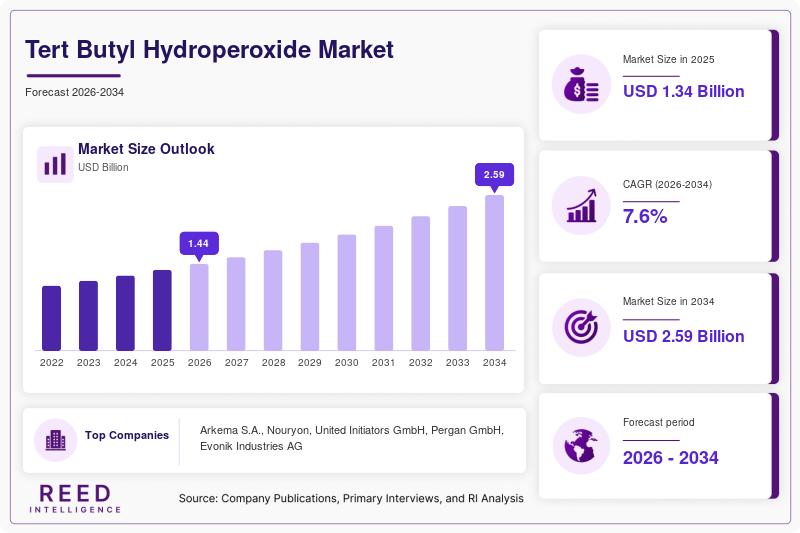
The global Tert Butyl Hydroperoxide Market size was valued at USD 1.34 billion in 2026 and is projected to reach USD 2.41 billion by 2034, expanding at a CAGR of 7.6% during 2026–2034. Tert butyl hydroperoxide (TBHP) is a critical organic peroxide used as an oxidation initiator, polymerization catalyst, and intermediate in chemical synthesis. Demand continues to rise due to expanding applications in propylene oxide production, epoxidation processes, specialty chemicals, and advanced polymer manufacturing. The growing shift toward higher-efficiency oxidation technologies in petrochemical and industrial synthesis has strengthened global market penetration. Rising investments in downstream chemical manufacturing, particularly in Asia Pacific and North America, have supported consistent consumption patterns across industrial-grade and reagent-grade TBHP categories.
A major global factor supporting market growth is the continued expansion of the petrochemical value chain, especially in propylene oxide and methyl tert-butyl ether derivative manufacturing. As chemical manufacturers focus on production efficiency, process optimization, and selective oxidation, TBHP remains an essential oxidizing agent with broad industrial value. Increased capacity additions in industrial chemicals, paired with rising specialty polymer demand, have also created sustained procurement momentum. Regulatory emphasis on process safety has encouraged the development of stabilized TBHP formulations, improving transportation and storage feasibility while widening industrial adoption.
Key Highlights
- North America dominated the market with a 36.4% share in 2025.
- Asia Pacific is expected to grow at the fastest CAGR of 8.9% during 2026–2034.
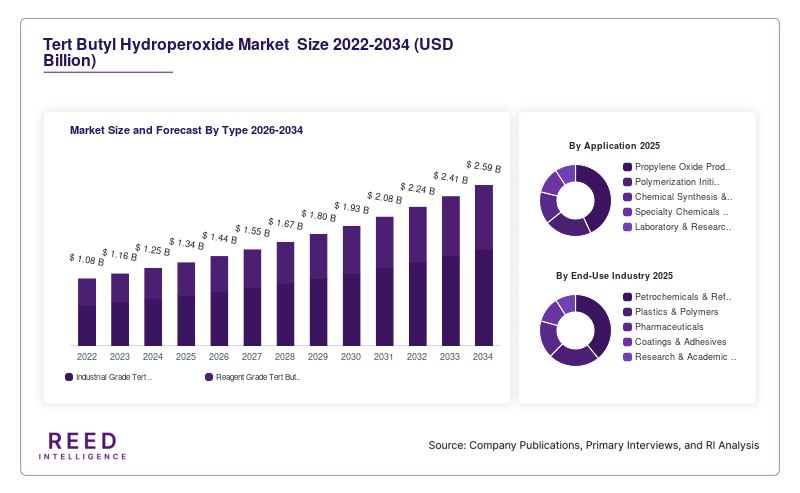
- By type, industrial grade accounted for the largest share of 61.8% in 2024, while reagent grade is projected to grow at a CAGR of 8.4%.
- By application, propylene oxide production led with a 39.6% share, whereas polymerization initiators are expected to expand at a CAGR of 8.7%.
- By end-use, petrochemicals dominated with a 44.3% share, while specialty chemicals are projected to grow at a CAGR of 8.8%.
- The United States remained the dominant country, with market values of USD 412 million in 2024 and USD 445 million in 2025.
Market Trends
Expansion of advanced oxidation chemistry in petrochemical processing
The Tert Butyl Hydroperoxide Market is witnessing stronger integration into advanced oxidation chemistry due to rising demand for selective oxidation in petrochemical manufacturing. TBHP is increasingly preferred in epoxidation reactions because it offers higher conversion efficiency and better process economics in propylene oxide synthesis. As refiners and chemical processors modernize production facilities, the use of TBHP in cleaner oxidation pathways has gained traction. This trend is particularly visible in integrated petrochemical complexes where production efficiency and product yield are essential. Growing investments in oxidation catalysts and process intensification technologies are also increasing TBHP consumption. Manufacturers are aligning production capabilities with industrial demand for stable oxidizing agents, creating long-term market expansion opportunities.
Rising demand for specialty polymers and fine chemical intermediates
The market is also benefiting from the growth of specialty polymers, coatings, and chemical intermediates that rely on peroxide-based polymerization systems. TBHP is used in radical initiation processes for acrylics, resins, and elastomers, making it increasingly relevant in advanced material manufacturing. Demand from electronics, packaging, and automotive lightweight materials has supported this trend. Fine chemical producers are also expanding TBHP applications in pharmaceutical synthesis and specialty oxidation. As industries seek higher-performance materials with enhanced durability, peroxide initiators have become more strategically important. This transition is driving investments in higher-purity TBHP grades and improving supplier competitiveness across industrial and laboratory applications.
Market Drivers
Growth in propylene oxide and epoxidation manufacturing capacity
A major driver for the Tert Butyl Hydroperoxide Market is the expansion of global propylene oxide production capacity. TBHP serves as a crucial oxidant in propylene oxide technologies, which are increasingly used in polyurethane foams, coatings, adhesives, and insulation products. Rising construction activity, automotive production, and appliance manufacturing are creating downstream demand for propylene oxide derivatives. As a result, TBHP consumption is increasing in regions investing heavily in integrated chemical production. Large-scale producers are enhancing supply chains to secure peroxide feedstock, reinforcing market growth. This industrial dependence on efficient oxidation systems supports sustained long-term demand for TBHP across developed and emerging manufacturing economies.
Increasing use in polymerization and specialty synthesis
TBHP demand is also rising because of its effectiveness as a polymerization initiator in resin and plastics manufacturing. It supports controlled radical reactions in synthetic rubber, polyethylene modifications, and coating systems. Growing use of engineered plastics and advanced composites in transportation, consumer goods, and industrial infrastructure is accelerating this demand. Specialty synthesis applications, including pharmaceuticals and performance chemicals, are further broadening market scope. As industries seek consistent process yields and efficient chemical conversion, TBHP remains a valuable operational input. Expanded industrial R&D in performance chemicals has further increased adoption rates.
Market Restraint
Safety risks and regulatory complexities in storage and transportation
A major restraint in the Tert Butyl Hydroperoxide Market is the hazardous nature of the compound, which creates challenges in storage, transportation, and regulatory compliance. TBHP is an organic peroxide with flammability and decomposition risks, requiring specialized containment systems and temperature-controlled logistics. Strict international safety regulations increase compliance costs for producers and distributors. Smaller manufacturers often face operational barriers due to capital-intensive safety infrastructure requirements. Regulatory restrictions in developed economies can also delay market entry and cross-border trade. For example, transportation classifications for hazardous oxidizers may increase insurance costs and reduce supply chain flexibility. These limitations can restrict market expansion, especially in cost-sensitive regions where infrastructure for safe chemical logistics remains underdeveloped.
Market Opportunities
Expansion in emerging Asian chemical manufacturing hubs
Asia Pacific presents substantial opportunities due to rapid industrialization and chemical production growth in China, India, and Southeast Asia. New petrochemical complexes, refining investments, and specialty chemical facilities are increasing demand for oxidation agents such as TBHP. Government-backed manufacturing initiatives and industrial corridor development are strengthening local supply chains. As regional producers scale domestic chemical output, TBHP suppliers can benefit from long-term procurement agreements. Increased investment in export-oriented chemical manufacturing also supports demand growth. This opportunity is further amplified by lower production costs and favorable infrastructure development across emerging industrial economies.
Development of stabilized and high-purity TBHP formulations
Innovation in stabilized TBHP formulations creates significant opportunities for market players. Improved product stability enhances safety, transportability, and broader industrial acceptance. Producers investing in reagent-grade and specialty-grade TBHP can target pharmaceutical synthesis, electronics chemicals, and laboratory applications. High-purity variants support premium pricing while diversifying beyond traditional petrochemical uses. This product evolution can improve supplier margins and reduce dependence on bulk industrial demand cycles. As industries prioritize safer and more specialized oxidation systems, technological advancement in formulation chemistry may unlock new revenue streams.
Segmental Analysis
By Type
Industrial grade TBHP dominated the market with a 61.8% share in 2024 due to widespread use in bulk oxidation, polymerization, and petrochemical synthesis. Its large-scale applicability in propylene oxide manufacturing and industrial oxidation processes makes it the primary commercial category. Cost efficiency, production scalability, and broad compatibility with heavy industrial applications have reinforced dominance. Industrial users prioritize consistent supply volumes, making this segment highly stable.
Reagent grade is expected to grow at the fastest CAGR of 8.4% through 2034. Growth is fueled by rising laboratory synthesis, pharmaceutical intermediates, and electronics-grade specialty chemicals. As purity requirements rise across research-intensive sectors, reagent-grade TBHP demand is increasing. Premium applications and specialized chemical pathways are creating stronger value opportunities.
By Application
Propylene oxide production accounted for 39.6% of market share in 2024, making it the leading application. TBHP’s role in epoxidation chemistry provides process efficiency and high-value downstream integration into polyurethane systems. Construction insulation, automotive seating, and packaging sectors continue supporting this segment. Industrial oxidation remains a major economic driver.
Polymerization initiators are projected to expand at a CAGR of 8.7%. Demand is increasing due to specialty plastics, synthetic rubber, and advanced coatings. TBHP supports radical polymerization systems essential for engineered materials. Growth in lightweight automotive materials and performance packaging enhances this segment’s outlook.
By End-Use
Petrochemicals dominated with a 44.3% share in 2024 due to extensive use in oxidation chemistry and feedstock conversion. Refining integration and large-scale chemical throughput support stable TBHP procurement. This segment benefits from established industrial ecosystems and high-volume purchasing.
Specialty chemicals are forecast to grow at the fastest CAGR of 8.8% through 2034. Demand is rising in pharmaceuticals, electronics chemicals, and precision synthesis. Product diversification and higher-margin specialty manufacturing are supporting this segment’s acceleration.
Regional Analysis
North America
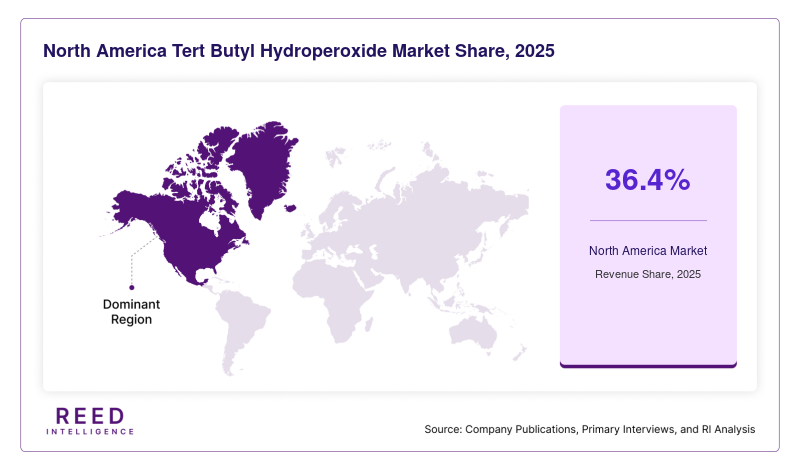
North America held 36.4% of the global Tert Butyl Hydroperoxide Market share in 2025 and is expected to expand at a CAGR of 6.8% through 2034. The region benefits from mature petrochemical infrastructure, advanced oxidation technology adoption, and strong specialty chemical manufacturing. High demand from propylene oxide production and polymer processing remains central to regional growth. The United States and Canada continue investing in process modernization and supply chain resilience.
The United States dominates the regional market due to large-scale chemical manufacturing and integrated refining capacity. A unique growth factor is the strong presence of advanced polyurethane and coatings industries, which depend heavily on propylene oxide derivatives. Domestic innovation in specialty synthesis also supports high-purity TBHP consumption.
Europe
Europe accounted for 24.1% of market share in 2025 and is projected to grow at a CAGR of 6.5% during the forecast period. Demand is supported by specialty chemicals, pharmaceuticals, and sustainable industrial oxidation systems. Regulatory frameworks encourage process optimization, which sustains TBHP demand in controlled industrial environments. Western Europe remains a key production center.
Germany leads the European market because of its chemical engineering base and strong industrial automation ecosystem. A distinctive growth factor is the region’s focus on high-value specialty chemicals and precision oxidation applications, particularly in pharmaceutical intermediates and engineered materials.
Asia Pacific
Asia Pacific captured 28.7% of global market share in 2025 and is forecast to register the fastest CAGR of 8.9% through 2034. Rapid industrialization, expanding petrochemical investments, and increasing polymer demand are driving growth. China, India, Japan, and South Korea are strengthening regional production capabilities.
China dominates due to massive petrochemical expansion and large-scale industrial manufacturing. A unique growth factor is the country’s integrated chemical parks, which support cost-efficient oxidation agent consumption across multiple downstream applications.
Middle East & Africa
Middle East & Africa represented 6.1% of market share in 2025 and is expected to grow at a CAGR of 7.1%. Petrochemical diversification and refinery expansion in Gulf economies are supporting demand. Industrial chemical investments are increasing across strategic export markets.
Saudi Arabia leads due to refining and downstream petrochemical expansion. A key growth factor is feedstock accessibility, enabling cost-effective industrial chemical production and stronger regional TBHP utilization.
Latin America
Latin America held 4.7% market share in 2025 and is projected to grow at a CAGR of 6.9%. Industrial modernization and chemical imports support regional expansion. Brazil and Mexico remain central demand centers.
Brazil dominates due to expanding industrial chemicals and coatings sectors. A unique factor is agricultural chemical manufacturing growth, which indirectly supports peroxide-related chemical processing demand.
Competitive Landscape
The Tert Butyl Hydroperoxide Market is moderately consolidated, with leading players focusing on production capacity, product stabilization, and regional distribution networks. Arkema S.A. remains a leading participant due to its broad peroxide portfolio and advanced chemical integration. Nouryon, United Initiators, Pergan GmbH, and Evonik Industries also maintain strong competitive positions. Companies are investing in safer peroxide logistics and higher-purity product lines to meet specialty demand. Recent developments include expanded peroxide manufacturing capacity in Asia, strategic supply agreements with petrochemical producers, and innovations in stabilized formulations for safer transport. Competitive differentiation increasingly depends on product purity, industrial-scale consistency, and regulatory compliance capabilities.
Key Players
- Arkema S.A.
- Nouryon
- United Initiators GmbH
- Pergan GmbH
- Evonik Industries AG
- Merck KGaA
- Tokyo Chemical Industry Co., Ltd.
- LyondellBasell Industries
- Thermo Fisher Scientific
- Santa Cruz Biotechnology
- Chevron Phillips Chemical Company
- Akzo Nobel N.V.
- Haihang Industry Co., Ltd.
- MP Biomedicals
- Otto Chemie Pvt. Ltd.
Recent Developments
- Arkema expanded organic peroxide optimization programs to strengthen industrial peroxide supply for specialty applications.
- Nouryon increased regional distribution partnerships in Asia Pacific to improve peroxide logistics capabilities.
- United Initiators introduced enhanced stabilized peroxide formulations to improve transportation safety and specialty synthesis efficiency.
Tert Butyl Hydroperoxide Market Segments
By Type
- Industrial Grade Tert Butyl Hydroperoxide
- Reagent Grade Tert Butyl Hydroperoxide
By Application
- Propylene Oxide Production
- Polymerization Initiators
- Chemical Synthesis & Oxidation Reactions
- Specialty Chemicals Manufacturing
- Laboratory & Research Applications
By End-Use Industry
- Petrochemicals & Refining
- Plastics & Polymers
- Pharmaceuticals
- Coatings & Adhesives
- Research & Academic Institutes
By Region
- North America
- Europe
- APAC
- Middle East and Africa
- LATAM