Test Automation Systems Powertrain Dynamometer Market Size, Share & Demand Report By Component (Hardware Systems, Software Platforms, Services), By Vehicle Type (Passenger Vehicles, Commercial Vehicles, Electric Vehicles, Hybrid Vehicles), By End-Use (Automotive OEMs, Independent Testing Laboratories, Automotive Component Manufacturers, Research Institutions), By Region & Segment Forecasts, 2026–2034
USD 3950
Market Overview
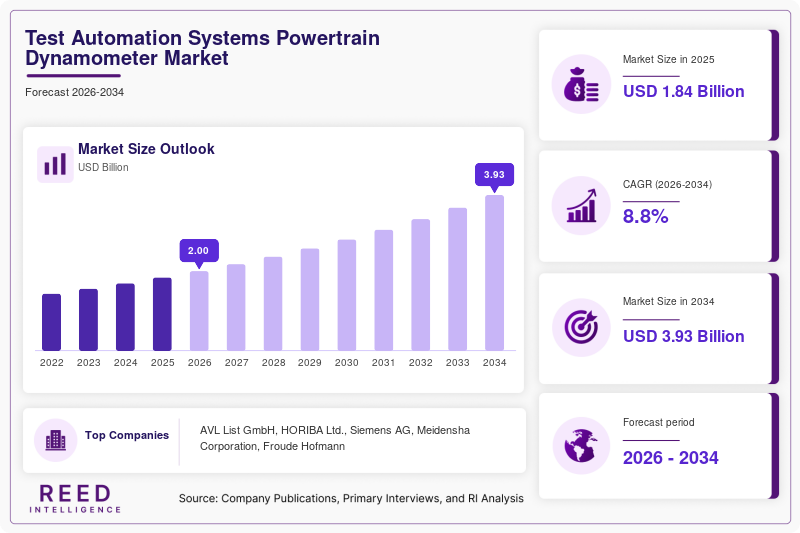
The global Test Automation Systems Powertrain Dynamometer Market size was valued at approximately USD 1.84 billion in 2026 and is projected to reach nearly USD 3.62 billion by 2034, expanding at a CAGR of 8.8% during the forecast period from 2026 to 2034. The market continues to gain momentum due to increasing investments in vehicle electrification, stricter emission compliance frameworks, and the growing adoption of automated testing platforms across automotive manufacturing facilities. Powertrain dynamometer systems are widely used to evaluate engine performance, transmission efficiency, hybrid power systems, and durability under controlled laboratory conditions. Automotive manufacturers are increasingly deploying automated test automation systems to improve testing accuracy, reduce operational downtime, and enhance product development cycles.
One major global factor supporting market expansion is the rapid transition toward electric and hybrid vehicles. Governments across North America, Europe, and Asia Pacific are implementing emission reduction policies that require automotive manufacturers to conduct advanced powertrain validation and durability testing. As a result, automotive OEMs and component suppliers are investing heavily in automated dynamometer systems capable of testing electric motors, battery-integrated drivetrains, and hybrid propulsion technologies. In addition, industrial automation trends and digital simulation technologies are improving test accuracy and enabling predictive analytics within test laboratories.
Key Highlights
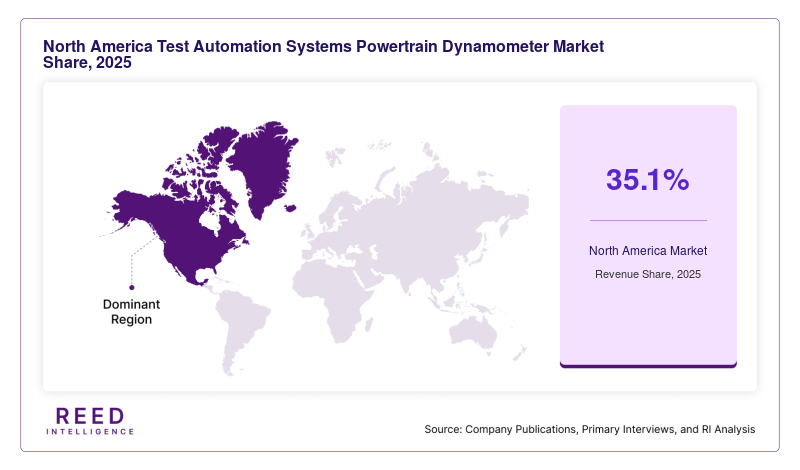
- North America dominated the market with a 35.1% share in 2025.
- Asia Pacific is expected to grow at the fastest CAGR of 10.9% during 2026–2034.
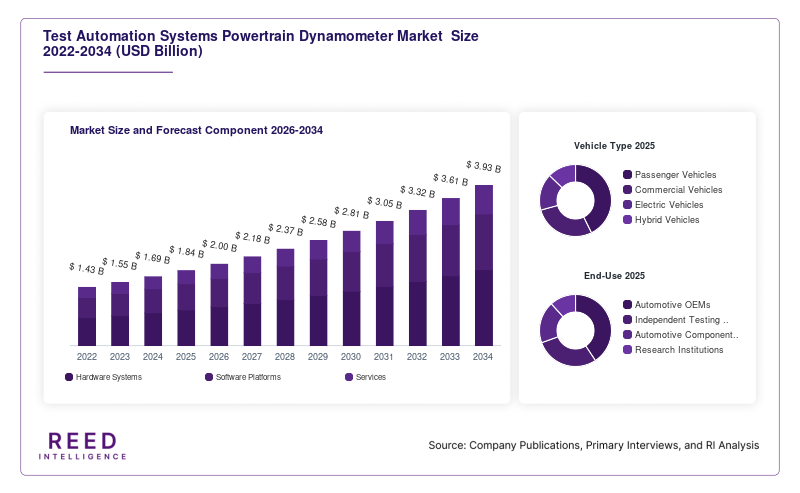
- By component, hardware systems accounted for the largest share of 43.8%, while software platforms are projected to grow at a CAGR of 11.6%.
- By vehicle type, passenger vehicles led with a 47.3% share, whereas electric vehicles are expected to expand at a CAGR of 12.2%.
- By end-use, automotive OEMs accounted for the highest share of 52.6%, while independent testing laboratories are projected to grow at a CAGR of 10.8%. The United States remained the dominant country, with market values of USD 468 million in 2024 and USD 512 million in 2025.
Market Trends
Expansion of Electric Powertrain Testing Infrastructure
Automotive manufacturers are significantly expanding electric powertrain testing infrastructure to support the rising production of battery electric vehicles and plug-in hybrid vehicles. Traditional dynamometer systems designed for internal combustion engines are being upgraded with automated testing software, thermal management integration, and high-speed data acquisition systems capable of evaluating electric drivetrains. Testing facilities are increasingly focusing on battery efficiency, regenerative braking performance, and inverter reliability. The growing complexity of electric propulsion systems has accelerated the deployment of automated testing platforms that can reduce manual intervention and improve consistency across testing procedures. Automotive OEMs are also integrating artificial intelligence-based analytics into powertrain testing environments to predict equipment failure and optimize energy efficiency during testing cycles.
Integration of Digital Twin and Cloud-Based Test Automation
The integration of digital twin technologies and cloud-enabled automation platforms is reshaping the operational framework of powertrain dynamometer systems. Manufacturers are increasingly adopting virtual simulation models that replicate real-world operating conditions, enabling engineers to conduct predictive testing before physical validation. Cloud-based software solutions are supporting remote monitoring, centralized data storage, and real-time collaboration between engineering teams across multiple locations. This trend is helping automotive companies reduce testing time and improve product development efficiency. Automated software platforms equipped with machine learning capabilities are also improving fault detection accuracy and minimizing calibration errors. The shift toward connected testing ecosystems is expected to create stronger demand for advanced automation software within modern dynamometer laboratories.
Market Drivers
Increasing Regulatory Pressure for Emission and Fuel Efficiency Testing
The implementation of stricter vehicle emission regulations across developed and emerging economies is driving substantial demand for automated powertrain testing systems. Governments and environmental agencies are enforcing rigorous testing requirements for fuel efficiency, carbon emissions, and engine durability, compelling automotive manufacturers to modernize testing infrastructure. Automated powertrain dynamometer systems help manufacturers conduct precise performance analysis while maintaining regulatory compliance across multiple vehicle categories. The transition toward Euro 7 emission standards and similar regulatory frameworks in Asia Pacific and North America has accelerated investments in sophisticated testing equipment. Additionally, rising consumer demand for fuel-efficient vehicles is encouraging automakers to conduct extensive drivetrain optimization testing using automated laboratory systems.
Growing Adoption of Automation Across Automotive Testing Facilities
Automotive companies are increasingly prioritizing automation within testing facilities to improve operational efficiency, reduce testing errors, and accelerate vehicle development cycles. Manual testing procedures often result in inconsistent data collection and higher labor costs, creating strong demand for automated test automation systems integrated with powertrain dynamometers. Automated systems enable real-time monitoring, programmable testing sequences, and predictive maintenance capabilities that improve laboratory productivity. The adoption of Industry 4.0 practices is further supporting the deployment of connected testing environments capable of sharing analytical data across production and research departments. Automotive suppliers are also investing in advanced dynamometer solutions to support collaborative product development projects with OEMs, contributing to long-term market growth.
Market Restraint
High Capital Investment and Complex Integration Requirements
The high cost associated with purchasing, installing, and maintaining automated powertrain dynamometer systems remains a major challenge for market expansion, particularly among small and medium-sized testing facilities. Advanced systems equipped with electric powertrain simulation, cloud-based analytics, and automated calibration modules require substantial infrastructure investment and highly skilled personnel for operation. Many regional automotive component manufacturers face budget limitations that restrict large-scale modernization of testing laboratories. Integration challenges also emerge when companies attempt to combine legacy testing equipment with modern automation platforms. In some cases, inconsistent software compatibility and limited interoperability increase implementation timelines and operational costs. Furthermore, frequent technological advancements in vehicle propulsion systems create additional financial pressure on testing laboratories that must continuously upgrade equipment to remain competitive and compliant with changing industry standards.
Market Opportunities
Rising Demand for Autonomous and Connected Vehicle Validation
The increasing development of autonomous and connected vehicles is creating new opportunities for advanced powertrain dynamometer systems integrated with automated testing technologies. Autonomous vehicles require extensive validation of propulsion performance, sensor interaction, and software-controlled power delivery under varying operational conditions. Test automation systems allow automotive manufacturers to simulate complex driving scenarios while collecting real-time performance data from multiple vehicle systems simultaneously. The growing integration of vehicle connectivity platforms and over-the-air software updates is also expanding the scope of testing requirements. As automotive companies continue investing in intelligent mobility solutions, demand for flexible and scalable automated dynamometer systems is expected to rise significantly across research centers and vehicle testing laboratories.
Expansion of Automotive Manufacturing in Emerging Economies
Emerging economies across Asia Pacific, Latin America, and the Middle East are witnessing increasing automotive production investments, creating favorable growth opportunities for powertrain dynamometer manufacturers. Governments in countries such as India, Thailand, Brazil, and the United Arab Emirates are promoting domestic automotive manufacturing through industrial development initiatives and foreign direct investment incentives. Automotive OEMs establishing new production facilities in these regions are simultaneously investing in advanced testing infrastructure to meet global quality standards. The expansion of local electric vehicle production and component manufacturing is further strengthening demand for automated testing systems. In addition, regional testing laboratories are upgrading their capabilities to attract international automotive clients seeking cost-efficient product validation services.
Segmental Analysis
By Component
Hardware systems accounted for the dominant share of approximately 43.8% in 2024 within the Test Automation Systems Powertrain Dynamometer Market. This segment includes dynamometers, sensors, controllers, data acquisition systems, and integrated mechanical testing equipment used in automotive laboratories. Automotive manufacturers continue investing heavily in high-performance hardware systems because they provide accurate torque measurement, speed analysis, and durability testing for both conventional and electric powertrains. The increasing complexity of modern vehicle propulsion systems has strengthened demand for precision testing equipment capable of supporting advanced simulation environments. In addition, the transition toward automated laboratories has increased the adoption of connected sensors and real-time monitoring devices that improve testing efficiency and reduce operational inconsistencies. Hardware investments remain particularly strong among large automotive OEMs and research institutions focused on next-generation vehicle development.
Software platforms are projected to witness the fastest CAGR of 11.6% during the forecast period due to the increasing integration of cloud computing, artificial intelligence, and predictive analytics within automotive testing operations. Advanced software solutions allow engineers to automate test sequences, monitor equipment performance remotely, and analyze large volumes of operational data in real time. Automotive companies are increasingly prioritizing software-driven testing frameworks because they improve operational flexibility and reduce product development timelines. The growing use of digital twin technology and virtual simulation models is also accelerating demand for sophisticated software platforms capable of supporting predictive validation processes. Furthermore, software vendors are developing scalable subscription-based platforms that enable small and medium-sized testing laboratories to access advanced automation capabilities without substantial infrastructure investment.
By Vehicle Type
Passenger vehicles represented the largest share of approximately 47.3% in 2024 owing to the high global production volume of cars and increasing investments in fuel efficiency optimization. Automotive manufacturers continue utilizing automated powertrain dynamometer systems to conduct engine calibration, transmission performance evaluation, and emission testing for passenger vehicles. The expansion of hybrid and electric passenger car production has further increased testing requirements across automotive laboratories. Manufacturers are integrating automated testing environments to improve product quality, reduce testing time, and meet changing consumer expectations regarding vehicle performance and reliability. In addition, rising investments in connected vehicle technologies and advanced driver assistance systems are contributing to higher demand for sophisticated testing platforms capable of evaluating integrated propulsion and software systems.
Electric vehicles are anticipated to register the fastest CAGR of 12.2% during the forecast period due to accelerating global adoption of sustainable mobility solutions. Automotive manufacturers are rapidly expanding electric vehicle production portfolios, creating significant demand for advanced dynamometer systems designed specifically for battery-powered drivetrains. Electric vehicle testing requires specialized capabilities such as thermal management analysis, regenerative braking simulation, and battery efficiency validation. Automated test automation systems are becoming increasingly important because they enable precise monitoring of electric motor performance and energy consumption under varying operating conditions. Government incentives supporting electric mobility and growing investments in charging infrastructure are also encouraging automotive companies to strengthen testing capabilities for electric propulsion systems. The rise of high-performance electric sports vehicles and commercial EV fleets is expected to further support segment growth.
By End-Use
Automotive OEMs accounted for the highest market share of approximately 52.6% in 2024 due to their extensive investments in research, development, and vehicle validation activities. Major automotive manufacturers operate dedicated testing facilities equipped with advanced powertrain dynamometer systems to evaluate engine efficiency, drivetrain durability, and emission compliance. The increasing complexity of modern vehicle architectures has encouraged OEMs to integrate automated testing technologies that improve accuracy and reduce engineering costs. Large-scale vehicle development programs often require continuous testing under multiple environmental and operational conditions, making automation essential for maintaining productivity. In addition, the transition toward electric and autonomous vehicles is compelling automotive OEMs to modernize laboratory infrastructure with scalable software-driven testing systems capable of supporting future mobility technologies.
Independent testing laboratories are projected to grow at the fastest CAGR of 10.8% during the forecast period because automotive suppliers and emerging vehicle manufacturers increasingly outsource testing operations to specialized service providers. Independent laboratories are investing in flexible automated testing environments to attract clients seeking cost-efficient validation services and faster project turnaround times. The growth of startup electric vehicle manufacturers and component suppliers is creating additional opportunities for third-party testing facilities that provide advanced powertrain validation services without requiring substantial in-house investment from clients. Furthermore, government agencies and regulatory organizations are partnering with independent laboratories to conduct emission certification and safety compliance testing. The increasing globalization of automotive supply chains is also contributing to demand for internationally certified testing service providers equipped with modern automation technologies.
Regional Analysis
North America
North America accounted for approximately 35.1% of the global Test Automation Systems Powertrain Dynamometer Market in 2025 and is expected to maintain a steady CAGR of 8.1% through 2034. The region benefits from the strong presence of automotive manufacturers, advanced testing laboratories, and established industrial automation infrastructure. Automotive OEMs in the United States and Canada continue investing in modern powertrain validation systems to support electric vehicle development and emission compliance testing. The increasing deployment of AI-driven analytics and connected testing environments is further contributing to market expansion across the region.
The United States remained the dominant country within North America due to its extensive automotive research ecosystem and rising investments in electric mobility. A major growth factor supporting the market is the increasing collaboration between automotive manufacturers and technology companies focused on autonomous vehicle testing. Testing facilities are integrating advanced simulation software, cloud-based monitoring systems, and high-capacity electric dynamometers to accelerate product validation processes. Government support for domestic EV manufacturing and clean transportation infrastructure is also strengthening long-term demand for automated testing solutions.
Europe
Europe represented nearly 28.4% of the global market share in 2025 and is projected to grow at a CAGR of 8.4% during the forecast period. The region continues to emphasize sustainable transportation and emission reduction initiatives, encouraging automotive manufacturers to modernize powertrain testing operations. Countries including Germany, France, Italy, and the United Kingdom are investing heavily in electric mobility and hybrid drivetrain innovation. The presence of premium automotive brands and advanced engineering capabilities has supported strong adoption of automated dynamometer systems across vehicle testing facilities.
Germany dominated the European market due to its strong automotive manufacturing base and continuous investments in automotive research and development. One unique growth factor driving regional demand is the increasing adoption of hydrogen fuel-cell vehicle testing infrastructure. Automotive companies and research institutions are deploying specialized dynamometer systems capable of evaluating fuel-cell powertrains under varying environmental conditions. Additionally, the growing focus on digital twin technology and virtual simulation platforms is improving testing efficiency and reducing vehicle development timelines across European automotive laboratories.
Asia Pacific
Asia Pacific held approximately 24.7% of the global Test Automation Systems Powertrain Dynamometer Market in 2025 and is expected to record the fastest CAGR of 10.9% through 2034. Rapid industrialization, rising vehicle production, and expanding electric vehicle manufacturing are supporting regional market growth. Countries such as China, Japan, South Korea, and India are investing significantly in automotive testing infrastructure to improve vehicle quality and meet international emission standards. The increasing adoption of automated manufacturing technologies is also encouraging automotive companies to modernize testing laboratories with advanced powertrain dynamometer systems.
China emerged as the leading country within Asia Pacific due to its large-scale electric vehicle production capacity and government-backed industrial development policies. A major growth factor influencing the regional market is the rapid expansion of battery manufacturing and electric drivetrain development projects. Automotive manufacturers are investing in integrated testing facilities capable of evaluating complete electric propulsion systems, including batteries, motors, and control units. The presence of cost-efficient manufacturing ecosystems and rising investments in smart mobility technologies are expected to sustain strong market growth across the region.
Middle East & Africa
The Middle East & Africa region accounted for nearly 6.3% of the global market share in 2025 and is anticipated to grow at a CAGR of 7.6% over the forecast period. Although the regional automotive testing infrastructure remains smaller compared to developed economies, increasing industrial diversification efforts are creating favorable opportunities for market expansion. Governments across the Gulf Cooperation Council countries are investing in advanced industrial automation technologies and transportation modernization programs. Automotive service providers and testing facilities are gradually adopting automated powertrain dynamometer systems to improve operational capabilities and meet international testing standards.
The United Arab Emirates dominated the regional market due to its growing automotive service industry and increasing investments in smart transportation initiatives. One unique growth factor supporting demand is the development of automotive innovation hubs and free economic zones designed to attract international automotive technology companies. Testing laboratories in the country are upgrading facilities with advanced automation software and high-performance dynamometer systems to support vehicle certification and performance validation. The gradual expansion of electric vehicle infrastructure is also expected to contribute to long-term market development.
Latin America
Latin America represented approximately 5.5% of the global market in 2025 and is projected to expand at a CAGR of 7.9% through 2034. The regional market is benefiting from increasing automotive manufacturing investments and modernization of industrial testing infrastructure. Countries such as Brazil, Mexico, and Argentina are witnessing rising demand for advanced vehicle testing systems due to expanding automotive exports and stricter environmental regulations. Automotive component manufacturers are also investing in automated quality assurance technologies to improve product reliability and support export competitiveness.
Brazil remained the dominant country within Latin America because of its large automotive production capacity and expanding industrial automation sector. A significant growth factor supporting the market is the increasing localization of automotive component manufacturing and drivetrain assembly operations. Local suppliers are adopting automated testing systems to align with international automotive standards and improve production efficiency. In addition, rising investments in hybrid vehicle development and regional emission testing programs are expected to stimulate demand for powertrain dynamometer systems across the country.
Competitive Landscape
The Test Automation Systems Powertrain Dynamometer Market remains moderately consolidated, with leading companies focusing on automation software integration, electric vehicle testing solutions, and strategic partnerships with automotive OEMs. Market participants are investing heavily in research and development to improve testing precision, energy efficiency, and data analytics capabilities. Companies are also expanding global service networks to support growing demand for modernization of automotive testing facilities.
AVL List GmbH continues to maintain a leading position within the market due to its extensive portfolio of automated powertrain testing systems and strong relationships with automotive manufacturers. The company recently introduced an advanced electric powertrain dynamometer platform integrated with AI-based predictive testing software to support next-generation vehicle validation projects. Other major participants are also focusing on cloud-based analytics, modular testing equipment, and scalable automation software to strengthen competitive positioning.
Key Players
- AVL List GmbH
- HORIBA Ltd.
- Siemens AG
- Meidensha Corporation
- Froude Hofmann
- Rototest International AB
- Schenck RoTec GmbH
- Mustang Dynamometer
- Taylor Dynamometer
- Dynojet Research Inc.
- A&D Technology Inc.
- SAKOR Technologies Inc.
- MAHA Maschinenbau Haldenwang GmbH & Co. KG
- Power Test LLC
- SuperFlow Dynamometers & Flowbenches
Recent Developments
- AVL List GmbH launched an automated electric drivetrain testing platform in 2025 designed to improve battery efficiency validation and thermal management analysis for electric vehicles.
- HORIBA Ltd. expanded its software-driven dynamometer testing portfolio through the integration of cloud-based monitoring and predictive maintenance capabilities across automotive laboratories.
- Siemens AG partnered with automotive testing facilities in Europe to deploy industrial IoT-enabled automation systems for real-time powertrain performance monitoring and advanced simulation testing.
- SAKOR Technologies Inc. introduced a modular dynamometer platform capable of supporting both conventional combustion engines and high-voltage electric propulsion systems within a single testing environment.
- Meidensha Corporation invested in next-generation motor testing infrastructure to support increasing demand for high-speed electric vehicle powertrain validation systems.
Test Automation Systems Powertrain Dynamometer Market Segments
Component
- Hardware Systems
- Software Platforms
- Services
Vehicle Type
- Passenger Vehicles
- Commercial Vehicles
- Electric Vehicles
- Hybrid Vehicles
End-Use
- Automotive OEMs
- Independent Testing Laboratories
- Automotive Component Manufacturers
- Research Institutions
By Region
- North America
- Europe
- APAC
- Middle East and Africa
- LATAM