Hydraulic Lifting Mobile Light Tower Market Size, Share, Demand Report By Power Source (Diesel Powered Light Towers, Electric Hybrid Light Towers), By Application (Construction, Mining, Events & Outdoor Activities), By End Use (Industrial Use, Commercial Construction) By Region & Segment Forecasts, 2026–2034
USD 3950
Market Overview
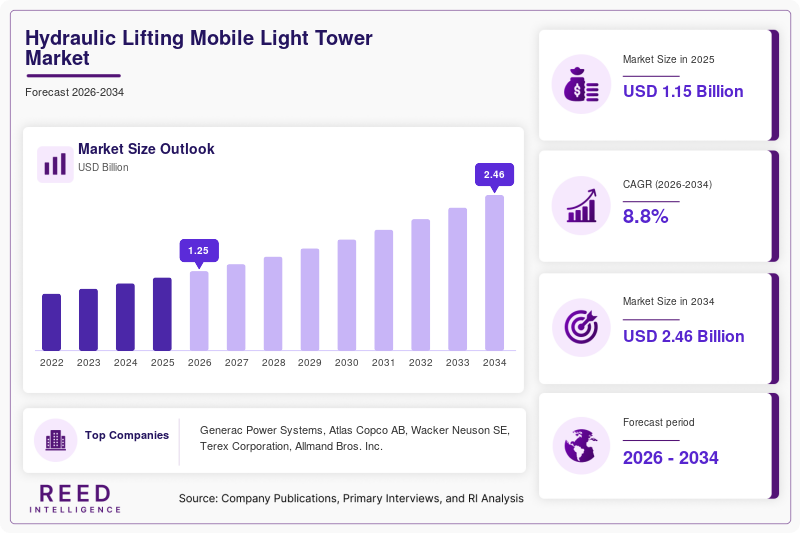
The Hydraulic Lifting Mobile Light Tower Market size valued at approximately USD 1.25 billion in 2026 and projected to reach nearly USD 2.45 billion by 2034, registering a CAGR of around 8.8% during the forecast period (2026–2034). The growth trajectory is primarily influenced by increasing demand for portable and energy-efficient lighting systems across construction, mining, oil & gas, and emergency response sectors. A significant global factor supporting market expansion is the accelerated infrastructure development activities in emerging economies, where continuous night-time operations and remote site illumination requirements are becoming essential for operational efficiency and safety compliance.
The integration of hydraulic lifting mechanisms with mobile light towers has enhanced deployment flexibility, allowing operators to quickly adjust lighting height and coverage in dynamic environments. Additionally, the growing adoption of hybrid and solar-powered lighting systems is reducing dependency on diesel generators, thereby improving sustainability performance and lowering operating costs. Government investments in smart city projects and large-scale transportation infrastructure further support the demand for mobile lighting solutions.
Key Highlights
- North America dominated the market with a 34.2% share in 2025.
- Asia Pacific is expected to grow at the fastest CAGR of 11.2% during 2026–2034.
- By equipment type, diesel-powered light towers accounted for the largest share of 39.1%, while solar-hybrid systems are projected to grow at a CAGR of 12.6%.
- By application, construction activities led with a 42.3% share, whereas emergency and disaster management applications are expected to expand at a CAGR of 11.4%.
- The United States remained the dominant country, with market values of USD 620 million in 2024 and USD 680 million in 2025.
Market Trends
Increasing Adoption of Hybrid and Solar-Powered Light Towers
The transition toward hybrid and solar-powered hydraulic lifting mobile light towers is becoming a prominent trend in the market. Industries are increasingly prioritizing energy-efficient lighting solutions to reduce fuel dependency and operational emissions. Hybrid systems, which combine diesel and solar energy, offer extended runtime and lower maintenance requirements, making them suitable for remote construction and mining operations. Governments in several regions are also encouraging low-emission equipment usage, further accelerating adoption. This shift is particularly strong in large infrastructure projects where sustainability targets are integrated into procurement strategies, driving manufacturers to innovate energy-optimized lighting systems.
Integration of Smart Monitoring and Remote Operation Technologies
Another key trend shaping the Hydraulic Lifting Mobile Light Tower Market is the integration of IoT-enabled monitoring systems and remote operation capabilities. Modern light towers are being equipped with sensors that track fuel consumption, operational efficiency, and maintenance requirements in real time. These systems allow fleet managers to optimize deployment and reduce downtime through predictive maintenance. Remote-controlled hydraulic lifting mechanisms further enhance operational convenience and safety in hazardous environments such as mining sites and disaster zones. The growing digitalization of construction and industrial equipment is expected to significantly improve asset management efficiency across end-use industries.
Market Drivers
Expansion of Infrastructure and Construction Activities
Rapid global infrastructure development is a major driver of the Hydraulic Lifting Mobile Light Tower Market. Large-scale construction projects such as highways, airports, smart cities, and industrial facilities require continuous lighting for nighttime operations and safety compliance. Emerging economies in Asia Pacific and the Middle East are investing heavily in infrastructure modernization, creating strong demand for portable lighting systems. Hydraulic lifting mobile light towers provide flexibility, durability, and quick deployment capabilities, making them ideal for dynamic construction environments. The increasing complexity and scale of construction projects further enhance reliance on advanced lighting solutions.
Rising Demand from Mining and Oil & Gas Industries
The mining and oil & gas sectors significantly contribute to market growth due to their reliance on remote and hazardous operational environments. These industries require reliable lighting systems to ensure worker safety and operational efficiency during night shifts or low-visibility conditions. Hydraulic lifting mobile light towers are particularly suitable due to their mobility and high mast elevation capabilities, which provide broad illumination coverage. As exploration activities expand in remote regions, especially in Africa, Latin America, and parts of Asia, the demand for durable and high-performance lighting systems continues to increase.
Market Restraint
High Maintenance and Operational Costs of Advanced Systems
Despite strong demand, the Hydraulic Lifting Mobile Light Tower Market faces challenges related to high maintenance and operational costs, particularly for advanced hybrid and hydraulic systems. These units require regular servicing of hydraulic components, engines, and lighting assemblies, which increases overall lifecycle expenses. Small and medium-sized contractors often find it difficult to invest in high-end systems due to budget constraints. Additionally, fluctuations in fuel prices further impact operating costs, especially for diesel-powered models. In developing regions, cost sensitivity limits the adoption of technologically advanced light towers, slowing market penetration despite growing infrastructure needs.
Market Opportunities
Growth in Disaster Management and Emergency Response Applications
The increasing frequency of natural disasters and emergency situations presents a significant opportunity for the Hydraulic Lifting Mobile Light Tower Market. Governments and humanitarian organizations are investing in rapid-response infrastructure to support rescue and recovery operations. Mobile light towers are essential for providing immediate illumination in disaster-hit areas where power supply is disrupted. Hydraulic lifting systems enhance deployment efficiency, enabling quick setup in challenging terrains. As climate-related events such as floods, hurricanes, and wildfires become more frequent, demand for portable lighting solutions in emergency response applications is expected to rise substantially.
Expansion of Rental Equipment Services
The growing preference for equipment rental services is creating new opportunities in the market. Construction companies and industrial operators are increasingly opting for rental models instead of purchasing equipment outright to reduce capital expenditure. Rental providers are expanding their fleets of hydraulic lifting mobile light towers to meet short-term project requirements. This trend is particularly strong in urban construction projects and seasonal industrial operations. The flexibility, cost efficiency, and maintenance support offered by rental services are driving widespread adoption, especially among small contractors and project-based operations.
Segmental Analysis
By Power Source
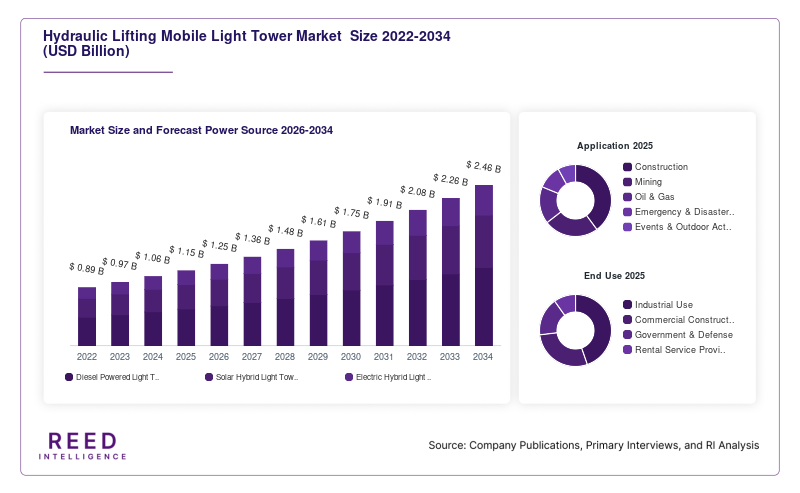
Diesel-powered systems dominated the market with a 42.5% share in 2024, driven by their reliability and widespread availability in remote operations. These systems remain preferred in construction and mining sectors due to their high power output and durability in harsh environments.
Solar-hybrid systems are expected to grow at a CAGR of 12.6%, supported by rising environmental concerns and fuel cost optimization strategies. Increasing adoption of renewable energy-based lighting solutions is encouraging manufacturers to develop hybrid models with improved efficiency and reduced emissions.
By Application
Construction applications held the largest share of 43.1% in 2024, driven by continuous infrastructure development and nighttime construction activities. Hydraulic lifting mobile light towers provide essential illumination for roadworks, bridges, and industrial projects.
Emergency and disaster management applications are expected to grow at a CAGR of 11.4%, supported by increasing investments in disaster response infrastructure. Governments and relief agencies are deploying mobile lighting systems for rapid response in crisis situations, enhancing operational efficiency in affected regions.
By End Use
Industrial end-use segments accounted for 38.9% market share in 2024, primarily driven by mining, oil & gas, and manufacturing activities requiring continuous lighting support. These industries rely on durable and high-performance lighting systems for operational safety.
Rental service providers are projected to grow at a CAGR of 10.9%, supported by rising demand for flexible equipment usage models. The rental segment benefits from cost efficiency, maintenance support, and increasing adoption among small contractors and temporary project operators.
Regional Analysis
North America
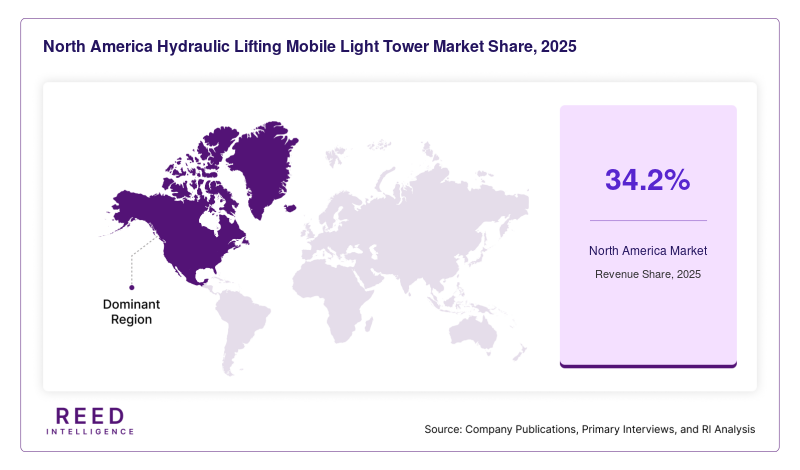
North America accounted for approximately 34.2% market share in 2025, with a projected CAGR of 7.9% during 2026–2034. The region benefits from strong infrastructure modernization programs and high adoption of advanced construction equipment.
The United States leads the regional market, driven by extensive highway expansion projects and oilfield operations in remote areas. Increased investment in smart infrastructure and emergency preparedness systems further supports demand for hydraulic lifting mobile light towers across various industries.
Europe
Europe held around 25.6% market share in 2025, with a forecast CAGR of 7.4% during the forecast period. The region’s growth is supported by strict energy efficiency regulations and increasing adoption of sustainable lighting solutions.
Germany remains the dominant country due to its strong construction machinery sector and emphasis on eco-friendly industrial equipment. The push toward low-emission hybrid lighting systems in public infrastructure projects is further accelerating market penetration.
Asia Pacific
Asia Pacific accounted for 27.8% market share in 2025 and is expected to grow at the fastest CAGR of 11.2%. Rapid urbanization and large-scale infrastructure development are key growth drivers.
China leads the region, supported by massive construction activities and industrial expansion. India is also emerging as a high-growth market due to government-backed infrastructure initiatives and increasing demand for mobile lighting solutions in construction and mining sectors.
Middle East & Africa
The Middle East & Africa region held approximately 7.1% market share in 2025, with a projected CAGR of 9.3%. Growth is driven by oil & gas exploration and large infrastructure projects in Gulf countries.
Saudi Arabia dominates the regional market, supported by mega infrastructure projects under national development programs. Harsh environmental conditions and remote operations increase reliance on durable mobile lighting systems with hydraulic lifting capabilities.
Latin America
Latin America accounted for 5.3% market share in 2025, with a CAGR of 8.1% during the forecast period. Mining activities and infrastructure expansion are key contributors to growth.
Brazil leads the region due to extensive mining operations and urban infrastructure development. Increasing demand for portable lighting in remote project sites further supports adoption of hydraulic lifting mobile light towers.
Competitive Landscape
The Hydraulic Lifting Mobile Light Tower Market is moderately consolidated, with key players focusing on product innovation, hybrid system integration, and rental fleet expansion. Major companies include Generac Power Systems, Atlas Copco, Allmand Bros., Wacker Neuson, and Terex Corporation. These players are investing in energy-efficient lighting technologies and smart monitoring systems to enhance operational efficiency. Recent developments include the launch of solar-hybrid mobile light towers by leading manufacturers and expansion of rental service networks across emerging markets. Strategic collaborations and regional expansions remain key competitive strategies.
Key Players List
- Generac Power Systems
- Atlas Copco
- Wacker Neuson
- Terex Corporation
- Allmand Bros. Inc.
- Doosan Portable Power
- JLG Industries
- Trime S.r.l.
- Chicago Pneumatic
- United Rentals
- Doosan Bobcat
- Himoin Lighting Equipment
- Pramac Group
- Larson Electronics
- Aska Equipment
Recent Developments
- A leading manufacturer introduced a next-generation solar-hybrid hydraulic lifting light tower featuring extended runtime and reduced fuel consumption.
- A major rental company expanded its fleet of mobile light towers across Asia Pacific to support growing infrastructure projects.
- An industrial equipment provider launched an IoT-enabled monitoring system for remote tracking and predictive maintenance of mobile lighting units.
Hydraulic Lifting Mobile Light Tower Market Segments
Power Source
- Diesel Powered Light Towers
- Solar Hybrid Light Towers
- Electric Hybrid Light Towers
Application
- Construction
- Mining
- Oil & Gas
- Emergency & Disaster Management
- Events & Outdoor Activities
End Use
- Industrial Use
- Commercial Construction
- Government & Defense
- Rental Service Providers
By Region
- North America
- Europe
- APAC
- Middle East and Africa
- LATAM