Phenylephrine Hydrochloride Market Size, Share & Demand Report By Product Type (Oral Formulations, Nasal Sprays, Injectable Formulations), By Application (Decongestants, Hypotension Treatment, Ophthalmic Use), By Distribution Channel (Retail Pharmacies, Hospital Pharmacies, Online Pharmacies), By End-User (Hospitals, Clinics, Homecare Settings), By Region & Segment Forecasts, 2026–2034
USD 3950
Market Overview
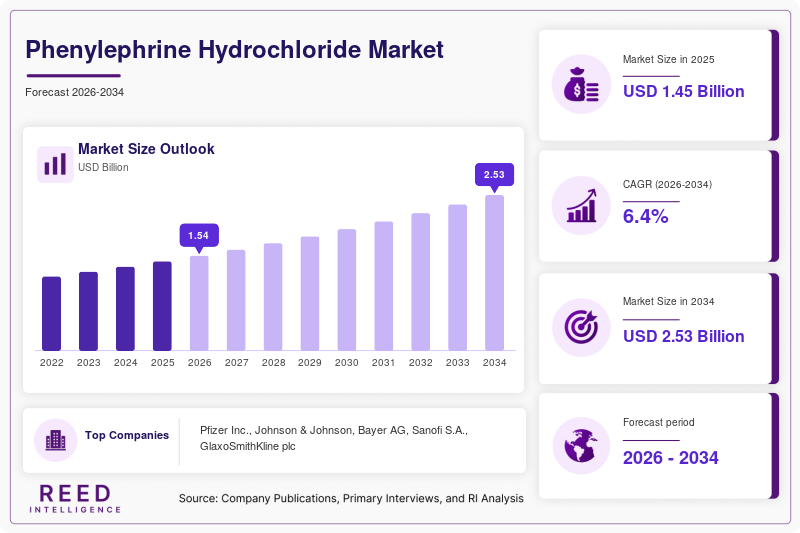
The Phenylephrine Hydrochloride Market size was valued at approximately USD 1.45 billion in 2026 and is projected to reach USD 2.38 billion by 2034, expanding at a compound annual growth rate (CAGR) of 6.4% during 2026–2034. This steady growth reflects increasing demand for decongestants, ophthalmic solutions, and injectable formulations across both developed and emerging healthcare systems.
A major global factor supporting the expansion of the Phenylephrine Hydrochloride Market is the rising prevalence of respiratory conditions such as seasonal allergies, sinusitis, and common cold. Urbanization, pollution levels, and changing climate patterns have contributed to a consistent increase in nasal congestion-related ailments, driving demand for over-the-counter and prescription medications containing phenylephrine hydrochloride.
Key Highlights:
- North America dominated the market with 36.5% share in 2025, while Asia Pacific is projected to register the fastest growth at a CAGR of 7.8%.
- Oral formulations led the product segment with 42% share, while injectable formulations are expected to grow fastest at a CAGR of 7.2%.
- The United States remained the dominant country, with market values of USD 420 million in 2024 and USD 445 million in 2025.
Market Trends
Rising Preference for Multi-Symptom Cold Medications
The Phenylephrine Hydrochloride Market is witnessing a growing preference for combination drugs that target multiple symptoms such as congestion, fever, and cough simultaneously. Pharmaceutical companies are increasingly integrating phenylephrine hydrochloride into multi-ingredient formulations alongside antihistamines and analgesics. This trend aligns with consumer demand for convenience and cost-effective treatment solutions. Retail pharmacies and e-commerce platforms have further amplified accessibility, making such products widely available. The shift toward combination therapies is expected to sustain market growth, especially in regions with high seasonal illness incidence.
Expansion of Injectable Applications in Critical Care
Another notable trend shaping the Phenylephrine Hydrochloride Market is the increasing use of injectable formulations in hospital and surgical settings. Phenylephrine hydrochloride is widely used to manage blood pressure during anesthesia and intensive care procedures. Hospitals are expanding their procurement of ready-to-use injectable formulations due to improved safety profiles and reduced preparation time. Furthermore, advancements in sterile manufacturing technologies have enhanced product stability and shelf life, encouraging adoption across healthcare institutions. This trend is expected to strengthen the market’s clinical segment over the forecast period.
Market Drivers
Increasing Prevalence of Respiratory Disorders
The rising global burden of respiratory conditions is a primary driver of the Phenylephrine Hydrochloride Market. Environmental pollution, allergens, and lifestyle factors have contributed to increased cases of nasal congestion and sinus-related issues. This has led to consistent demand for decongestants, particularly in urban populations. The accessibility of over-the-counter medications containing phenylephrine hydrochloride further supports its widespread usage. Additionally, growing awareness about early symptom management has encouraged consumers to opt for quick-relief medications, driving product consumption across multiple regions.
Growing Pharmaceutical Manufacturing Capacity
The expansion of pharmaceutical manufacturing capabilities, particularly in emerging economies, is another key driver of the Phenylephrine Hydrochloride Market. Countries in Asia Pacific and Latin America are investing in large-scale drug production facilities to meet both domestic and export demand. This has improved the availability and affordability of phenylephrine-based products. Moreover, advancements in formulation technologies have enabled manufacturers to develop diverse dosage forms, enhancing market penetration. The increasing number of generic drug manufacturers entering the market is also contributing to competitive pricing and broader accessibility.
Market Restraint
Regulatory Scrutiny on Efficacy of Oral Phenylephrine
A significant restraint impacting the Phenylephrine Hydrochloride Market is the growing regulatory scrutiny regarding the efficacy of oral phenylephrine formulations. Certain health authorities have questioned the effectiveness of phenylephrine as a nasal decongestant when administered orally. This has led to increased evaluation and, in some cases, reconsideration of its inclusion in over-the-counter medications.
The potential for regulatory changes has created uncertainty among manufacturers and distributors. Companies may need to invest in additional clinical studies or reformulate products to comply with evolving guidelines. This could increase operational costs and delay product launches.
Furthermore, negative public perception regarding efficacy may influence consumer preferences, leading to a shift toward alternative decongestants. While phenylephrine continues to hold a strong position in injectable and topical applications, the oral segment may face moderate growth challenges over the forecast period.
Market Opportunities
Expansion in Emerging Healthcare Markets
Emerging economies present significant growth opportunities for the Phenylephrine Hydrochloride Market. Rapid urbanization, improving healthcare infrastructure, and rising disposable incomes are driving demand for pharmaceutical products. Governments in these regions are also increasing healthcare spending, facilitating better access to medications. Local manufacturing initiatives and favorable regulatory frameworks are encouraging multinational companies to expand their presence, thereby boosting market growth.
Development of Advanced Drug Delivery Systems
The advancement of drug delivery technologies offers new opportunities in the Phenylephrine Hydrochloride Market. Innovations such as controlled-release formulations, nasal sprays with enhanced absorption, and prefilled syringes are improving patient compliance and therapeutic outcomes. Pharmaceutical companies are investing in research and development to create more effective and user-friendly products. These innovations not only enhance product differentiation but also open new avenues for market expansion, particularly in specialized medical applications.
Segmental Analysis
By Product Type
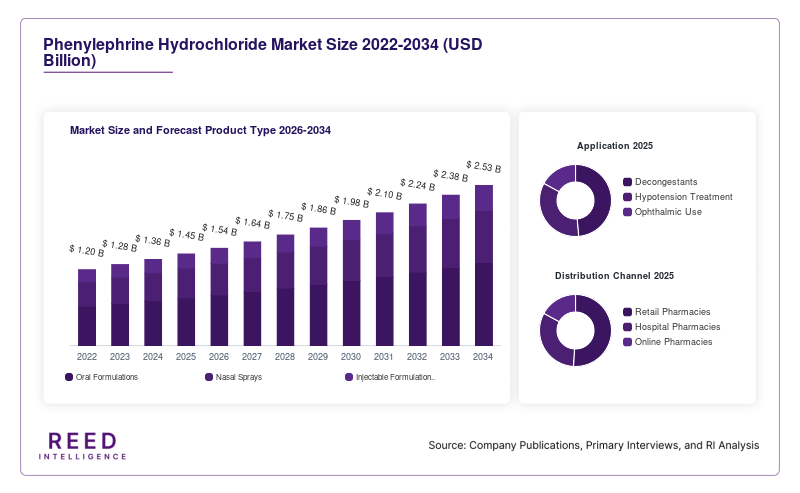
Oral formulations dominated the Phenylephrine Hydrochloride Market with a 42% share in 2025. Their widespread availability, ease of administration, and affordability have made them the preferred choice for treating common cold and congestion.
Injectable formulations will grow at the fastest CAGR of 7.2% during the forecast period. Their increasing use in hospital settings for managing hypotension and surgical procedures will drive demand.
By Application
Decongestants accounted for the largest share of 48% in 2025, driven by high demand for cold and allergy treatments. The widespread prevalence of respiratory conditions has supported this segment’s dominance.
Hypotension treatment will be the fastest-growing application, with a projected CAGR of 6.9%. The rising number of surgical procedures and critical care cases will increase demand for injectable phenylephrine.
By Distribution Channel
Retail pharmacies led the market with a 45% share in 2025 due to easy accessibility and consumer preference for over-the-counter medications.
Online pharmacies will grow at the fastest CAGR of 8.1%, driven by increasing digital adoption and convenience of home delivery services.
By End-User
Hospitals accounted for the largest share of 39% in 2025, as they are primary users of injectable formulations and critical care medications.
Homecare settings will expand at the fastest CAGR of 7.5%, supported by growing self-medication trends and availability of OTC drugs.
Regional Analysis
North America
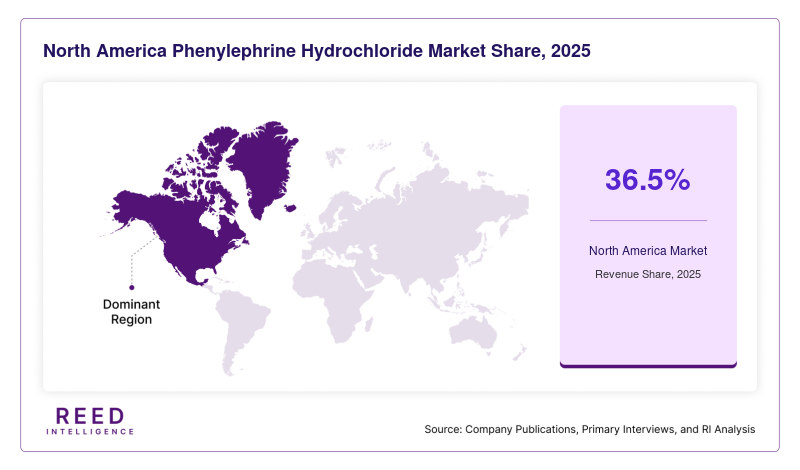
North America accounted for 36.5% of the Phenylephrine Hydrochloride Market share in 2025 and will grow at a CAGR of 5.8% during 2026–2034. The region’s mature pharmaceutical industry and strong healthcare infrastructure will support steady demand. High awareness regarding over-the-counter medications and established distribution networks will further contribute to growth.
The United States dominated the regional market due to high healthcare expenditure and widespread availability of pharmaceutical products. The country’s strong presence of leading drug manufacturers and advanced clinical practices has supported consistent demand for phenylephrine hydrochloride formulations.
Europe
Europe held approximately 27.2% market share in 2025 and will expand at a CAGR of 5.6% through 2034. The region’s well-regulated pharmaceutical market and increasing demand for effective decongestants will drive growth. Aging populations and seasonal illnesses will also contribute to sustained demand.
Germany emerged as the dominant country in Europe due to its strong pharmaceutical manufacturing base and high adoption of advanced medications. The country’s focus on quality standards and research-driven innovation has supported market expansion.
Asia Pacific
Asia Pacific captured 22.8% share in 2025 and will register the fastest CAGR of 7.8% during the forecast period. Rapid urbanization, population growth, and increasing healthcare access will drive market growth in this region. Rising pollution levels and respiratory issues will further boost demand.
China dominated the Asia Pacific market due to its large population and expanding pharmaceutical industry. Government initiatives to enhance healthcare infrastructure and local drug production have significantly contributed to market growth.
Middle East & Africa
The Middle East & Africa accounted for 7.1% market share in 2025 and will grow at a CAGR of 5.2% through 2034. Improving healthcare facilities and increasing awareness about respiratory treatments will support market expansion.
Saudi Arabia led the regional market due to rising healthcare investments and growing demand for modern pharmaceutical products. The country’s focus on healthcare diversification has supported the adoption of advanced medications.
Latin America
Latin America held 6.4% share in 2025 and will expand at a CAGR of 5.4% during the forecast period. The region’s improving economic conditions and healthcare access will drive market growth.
Brazil dominated the market due to its large population and expanding pharmaceutical sector. Government healthcare programs and increasing availability of medications have supported steady demand.
Competitive Landscape
The Phenylephrine Hydrochloride Market is moderately fragmented, with both global and regional players competing across various product segments. Key companies focus on expanding product portfolios, improving manufacturing capabilities, and investing in research and development.
A leading player in the market has strengthened its position through the launch of advanced injectable formulations designed for hospital use. This development has enhanced its presence in the clinical segment and improved its competitive advantage.
Other companies are focusing on strategic partnerships, mergers, and acquisitions to expand their geographic footprint. The increasing emphasis on generic drug production has also intensified competition, leading to competitive pricing and broader market accessibility.
Key Players List
- Pfizer Inc.
- Johnson & Johnson
- Bayer AG
- Sanofi S.A.
- GlaxoSmithKline plc
- Novartis AG
- Teva Pharmaceutical Industries Ltd.
- Sun Pharmaceutical Industries Ltd.
- Cipla Ltd.
- Dr. Reddy’s Laboratories Ltd.
- Mylan N.V.
- Lupin Limited
- Zydus Lifesciences Ltd.
- Hikma Pharmaceuticals PLC
- Fresenius Kabi AG
Recent Developments
- A major pharmaceutical company introduced a ready-to-use injectable phenylephrine hydrochloride formulation to improve efficiency in emergency care settings.
- Several generic drug manufacturers expanded production capacities to meet rising global demand.
- Companies invested in advanced nasal spray technologies to enhance drug absorption and patient experience.
- Strategic collaborations were observed to strengthen distribution networks in emerging markets.
Phenylephrine Hydrochloride Market Segments
Product Type
- Oral Formulations
- Nasal Sprays
- Injectable Formulations
Application
- Decongestants
- Hypotension Treatment
- Ophthalmic Use
Distribution Channel
- Retail Pharmacies
- Hospital Pharmacies
- Online Pharmacies
End-User
- Hospitals
- Clinics
- Homecare Settings
By Region
- North America
- Europe
- APAC
- Middle East and Africa
- LATAM