Theater Linen Market Size, Share Demand Report By Product Type (Curtains & Drapes, Backdrops, Cycloramas, Scrims, Legs & Borders), By Material (Cotton, Polyester, Velvet, Canvas, Silk), Regional Insights & Segment Forecasts, 2026–2034
USD 3950
Theater Linen Market Size
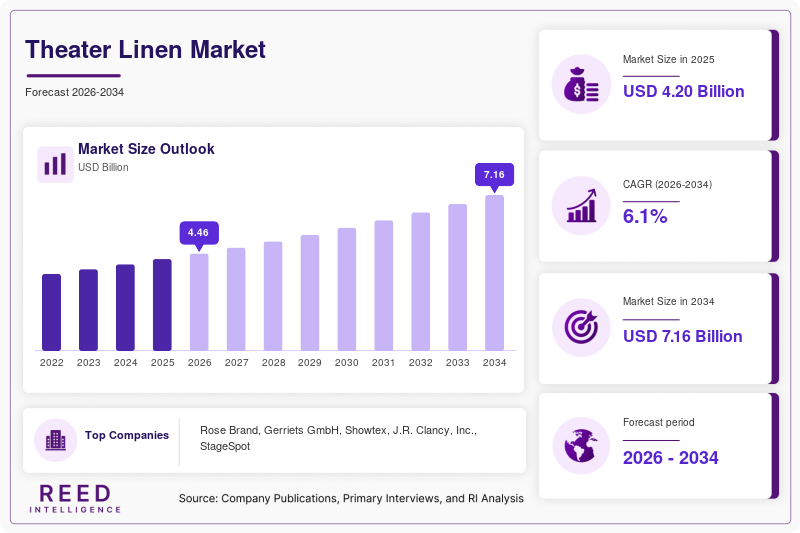
The Theater Linen market size is projected at USD 485.6 million in 2026 and is expected to hit USD 785.3 million by 2034 with a CAGR of 6.2% during the forecast period. The increasing number of theatrical productions and live events, coupled with the growing demand for high-quality, durable, and aesthetically pleasing stage linens, underpins market expansion. This report delivers a comprehensive analysis of the Theater Linen market, including segmentation by product type and material, competitive dynamics, and regional growth patterns, equipping stakeholders with critical intelligence. The Theater Linen market continues to demonstrate strong growth potential, fueled by the rising investments in live entertainment, the expanding film and television production industry, and continuous innovation in textile technology.
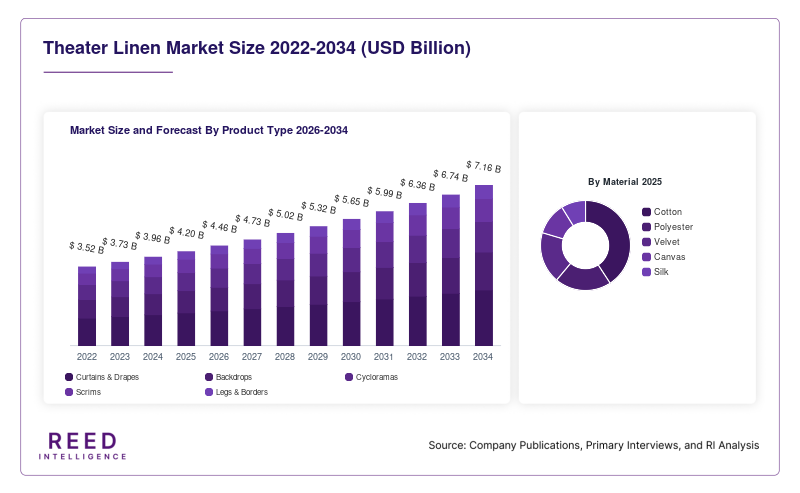
Theater linen refers to the wide range of fabric-based products used in stage production, including curtains, drapes, backdrops, cycloramas, scrims, and other soft goods. These are essential for setting the scene, controlling lighting, and creating visual depth in theatrical, film, and live event productions. The global Theater Linen market is significant, with over 12 million linear yards of theater linen produced globally in 2025, reflecting a 7% increase from 2023, driven by the growing demand from the live entertainment and film industries. Adoption patterns reveal that the Curtains & Drapes product type dominates the market, accounting for 35% of total revenue, followed by Backdrops at 25%, Cycloramas at 18%, Scrims at 12%, and Legs & Borders at 10%. The Theater Linen market's trajectory is closely linked to the growth of the global live entertainment market, which is projected to reach USD 60 billion by 2028, and the increasing focus on visual storytelling and immersive experiences.
Theater Linen Market Trends
Growing Demand for Fire-Retardant and High-Performance Fabrics
The Theater Linen market is witnessing a significant trend toward the demand for fire-retardant and high-performance fabrics, driven by stringent safety regulations and the need for durable and reliable stage linens. The production of fire-retardant theater linens increased by 15% in 2025, reaching 5 million linear yards, as 40% of new theater constructions in 2025 specified fire-rated fabrics. Adoption rates of flame-retardant linens in commercial theaters reached 35%, with this figure projected to exceed 55% by 2030. The Theater Linen market's trend toward fire safety is reinforced by the need for compliance with safety codes, the increasing awareness of fire risks in venues, and the continuous innovation in flame-retardant textile treatments.
Increasing Use of Digital and Customizable Backdrops
The increasing focus on visual innovation and customization is a major trend shaping the Theater Linen market, with the development of digital and customizable backdrops and cycloramas using advanced printing and projection mapping technologies. The market has seen a 12% increase in demand for digitally printed backdrops since 2022, with 25% of new productions in 2025 featuring custom-designed digital backdrops. The use of projection-ready fabrics and interactive stage elements has also gained significant traction. The Theater Linen market's trend toward digitalization is reinforced by the need for creative flexibility, the increasing use of technology in live performances, and the continuous innovation in textile printing and projection technologies.
Theater Linen Market Drivers
The Theater Linen market's expansion is primarily driven by the increasing number of theatrical productions, live events, and concerts, with the global live entertainment industry valued at over USD 50 billion in 2025. The need for high-quality, durable, and visually appealing stage linens to enhance the overall production value has been a major driver, with theater linen being an essential element of stage design. The growing investments in cultural infrastructure and the expansion of the film and television industry have also fueled market demand. Additionally, the increasing focus on immersive and experiential events has spurred growth. The Theater Linen market's growth is further reinforced by the continuous innovation in textile technology, leading to improved performance, durability, and aesthetics.
Theater Linen Market Restraints
Despite favorable growth prospects, the Theater Linen market faces significant constraints, primarily related to the high cost of high-quality, fire-retardant, and custom-designed linens, which can be a burden for smaller theaters and production companies. The maintenance and care requirements of theater linens, including cleaning and storage, can also be a limitation. The Theater Linen market's growth is also tempered by the competition from digital and projection-based alternatives, which may reduce the demand for traditional physical backdrops in some applications.
Theater Linen Market Opportunities
The Theater Linen market presents significant opportunities in the rapidly expanding market for immersive and interactive experiences, where innovative stage linens can enhance audience engagement. The development of smart fabrics and textiles with integrated lighting and digital capabilities is expected to grow at a CAGR of 10% through 2034. Emerging opportunities also exist in the use of sustainable and eco-friendly materials for theater linens, catering to the growing demand for green productions. The Theater Linen market's opportunity profile is further enhanced by the growing trend of experiential marketing and the increasing use of theaters and event spaces for corporate and brand events.
Challenges in Theater Linen Market
The Theater Linen market faces persistent challenges related to the need for continuous innovation to create fabrics that are both visually stunning and durable, while also meeting stringent safety standards. The complexity of managing the supply chain and ensuring timely delivery of custom orders can also be a challenge. The market is also contending with the challenge of adapting to changing audience expectations and the increasing use of digital and interactive technologies in live performances. Additionally, the Theater Linen market is challenged by the need to educate production designers about the benefits and capabilities of advanced textile options.
Theater Linen Market Segmentation
The Theater Linen market is segmented by Product Type and Material to provide a comprehensive market perspective. By Product Type, Curtains & Drapes dominate with a 35% market share, driven by their essential role in stage design. The Material segment is led by Polyester, which accounts for 40% of the market, followed by Cotton at 25%, Velvet at 18%, Canvas at 12%, and Silk at 5%.
By Product Type
Curtains & Drapes represent the largest segment in the Theater Linen market, commanding a 35% share, with revenue exceeding USD 170 million in 2025. These are characterized by their use in front-of-house, stage framing, and masking applications. Technical specifications include fire-retardancy, weight, and drape. The Theater Linen market's Curtains & Drapes segment is driven by their use in all types of venues.
Backdrops capture a 25% share of the Theater Linen market, with revenue of USD 121 million in 2025. These are characterized by their use in scenic backgrounds, often featuring custom designs and prints. Technical specifications include size, material, and print quality. The Theater Linen market's Backdrops segment is driven by their use in theatrical productions, film, and events.
Cycloramas represent 18% of the market, with revenue of USD 87 million in 2025, characterized by their use as a large, curved backdrop for sky or horizon effects. Technical specifications include size, material, and seamless appearance. The Theater Linen market's Cycloramas segment is driven by their use in studios and theaters.
Scrims account for 12% of the market, with revenue of USD 58 million in 2025, characterized by their use as a semi-transparent fabric for lighting and projection effects. Technical specifications include transparency, texture, and material. The Theater Linen market's Scrims segment is driven by their use in creative stage design.
Legs & Borders account for the remaining 10% of the market, with revenue of USD 49 million in 2025, used for masking and framing stage areas. The Theater Linen market's Legs & Borders segment is driven by their use in stage and studio settings.
By Material
Polyester dominates the Theater Linen market, accounting for 40% of sales, representing USD 194 million in 2025. This segment includes use in durable, wrinkle-resistant, and cost-effective theater linens. Usage penetration exceeds 40% in commercial theaters. The Theater Linen market's Polyester segment is characterized by its focus on durability and affordability.
Cotton accounts for 25% of the Theater Linen market, with revenue of USD 121 million in 2025. This segment encompasses use in traditional and natural-fiber theater linens, offering a classic look and feel. The segment is growing at a steady CAGR, driven by the demand for natural materials. The Theater Linen market's Cotton segment is characterized by its focus on aesthetics and comfort.
Velvet represents 18% of the market, with revenue of USD 87 million in 2025, involving use in high-end and luxury theater linens, offering a rich, luxurious appearance. The segment's growth is fueled by the demand for premium productions. The Theater Linen market's Velvet segment is characterized by its focus on elegance and visual impact.
Canvas accounts for 12% of the market, with revenue of USD 58 million in 2025, used in durable and heavy-duty backdrops and cycloramas. The Theater Linen market's Canvas segment is characterized by its focus on strength and durability.
Silk accounts for the remaining 5% of the market, with revenue of USD 24 million in 2025, used in high-end, luxury theater linens for its luxurious feel and visual appeal. The Theater Linen market's Silk segment is characterized by its focus on exclusivity and premium quality.
Theater Linen Market Regional Outlook
North America Theater Linen Market
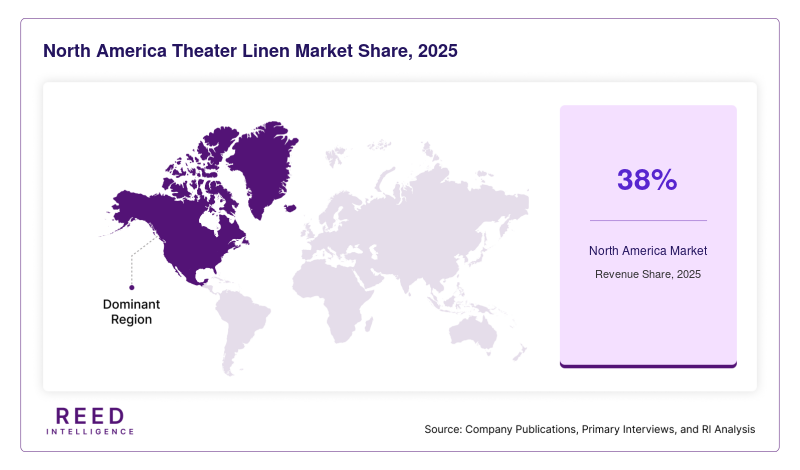
Leads the Theater Linen market, commanding a 38% share, with a revenue of USD 184 million in 2025. The United States is the primary driver, accounting for 85% of regional demand, driven by the high concentration of theaters, film studios, and event venues, as well as a strong focus on production quality. The North American Theater Linen market is characterized by its focus on innovation and premium products.
Europe Theater Linen Market
Represents the second-largest market, capturing a 30% share with a revenue of USD 146 million in 2025. Germany, the UK, and France are the primary drivers, collectively accounting for 55% of regional demand, driven by a rich theatrical tradition, strong cultural infrastructure, and a focus on quality. The Theater Linen market in Europe is characterized by its focus on craftsmanship and tradition.
Asia-Pacific Theater Linen Market
Accounts for 22% of the global Theater Linen market, with a revenue of USD 107 million in 2025. China, Japan, and India are the primary drivers, together accounting for 65% of regional demand, driven by the rapidly growing entertainment industry, increasing investments in cultural infrastructure, and a large population base. The Asia-Pacific Theater Linen market is projected to grow at the fastest CAGR of 8% through 2034.
Middle East & Africa and Latin America Theater Linen Market
Together account for the remaining 10% of the Theater Linen market, with the UAE and Brazil leading their respective regions. Both regions are projected to grow at CAGRs exceeding 7%, driven by increasing investments in cultural and entertainment infrastructure.
Top players in Theater Linen Market
- Rose Brand
- Gerriets GmbH
- Showtex
- J.R. Clancy, Inc.
- StageSpot
- Production Advantage, Inc.
- BMI Supply
- Syracuse Scenery & Stage Lighting Co., Inc.
- Lighten the Stage
- Stage Decoration & Supplies, Inc.
- Drapery Industries
- Atlanta Stage Works
- Staging Concepts
- Monte Vista Theatre Supplies
- Lambert's Linens
Rose Brand
Rose Brand holds a dominant position in the Theater Linen market, with an estimated 12% global market share, particularly strong in the North American, European, and Asia-Pacific theatrical and film production segments. The company's portfolio of stage linens, including curtains, drapes, backdrops, and scrims, is widely recognized for its quality, durability, and innovative designs. Rose Brand's market leadership is reinforced by its significant investment in R&D and production technology, its extensive product range, and its strong relationships with leading theaters and production companies. Rose Brand commands over 15% of the North American market and 10% of the European market for theater linens, positioning it as a key player in the global market.
Gerriets GmbH
Gerriets GmbH is a leading player in the Theater Linen market, commanding approximately 10% of the global market share through its comprehensive portfolio of high-quality stage and theater fabrics. The company's expertise in textile technology and its focus on precision, quality, and innovation have solidified its position, particularly in the European market. Gerriets' theater linens are known for their exceptional quality, fire-retardant properties, and wide range of colors and textures. The company's commitment to quality and its strong presence in the European and North American markets have enhanced its competitive advantage.
Showtex holds a significant 8% market share, with particular strength in the European and international stage and event markets. J.R. Clancy, Inc. is a major player in the stage equipment market, holding a 7% share, known for its comprehensive solutions for theaters.
Recent Developments in Theater Linen Market
- 2025: Rose Brand launched a new line of eco-friendly theater linens made from recycled materials, targeting the growing demand for sustainable production solutions in the entertainment industry.
- 2025: Gerriets GmbH introduced a new range of digitally printable scrims designed for projection mapping, expanding creative possibilities for stage designers.
Theater Linen Market Segments
By Product Type
- Curtains & Drapes
- Backdrops
- Cycloramas
- Scrims
- Legs & Borders
By Material
- Cotton
- Polyester
- Velvet
- Canvas
- Silk
By Region
- North America
- Europe
- APAC
- Middle East and Africa
- LATAM