Thermal Conductive Additive Market Size, Share & Demand Report By Type (Ceramic-Based Additives, Carbon-Based Additives, Metal-Based Additives), By Material (Aluminum Oxide, Boron Nitride, Graphite, Others), By Application (Electronics, Automotive, Industrial Equipment, Energy Systems), By End-Use Industry (Electrical & Electronics, Automotive, Aerospace, Construction, Others), By Region & Segment Forecasts, 2025–2034
USD 3950
Market Overview
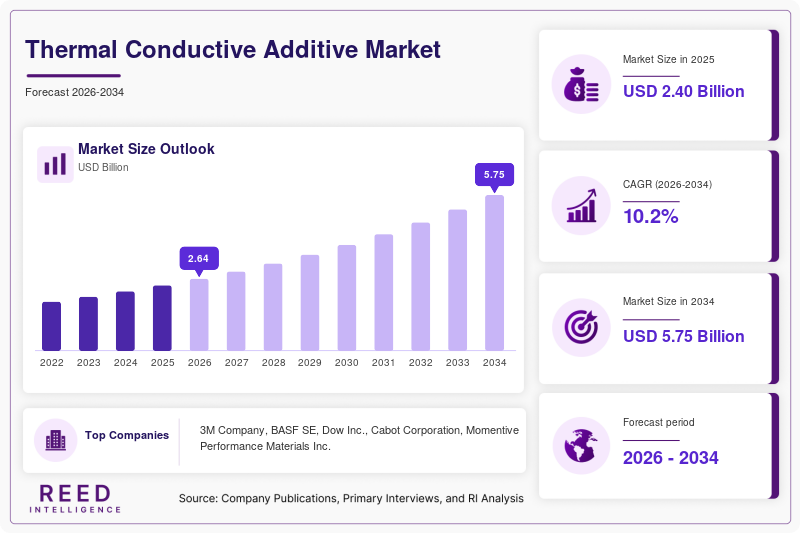
The global Thermal Conductive Additive Market size was estimated at USD 2.4 billion in 2025 and is projected to reach approximately USD 5.8 billion by 2034, expanding at a CAGR of 10.2% during the forecast period (2025–2034). The market growth has been driven by the rising need for efficient heat dissipation across high-performance electronics, automotive systems, and industrial equipment. Thermal conductive additives play a critical role in improving thermal conductivity in polymers, coatings, adhesives, and composites, enabling advanced product performance and reliability.
A major global factor supporting the growth of the Thermal Conductive Additive Market is the rapid expansion of electronic devices and miniaturization trends. As components become more compact and powerful, the need for effective thermal management solutions has intensified, boosting demand for high-performance additives across industries.
Key Highlights
- Asia Pacific dominated the market with a 41.3% share in 2025, while it is expected to grow at the fastest CAGR of 11.4% during the forecast period.
- By type, ceramic-based additives led with a 46.8% share, while carbon-based additives are projected to grow at the fastest CAGR of 11.9%.
- By application, electronics accounted for the largest share at 38.5%, whereas electric vehicles (EVs) are expected to expand at a CAGR of 12.3%.
- China remained the dominant country, with market values of USD 0.72 billion in 2025 and USD 0.79 billion in 2026.
Market Trends
Increasing Adoption in Electric Vehicles
The Thermal Conductive Additive Market is witnessing growing demand from the electric vehicle sector. As EV batteries generate significant heat during operation, thermal conductive additives are increasingly used in battery enclosures, thermal interface materials, and coatings. This trend is shaping product innovation, with manufacturers focusing on lightweight and high-efficiency solutions to improve battery performance and lifespan.
Shift Toward Sustainable and Bio-Based Additives
Sustainability has emerged as a key trend influencing the Thermal Conductive Additive Market. Manufacturers are exploring eco-friendly and recyclable materials to align with environmental regulations and corporate sustainability goals. Bio-based polymers combined with thermally conductive fillers are gaining traction, especially in packaging and consumer electronics applications. This shift is expected to reshape product portfolios and enhance the long-term outlook of the market.
Market Drivers
Rising Demand for Advanced Electronics
The expansion of consumer electronics, data centers, and communication infrastructure has significantly increased the need for effective heat management. Thermal conductive additives are essential in preventing overheating, ensuring device efficiency, and extending product life. This demand is expected to continue as technologies such as 5G and IoT evolve.
Growth in Industrial Automation
Industrial automation has led to increased deployment of machinery and equipment that operate under high temperatures. Thermal conductive additives are widely used in coatings, adhesives, and composites to maintain operational stability. As industries adopt smart manufacturing practices, the demand for these additives is expected to rise steadily.
Market Restraint
High Cost of Advanced Materials
One of the key challenges in the Thermal Conductive Additive Market is the high cost associated with advanced materials such as graphene, boron nitride, and specialized ceramics. These materials offer superior thermal performance but are expensive to produce and integrate into end-use applications. Small and medium-scale manufacturers often face difficulties in adopting these solutions due to budget constraints. Additionally, price volatility in raw materials can impact overall production costs, limiting widespread adoption. This restraint is particularly significant in cost-sensitive industries such as construction and packaging, where alternative solutions may be preferred.
Market Opportunities
Expansion in Renewable Energy Systems
The growing adoption of renewable energy systems, such as solar panels and wind turbines, presents significant opportunities for the Thermal Conductive Additive Market. These systems require efficient thermal management to ensure optimal performance and durability. Additives are increasingly used in encapsulants, coatings, and structural components to enhance heat dissipation.
Development of High-Performance Polymers
Advancements in polymer technology are creating new opportunities for thermal conductive additives. High-performance polymers integrated with conductive fillers are being used in aerospace, automotive, and electronics industries. These materials offer a balance of thermal conductivity, mechanical strength, and lightweight properties, making them suitable for next-generation applications.
Segmental Analysis
By Type
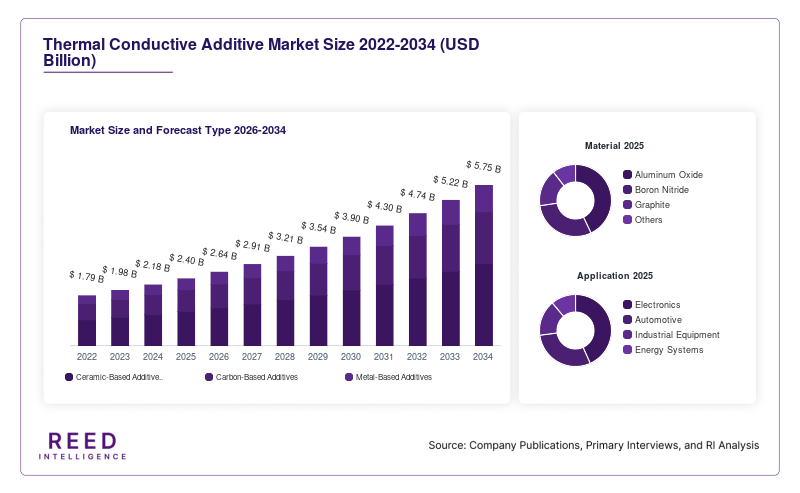
Ceramic-based additives dominated the Thermal Conductive Additive Market with a 46.8% share in 2025. These additives are widely used due to their excellent thermal conductivity and electrical insulation properties, making them suitable for electronics and automotive applications.
Carbon-based additives are expected to grow at the fastest CAGR of 11.9% during the forecast period. Their superior thermal performance and lightweight nature will drive adoption in advanced applications such as aerospace and high-performance electronics.
By Material
Aluminum oxide emerged as the dominant material segment, accounting for 34.2% of the market share in 2025. Its cost-effectiveness and thermal stability made it a preferred choice across multiple applications.
Boron nitride is projected to grow at the fastest CAGR of 12.1%. Its high thermal conductivity and electrical insulation properties will drive demand in specialized applications such as semiconductor manufacturing.
By Application
Electronics accounted for the largest share of 38.5% in 2025, driven by the need for efficient heat dissipation in devices such as smartphones, laptops, and servers.
Electric vehicles are expected to grow at a CAGR of 12.3%, supported by increasing adoption of EVs and the need for thermal management in battery systems.
By End-Use Industry
The electrical and electronics industry dominated the market with a 40.7% share in 2025 due to the widespread use of thermal conductive additives in circuit boards and components.
The automotive industry is projected to grow at the fastest CAGR of 11.8%, driven by the shift toward electric mobility and advanced vehicle systems.
Regional Analysis
North America
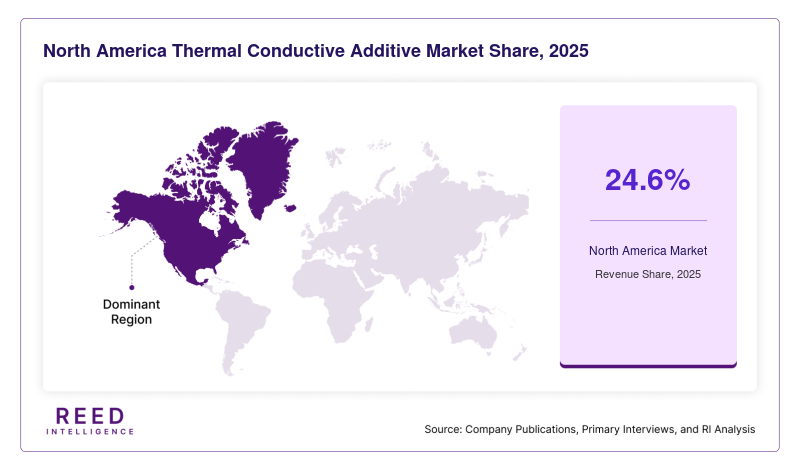
North America accounted for 24.6% of the Thermal Conductive Additive Market share in 2025 and is expected to grow at a CAGR of 9.6% during the forecast period. The region has witnessed steady demand driven by advancements in electronics and automotive industries.
The United States dominated the regional market due to strong investment in research and development. The presence of advanced manufacturing facilities and a focus on innovation in thermal management solutions contributed to market growth.
Europe
Europe held a 21.8% share of the Thermal Conductive Additive Market in 2025 and is projected to grow at a CAGR of 9.8%. The region has shown consistent growth due to strict environmental regulations and increasing adoption of energy-efficient technologies.
Germany emerged as the dominant country, driven by its strong automotive industry. The shift toward electric mobility has significantly increased demand for thermal conductive materials in battery systems and electronic components.
Asia Pacific
Asia Pacific dominated the Thermal Conductive Additive Market with a 41.3% share in 2025 and is expected to grow at the fastest CAGR of 11.4%. Rapid industrialization and expansion of electronics manufacturing hubs have fueled market growth.
China led the region due to its large-scale production capabilities and growing demand from consumer electronics and EV sectors. Government initiatives supporting industrial growth have further strengthened the market.
Middle East & Africa
The Middle East & Africa accounted for 6.5% of the market share in 2025 and is anticipated to grow at a CAGR of 8.7%. The region has experienced gradual growth driven by infrastructure development and increasing industrial activities.
The United Arab Emirates dominated the market due to investments in construction and energy sectors. The demand for thermal conductive materials in coatings and insulation applications has supported growth.
Latin America
Latin America held a 5.8% share of the Thermal Conductive Additive Market in 2025 and is expected to grow at a CAGR of 8.9%. The region has shown moderate growth due to expanding manufacturing and automotive sectors.
Brazil emerged as the leading country, supported by increasing industrialization and demand for advanced materials. The growth of local manufacturing industries has contributed to the adoption of thermal conductive additives.
Competitive Landscape
The Thermal Conductive Additive Market is moderately fragmented, with key players focusing on product innovation and strategic partnerships. Leading companies are investing in research to develop high-performance and cost-effective solutions.
3M Company is identified as the market leader, driven by its extensive product portfolio and global presence. The company recently introduced advanced thermal conductive materials designed for next-generation electronics, strengthening its position in the market.
Other prominent players are focusing on expanding their production capacities and entering emerging markets to enhance their competitive edge. Continuous innovation and technological advancements remain key strategies for maintaining market share.
Key Players List
- 3M Company
- BASF SE
- Dow Inc.
- Cabot Corporation
- Momentive Performance Materials Inc.
- Huntsman Corporation
- Henkel AG & Co. KGaA
- Evonik Industries AG
- Wacker Chemie AG
- Arkema S.A.
- SABIC
- Parker Hannifin Corporation
- PolyOne Corporation
- Shin-Etsu Chemical Co., Ltd.
- Sumitomo Chemical Co., Ltd.
Recent Developments
- In 2024, 3M Company launched a new range of thermal conductive additives targeting high-performance electronics.
- BASF SE expanded its production capacity for advanced thermal materials in Asia.
- Dow Inc. introduced innovative polymer-based additives for EV applications.
- Cabot Corporation focused on developing carbon-based solutions for improved thermal efficiency.
- Evonik Industries AG invested in R&D to enhance sustainable additive solutions.
Thermal Conductive Additive Market Segments
Type
- Ceramic-Based Additives
- Carbon-Based Additives
- Metal-Based Additives
Material
- Aluminum Oxide
- Boron Nitride
- Graphite
- Others
Application
- Electronics
- Automotive
- Industrial Equipment
- Energy Systems
End-Use Industry
- Electrical & Electronics
- Automotive
- Aerospace
- Construction
- Others
By Region
- North America
- Europe
- APAC
- Middle East and Africa
- LATAM