Thermal Flow Meter Market Size, Share & Demand Report By Type (Inline Thermal Flow Meters, Insertion Thermal Flow Meters), By Technology (Constant Temperature Thermal Flow Meters, Constant Power Thermal Flow Meters), By Application (Gas Flow Measurement, Compressed Air Monitoring), By End-Use Industry (Oil & Gas, Chemical & Petrochemical, Power Generation, Water & Wastewater), By Distribution Channel (Direct Sales, Distributors & Wholesalers), By Region & Segment Forecasts, 2026–2034
USD 3950
Market Overview
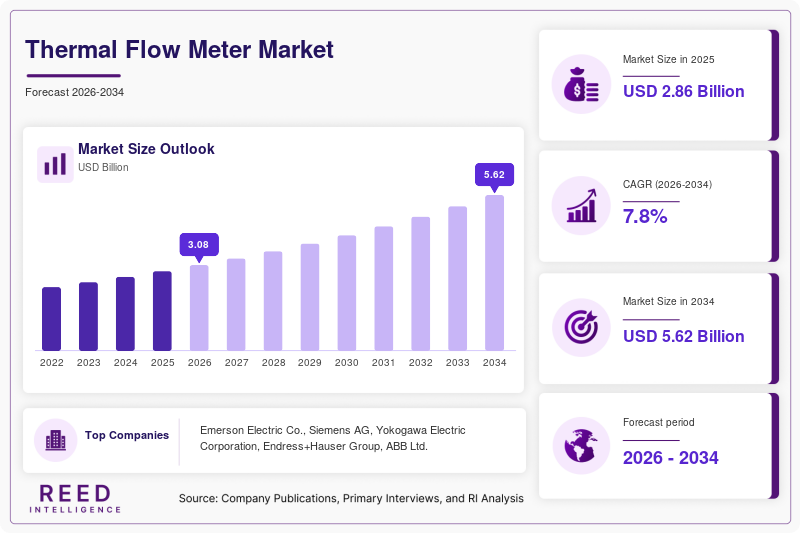
The global Thermal Flow Meter Market size was valued at USD 2.86 billion in 2026 and is projected to reach USD 5.21 billion by 2034, expanding at a CAGR of 7.8% during the forecast period (2026–2034). The market growth was supported by increasing industrial automation and rising demand for accurate flow measurement systems across oil & gas, chemicals, water treatment, power generation, and food processing industries. Growing investments in smart manufacturing infrastructure and energy efficiency programs accelerated the adoption of advanced thermal flow metering technologies worldwide.
The expansion of industrial process monitoring systems significantly contributed to the growth of the Thermal Flow Meter Market. Thermal flow meters gained wider adoption due to their high measurement accuracy, low maintenance requirements, and ability to measure gas flow without moving parts. Increasing demand for digital monitoring systems and process optimization solutions further strengthened long-term market expansion.
Key Highlights
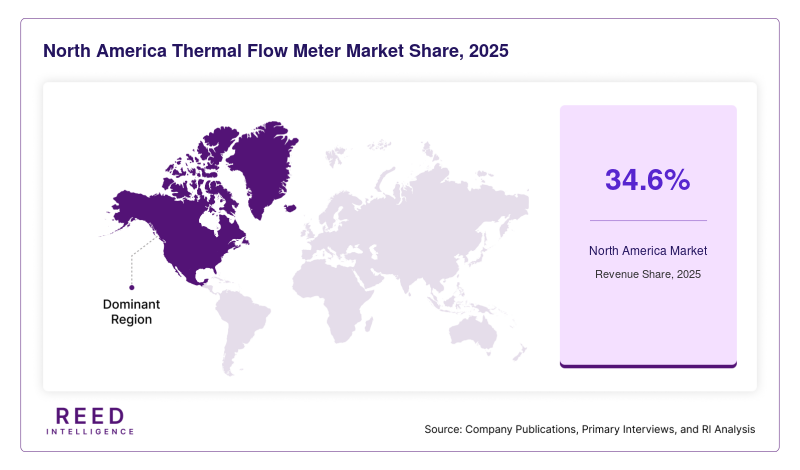
- North America accounted for 34.6% of the global Thermal Flow Meter Market share in 2025, while Asia Pacific is projected to register the fastest CAGR of 8.7% during the forecast period.
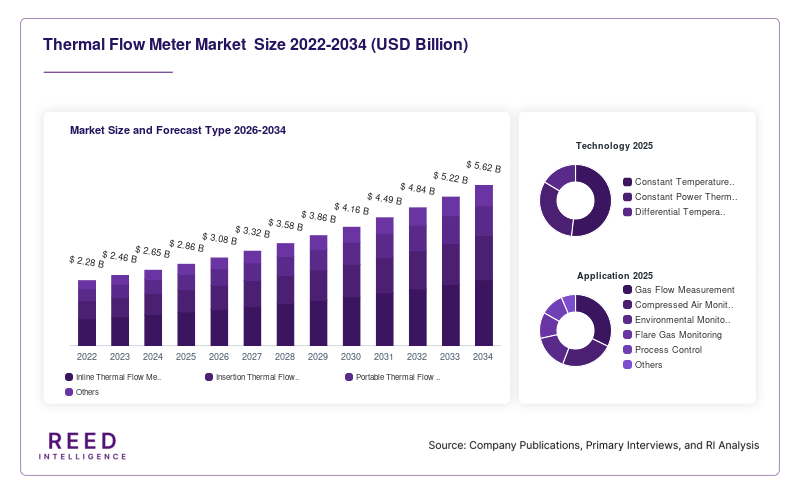
- By type, inline thermal flow meters held the leading share of 44.2% in 2025, whereas insertion thermal flow meters are expected to witness the fastest CAGR of 9.1% through 2034.
- By technology, constant temperature thermal flow meters dominated with a 57.3% share in 2025, while constant power thermal flow meters are forecast to grow at a CAGR of 8.5%.
- By application, gas flow measurement represented the largest share of 48.7% in 2025, whereas compressed air monitoring is anticipated to record the fastest CAGR of 9.0%.
- By end-use industry, oil & gas accounted for 29.4% of the market share in 2025, while semiconductor manufacturing is projected to expand at a CAGR of 9.3%.
- The United States dominated the Thermal Flow Meter Market with a market value of USD 518 million in 2024 and USD 552 million in 2025.
Market Trends
Increasing Integration of Industrial IoT Technologies
The integration of Industrial Internet of Things technologies emerged as a major trend influencing the Thermal Flow Meter Market. Industrial facilities increasingly adopted connected flow monitoring systems to improve operational visibility and predictive maintenance capabilities.
Thermal flow meter manufacturers focused on integrating wireless communication protocols, cloud connectivity, and real-time analytics into their products. These smart flow measurement systems enabled remote monitoring, automated diagnostics, and process optimization across industrial operations. The trend gained momentum in oil & gas, chemicals, and water treatment industries where real-time monitoring became essential for efficiency improvement.
Growing Adoption of Energy-Efficient Monitoring Systems
The rising focus on energy conservation and emission reduction significantly influenced market trends. Industries increasingly implemented advanced flow monitoring systems to optimize compressed air consumption, gas distribution, and industrial energy usage.
Thermal flow meters gained wider adoption because they provided precise low-flow measurement and improved energy management capabilities. Manufacturers also developed compact and energy-efficient flow meter solutions suitable for HVAC systems, cleanrooms, and industrial process applications.
Market Drivers
Expansion of Industrial Automation Across Manufacturing Sectors
The rapid expansion of industrial automation significantly supported the growth of the Thermal Flow Meter Market. Manufacturing facilities increasingly implemented automated process control systems to improve productivity, reduce downtime, and optimize resource utilization.
Thermal flow meters became essential components in automated production environments because they enabled accurate gas and air flow monitoring. Industries including chemicals, pharmaceuticals, food processing, and power generation increasingly adopted advanced thermal flow metering solutions for process optimization and operational efficiency.
Rising Demand for Accurate Gas Flow Measurement
The growing demand for precise gas flow monitoring accelerated market growth globally. Industrial operators increasingly required accurate flow measurement systems for natural gas distribution, compressed air systems, flare gas monitoring, and environmental compliance applications.
Thermal flow meters gained broader acceptance due to their ability to deliver direct mass flow measurement without requiring pressure or temperature compensation. Their suitability for low-flow gas applications further strengthened market adoption.
Market Restraint
High Initial Installation and Calibration Costs
High installation and calibration expenses restrained the growth of the Thermal Flow Meter Market to a certain extent. Advanced thermal flow measurement systems require specialized calibration and integration processes, increasing overall implementation costs for industrial users. Small and medium-scale enterprises often face budget limitations that restrict adoption of high-performance thermal flow metering technologies.
Market Opportunities
Growth of Hydrogen and Renewable Energy Projects
The increasing development of hydrogen production and renewable energy infrastructure presents significant growth opportunities for the Thermal Flow Meter Market. Hydrogen processing facilities require precise gas flow monitoring systems to ensure operational safety and process efficiency.
Thermal flow meters are expected to witness rising demand in hydrogen production, fuel cell systems, and renewable gas distribution applications due to their accuracy and reliability in gas measurement.
Expansion of Semiconductor Manufacturing Facilities
The growing semiconductor manufacturing industry is expected to create favorable opportunities for the market. Semiconductor fabrication facilities require advanced gas monitoring systems capable of handling ultra-clean process environments and low-flow applications.
Thermal flow meter manufacturers are anticipated to benefit from rising investments in semiconductor production capacity and electronics manufacturing infrastructure.
Segmental Analysis
By Type
Based on type, the Thermal Flow Meter Market is segmented into inline thermal flow meters, insertion thermal flow meters, portable thermal flow meters, and others.
Inline thermal flow meters accounted for the largest market share of 44.2% in 2025. Their dominance was attributed to superior accuracy, stable performance, and suitability for continuous industrial process monitoring. Inline thermal flow meters were widely utilized across oil & gas, chemical processing, pharmaceutical manufacturing, and power generation industries due to their ability to provide precise gas flow measurement.
Manufacturers increasingly preferred inline systems because they minimized measurement fluctuations and improved process efficiency. Their compatibility with automated industrial systems further contributed to segment dominance.
Insertion thermal flow meters are projected to register the fastest CAGR of 9.1% during the forecast period. Their growth will be supported by increasing demand for cost-effective and flexible flow monitoring solutions across large pipe systems. Insertion thermal flow meters will gain wider adoption due to simplified installation and reduced maintenance requirements.
Portable thermal flow meters are also expected to witness stable growth because industries increasingly require temporary flow analysis and diagnostic monitoring capabilities during maintenance operations.
By Technology
Based on technology, the Thermal Flow Meter Market is categorized into constant temperature thermal flow meters, constant power thermal flow meters, and differential temperature thermal flow meters.
Constant temperature thermal flow meters dominated the market with a 57.3% share in 2025. Their widespread adoption was supported by high measurement sensitivity, improved accuracy, and stable performance under varying industrial conditions. These flow meters maintained constant sensor temperature while measuring heat dissipation caused by fluid flow, enabling precise flow analysis.
Industries increasingly utilized constant temperature technology in gas measurement applications due to faster response time and enhanced operational efficiency. The segment also maintained strong demand in environmental monitoring and semiconductor processing applications.
Constant power thermal flow meters are projected to grow at a CAGR of 8.5% during the forecast period. The growth will be driven by increasing adoption in industrial systems requiring simplified operation and low-energy consumption. These systems are expected to gain traction in HVAC, compressed air, and cleanroom monitoring applications.
Differential temperature thermal flow meters are also anticipated to witness moderate growth because of increasing demand in specialized industrial applications requiring high process stability.
By Application
Based on application, the Thermal Flow Meter Market is divided into gas flow measurement, compressed air monitoring, environmental monitoring, flare gas monitoring, process control, and others.
Gas flow measurement accounted for the leading market share of 48.7% in 2025. The segment dominance was attributed to increasing industrial demand for precise gas consumption analysis and process optimization. Thermal flow meters enabled direct mass flow measurement without requiring external compensation systems, making them suitable for industrial gas applications.
Manufacturers increasingly adopted thermal flow meters for natural gas distribution, industrial gas processing, and chemical manufacturing operations. Rising investments in energy monitoring infrastructure further supported segment growth.
Compressed air monitoring is projected to register the fastest CAGR of 9.0% during the forecast period. The growth will be driven by increasing industrial focus on energy efficiency and compressed air system optimization. Industries are expected to implement advanced monitoring systems to reduce air leakage losses and improve energy consumption management.
Environmental monitoring applications are also anticipated to maintain steady growth due to increasing regulatory requirements for emission monitoring and industrial air quality management.
By End-Use Industry
Based on end-use industry, the Thermal Flow Meter Market is segmented into oil & gas, chemical & petrochemical, power generation, water & wastewater, food & beverage, semiconductor manufacturing, and others.
Oil & gas held the largest market share of 29.4% in 2025. The segment growth was supported by increasing investments in refinery modernization, natural gas infrastructure, and petrochemical processing facilities. Thermal flow meters were widely utilized for flare gas measurement, fuel gas monitoring, and process optimization applications.
Industrial operators increasingly adopted advanced thermal flow metering systems to improve operational efficiency and regulatory compliance. Expanding LNG processing and pipeline infrastructure projects further strengthened segment demand.
Semiconductor manufacturing is projected to register the fastest CAGR of 9.3% during the forecast period. The growth will be supported by increasing investments in semiconductor fabrication facilities and electronics manufacturing infrastructure. Semiconductor manufacturers are expected to adopt advanced thermal flow meters capable of measuring ultra-low gas flow rates in cleanroom environments.
Chemical & petrochemical industries are also expected to witness stable growth due to increasing process automation and industrial safety requirements.
By Distribution Channel
Based on distribution channel, the Thermal Flow Meter Market is segmented into direct sales, distributors & wholesalers, online industrial suppliers, and system integrators.
Direct sales accounted for the dominant market share in 2025 due to strong procurement relationships between flow meter manufacturers and industrial customers. Large industrial facilities preferred direct purchasing agreements for customized flow monitoring solutions and technical support services.
System integrators are projected to witness the fastest CAGR during the forecast period because industries increasingly require integrated automation and monitoring systems.
Regional Analysis
North America
North America held 34.6% of the global Thermal Flow Meter Market share in 2025 and is projected to expand at a CAGR of 7.1% during the forecast period. The region maintained a dominant position due to advanced industrial automation infrastructure and increasing adoption of smart process monitoring systems.
The United States dominated the regional market owing to strong investments in oil & gas infrastructure and industrial digitalization projects. Growing demand for energy-efficient manufacturing systems further supported market growth across the country.
Europe
Europe accounted for 26.1% of the Thermal Flow Meter Market share in 2025 and is anticipated to grow at a CAGR of 7.3% through 2034. The region experienced stable demand due to increasing environmental compliance requirements and industrial energy efficiency initiatives.
Germany led the regional market owing to expanding industrial automation and strong manufacturing capabilities. Rising investments in hydrogen energy projects and sustainable industrial technologies contributed to regional market expansion.
Asia Pacific
Asia Pacific represented 27.8% of the global Thermal Flow Meter Market share in 2025 and is expected to register the fastest CAGR of 8.7% during the forecast period. The region witnessed strong growth due to expanding manufacturing industries and rising investments in industrial infrastructure.
China dominated the Asia Pacific market due to rapid industrialization and increasing adoption of smart factory technologies. Expanding semiconductor manufacturing and energy infrastructure projects further strengthened regional demand.
Middle East & Africa
The Middle East & Africa accounted for 6.3% of the Thermal Flow Meter Market share in 2025 and is forecast to grow at a CAGR of 7.8% during the forecast period. Increasing investments in oil & gas processing facilities and industrial automation supported regional market growth.
Saudi Arabia emerged as the dominant country due to expanding refinery modernization projects and industrial diversification programs. Rising adoption of advanced monitoring technologies across petrochemical industries accelerated market demand.
Latin America
Latin America held 5.2% of the global Thermal Flow Meter Market share in 2025 and is projected to expand at a CAGR of 7.0% during the forecast period. The regional market benefited from increasing industrial process automation and expanding energy sector investments.
Brazil dominated the Latin American market due to growing oil & gas exploration activities and rising industrial modernization projects. Expanding water treatment infrastructure also contributed to regional market development.
Competitive Landscape
The Thermal Flow Meter Market remains moderately competitive with the presence of global instrumentation manufacturers and industrial automation solution providers focusing on digital innovation, product accuracy, and smart monitoring capabilities. Companies continue investing in advanced sensor technologies and wireless connectivity features to improve industrial process efficiency.
Emerson Electric Co. maintained a strong market position due to its diversified industrial automation portfolio and advanced flow measurement technologies. The company recently introduced upgraded thermal flow meter solutions with enhanced digital diagnostics and Industrial IoT integration capabilities for industrial gas monitoring applications.
Other major companies including Siemens AG, Yokogawa Electric Corporation, Endress+Hauser Group, and ABB Ltd. focused on expanding smart instrumentation solutions and strengthening industrial automation partnerships. Strategic investments in hydrogen monitoring systems and semiconductor manufacturing applications also remained key competitive strategies across the market.
Key Players List
- Emerson Electric Co.
- Siemens AG
- Yokogawa Electric Corporation
- Endress+Hauser Group
- ABB Ltd.
- Honeywell International Inc.
- Bronkhorst High-Tech B.V.
- Fuji Electric Co., Ltd.
- Azbil Corporation
- KROHNE Group
- Sage Metering, Inc.
- FCI Fluid Components International LLC
- OMEGA Engineering Inc.
- Badger Meter, Inc.
- Sierra Instruments, Inc.
Recent Developments
- In 2025, Emerson Electric Co. introduced Industrial IoT-enabled thermal flow meters with enhanced digital diagnostics for industrial gas monitoring.
- Siemens AG expanded smart instrumentation solutions focused on hydrogen energy and renewable gas applications.
- Yokogawa Electric Corporation launched advanced thermal flow monitoring systems designed for semiconductor manufacturing facilities.
- Endress+Hauser Group invested in wireless industrial flow measurement technologies to improve remote process monitoring capabilities.
- ABB Ltd. enhanced flow meter calibration technologies for high-precision industrial automation applications.
- Honeywell International Inc. strengthened industrial automation partnerships across oil & gas and chemical processing industries.
- KROHNE Group expanded thermal flow meter production capacity to support increasing global industrial automation demand.
Thermal Flow Meter Market Segments
Type
- Inline Thermal Flow Meters
- Insertion Thermal Flow Meters
- Portable Thermal Flow Meters
- Others
Technology
- Constant Temperature Thermal Flow Meters
- Constant Power Thermal Flow Meters
- Differential Temperature Thermal Flow Meters
Application
- Gas Flow Measurement
- Compressed Air Monitoring
- Environmental Monitoring
- Flare Gas Monitoring
- Process Control
- Others
End-Use Industry
- Oil & Gas
- Chemical & Petrochemical
- Power Generation
- Water & Wastewater
- Food & Beverage
- Semiconductor Manufacturing
- Others
Distribution Channel
- Direct Sales
- Distributors & Wholesalers
- Online Industrial Suppliers
- System Integrators
By Region
- North America
- Europe
- APAC
- Middle East and Africa
- LATAM