Thermal Insulation Paint Market Size, Share & Demand Report By Product Type (Acrylic-Based Thermal Insulation Paint, Epoxy-Based Thermal Insulation Paint, Polyurethane Thermal Insulation Paint, Nano-Ceramic Thermal Insulation Paint, Others), By Application (Building & Construction, Industrial Equipment, Automotive, Marine, Aerospace, Others), By End-Use Industry (Residential, Commercial, Industrial, Automotive & Transportation, Energy & Power, Others), By Region & Segment Forecasts, 2026–2034
USD 3950
Market Overview
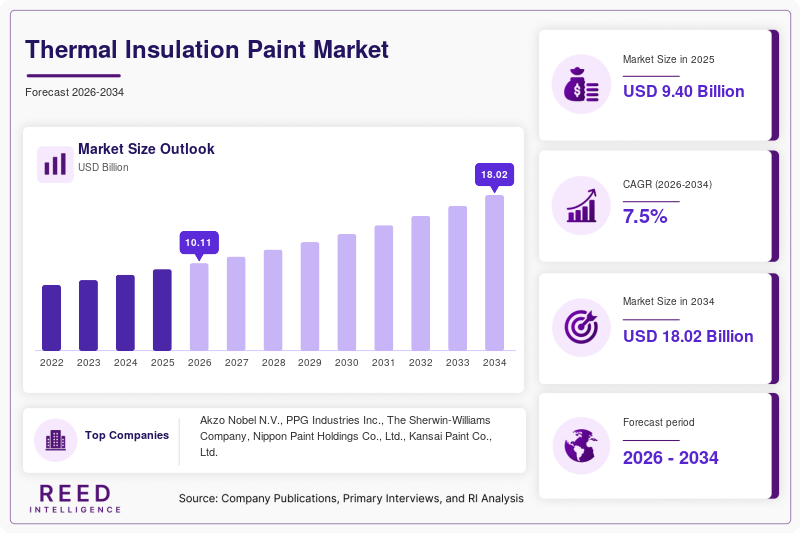
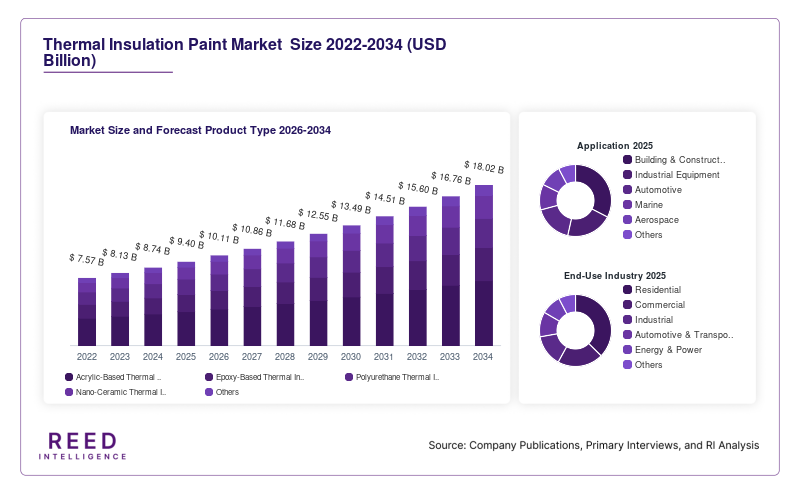
The global Thermal Insulation Paint Market size was valued at approximately USD 9.4 billion in 2026 and is projected to reach nearly USD 16.8 billion by 2034, expanding at a CAGR of 7.5% during the forecast period from 2026 to 2034. The market continues to gain momentum due to increasing construction activities, industrial energy-efficiency regulations, and rising awareness regarding sustainable coating technologies. Thermal insulation paints are widely used across residential, commercial, industrial, automotive, and marine applications because they help reduce heat transfer, improve indoor temperature control, and lower overall energy consumption.
Growing emphasis on energy conservation across developed and emerging economies has become a major factor supporting market expansion. Governments and private organizations are investing in green infrastructure projects that require efficient insulation materials capable of reducing carbon emissions and operational energy costs. Thermal insulation paints offer an economical alternative to traditional insulation systems because they are lightweight, easy to apply, corrosion-resistant, and suitable for complex surfaces. The increasing adoption of reflective and ceramic-based insulation coatings in warehouses, manufacturing plants, transportation systems, and commercial buildings is further contributing to market growth.
Key Highlights
- North America dominated the market with a 34.6% share in 2025.
- Asia Pacific is expected to grow at the fastest CAGR of 9.3% during 2026–2034.
- By product type, acrylic-based thermal insulation paints accounted for the largest share of 39.8%, while nano-ceramic coatings are projected to grow at a CAGR of 10.8%.
- By application, building and construction led with a 44.1% share, whereas industrial equipment applications are expected to expand at a CAGR of 9.9%.
- The United States remained the dominant country, with market values of USD 1.82 billion in 2024 and USD 1.96 billion in 2025.
Market Trends
Increasing Adoption of Nano-Ceramic Thermal Coatings
The Thermal Insulation Paint Market is witnessing significant adoption of nano-ceramic coating technologies across commercial and industrial applications. Nano-ceramic additives improve reflective properties and thermal resistance, allowing surfaces to maintain stable temperatures under harsh environmental conditions. These coatings are increasingly used in manufacturing plants, petrochemical facilities, metal roofs, warehouses, and logistics centers where temperature control is important for operational efficiency. The technology also offers advantages such as corrosion resistance, moisture protection, and long service life. Manufacturers are investing in advanced research to improve coating durability while reducing thickness requirements, making nano-ceramic paints more practical for large-scale infrastructure and industrial maintenance projects.
Rising Demand for Sustainable and Low-VOC Paint Solutions
Environmental regulations and green building initiatives are accelerating the transition toward water-based and low-VOC thermal insulation paints. Construction companies and property developers are prioritizing sustainable coating materials to meet green certification requirements and energy-efficiency standards. Consumers are increasingly selecting insulation coatings that reduce air-conditioning dependency and support lower carbon emissions. Water-based insulation paints are gaining popularity because they release fewer pollutants during application and offer safer indoor air quality. The trend is particularly visible in urban residential projects and commercial complexes where sustainability targets influence material selection. Continuous product innovation by coating manufacturers is further strengthening demand for environmentally responsible insulation paint technologies.
Market Drivers
Expansion of Energy-Efficient Construction Activities
Rapid growth in energy-efficient construction projects is a major factor driving the Thermal Insulation Paint Market. Governments across several countries are implementing building efficiency standards aimed at reducing electricity consumption and greenhouse gas emissions. Thermal insulation paints help maintain indoor temperatures by reflecting solar radiation and minimizing heat transfer through walls and roofs. This capability reduces dependence on heating and cooling systems, resulting in lower operational costs for residential and commercial buildings. Increasing urbanization and infrastructure modernization are also supporting demand for advanced insulation coatings. Builders and contractors are adopting thermal insulation paints because they are easier to apply than traditional insulation materials and require less structural modification during installation.
Growing Industrial Requirement for Heat Management Solutions
Industrial facilities are increasingly adopting thermal insulation paints to improve heat management and equipment efficiency. Industries such as oil and gas, power generation, chemicals, marine transportation, and manufacturing require protective coatings capable of withstanding extreme temperatures while reducing energy losses. Thermal insulation paints are used on pipelines, storage tanks, boilers, and industrial machinery to maintain temperature stability and reduce maintenance expenses. The coatings also assist in worker safety by lowering surface temperatures on industrial equipment. Rising energy prices are encouraging industries to invest in insulation technologies that improve operational efficiency and lower fuel consumption. Expanding industrial infrastructure in developing economies continues to create favorable growth opportunities for insulation paint manufacturers.
Market Restraint
Performance Limitations Compared to Conventional Insulation Systems
Despite growing adoption, the Thermal Insulation Paint Market faces limitations related to performance efficiency when compared with traditional insulation systems such as fiberglass, foam boards, and mineral wool. Thermal insulation paints can reduce heat transfer and improve energy efficiency, but they may not provide the same insulation thickness or thermal resistance required for certain large-scale industrial and cold-storage applications. Some end users remain cautious regarding long-term energy savings and durability under extreme environmental conditions. In regions with severe climatic variations, conventional insulation materials are often preferred for high-performance requirements. Additionally, fluctuating raw material costs and higher prices associated with advanced ceramic coatings can limit adoption among small construction companies and budget-sensitive consumers. These challenges may slow penetration in price-competitive markets where traditional insulation methods remain widely established and trusted by contractors and facility operators.
Market Opportunities
Growing Demand Across Emerging Economies
Emerging economies present substantial opportunities for the Thermal Insulation Paint Market due to rapid urbanization and expanding infrastructure investments. Countries across Asia Pacific, Latin America, and the Middle East are experiencing increasing demand for residential housing, industrial facilities, airports, commercial buildings, and transportation infrastructure. Rising temperatures and growing electricity consumption are encouraging governments and developers to adopt energy-saving construction materials. Thermal insulation paints are becoming attractive because they can be applied quickly on existing structures without major renovation costs. Increasing awareness regarding sustainable construction practices and energy conservation is expected to support market penetration across developing nations where energy efficiency policies are gradually becoming stricter.
Expansion of Automotive and Transportation Applications
The use of thermal insulation paints in automotive and transportation sectors is creating new growth opportunities for market participants. Vehicle manufacturers are increasingly using insulation coatings to reduce cabin heat, improve passenger comfort, and enhance fuel efficiency by lowering air-conditioning requirements. Thermal coatings are also being adopted in electric vehicles to support battery temperature management and energy optimization. In marine and railway applications, insulation paints help protect metal surfaces from heat exposure and corrosion while improving operational efficiency. Growing investment in electric mobility, public transportation modernization, and advanced logistics infrastructure is expected to increase demand for lightweight insulation technologies that offer both protective and energy-saving benefits.
Segmental Analysis
By Product Type
Acrylic-based thermal insulation paints represented the dominant subsegment in 2024, accounting for approximately 39.8% of the global market share. These coatings are widely preferred because they offer strong adhesion, weather resistance, flexibility, and cost-effectiveness across multiple applications. Acrylic formulations are extensively used in residential and commercial construction projects due to their compatibility with concrete, metal, and masonry surfaces. The segment also benefits from growing demand for water-based insulation paints that comply with environmental regulations regarding VOC emissions. Acrylic coatings provide effective solar reflectivity and durability, making them suitable for roof insulation, exterior walls, and industrial structures exposed to varying climatic conditions. Their easy application process and lower maintenance requirements continue to support widespread adoption among contractors and property developers.
Nano-ceramic thermal insulation paints are projected to register the fastest CAGR of 10.8% during the forecast period. Increasing focus on advanced insulation performance and long-term energy savings is supporting rapid adoption of ceramic-based coating technologies. Nano-ceramic coatings contain microscopic particles capable of reflecting radiant heat while providing enhanced thermal stability and corrosion resistance. These paints are increasingly used in industrial machinery, marine vessels, storage tanks, and transportation systems where temperature control is essential. Growing investment in research and development has improved coating efficiency and durability, encouraging broader commercial adoption. Demand is also rising in high-temperature industrial environments where conventional paints may fail to deliver adequate insulation performance. Expanding infrastructure modernization projects and rising industrial energy costs are expected to sustain strong growth for this segment.
By Application
The building and construction segment accounted for the largest share of the Thermal Insulation Paint Market in 2024, contributing nearly 44.1% of global revenue. Increasing adoption of energy-efficient building materials in residential, commercial, and institutional construction projects continues to drive segment growth. Thermal insulation paints are widely applied on roofs, ceilings, exterior walls, and facades to minimize heat transfer and improve indoor comfort. Urbanization and growing demand for sustainable infrastructure are encouraging developers to integrate advanced insulation coatings into modern building designs. The segment is also supported by government incentives promoting green construction practices and reduced energy consumption. Rising renovation activities across aging commercial structures and residential housing further contribute to growing demand for thermal insulation paint applications worldwide.
Industrial equipment applications are anticipated to expand at the fastest CAGR of 9.9% during the forecast period. Industrial operators are increasingly using thermal insulation paints on boilers, pipelines, reactors, storage tanks, and processing equipment to improve heat management and operational efficiency. These coatings help reduce thermal losses, protect equipment from corrosion, and enhance workplace safety by lowering external surface temperatures. Industries such as oil and gas, power generation, chemicals, and manufacturing are investing in insulation technologies to control rising energy costs and improve sustainability performance. Rapid industrialization in emerging economies is creating additional demand for high-performance thermal coatings. Technological advancements in ceramic and heat-reflective formulations are also expanding the application scope of insulation paints across harsh industrial environments requiring reliable temperature control solutions.
By End-Use Industry
The residential sector emerged as the dominant end-use industry in 2024, holding approximately 36.7% share of the Thermal Insulation Paint Market. Rising awareness regarding energy-efficient homes and increasing electricity costs are encouraging homeowners to adopt insulation coatings for roofs and exterior walls. Thermal insulation paints help maintain comfortable indoor temperatures by reducing heat absorption during summer and minimizing heat loss during winter. Growing urban housing developments and rising consumer preference for sustainable building materials continue to support segment growth. Government initiatives promoting environmentally friendly housing construction and energy conservation have further accelerated product adoption. Residential consumers are increasingly selecting water-based insulation paints due to their low odor, environmentally compliant formulations, and ease of application across new construction and renovation projects.
The automotive and transportation segment is projected to witness the fastest CAGR of 9.5% between 2026 and 2034. Vehicle manufacturers are increasingly integrating thermal insulation coatings into automotive components, cargo containers, rail systems, and marine vessels to improve thermal management and passenger comfort. In electric vehicles, insulation paints help regulate battery temperatures and support energy efficiency. Transportation operators are adopting advanced coatings to reduce heat buildup and improve durability of metallic surfaces exposed to extreme environmental conditions. Growing investment in electric mobility infrastructure and expansion of logistics networks are creating favorable opportunities for insulation paint suppliers. Increasing focus on lightweight materials and fuel efficiency is also encouraging adoption of thermal coating technologies across modern transportation systems.
Regional Analysis
North America
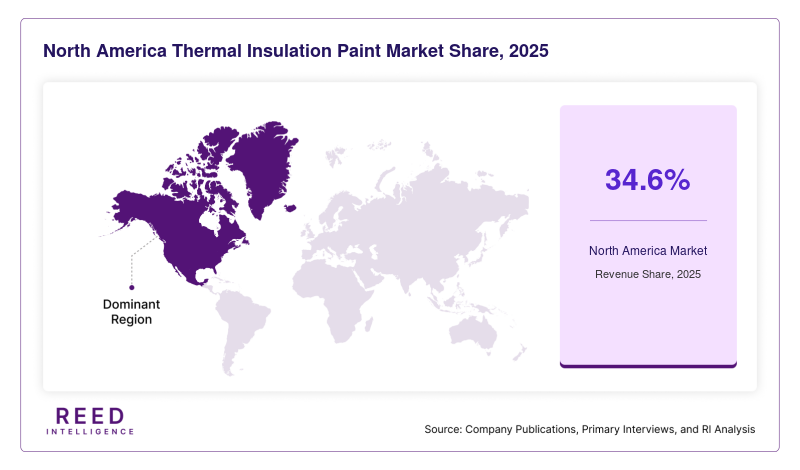
North America accounted for approximately 34.6% of the global Thermal Insulation Paint Market in 2025 and maintained its leading position due to high adoption of energy-efficient construction technologies. The region is expected to expand at a CAGR of 6.8% during the forecast period. Strong demand from commercial buildings, industrial manufacturing facilities, and residential renovation projects continues to support market expansion. Government regulations promoting sustainable infrastructure and reduced energy consumption have encouraged widespread use of insulation coatings across roofing, wall systems, and industrial equipment applications throughout the region.
The United States remained the dominant contributor within North America due to rising investments in green building initiatives and industrial modernization projects. Increasing energy costs have encouraged property owners and industrial operators to adopt insulation paints that improve thermal performance and reduce electricity expenses. The country also benefits from advanced coating technology development and strong presence of leading paint manufacturers. Growing renovation activities in aging commercial buildings are further supporting adoption of reflective and ceramic-based thermal insulation coatings across urban infrastructure projects.
Europe
Europe represented nearly 27.1% of the Thermal Insulation Paint Market in 2025 and is projected to register a CAGR of 6.9% through 2034. Strict environmental regulations regarding carbon emissions and energy efficiency are supporting market growth across the region. European countries continue to promote sustainable construction practices through incentives and building standards that encourage the use of insulation materials with low environmental impact. Thermal insulation paints are increasingly used in residential retrofitting projects, commercial properties, and industrial facilities seeking to reduce heating and cooling energy consumption.
Germany remained the leading country within the European market due to strong industrial infrastructure and high focus on energy-efficient building technologies. The country’s manufacturing sector has shown increasing demand for heat-resistant and corrosion-protective coatings used in machinery and industrial equipment. Rising adoption of eco-friendly construction materials and growing investment in renovation of old residential structures are also contributing to market growth. The presence of established coating technology companies further supports product innovation and widespread adoption across multiple end-use industries.
Asia Pacific
Asia Pacific held around 23.8% share of the global Thermal Insulation Paint Market in 2025 and is anticipated to record the fastest CAGR of 9.3% during the forecast period. Rapid urbanization, rising industrialization, and increasing infrastructure development are major factors supporting regional growth. Countries across the region are investing heavily in commercial complexes, manufacturing facilities, transportation systems, and smart city projects that require energy-efficient construction materials. Growing awareness regarding energy conservation and climate-responsive infrastructure is further encouraging adoption of thermal insulation paints in both residential and industrial sectors.
China dominated the Asia Pacific market owing to extensive construction activities and strong industrial manufacturing capacity. Rising government emphasis on sustainable infrastructure development and energy-saving technologies has increased demand for thermal insulation coatings in urban housing and industrial facilities. Expanding automotive production and growth in logistics infrastructure are also contributing to market expansion. Increasing temperature levels in densely populated urban regions have encouraged adoption of reflective roof coatings and advanced insulation paints aimed at reducing cooling costs and improving indoor comfort.
Middle East & Africa
The Middle East & Africa accounted for approximately 8.1% of the global Thermal Insulation Paint Market in 2025 and is expected to grow at a CAGR of 7.8% through 2034. Rising temperatures and increasing demand for cooling efficiency are major factors driving regional market growth. Thermal insulation paints are widely adopted across commercial buildings, warehouses, industrial plants, and oil and gas infrastructure to minimize heat absorption and reduce energy expenses. Governments across Gulf countries are investing in sustainable urban infrastructure and energy-efficient construction solutions to support long-term environmental objectives.
Saudi Arabia emerged as the dominant country within the region due to ongoing infrastructure expansion and large-scale commercial construction projects. Increasing investment in smart cities, hospitality infrastructure, and industrial diversification initiatives has accelerated demand for energy-saving coating technologies. Thermal insulation paints are increasingly used in roofing systems and industrial facilities exposed to extreme heat conditions. Growth in petrochemical and energy sectors has also created demand for high-performance coatings capable of improving thermal management and corrosion resistance in industrial operations.
Latin America
Latin America captured nearly 6.4% share of the Thermal Insulation Paint Market in 2025 and is forecast to grow at a CAGR of 7.1% during the study period. The market is benefiting from rising construction investments, growing industrial activity, and increasing awareness regarding energy conservation. Countries in the region are gradually adopting modern insulation technologies to improve building efficiency and reduce electricity costs associated with cooling systems. Demand for thermal insulation paints is increasing across commercial properties, residential housing developments, and transportation infrastructure projects.
Brazil remained the leading market in Latin America due to rapid urban development and expanding industrial manufacturing activities. Growing need for cost-effective cooling solutions in warm climatic conditions has encouraged adoption of reflective insulation coatings across residential and commercial buildings. The country is also witnessing increasing interest in sustainable construction materials as environmental awareness improves among developers and government agencies. Industrial sectors such as food processing, logistics, and automotive manufacturing are further supporting market demand for thermal insulation paint applications.
Competitive Landscape
The Thermal Insulation Paint Market remains moderately fragmented, with international coating manufacturers and regional specialty paint companies competing through product innovation, sustainability initiatives, and strategic expansion activities. Leading players are investing in research and development to improve thermal resistance performance, durability, and environmental compliance of insulation coatings. Companies are increasingly introducing low-VOC and water-based formulations to align with changing regulatory standards and customer preferences for eco-friendly products.
Akzo Nobel N.V. emerged as one of the leading participants in the market due to its broad coating portfolio and strong distribution network across industrial and construction sectors. The company recently expanded its energy-efficient coating product line aimed at commercial roofing applications. Other major participants are focusing on mergers, distribution partnerships, and capacity expansion to strengthen market presence in emerging economies.
Key Players
- Akzo Nobel N.V.
- PPG Industries Inc.
- The Sherwin-Williams Company
- Nippon Paint Holdings Co., Ltd.
- Kansai Paint Co., Ltd.
- Jotun A/S
- BASF SE
- Asian Paints Limited
- RPM International Inc.
- Berger Paints India Limited
- Mascoat Inc.
- Hempel A/S
- The Dow Chemical Company
- Tnemec Company Inc.
- Thermilate Technologies
Recent Developments
- In February 2026, PPG Industries Inc. introduced a new ceramic-based insulation coating designed for industrial storage tanks and energy facilities operating in high-temperature environments.
- In August 2025, Asian Paints Limited expanded its thermal insulation coating portfolio with water-based roof cooling paints targeting residential housing projects across tropical regions.
- In November 2025, Akzo Nobel N.V. announced investment in advanced sustainable coating technologies focused on reducing VOC emissions and improving thermal efficiency performance for commercial buildings.
Thermal Insulation Paint Market Segments
Product Type
- Acrylic-Based Thermal Insulation Paint
- Epoxy-Based Thermal Insulation Paint
- Polyurethane Thermal Insulation Paint
- Nano-Ceramic Thermal Insulation Paint
- Others
Application
- Building & Construction
- Industrial Equipment
- Automotive
- Marine
- Aerospace
- Others
End-Use Industry
- Residential
- Commercial
- Industrial
- Automotive & Transportation
- Energy & Power
- Others
By Region
- North America
- Europe
- APAC
- Middle East and Africa
- LATAM