Global Thermal Management for Advanced Driver-Assistance Systems Market Size, Share & Trends Analysis Report By Component Type (Thermal Interface Materials (TIMs) Pads, gels, greases, and adhesives, Heat Sinks and Spreaders, Liquid Cooling Systems, Thermoelectric Coolers (TECs) ), By Technology Type (Passive CoolingConvection, conduction, heat spreaders, Active Cooling Liquid circulationPeltier-based (TEC)Forced air cooling ), By Country (North America, Europe, APAC, Middle East and Africa,
USD 3950
Thermal Management for Advanced Driver-Assistance Systems Market Size
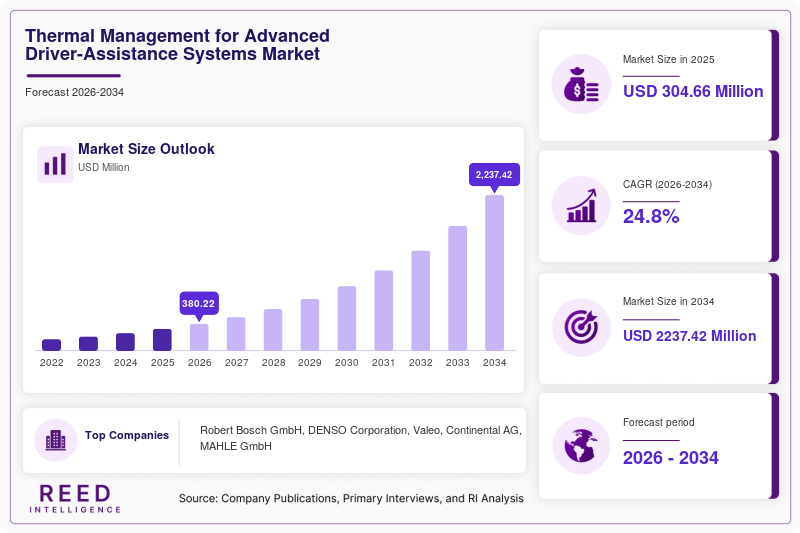
Global Thermal Management for Advanced Driver-Assistance Systems Market size is projected at USD 380.21 million in 2026 and is expected to hit USD 2,176.84 million by 2034 with a CAGR of 24.8%. The industry is expanding from USD 305.82 million in 2025 as higher sensor density, centralized computing, electrification, and increasingly capable ADAS architectures raise requirements for stable operating temperatures. The report evaluates component segmentation, technology adoption, vehicle applications, regional performance, competitive positioning, and the evolving supplier landscape.
Key Takeaways
- North America dominates regional revenue with USD 143.60 million in 2026, equivalent to approximately 37.8% of the regional total, while Latin America records the fastest regional CAGR at 25.90%.
- Thermal Interface Materials dominate component revenue at USD 114.42 million in 2026, representing approximately 30.0% of the component total.
- Thermoelectric Coolers are the fastest-growing component category, recording a 26.68% CAGR through 2034 and reaching USD 362.79 million.
- Europe increases from USD 86.35 million in 2026 to USD 529.38 million by 2034 at a 25.44% CAGR.
- Country-level 2034 values were not supplied in the mandatory dataset; therefore, an emerging-country forecast is not independently quantified to avoid introducing unsupported market figures.
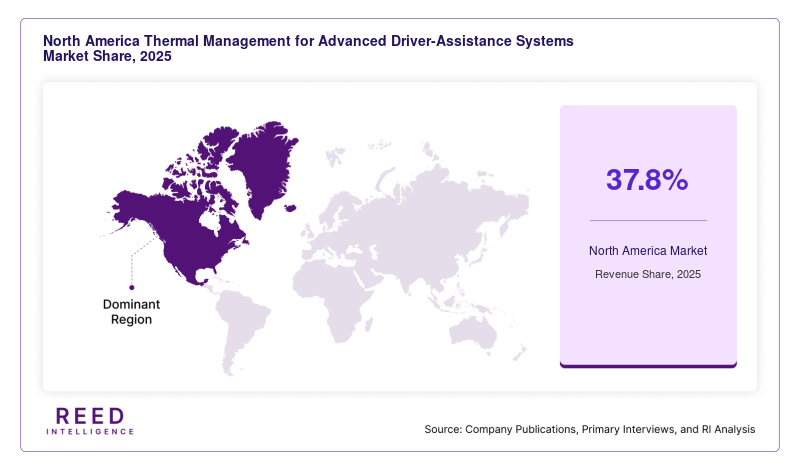
The market covers materials, components, cooling assemblies, and control technologies designed to regulate temperatures in cameras, radar, LiDAR, ultrasonic sensors, ECUs, and driver-monitoring electronics. Global motor-vehicle production reached 96.4 million units in 2025, up 3.9% from 92.7 million in 2024, while sales reached 99.8 million units. Within the supplied market dataset, North America contributed approximately 37.8% of 2026 revenue, Europe 22.7%, and Asia Pacific 19.9%. TIMs accounted for approximately 30.0% of component revenue, followed by heat sinks and spreaders at approximately 22.9%. Level 2 automation has simultaneously moved into the mainstream: around 50% of new cars sold globally in 2025 could automate both steering and speed, compared with less than 1% a decade earlier.
Thermal Management for Advanced Driver-Assistance Systems Market Trends
Higher Sensor Density Is Accelerating the Shift Toward Compact Active and Hybrid Cooling
ADAS platforms are moving from isolated cameras and radar toward multi-sensor architectures incorporating high-resolution imaging, 4D radar, LiDAR, driver monitoring, and centralized processors. Around half of new cars sold globally already incorporated Level 2 functionality in 2025, while Level 2+ penetration reached approximately 10% in China and 6% in the United States. With 96.4 million vehicles manufactured globally during 2025, even incremental increases in sensor content translate into tens of millions of additional heat-generating electronic nodes.
Thermal design is consequently shifting toward integrated heat spreaders, advanced TIMs, liquid loops, Peltier cooling, and predictive software. Bosch notes that an advanced EV thermal architecture can involve more than 40 components and over 10 operating modes, illustrating the increasing control complexity confronting vehicle electronics engineers. LiDAR commercialization further intensifies this requirement: industry reporting cited approximately 3.7 million passenger-vehicle LiDAR shipments in 2025, including roughly 3.1 million long-range ADAS units.
Thermal Management for Advanced Driver-Assistance Systems Market Drivers
Rapid Mainstreaming of Level 2 ADAS Expands the Installed Thermal Load
The primary driver is the increasing electronics content per vehicle. Global vehicle output increased 3.9% to 96.4 million units in 2025, while sales advanced 4.7% to 99.8 million units. Approximately 50% of new cars sold in 2025 incorporated Level 2 steering-and-speed automation, versus below 1% ten years earlier. Each transition toward higher-resolution cameras, radar processing, domain controllers, and LiDAR increases sustained computational loads, creating demand for materials and systems capable of minimizing thermal resistance and preventing performance throttling.
Thermal Management for Advanced Driver-Assistance Systems Market Restraints
Packaging Complexity and Automotive Qualification Requirements Increase Integration Costs
Advanced cooling must operate within tightly constrained vehicle packaging while surviving vibration, humidity, dust, and wide temperature cycles. The engineering burden rises further in electrified vehicles, where thermal circuits already support batteries, power electronics, cabin conditioning, and charging. Bosch describes EV thermal systems as considerably more complex than combustion-engine configurations and is developing pre-integrated coolant and refrigerant modules to reduce component and connector complexity. Qualification gaps remain evident in emerging sensing technologies: a 2025 review assessed 216 hyperspectral/multispectral cameras, found only 4 meeting specified performance thresholds, and none meeting the study's AEC-Q100 criterion.
Thermal Management for Advanced Driver-Assistance Systems Market Opportunities
Software-Defined Thermal Control Creates New Value Beyond Conventional Hardware
Predictive temperature control creates opportunities to coordinate pumps, valves, cooling circuits, sensors, and software instead of treating cooling hardware independently. Bosch's predictive thermal platform addresses architectures containing more than 40 components and 10 operating modes, while modular software can manage heat pumps, waste-heat recovery, and preconditioning. Valeo reported that its broader smart thermal-management approach, combined with Predict4Range software, can recover up to 24% of electric driving range under applicable conditions. These developments support growing demand for intelligent, electronically controlled thermal architectures.
Challenges in Global Thermal Management for Advanced Driver-Assistance Systems Market
Reliability, Cost Reduction, and Sensor Redundancy Must Progress Simultaneously
Suppliers must reduce cost while supporting increasingly redundant perception stacks. Automotive LiDAR illustrates the pressure: one major 2025 supply agreement involved 9 million Surround ADAS units, with industry reporting indicating systems combining cameras and radar rather than relying exclusively on a single sensor modality. At the same time, LiDAR suppliers face rapid scaling requirements, with reported monthly production and deliveries at one leading supplier exceeding 200,000 units during 2025. Thermal solutions therefore need to balance compactness, automotive-grade durability, power consumption, manufacturability, and cost.
Thermal Management for Advanced Driver-Assistance Systems Market Segmentation
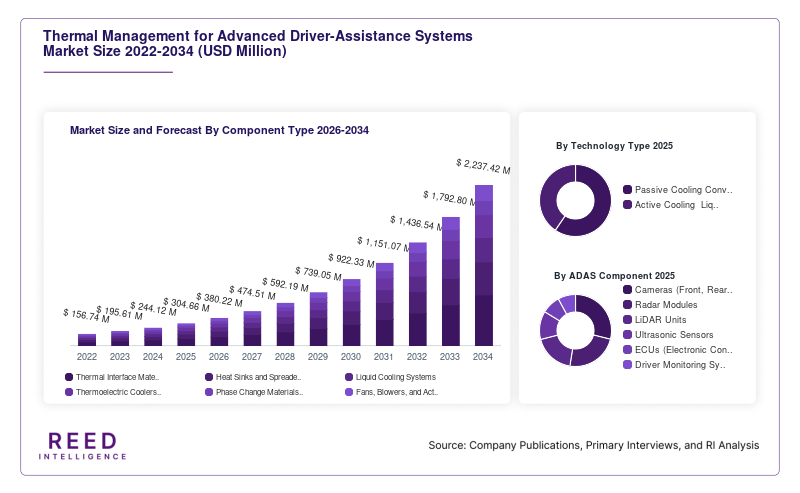
Component type represents the quantitatively supplied segmentation. TIMs lead with USD 114.42 million in 2026, approximately 30.0% of the component dataset, while heat sinks and spreaders account for roughly 22.9%. The broader taxonomy also covers passive versus active cooling; cameras, radar, LiDAR, ultrasonic sensors, ECUs, and DMS; metal, polymer, ceramic and carbon materials; passenger, commercial and electric vehicles; and Levels 1–5 autonomy.
By Component Type
Thermal Interface Materials are the largest component category, rising from USD 92.48 million in 2025 to USD 114.42 million in 2026 and USD 628.07 million by 2034 at a 23.72% CAGR. Pads, gels, greases, and adhesives remain critical where heat must be transferred efficiently from processors, sensor electronics, and power devices to structural cooling surfaces.
Thermoelectric Coolers are the fastest-growing supplied component category at a 26.68% CAGR, reaching USD 362.79 million by 2034. Heat sinks and spreaders expand at 26.28%, followed by PCMs at 24.98%, fans/blowers at 23.82%, TIMs at 23.72%, and liquid cooling systems at 23.30%. The total component dataset rises from USD 381.51 million in 2026 to USD 2,247.67 million in 2034.
By Technology, ADAS Component, Material, Vehicle and Autonomy
Passive cooling encompasses conduction, convection, and heat spreading, while active architectures include liquid circulation, Peltier-based TECs, and forced-air systems. Cameras, radar, LiDAR, ultrasonic sensors, ECUs, and DMS create distinct thermal profiles, with material choices spanning aluminum/copper, polymer composites, ceramics, graphene, and carbon-based alternatives.
Passenger vehicles, commercial vehicles, and EVs represent the principal vehicle categories, while Levels 1–2, Level 3, and Levels 4–5 define increasing automation intensity. Numerical size and CAGR figures for these classifications were not included in the mandatory input tables; therefore, no unsupported subsegment values are introduced.
Thermal Management for Advanced Driver-Assistance Systems Market Regional Outlook
North America
North America leads with USD 143.60 million in 2026, approximately 37.8% of the regional dataset, and is forecast to reach USD 748.38 million by 2034 at a 22.92% CAGR. The United States is a key adoption center, where Level 2+ systems represented approximately 6% of new-car sales in 2025. Demand spans passenger EVs, premium vehicles, autonomous-development fleets, cameras, radar, ECUs, and increasingly LiDAR-equipped platforms.
Europe
Europe increases from USD 68.84 million in 2025 to USD 86.35 million in 2026 and USD 529.38 million in 2034, representing approximately 22.7% of 2026 regional revenue and a 25.44% CAGR. Germany, France, the United Kingdom, Italy, and Nordic automotive markets support deployment through premium vehicles, electrification, safety regulation, and sophisticated electronic architectures.
APAC
Asia Pacific reaches USD 75.48 million in 2026, approximately 19.9% of regional revenue, before expanding to USD 443.60 million by 2034 at 24.78%. China is particularly important: Level 2+ technology reached around 10% of new-car sales there in 2025. Regional demand is supported by high-volume EV production and accelerating LiDAR, camera, radar, and centralized-compute integration.
Middle East and Africa
Middle East and Africa advances from USD 45.21 million in 2026 to USD 268.79 million in 2034 at a 24.96% CAGR, contributing approximately 11.9% of 2026 regional revenue. Gulf-market premium vehicles, high ambient temperatures, commercial fleets, and expanding ADAS penetration increase the importance of temperature-stable electronics and robust cooling designs.
Latin America
Latin America represents approximately 7.8% of 2026 regional revenue at USD 29.57 million but records the fastest regional CAGR, 25.90%, reaching USD 186.69 million by 2034. Brazil and Mexico provide major automotive manufacturing and demand centers, while increasing penetration of passenger-vehicle safety electronics supports cameras, radar, ECUs, passive heat spreading, and active cooling applications.
Top players in Global Thermal Management for Advanced Driver-Assistance Systems Market
- Robert Bosch GmbH
- DENSO Corporation
- Valeo
- Continental AG
- MAHLE GmbH
- ZF Friedrichshafen AG
- Gentherm Incorporated
- Modine Manufacturing Company
- BorgWarner Inc.
- Hanon Systems
- Dana Incorporated
- Parker Hannifin Corporation
- Boyd Corporation
- Henkel AG & Co. KGaA
- Laird Thermal Systems
Top Two Companies
-
Robert Bosch GmbH: Bosch maintains strong positioning through integrated automotive electronics, ADAS capabilities, electrification, and thermal engineering. Its predictive thermal software is designed for systems involving more than 40 components and over 10 operating modes, while its flexible thermal-unit strategy integrates coolant and refrigerant functions. A reliable standalone percentage share for Bosch in this narrowly defined ADAS thermal-management category is not publicly disclosed in the reviewed sources; assigning an unsupported percentage would therefore misrepresent competitive concentration.
-
Valeo: Valeo combines ADAS sensing and vehicle-electronics capabilities with electrified-vehicle thermal systems. At IAA Mobility 2025, the company presented compact modular thermal-management hardware and software alongside ADAS technologies, while its Smart Thermal Management and Predict4Range combination was stated to recover up to 24% of electric range under relevant conditions. As with Bosch, a verified company-specific percentage for this exact market definition is not publicly disclosed, so no fabricated share is assigned.
Recent Developments in Global Thermal Management for Advanced Driver-Assistance Systems Market
- 2026: OICA reported that 2025 global vehicle manufacturing reached 96.4 million units, increasing 3.9%, while sales reached 99.8 million units, up 4.7%, expanding the addressable installed base for ADAS electronics.
- 2026: IEA analysis reported that approximately 50% of new cars sold globally in 2025 offered Level 2 steering-and-speed automation, with Level 2+ penetration reaching 10% in China and 6% in the United States.
- 2025: Valeo showcased next-generation electrification and smart thermal technologies, including solutions capable of recovering up to 24% of EV range when paired with Predict4Range software.
- 2025: Industry reporting indicated a major 9-million-unit Surround ADAS supply agreement, highlighting the accelerating scale of multi-sensor vehicle architectures and associated electronics-management requirements.
- 2025: Automotive LiDAR commercialization accelerated, with reported passenger-vehicle LiDAR shipments of approximately 3.7 million units, including around 3.1 million long-range ADAS units.
Thermal Management for Advanced Driver-Assistance Systems Market Growth
Expansion through 2034 is underpinned by the convergence of higher global vehicle production, approximately 50% Level 2 penetration among new cars in 2025, rising Level 2+ deployment, multi-sensor redundancy, EV architectures, and greater processing density. Cooling is evolving from passive component protection into a system-level engineering function covering thermal interfaces, heat spreading, liquid circuits, thermoelectrics, airflow, predictive software, and integrated vehicle energy management.
Thermal Management for Advanced Driver-Assistance Systems Market Insights
The competitive direction favors suppliers capable of combining automotive qualification, materials expertise, compact packaging, active cooling, and software-based thermal optimization. Sensor proliferation raises thermal density while centralized compute increases localized heat loads. The strongest opportunities consequently lie in scalable TIMs, high-performance spreaders, thermoelectric solutions, integrated liquid cooling, and predictive controls capable of maintaining sensor accuracy and electronics durability across increasingly demanding Levels 2–5 architectures.
Thermal Management for Advanced Driver-Assistance Systems Market Segments
By Component Type
-
Thermal Interface Materials (TIMs)
- Pads, gels, greases, and adhesives
- Heat Sinks and Spreaders
- Liquid Cooling Systems
- Thermoelectric Coolers (TECs)
- Phase Change Materials (PCMs)
- Fans, Blowers, and Active Air Cooling Units
By Technology Type
-
Passive Cooling
- Convection, conduction, heat spreaders
-
Active Cooling
- Liquid circulation
- Peltier-based (TEC)
- Forced air cooling
By ADAS Component
- Cameras (Front, Rear, Surround View)
- Radar Modules
- LiDAR Units
- Ultrasonic Sensors
- ECUs (Electronic Control Units)
- Driver Monitoring Systems (DMS)
By Material Type
- Metal-Based (Aluminum, Copper)
- Polymer-Based Composites
- Ceramics
- Graphene and Carbon-Based Materials
By Vehicle Type
- Passenger Vehicles
- Commercial Vehicles
- Electric Vehicles (EVs)
By Level of Autonomy
- Level 1–2 (Driver Assistance)
- Level 3 (Partial Automation)
- Level 4–5 (High/Full Automation)
By Region
- North America
- Europe
- APAC
- Middle East and Africa
- LATAM