Thermal Pallet Cover Market Size, Share & Demand Report By Product Type (Reusable Thermal Covers, Disposable Thermal Covers), By Material (Foil-Based Insulation, Bubble Insulation), By End Use (Pharmaceutical Logistics, Fresh Food Exports, Chemicals, Consumer Goods, Industrial Products), By Distribution Channel (Direct Sales, Distributors, By Region & Segment Forecasts, 2026–2034
USD 3950
Market Overview
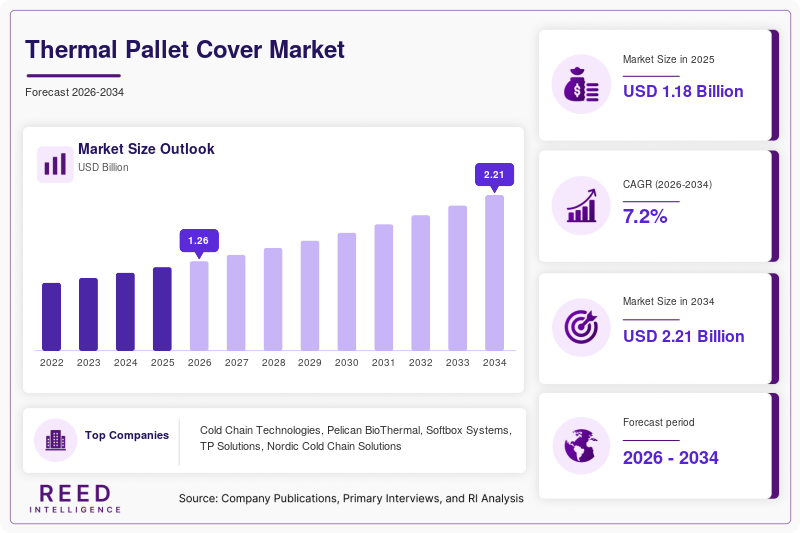
The global Thermal Pallet Cover Market size was valued at USD 1.18 billion in 2026 and is projected to reach USD 2.06 billion by 2034, expanding at a CAGR of 7.2% during 2026–2034. The market has gained momentum due to the rising need for temperature-controlled logistics across pharmaceuticals, food exports, chemicals, and specialty consumer goods. Thermal pallet covers help maintain product integrity during storage and transit by protecting palletized shipments from heat, cold, moisture, and contamination.
One major global factor supporting growth has been the rapid expansion of cross-border cold chain trade. As pharmaceutical biologics, vaccines, frozen foods, dairy products, and temperature-sensitive industrial products move across continents, companies are increasingly adopting reusable and disposable pallet insulation systems to reduce spoilage risks and maintain compliance standards.
Key Highlights
- North America accounted for the dominant 34.8% market share in 2025, while Asia Pacific is expected to register the fastest CAGR of 8.6% through 2034.
- By product type, Reusable Thermal Covers led with 58.3% share in 2025, while Disposable Covers are projected to grow fastest at 7.9% CAGR.
- By material, Foil-Based Insulated Covers dominated with 41.6% share, while Multi-layer Bubble Insulation Covers are expected to grow at 8.3% CAGR.
- By end use, Pharmaceutical Logistics held the leading share of 36.5%, while Fresh Food Exports are forecast to expand at 8.8% CAGR.
- The United States, the dominant country, was valued at USD 312 million in 2024 and USD 334 million in 2025.
Market Trends
Rising Adoption of Reusable Sustainable Covers
Sustainability goals across logistics and manufacturing sectors are accelerating demand for reusable thermal pallet covers. Companies are replacing single-use insulated wraps with durable covers that can withstand multiple shipping cycles. This trend supports waste reduction targets and lowers long-term packaging costs.
Smart Monitoring Integration in Thermal Packaging
The market is witnessing rising use of thermal pallet covers integrated with RFID tags, QR labels, and temperature sensors. These systems improve shipment visibility, enable compliance tracking, and help users respond quickly to temperature excursions during transit.
Market Drivers
Increasing Temperature-Sensitive Pharmaceutical Shipments
The growth of biologics, vaccines, blood products, and specialty medicines has increased demand for reliable thermal protection. Thermal pallet covers help maintain stable shipment conditions during airport handling, warehousing, and last-mile transfer, making them essential in healthcare logistics.
Expansion of Global Food Supply Chains
Rising trade in fresh produce, seafood, meat, dairy, and confectionery products has driven adoption of insulated pallet solutions. Exporters use pallet covers to minimize quality loss caused by fluctuating temperatures during long-distance transport.
Market Restraint
High Initial Cost of Premium Reusable Covers
Advanced reusable thermal pallet covers made from multilayer insulated fabrics often require higher upfront investment than conventional wrapping materials. Small logistics operators and low-margin exporters may delay adoption due to budget constraints.
Market Opportunities
Growth in E-commerce Grocery Fulfillment
Online grocery platforms and direct-to-consumer meal delivery services are creating demand for compact pallet insulation systems in fulfillment centers. This offers new revenue opportunities for manufacturers.
Rising Demand in Emerging Cold Chain Markets
Developing economies are investing in refrigerated transport and warehouse infrastructure. Thermal pallet cover suppliers can expand through localized production and distributor partnerships in these regions.
Segmental Analysis
By Product Type
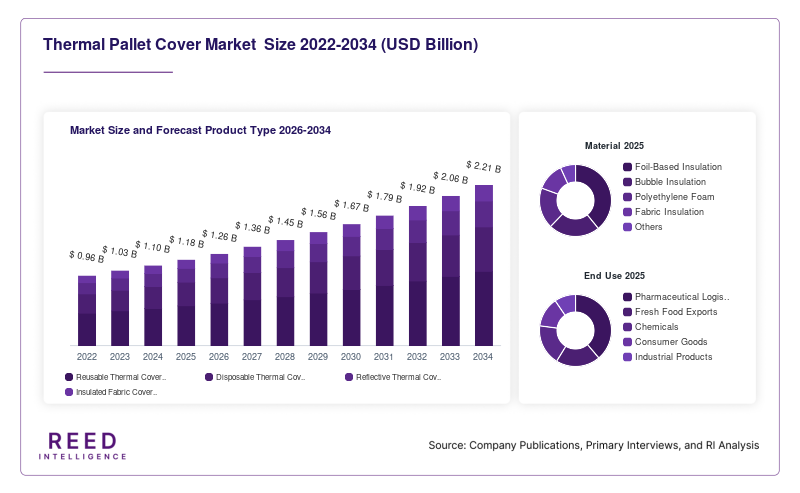
Reusable thermal covers accounted for the dominant 58.3% share in 2025 due to their durability, cost efficiency over repeated cycles, and stronger insulation performance.
Disposable covers are projected to grow at the fastest 7.9% CAGR through 2034. Their growth will be supported by one-way international shipments where product recovery and reverse logistics remain difficult.
By Material
Foil-based insulated covers held the leading 41.6% market share in 2025 as they provide effective radiant heat reflection and moisture resistance.
Multi-layer bubble insulation covers are expected to grow at 8.3% CAGR. Their lightweight structure and shock absorption benefits will make them attractive for air freight shipments.
By End Use
Pharmaceutical logistics represented the dominant 36.5% share in 2025 because of strict product stability requirements and regulated supply chains.
Fresh food exports are expected to witness the fastest 8.8% CAGR through 2034. Rising international trade in seafood, fruits, vegetables, and dairy products will create sustained demand.
By Distribution Channel
Direct sales accounted for 61.2% share in 2025, as large manufacturers and logistics companies preferred customized procurement contracts.
Online and distributor-led sales are forecast to grow at 8.1% CAGR owing to easier access for SMEs and regional buyers.
By Temperature Range Application
Ambient-controlled pallet covers dominated with 46.9% share in 2025 because they are widely used for moderate climate protection during warehousing and transit.
Frozen-chain thermal covers are expected to grow at 8.5% CAGR as frozen food and biologic transport volumes increase globally.
Regional Analysis
North America
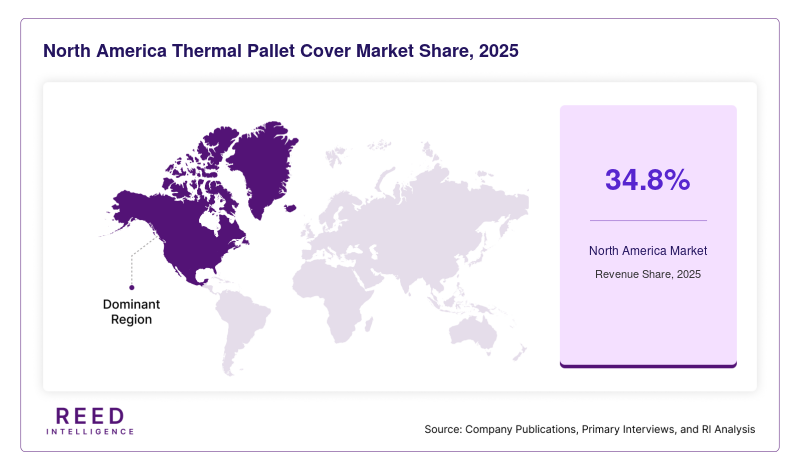
North America held 34.8% of the Thermal Pallet Cover Market share in 2025 and is projected to grow at a 6.5% CAGR through 2034. The United States remained the dominant country due to its mature pharmaceutical logistics network. Growing biologics exports and strict shipment quality standards will continue to support regional demand.
Europe
Europe accounted for 27.1% market share in 2025 and will expand at a 6.8% CAGR during the forecast period. Germany led the region due to its advanced food processing and industrial export sectors. Rising intra-European cold chain distribution will strengthen product adoption.
Asia Pacific
Asia Pacific represented 23.9% share in 2025 and is expected to record the fastest 8.6% CAGR through 2034. China dominated the region because of its large manufacturing base and growing pharmaceutical production. Increasing exports of temperature-sensitive products will accelerate market expansion.
Middle East & Africa
Middle East & Africa captured 7.4% market share in 2025 and is forecast to grow at a 7.1% CAGR. The United Arab Emirates led regional demand due to its role as a re-export logistics hub. Expansion of air cargo and healthcare imports will drive adoption.
Latin America
Latin America held 6.8% share in 2025 and will grow at a 7.0% CAGR through 2034. Brazil remained the dominant country owing to its agricultural exports and vaccine distribution programs. Demand for insulated pallet transport in food exports will support growth.
Competitive Landscape
The Thermal Pallet Cover Market remains moderately fragmented with a mix of global insulation packaging companies and regional manufacturers. Key players compete on product durability, thermal retention efficiency, custom sizing, sustainability credentials, and logistics partnerships. Cold Chain Technologies remained a market leader due to its wide product portfolio and strong presence in pharmaceutical shipping solutions. The company recently expanded its reusable thermal packaging line to support circular supply chain programs.
Pelican BioThermal continues to focus on life sciences transport packaging with advanced passive temperature solutions. TP Solutions offers reflective pallet covers for industrial and food logistics markets. Softbox Systems strengthens its position through innovation in reusable insulated transport systems. Nordic Cold Chain Solutions is expanding in North America with customized pallet blanket solutions.
Market participants are also investing in recyclable materials, sensor-enabled packaging, and rental-based reusable cover programs to increase customer retention and reduce lifecycle costs.
Key Players List
- Cold Chain Technologies
- Pelican BioThermal
- Softbox Systems
- TP Solutions
- Nordic Cold Chain Solutions
- IPC (Insulated Products Corporation)
- Thermal Packaging Solutions
- EcoCool GmbH
- Tempack Packaging Solutions
- Snyder Industries
- Protek Cargo
- Insulated Products Ltd.
- Exeltainer SL
- Cryopak Industries
- Sonoco ThermoSafe
- Inmark Packaging
- Va-Q-Tec AG
Recent Developments
- Cold Chain Technologies launched an upgraded reusable pallet cover platform with higher cycle durability in 2025.
- Pelican BioThermal introduced expanded passive shipping solutions for pharmaceutical freight handling.
- Softbox Systems increased manufacturing capacity for insulated logistics products in Europe.
- Nordic Cold Chain Solutions launched custom pallet blanket sizing for food distributors.
- Several regional suppliers introduced recyclable foil-free thermal pallet covers to align with sustainability targets.
Thermal Pallet Cover Market Segments
Product Type
- Reusable Thermal Covers
- Disposable Thermal Covers
- Reflective Thermal Covers
- Insulated Fabric Covers
Material
- Foil-Based Insulation
- Bubble Insulation
- Polyethylene Foam
- Fabric Insulation
- Others
End Use
- Pharmaceutical Logistics
- Fresh Food Exports
- Chemicals
- Consumer Goods
- Industrial Products
Distribution Channel
- Direct Sales
- Distributors
- Online Sales
By Region
- North America
- Europe
- APAC
- Middle East and Africa
- LATAM