Thermal Release Tape Market Size, Share & Demand Report By Material Type (Polyolefin-Based, Acrylic-Based, PET-Based, Others), By Application (Semiconductor Wafer Dicing, Flexible Electronics Assembly, Optical Component Processing, PCB Manufacturing, Others), By End-Use Industry (Electronics Manufacturing, Automotive Electronics, Healthcare Devices, Telecommunications, Industrial Equipment), By Region & Segment Forecasts, 2026–2034
USD 3950
Market Overview
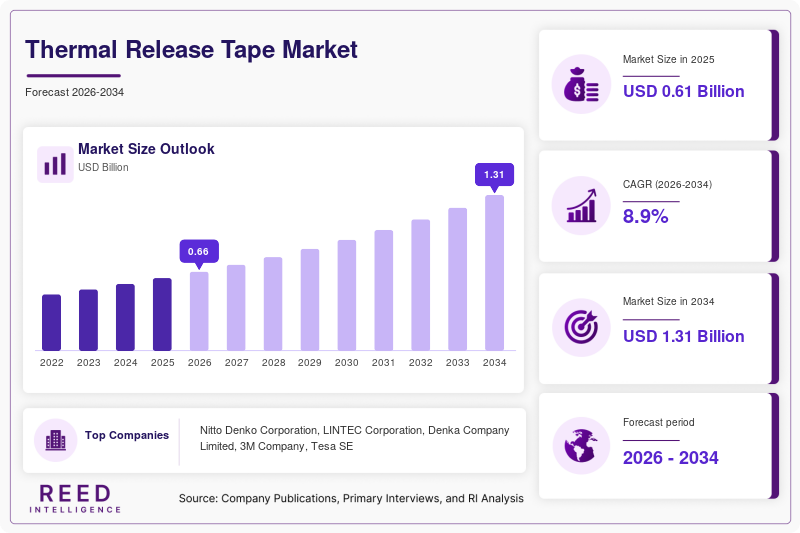
The global Thermal Release Tape Market size was valued at approximately USD 0.612 billion in 2026 and is projected to reach nearly USD 1.21 billion by 2034, expanding at a CAGR of 8.9% during 2026–2034. Thermal release tapes are pressure-sensitive adhesive materials designed to lose adhesion when exposed to elevated temperatures. These tapes are widely used in semiconductor wafer processing, electronics assembly, optical component manufacturing, and precision dicing applications. The growing demand for compact electronic devices and advanced semiconductor packaging technologies continues to create sustained demand for high-performance thermal release tapes across global manufacturing industries.
A major factor supporting market growth is the rapid expansion of semiconductor fabrication capacity worldwide. Governments and private manufacturers are increasing investments in advanced chip manufacturing facilities to support artificial intelligence, automotive electronics, 5G infrastructure, and industrial automation. Thermal release tapes are becoming essential in wafer back-grinding, die cutting, and temporary bonding applications due to their ability to reduce substrate damage and improve production precision. In addition, increasing adoption of flexible electronics and miniaturized devices has encouraged manufacturers to develop tapes with improved thermal stability, low residue characteristics, and higher peel strength.
Key Highlights
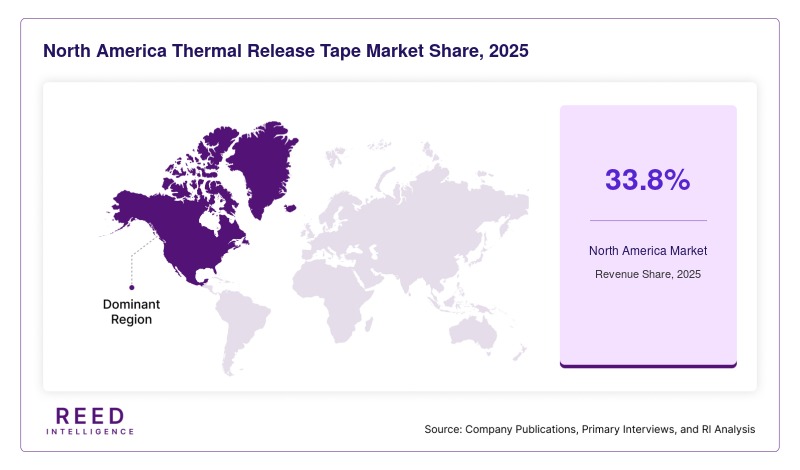
- North America dominated the market with a 33.8% share in 2025.
- Asia Pacific is expected to grow at the fastest CAGR of 10.8% during 2026–2034.
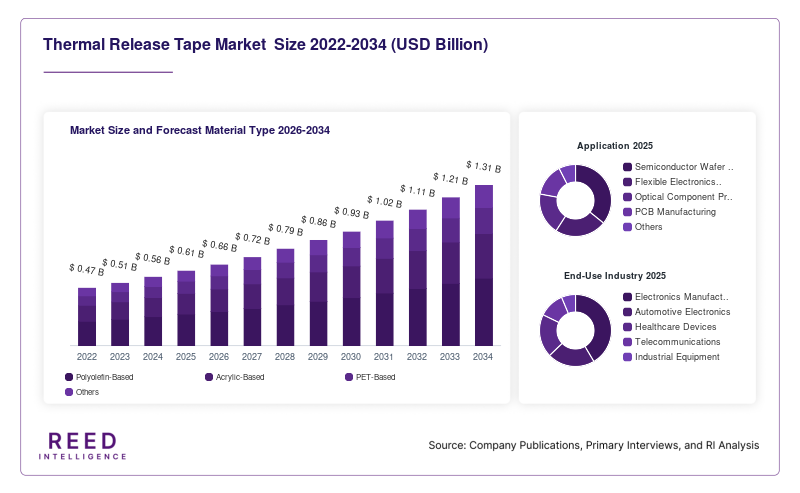
- By material type, polyolefin-based tapes accounted for the largest share of 39.4%, while acrylic-based tapes are projected to grow at a CAGR of 10.9%.
- By application, semiconductor wafer dicing led with a 44.1% share, whereas flexible electronics assembly is expected to expand at a CAGR of 11.3%.
- The United States remained the dominant country, with market values of USD 168 million in 2024 and USD 184 million in 2025.
Market Trends
Expansion of Advanced Semiconductor Packaging Technologies
The increasing adoption of advanced semiconductor packaging technologies has emerged as a major trend shaping the Thermal Release Tape Market. Semiconductor manufacturers are moving toward wafer-level packaging, 3D integrated circuits, and fan-out packaging methods to improve chip performance while reducing device size. These manufacturing techniques require temporary bonding materials that can withstand grinding, polishing, and cutting processes without damaging delicate wafers. Thermal release tapes are gaining preference because they provide stable adhesion during processing and release cleanly when exposed to heat. This helps reduce wafer breakage rates and improves manufacturing efficiency. The trend is particularly visible in countries investing heavily in semiconductor production expansion, including the United States, South Korea, Taiwan, and China. Manufacturers are also introducing ultra-thin tapes compatible with smaller semiconductor nodes and advanced chip architectures. As electronic devices become more compact and multifunctional, demand for precision dicing and temporary bonding materials is expected to remain strong throughout the forecast period.
Rising Adoption of Flexible and Wearable Electronics
Flexible electronics and wearable devices are creating new growth opportunities for thermal release tape manufacturers. Consumer electronics companies are increasingly incorporating foldable displays, flexible sensors, lightweight batteries, and compact circuit structures into smartphones, healthcare devices, and industrial monitoring systems. Thermal release tapes support these applications by providing temporary adhesion during assembly while protecting delicate substrates from mechanical stress. The growing preference for lightweight and thin electronic components has encouraged manufacturers to develop tapes with improved conformability and residue-free removal properties. Demand from the healthcare sector is also rising as wearable monitoring devices become more common for remote patient care and fitness tracking. In addition, automotive manufacturers are integrating flexible electronic systems into dashboards, advanced driver assistance systems, and interior lighting components. These developments are encouraging tape manufacturers to invest in heat-resistant materials and low-contamination adhesive technologies tailored for sensitive electronic applications.
Market Drivers
Increasing Global Semiconductor Manufacturing Investments
Rapid investments in semiconductor fabrication facilities are significantly driving the Thermal Release Tape Market. Governments and private organizations across North America, Asia Pacific, and Europe are increasing funding for domestic chip manufacturing to reduce supply chain dependence and support strategic industries. Thermal release tapes are essential during wafer grinding, dicing, and die transfer processes because they protect fragile semiconductor wafers while enabling precise separation during manufacturing. The expansion of electric vehicles, artificial intelligence systems, data centers, and industrial automation equipment has intensified demand for advanced semiconductor devices, indirectly supporting the consumption of thermal release tapes. Manufacturers are also expanding cleanroom production capacity to meet rising industry requirements. Additionally, semiconductor packaging companies are focusing on improving yield rates and reducing contamination during production, further increasing the importance of high-performance thermal release adhesive solutions in fabrication environments.
Growth in Consumer Electronics Production
The increasing production of smartphones, tablets, wearable devices, and smart home products is another major growth driver for the market. Consumer electronics manufacturers require precision assembly solutions that ensure component stability during production while allowing clean removal without residue. Thermal release tapes are widely used for temporary fixation of sensitive substrates, display panels, and semiconductor chips during processing stages. The trend toward miniaturized devices and thinner electronic assemblies has further increased the need for advanced adhesive materials with controlled release characteristics. In addition, the rising adoption of OLED displays and foldable smartphone technologies has accelerated demand for specialized thermal release tapes that can maintain adhesion under varying thermal conditions. Electronics manufacturing companies are also investing in automated assembly systems, which require consistent adhesive performance to improve operational efficiency. These factors collectively support long-term growth opportunities for thermal release tape manufacturers worldwide.
Market Restraint
High Production Costs and Complex Material Requirements
High production costs associated with advanced thermal release tapes remain a key restraint affecting market expansion. Manufacturing these tapes requires specialized polymer formulations, precision coating technologies, and strict contamination control standards, particularly for semiconductor applications. The use of high-purity materials and temperature-sensitive adhesive systems increases production complexity and operational expenses. Small and medium-sized electronics manufacturers often face challenges in adopting premium thermal release tapes due to higher procurement costs compared to conventional adhesive solutions. Additionally, fluctuations in raw material prices for specialty polymers and synthetic adhesives can create pricing instability within the market. Manufacturers are also required to comply with stringent environmental and safety regulations related to chemical processing and electronic manufacturing standards. In some developing regions, limited awareness regarding advanced temporary bonding technologies further restricts adoption rates. These challenges may slow penetration in price-sensitive manufacturing sectors, particularly among companies operating with narrow production margins and limited automation capabilities.
Market Opportunities
Development of Low-Residue and Eco-Friendly Adhesive Solutions
The growing emphasis on sustainable manufacturing practices is creating significant opportunities for eco-friendly thermal release tape products. Electronics manufacturers are increasingly seeking adhesive materials that minimize contamination, reduce chemical waste, and support environmentally responsible production operations. This trend has encouraged tape manufacturers to develop low-residue adhesive formulations with reduced volatile organic compound emissions. Companies are investing in recyclable backing materials and solvent-free coating technologies to meet evolving environmental regulations across Europe and North America. Demand for cleaner adhesive removal processes is also increasing in semiconductor manufacturing because even minor contamination can affect device performance. Manufacturers introducing bio-based polymers and low-emission adhesive technologies are expected to gain competitive advantages in the coming years. The transition toward green electronics manufacturing and sustainable packaging solutions is likely to create new revenue opportunities for suppliers specializing in environmentally compatible thermal release tapes.
Expansion of Electric Vehicle Electronics Manufacturing
The rapid growth of electric vehicle production is expected to generate new opportunities for the Thermal Release Tape Market. Electric vehicles rely heavily on advanced electronic systems, including battery management units, sensors, power semiconductors, and infotainment modules. Thermal release tapes are increasingly used during semiconductor packaging and electronic component assembly processes for automotive applications. As automakers focus on improving vehicle efficiency and reducing component size, demand for precision manufacturing materials is rising steadily. Battery manufacturers are also adopting advanced adhesive solutions during cell assembly and module integration processes. Governments worldwide are supporting electric vehicle adoption through subsidies and infrastructure investments, encouraging automotive electronics production expansion. In addition, autonomous driving technologies and connected vehicle systems require increasingly sophisticated semiconductor components, further strengthening the demand for high-performance thermal release tapes within automotive manufacturing ecosystems.
Segmental Analysis
By Material Type
Polyolefin-based thermal release tapes accounted for the largest market share of approximately 39.4% in 2024 due to their balanced adhesion performance, thermal stability, and cost efficiency. These tapes are widely used in semiconductor wafer dicing and electronics assembly applications because they provide reliable temporary bonding during high-precision manufacturing processes. Polyolefin materials offer excellent flexibility and clean release properties, reducing the risk of substrate contamination during component separation. Manufacturers prefer these tapes for automated semiconductor production lines where consistent adhesive performance is critical. Increasing demand for advanced packaging technologies and high-volume electronics manufacturing continues to strengthen the dominance of polyolefin-based thermal release tapes across global industrial applications. In addition, improvements in polymer engineering have enhanced the durability and heat resistance of these tapes, supporting broader adoption in sensitive electronic assembly environments.
Acrylic-based thermal release tapes are projected to grow at the fastest CAGR of 10.9% during the forecast period due to their superior adhesion control and low-residue performance. These tapes are increasingly preferred in advanced semiconductor fabrication and flexible electronics manufacturing applications where precision handling is essential. Acrylic materials provide enhanced resistance to temperature fluctuations and chemical exposure, making them suitable for complex wafer processing operations. Manufacturers are also developing next-generation acrylic adhesive systems capable of supporting ultra-thin semiconductor wafers and delicate display components. The rising adoption of flexible displays, wearable electronics, and miniaturized semiconductor devices is expected to accelerate demand for acrylic-based thermal release tapes. Furthermore, ongoing research focused on improving heat activation efficiency and environmental compatibility is creating additional growth opportunities for this segment.
By Application
Semiconductor wafer dicing emerged as the dominant application segment, accounting for nearly 44.1% of the global market share in 2024. Thermal release tapes are extensively used during wafer thinning and dicing operations to secure semiconductor wafers while minimizing damage during processing. The increasing complexity of semiconductor devices and shrinking chip sizes have heightened the need for precision adhesive materials capable of supporting advanced fabrication requirements. Manufacturers rely on thermal release tapes to maintain wafer stability throughout grinding, polishing, and cutting stages before enabling residue-free removal through controlled heating. The rapid expansion of semiconductor production capacity worldwide continues to strengthen demand for these tapes in wafer processing applications. In addition, the growing integration of semiconductors into electric vehicles, artificial intelligence systems, and communication infrastructure supports sustained segment dominance.
Flexible electronics assembly is expected to witness the fastest CAGR of 11.3% during the forecast period due to rising demand for foldable displays, wearable devices, and lightweight electronic systems. Thermal release tapes are increasingly used to temporarily secure flexible substrates during component integration and precision assembly operations. Manufacturers require adhesive solutions that can provide stable bonding while preventing mechanical stress on delicate electronic materials. The growth of smart healthcare devices, flexible sensors, and advanced display technologies is accelerating adoption of thermal release tapes in this segment. Companies are also investing in ultra-thin adhesive products designed specifically for flexible electronic manufacturing processes. As consumer electronics manufacturers continue introducing compact and multifunctional products, the need for high-performance temporary bonding solutions in flexible assembly applications is expected to increase significantly.
By End-Use Industry
The electronics manufacturing industry accounted for the largest share of approximately 48.6% in 2024 due to extensive use of thermal release tapes in semiconductor packaging, display assembly, and circuit board manufacturing processes. Electronics manufacturers require temporary bonding solutions capable of withstanding precision processing operations while ensuring contamination-free removal. The increasing production of smartphones, tablets, laptops, and wearable devices continues to support strong demand for thermal release tapes across electronics assembly facilities. In addition, automation within electronics manufacturing plants has increased the importance of consistent adhesive performance during high-speed production operations. Manufacturers are focusing on developing tapes with enhanced thermal resistance and improved peel characteristics to meet the evolving needs of advanced electronics production environments. Continued innovation in miniaturized electronic components further strengthens demand within this end-use segment.
The automotive electronics industry is projected to register the fastest CAGR of 10.5% during 2026–2034 owing to rapid expansion in electric vehicle production and advanced driver assistance systems. Modern vehicles incorporate a growing number of semiconductor components, sensors, and electronic control units that require precision manufacturing solutions. Thermal release tapes are increasingly adopted during semiconductor packaging and electronic module assembly processes for automotive applications. Demand for reliable adhesive materials is rising as automakers focus on improving component durability and manufacturing efficiency. The transition toward connected vehicles and autonomous driving technologies is also increasing semiconductor usage within the automotive sector. Furthermore, investments in electric vehicle battery technologies and smart vehicle electronics are expected to create additional opportunities for thermal release tape manufacturers serving automotive production markets.
Regional Analysis
North America
North America accounted for approximately 33.8% of the global Thermal Release Tape Market share in 2025 and is expected to maintain steady growth at a CAGR of 8.1% during the forecast period. The region benefits from strong semiconductor manufacturing investments, advanced electronics production capabilities, and increasing research activity related to wafer-level packaging technologies. Demand for high-performance thermal release tapes is rising among semiconductor fabrication facilities and electronics assembly companies seeking contamination-free manufacturing solutions. The presence of major chip manufacturers and increasing government support for domestic semiconductor production continue to strengthen regional market expansion.
The United States remains the dominant country within North America due to large-scale investments in semiconductor manufacturing infrastructure and electronics innovation. The country is witnessing increasing adoption of thermal release tapes in artificial intelligence chip production, automotive semiconductor packaging, and aerospace electronics manufacturing. Expansion of advanced fabrication plants and increasing automation within electronics assembly operations are contributing to higher demand for precision adhesive solutions. In addition, the growing focus on domestic semiconductor supply chain security has encouraged additional investments in high-purity manufacturing materials.
Europe
Europe represented nearly 24.6% of the global Thermal Release Tape Market in 2025 and is projected to expand at a CAGR of 7.7% during 2026–2034. The regional market is supported by rising investments in automotive electronics, industrial automation systems, and semiconductor research initiatives. European manufacturers are emphasizing high-quality electronic production processes that require reliable temporary bonding materials. Thermal release tapes are increasingly used in advanced sensor production, optical device assembly, and precision semiconductor processing applications. Environmental regulations promoting cleaner manufacturing technologies are also encouraging the adoption of low-residue adhesive products across regional industries.
Germany continues to dominate the European market owing to its strong automotive manufacturing base and industrial electronics sector. The country is experiencing rising demand for semiconductor components used in electric vehicles, factory automation equipment, and renewable energy systems. Thermal release tapes are becoming important in precision assembly applications requiring stable adhesion and residue-free release. Furthermore, German electronics manufacturers are investing in advanced production automation technologies, increasing the requirement for consistent and high-performance adhesive materials compatible with automated manufacturing lines.
Asia Pacific
Asia Pacific held approximately 28.9% of the global Thermal Release Tape Market share in 2025 and is anticipated to register the fastest CAGR of 10.8% through 2034. The region benefits from extensive semiconductor manufacturing activity, rising electronics exports, and increasing investments in consumer device production. Countries including China, South Korea, Taiwan, and Japan continue to expand chip fabrication capacity to meet growing global demand for semiconductors. Thermal release tapes are widely adopted in wafer dicing, chip packaging, and display manufacturing applications across the region. Increasing smartphone production and rapid industrialization further contribute to sustained market growth.
China dominates the Asia Pacific market due to its extensive electronics manufacturing ecosystem and large semiconductor packaging industry. The country is rapidly expanding domestic semiconductor production capabilities to support consumer electronics, telecommunications equipment, and electric vehicle manufacturing. Demand for advanced thermal release tapes is rising in response to increasing investments in chip fabrication facilities and flexible electronics production. In addition, government initiatives supporting local electronics manufacturing and advanced material innovation continue to encourage market expansion across industrial sectors.
Middle East & Africa
The Middle East & Africa region accounted for around 6.1% of the global Thermal Release Tape Market in 2025 and is expected to grow at a CAGR of 6.9% during the forecast period. Market growth in the region is supported by gradual expansion of electronics assembly operations and increasing investments in industrial automation projects. Demand for semiconductor components used in telecommunications infrastructure, renewable energy systems, and smart city initiatives is creating moderate opportunities for thermal release tape suppliers. The region is also witnessing increasing adoption of advanced manufacturing technologies across selected industrial sectors.
Saudi Arabia remains the leading market within the region due to ongoing investments in technology diversification and industrial modernization initiatives. The country is encouraging development of domestic electronics manufacturing capabilities through government-backed industrial programs. Demand for thermal release tapes is increasing in electronic component assembly and renewable energy equipment manufacturing applications. Additionally, growing investments in smart infrastructure projects and advanced communication technologies are supporting the adoption of semiconductor-related manufacturing materials across the country.
Latin America
Latin America represented approximately 6.6% of the global Thermal Release Tape Market share in 2025 and is forecast to expand at a CAGR of 7.2% during 2026–2034. The market is benefiting from gradual growth in electronics assembly operations, automotive component manufacturing, and consumer appliance production. Countries across the region are increasing imports of semiconductor components and investing in localized electronics production to strengthen supply chain efficiency. Thermal release tapes are increasingly used in precision assembly processes requiring temporary adhesion and controlled thermal release characteristics.
Brazil dominates the Latin American market due to its relatively developed industrial manufacturing base and expanding automotive electronics sector. The country is witnessing increased production of consumer appliances, automotive control systems, and industrial electronic equipment. Thermal release tapes are gaining adoption in assembly processes that require contamination-free handling of sensitive electronic components. Moreover, increasing foreign investments in electronics manufacturing and industrial modernization programs are expected to support long-term demand growth within the Brazilian market.
Competitive Landscape
The Thermal Release Tape Market is moderately consolidated, with leading companies focusing on product innovation, semiconductor industry partnerships, and global manufacturing expansion strategies. Major participants are investing in advanced adhesive technologies capable of supporting next-generation semiconductor fabrication and flexible electronics manufacturing applications. Companies are also emphasizing low-residue adhesive formulations, higher thermal stability, and contamination-free release characteristics to strengthen competitive positioning. Strategic collaborations with semiconductor manufacturers and electronics assembly companies remain common across the industry.
Nitto Denko Corporation continues to hold a leading position in the market due to its extensive product portfolio, global manufacturing footprint, and strong presence in semiconductor processing applications. The company recently introduced advanced thermal release tape products designed for ultra-thin wafer processing and high-temperature semiconductor packaging operations. Other key market participants are focusing on expanding production capacity and improving compatibility with automated assembly systems. Increasing investments in research and development activities related to environmentally sustainable adhesive materials are also shaping competitive strategies within the industry.
Key Players
- Nitto Denko Corporation
- LINTEC Corporation
- Denka Company Limited
- Furukawa Electric Co., Ltd.
- Mitsui Chemicals, Inc.
- 3M Company
- Tesa SE
- Sekisui Chemical Co., Ltd.
- AI Technology, Inc.
- Sumitomo Bakelite Co., Ltd.
- Adwill Corporation
- Hitachi Chemical Co., Ltd.
- Nichiban Co., Ltd.
- Henkel AG & Co. KGaA
- Scapa Group plc
Recent Developments
- Nitto Denko Corporation expanded its semiconductor adhesive materials production facility in East Asia to support increasing demand for wafer processing applications in 2025.
- LINTEC Corporation introduced a new low-residue thermal release tape designed for advanced semiconductor packaging and flexible display manufacturing applications in 2024.
- Tesa SE announced investments in sustainable adhesive research programs focused on reducing solvent emissions and improving recyclability of electronic manufacturing tapes in 2025.
- Denka Company Limited partnered with electronics assembly firms to develop ultra-thin thermal release tapes compatible with next-generation wearable electronics production systems in 2024.
Thermal Release Tape Market Segments
Material Type
- Polyolefin-Based
- Acrylic-Based
- PET-Based
- Others
Application
- Semiconductor Wafer Dicing
- Flexible Electronics Assembly
- Optical Component Processing
- PCB Manufacturing
- Others
End-Use Industry
- Electronics Manufacturing
- Automotive Electronics
- Healthcare Devices
- Telecommunications
- Industrial Equipment
By Region
- North America
- Europe
- APAC
- Middle East and Africa
- LATAM