Thermal Silicone Caps Market Size, Share & Growth Report By Type (High-Temperature Silicone Caps, Specialty Engineered Silicone Caps, Standard Silicone Caps), By Application (Electronics Manufacturing, Electric Vehicles, Industrial Equipment, Aerospace & Defense, Energy Systems), By End-Use (Automotive Manufacturing, Electronics & Semiconductors, Aerospace Industry, Energy & Utilities, Industrial Manufacturing) – Global Forecast 2026–2034
USD 3950
Market Overview
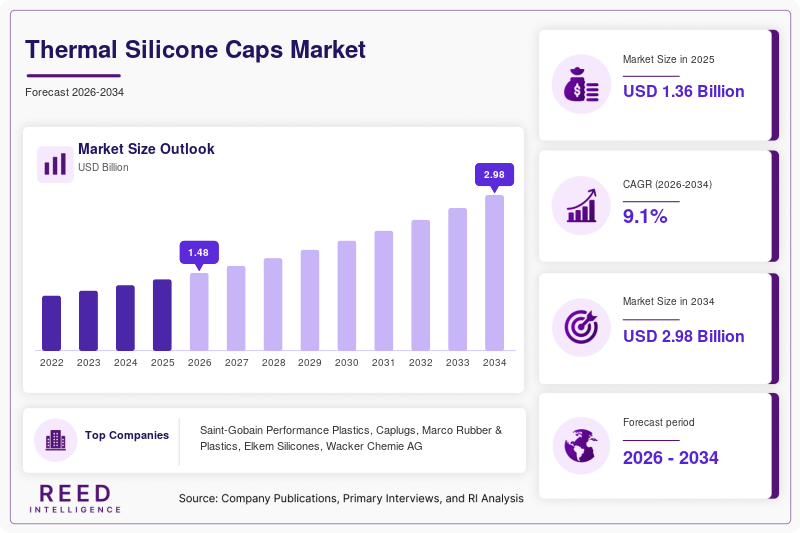
The Thermal Silicone Caps Market size is projected to reach approximately USD 1.48 billion in 2026 and is expected to attain a value of USD 2.96 billion by 2034, expanding at a CAGR of 9.1% during the forecast period (2026–2034). Growth in the market is primarily driven by increasing demand for high-performance thermal insulation solutions across electronics, automotive systems, and industrial manufacturing environments where heat protection and component longevity are critical. Thermal silicone caps are widely used to mask and protect components during coating, anodizing, and thermal processing, thereby improving production quality and operational efficiency.
One of the global factors supporting market expansion is the rapid growth of advanced manufacturing industries, particularly semiconductor fabrication and electric vehicle production. These industries require precision masking solutions capable of withstanding extreme thermal conditions while maintaining dimensional stability. Thermal silicone caps have become essential due to their reusability, chemical resistance, and ability to maintain performance under fluctuating temperatures, making them suitable for automated production environments and high-throughput assembly lines.
Key Highlights
- North America dominated the market with a 34.2% share in 2025.
- Asia Pacific is expected to grow at the fastest CAGR of 11.2% during 2026–2034.
- By application, electronics manufacturing accounted for the largest share of 40.6%, while automotive thermal protection applications are projected to grow at a CAGR of 12.1%.
- By material type, high-temperature silicone caps held a dominant 45.3% share, whereas specialty engineered silicone compounds are expected to expand at a CAGR of 11.6%.
- The United States remained the dominant country, with market values of USD 510 million in 2024 and USD 560 million in 2025.
Market Trends
Rising Automation in Manufacturing Processes
The adoption of automation in industrial manufacturing is significantly influencing the demand for thermal silicone caps. As industries such as electronics, aerospace, and automotive shift toward robotic coating and automated thermal treatment systems, the need for reliable masking components has increased. Thermal silicone caps are increasingly integrated into automated production lines due to their uniform performance, ease of application, and compatibility with robotic handling systems. Manufacturers are also designing customized caps that fit automated grippers, improving precision in repetitive tasks. This trend is further supported by Industry 4.0 initiatives, where digital manufacturing ecosystems require durable, reusable, and high-performance consumables that can withstand continuous operational cycles without degradation.
Expansion of High-Temperature Applications in Electronics and EVs
Another prominent trend is the growing use of thermal silicone caps in high-temperature environments such as electric vehicle battery systems, power electronics, and semiconductor manufacturing. As devices become smaller and more powerful, heat management becomes a critical engineering challenge. Thermal silicone caps are being utilized to protect sensitive components during soldering, powder coating, and thermal cycling processes. In EV manufacturing, these caps ensure insulation of battery terminals and connectors during assembly. Additionally, advancements in silicone material formulations are enabling higher thermal resistance and chemical stability, expanding their applicability in next-generation electronics and energy storage systems.
Market Drivers
Growing Demand from Electronics and Semiconductor Manufacturing
The expansion of the global electronics and semiconductor industries is a major driver for the Thermal Silicone Caps Market. As semiconductor fabrication becomes more complex, manufacturers require precision masking solutions capable of withstanding aggressive chemical processes and high temperatures. Thermal silicone caps provide excellent insulation and durability, making them ideal for wafer processing, circuit board coating, and micro-component protection. Increasing production of smartphones, wearable devices, and IoT components is further boosting demand. Additionally, the shift toward miniaturized and high-density electronic assemblies has created a strong need for reusable and contamination-free masking solutions, reinforcing market adoption across production facilities worldwide.
Rapid Growth of Electric Vehicle Production
The accelerating adoption of electric vehicles is another key factor driving market growth. EV manufacturing involves multiple thermal and chemical processing stages where components must be protected from heat exposure and coating contamination. Thermal silicone caps are widely used to mask battery connectors, charging ports, and electrical terminals during production. Their ability to withstand high temperatures without deformation ensures reliability in automotive assembly lines. Government incentives promoting electric mobility, combined with increasing consumer demand for sustainable transportation, are fueling large-scale EV production globally. This directly increases the consumption of thermal silicone caps in automotive manufacturing ecosystems.
Market Restraint
High Material Cost and Limited Cost Efficiency for Small Manufacturers
One of the primary restraints affecting the Thermal Silicone Caps Market is the relatively high cost of high-grade silicone materials used in manufacturing these caps. Advanced formulations designed for extreme temperature resistance and chemical stability significantly increase production costs. For small and medium-scale manufacturers, this creates a barrier to adoption, especially in cost-sensitive regions. Additionally, although silicone caps are reusable, their lifecycle depends heavily on operating conditions, and frequent replacement in harsh environments can increase operational expenses. This cost sensitivity limits widespread adoption in low-margin industries, where alternative masking solutions such as tapes or low-cost polymers are often preferred despite lower performance efficiency.
Market Opportunities
Increasing Adoption in Renewable Energy Equipment Manufacturing
The renewable energy sector presents a significant growth opportunity for the Thermal Silicone Caps Market. Equipment used in solar panel production, wind turbine manufacturing, and energy storage systems requires high-temperature coating and corrosion-resistant treatments. Thermal silicone caps are increasingly used to protect connectors, sensors, and metallic components during these processes. As global investments in renewable energy infrastructure expand, manufacturers are seeking durable masking solutions that improve production quality and reduce waste. This trend is expected to accelerate demand for advanced silicone-based products designed for long-term industrial use in sustainable energy systems.
Technological Advancements in Silicone Material Engineering
Ongoing innovations in silicone material science are creating new opportunities for market expansion. Manufacturers are developing enhanced silicone compounds with improved elasticity, higher thermal thresholds, and resistance to aggressive chemicals. These advancements enable the production of customized thermal silicone caps tailored for specific industrial applications. Additionally, the integration of nano-reinforced silicone materials is improving durability and lifespan, making them more cost-effective over time. These technological developments are expected to open new application areas in aerospace, medical device manufacturing, and precision engineering, thereby broadening the market scope.
Segmental Analysis
By Type Segment
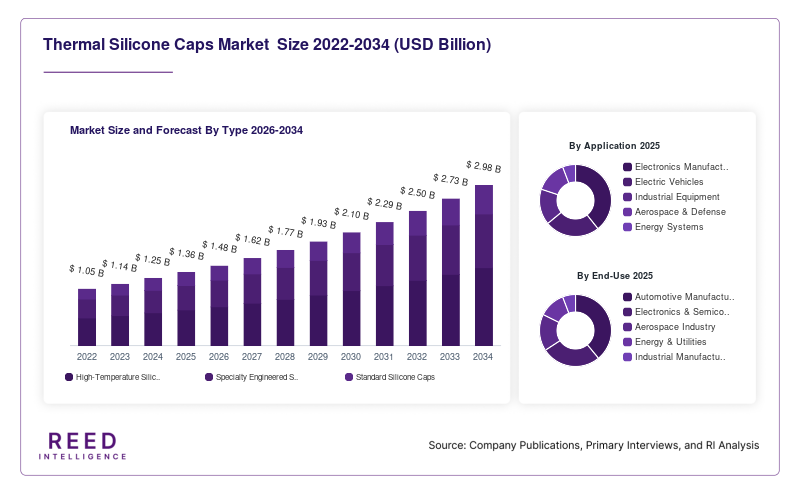
The Thermal Silicone Caps Market is primarily segmented into high-temperature silicone caps, specialty engineered silicone caps, and standard silicone caps, each catering to different industrial masking and thermal protection requirements. High-temperature silicone caps dominated the market with a 45.3% share in 2024, driven by their widespread application in electronics manufacturing, automotive coating processes, and semiconductor fabrication. These caps are designed to withstand extreme heat exposure without deformation, making them highly suitable for precision masking during powder coating, anodizing, and thermal curing processes. Their durability, chemical resistance, and reusability further strengthen their adoption in large-scale production environments where operational efficiency and consistency are critical. Increasing automation in manufacturing lines has also reinforced demand for standardized high-performance caps that can function reliably under continuous production cycles.
Specialty engineered silicone caps are expected to register the fastest growth, expanding at a CAGR of 11.8% during 2026–2034, supported by rising demand for customized solutions in aerospace, defense, and advanced semiconductor manufacturing. These caps are designed with enhanced elasticity, tighter sealing precision, and superior resistance to aggressive chemicals and fluctuating thermal conditions. Manufacturers are increasingly investing in product customization to meet application-specific requirements such as micro-component protection in electronics and high-precision masking in aerospace assemblies. Continuous innovation in silicone polymer engineering, including nano-reinforced and hybrid silicone materials, is further expanding the application scope of this segment, making it a key driver of future market expansion.
By Application Segment
The application segment is led by electronics manufacturing, which accounted for the largest share of 40.6% in 2024, driven by extensive usage in circuit board protection, semiconductor wafer processing, and device assembly operations. Thermal silicone caps are widely used in this segment to ensure contamination-free masking during high-temperature soldering and coating processes. The rapid miniaturization of electronic components has increased the need for precision masking tools that can protect delicate parts without compromising production speed. Additionally, the expansion of consumer electronics, IoT devices, and wearable technology production has further strengthened demand for reliable thermal protection solutions across global manufacturing hubs.
Electric vehicle applications are expected to grow at the fastest CAGR of 12.1% during the forecast period, driven by increasing EV production and battery system manufacturing worldwide. Thermal silicone caps play a critical role in protecting battery connectors, charging ports, and electrical terminals during thermal processing and assembly operations. The rising adoption of lithium-ion battery systems and high-voltage electrical architectures has intensified the need for heat-resistant and chemically stable masking components. Government incentives promoting electric mobility, coupled with investments in EV infrastructure and gigafactories, are further accelerating demand in this segment, making it one of the most dynamic growth areas in the market.
By End-Use Segment
The automotive manufacturing segment held the dominant position with a 38.2% share in 2024, supported by large-scale production activities and strict quality requirements in vehicle assembly processes. Thermal silicone caps are extensively used for masking components during painting, coating, and thermal treatment operations in automotive plants. Their ability to withstand repeated exposure to high temperatures and chemical processes makes them ideal for improving production efficiency and reducing material waste. The growing shift toward automated vehicle manufacturing lines has further enhanced the need for durable, reusable masking solutions that can integrate seamlessly into robotic production systems.
The aerospace and defense segment is projected to grow at a CAGR of 10.9% during 2026–2034, driven by increasing demand for precision-engineered components and advanced thermal protection systems. In aerospace manufacturing, thermal silicone caps are used to mask critical parts during surface treatment, coating, and heat-intensive assembly processes. The sector’s emphasis on safety, precision, and compliance with strict quality standards is fueling the adoption of high-performance silicone-based solutions. Rising investments in aircraft production, satellite systems, and defense modernization programs are further contributing to the expansion of this segment, making it a key high-value application area.
Regional Analysis
North America
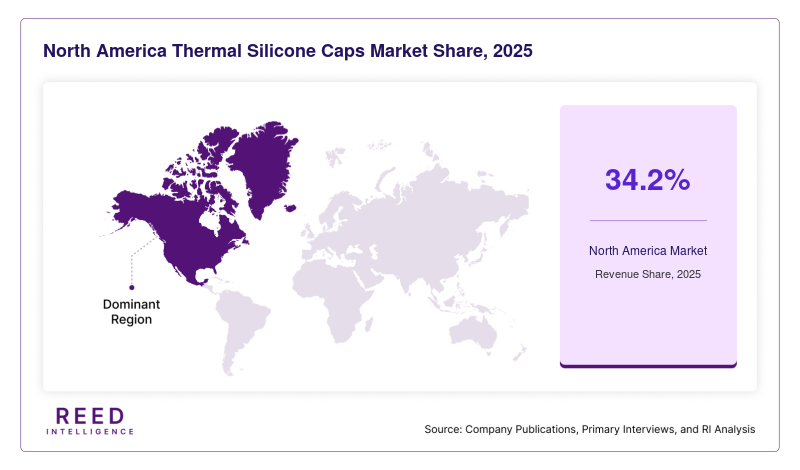
North America accounted for a 34.2% market share in 2025, and the region is projected to grow at a CAGR of 8.7% from 2026 to 2034. The region’s dominance is supported by a strong industrial base in electronics, automotive manufacturing, and aerospace production, where thermal silicone caps are widely used for precision masking and thermal protection applications. Advanced manufacturing technologies, coupled with high automation levels, continue to drive demand for reusable and high-performance silicone components across production facilities. Additionally, the presence of leading semiconductor fabrication plants and electric vehicle manufacturing hubs further strengthens market growth across the region.
The United States remains the dominant country in North America, supported by its leadership in semiconductor innovation and EV production ecosystems. A key growth factor is the rapid expansion of automated manufacturing facilities that require high-durability masking solutions capable of withstanding continuous thermal processing cycles. Increasing investment in advanced robotics and smart factories is also enhancing the adoption of silicone-based thermal protection products across industrial applications.
Europe
Europe held a 27.5% market share in 2025, with a projected CAGR of 8.3% during 2026–2034. The region benefits from strong automotive manufacturing capabilities and strict industrial quality standards, which drive the adoption of high-performance thermal masking solutions. Countries across Europe are increasingly focusing on sustainable manufacturing practices, which has led to greater demand for reusable and long-life silicone-based components. The presence of advanced engineering industries and precision manufacturing sectors further supports market expansion.
Germany leads the European market due to its robust automotive and industrial machinery sectors. A major growth factor is the rapid transition toward electric mobility and the increasing production of EV components, which require reliable thermal protection during manufacturing. Additionally, the country’s emphasis on Industry 4.0 technologies and smart manufacturing systems is accelerating the integration of advanced silicone masking solutions.
Asia Pacific
Asia Pacific accounted for 29.8% share in 2025 and is expected to register the fastest CAGR of 11.2% from 2026 to 2034. The region’s growth is driven by large-scale electronics manufacturing, semiconductor production, and expanding automotive industries. Rapid industrialization, combined with the presence of major manufacturing hubs, is significantly increasing demand for thermal silicone caps. The region is also witnessing strong adoption of automation and advanced production technologies.
China dominates the Asia Pacific market due to its extensive electronics and EV manufacturing ecosystem. A key growth factor is the expansion of export-oriented manufacturing industries that require high-volume production and precision masking solutions. Additionally, government support for semiconductor self-sufficiency and EV adoption is further boosting market demand across industrial sectors.
Middle East & Africa
The Middle East & Africa region accounted for 5.4% market share in 2025, with a projected CAGR of 7.9% during 2026–2034. The region is gradually diversifying from oil-dependent economies toward industrial and manufacturing sectors. This transition is increasing the adoption of advanced industrial materials, including thermal silicone caps, for use in emerging production facilities. Infrastructure development and industrial modernization initiatives are also contributing to market growth.
Saudi Arabia leads the regional market, supported by large-scale investments in industrial diversification programs under national development strategies. A key growth factor is the establishment of advanced manufacturing zones and industrial clusters that require high-performance materials for production efficiency and quality control.
Latin America
Latin America accounted for 3.1% market share in 2025, with a projected CAGR of 7.6% through 2034. The region is experiencing gradual industrial expansion, particularly in automotive manufacturing and consumer electronics assembly. Increasing foreign direct investment is supporting the development of manufacturing infrastructure, which is driving demand for thermal silicone caps in production processes.
Brazil is the leading country in the region due to its growing automotive manufacturing industry. A key growth factor is the increasing adoption of cost-effective industrial masking solutions to improve production efficiency and reduce manufacturing defects in automotive and electronics assembly operations.
Competitive Landscape
The Thermal Silicone Caps Market is moderately consolidated, with leading players focusing on product innovation, material enhancement, and global distribution expansion. Key companies include manufacturers specializing in industrial silicone components and precision masking solutions. The market leader continues to strengthen its position through customized product offerings and partnerships with electronics and automotive manufacturers. Recent development activities include the introduction of high-temperature resistant silicone caps designed for automated production lines, improving compatibility with robotic manufacturing systems and reducing operational downtime across industrial applications.
Key Players
- Saint-Gobain Performance Plastics
- Caplugs
- Marco Rubber & Plastics
- Elkem Silicones
- Wacker Chemie AG
- Dow Inc.
- Freudenberg Sealing Technologies
- 3M Company
- Shin-Etsu Chemical Co., Ltd.
- Stockwell Elastomerics
- SIMONA AG
- Trelleborg AB
- Rogers Corporation
- Avery Dennison Performance Tapes
- Minor Rubber Products
Recent Developments
- In 2025, manufacturers in the Thermal Silicone Caps Market expanded production capabilities by integrating advanced injection molding and precision forming technologies to improve dimensional accuracy and thermal resistance performance of caps used in electronics and automotive masking applications.
- In 2025, several global silicone component producers introduced next-generation high-temperature thermal silicone caps designed specifically for automated coating lines, enhancing compatibility with robotic handling systems and reducing failure rates in high-throughput manufacturing environments.
- In 2024, leading industrial polymer suppliers implemented material innovation programs focused on developing reinforced silicone compounds with improved elasticity and chemical resistance, supporting longer product life cycles in semiconductor and aerospace applications.
- In 2024, key market participants strengthened their global distribution networks through partnerships with electronics manufacturing service providers across Asia Pacific and Europe, enabling faster supply chain responsiveness and improved availability of thermal masking solutions in high-demand regions.
Thermal Silicone Caps Market Segments
By Type
- High-Temperature Silicone Caps
- Specialty Engineered Silicone Caps
- Standard Silicone Caps
By Application
- Electronics Manufacturing
- Electric Vehicles
- Industrial Equipment
- Aerospace & Defense
- Energy Systems
By End-Use
- Automotive Manufacturing
- Electronics & Semiconductors
- Aerospace Industry
- Energy & Utilities
- Industrial Manufacturing
By Region
- North America
- Europe
- APAC
- Middle East and Africa
- LATAM