Thermodilution Catheter Market Size, Share Demand Report By Type (Pulmonary Artery Catheters, Disposable Catheters, Reusable Catheters, Specialized Thermodilution Catheters), By Application (Cardiac Output Monitoring, Critical Care Monitoring, Pulmonary Pressure Monitoring, Surgical and Diagnostic Procedures), By End-Use (Hospitals, Ambulatory Surgical Centers, Specialty Clinics, Research and Academic Institutes), By Region & Segment Forecasts, 2026–2034
USD 3950
Market Overview
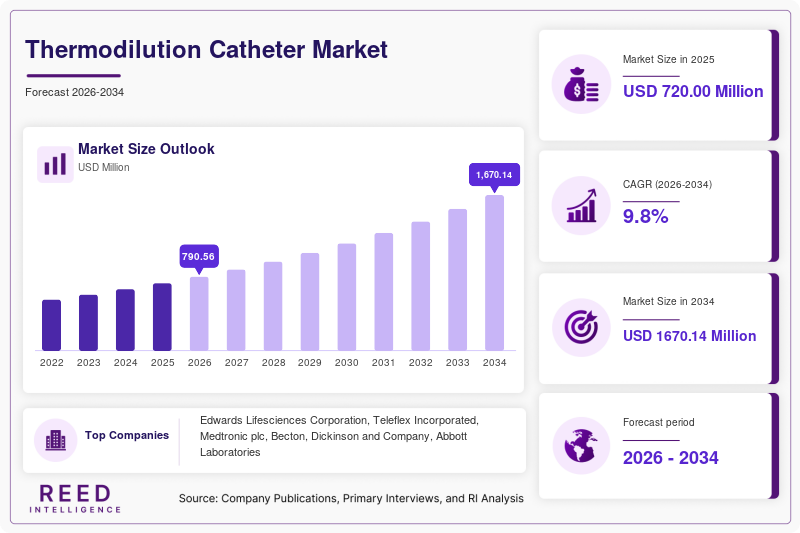
The Thermodilution Catheter Market size was valued at approximately USD 720 million in 2026 and is projected to reach around USD 1520 million by 2034, expanding at a compound annual growth rate (CAGR) of 9.8% during the forecast period (2026–2034). The market growth is largely supported by the rising global burden of cardiovascular diseases, which continues to increase the demand for advanced hemodynamic monitoring solutions in critical care settings. Thermodilution catheters are widely used for cardiac output measurement and pulmonary artery pressure monitoring, making them essential in intensive care units and cardiac procedures.
The increasing prevalence of minimally invasive procedures has also contributed significantly to market expansion. Healthcare providers are increasingly adopting catheter-based technologies due to their ability to provide real-time physiological data with improved patient outcomes. Moreover, advancements in catheter materials and integration with digital monitoring systems are further strengthening market penetration across developed and emerging economies.
Key Highlights
- North America dominated the market with a 36.4% share in 2025.
- Asia Pacific is expected to grow at the fastest CAGR of 11.6% during 2026–2034.
- By type, pulmonary artery catheters accounted for the largest share of 44.1%.
- while disposable catheters are projected to grow at a CAGR of 12.2%.
- By application, cardiac output monitoring led with a 48.6% share, whereas critical care monitoring is expected to expand at a CAGR of 11.9%.
- The United States remained the dominant country, with market values of USD 285 million in 2024 and USD 312 million in 2025.
Market Trends
Integration of Digital Monitoring and Smart Catheter Technologies
A key trend shaping the thermodilution catheter market is the increasing integration of digital monitoring capabilities with catheter systems. Modern thermodilution catheters are being designed with embedded sensors and connectivity features that enable seamless data transmission to centralized monitoring systems. This advancement allows healthcare professionals to obtain real-time insights into cardiac output and other hemodynamic parameters without manual intervention. Hospitals are prioritizing such technologies to enhance patient monitoring efficiency and reduce clinical errors. The growing adoption of electronic health records (EHRs) and hospital information systems further supports this integration, enabling comprehensive patient data analysis. As a result, manufacturers are focusing on developing smart catheter solutions that combine precision, automation, and data analytics, driving innovation in the market.
Rising Preference for Disposable and Infection-Control Solutions
Another notable trend is the increasing preference for disposable thermodilution catheters due to heightened concerns about hospital-acquired infections. Reusable devices pose risks related to improper sterilization, prompting healthcare facilities to shift toward single-use solutions that ensure patient safety. This trend has gained momentum particularly after global health crises, where infection control became a priority across healthcare systems. Disposable catheters also reduce maintenance costs and streamline workflow in busy clinical environments. Manufacturers are responding by introducing cost-effective disposable variants with improved materials that maintain accuracy and durability. The trend is expected to accelerate further as regulatory bodies emphasize stricter hygiene standards, thereby supporting sustained market growth.
Market Drivers
Increasing Prevalence of Cardiovascular and Critical Care Conditions
The growing incidence of cardiovascular diseases worldwide is a major driver of the thermodilution catheter market. Conditions such as heart failure, coronary artery disease, and pulmonary hypertension require continuous monitoring of cardiac function, which is effectively achieved through thermodilution techniques. Aging populations and lifestyle-related risk factors such as obesity and hypertension are contributing to a steady rise in these conditions. Hospitals and intensive care units are therefore investing in advanced hemodynamic monitoring tools to manage critically ill patients. Thermodilution catheters provide accurate and reliable measurements, making them indispensable in cardiac surgeries and critical care management. This rising clinical demand is expected to sustain long-term market growth.
Expansion of Healthcare Infrastructure in Emerging Economies
Another significant driver is the rapid expansion of healthcare infrastructure in emerging markets. Countries in Asia Pacific, Latin America, and the Middle East are increasing investments in hospital construction, medical equipment, and critical care facilities. Governments and private healthcare providers are focusing on improving access to advanced medical technologies, including hemodynamic monitoring systems. As a result, the adoption of thermodilution catheters is increasing in these regions. Additionally, growing medical tourism and the establishment of specialized cardiac care centers are further boosting demand. The combination of improved healthcare access and rising awareness among clinicians is creating favorable conditions for market expansion.
Market Restraint
High Cost of Advanced Catheter Systems and Limited Accessibility
One of the primary restraints in the thermodilution catheter market is the high cost associated with advanced catheter systems and monitoring equipment. These devices require significant investment not only for procurement but also for maintenance and training of healthcare professionals. In developing regions, budget constraints often limit the adoption of such technologies, particularly in smaller hospitals and clinics. Additionally, the need for skilled personnel to operate thermodilution systems can act as a barrier, as inadequate training may affect the accuracy of measurements. This cost-related challenge impacts market penetration, especially in low- and middle-income countries, where healthcare budgets are limited. Consequently, despite the clinical benefits of thermodilution catheters, their adoption remains uneven across different regions.
Market Opportunities
Growth Potential in Minimally Invasive Cardiac Procedures
The increasing shift toward minimally invasive cardiac procedures presents a significant opportunity for the thermodilution catheter market. These procedures require precise monitoring of cardiac output and hemodynamic parameters, which thermodilution catheters can provide effectively. As patients and healthcare providers prefer less invasive treatment options with shorter recovery times, the demand for catheter-based monitoring solutions is rising. Innovations in catheter design, including smaller sizes and enhanced flexibility, are making them more suitable for minimally invasive interventions. This trend is expected to create new growth avenues for manufacturers, particularly in advanced healthcare settings.
Technological Advancements and Product Innovation
Continuous technological advancements are opening new opportunities in the market. Companies are investing in research and development to improve catheter accuracy, durability, and ease of use. The integration of artificial intelligence and data analytics into monitoring systems is enabling predictive insights and better clinical decision-making. Additionally, the development of hybrid catheters that combine multiple monitoring functions is gaining traction. These innovations not only enhance clinical outcomes but also improve operational efficiency in healthcare facilities. As technology continues to evolve, the thermodilution catheter market is expected to benefit from increased adoption and expanded application areas.
Segmental Analysis
By Type
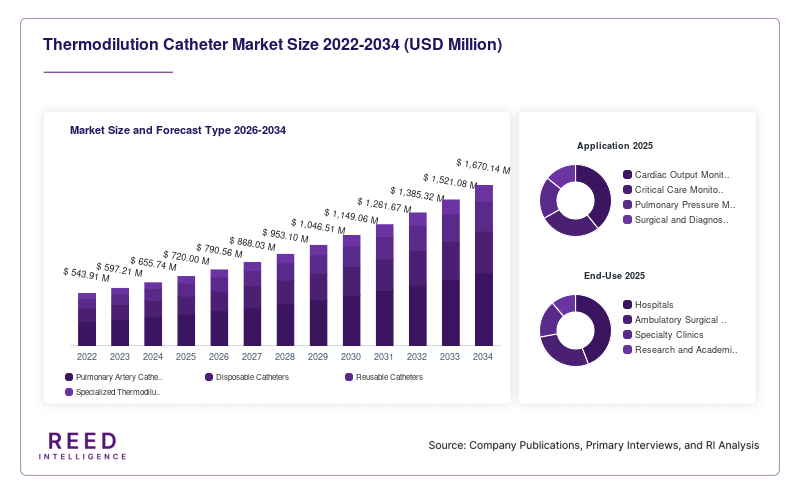
Pulmonary artery catheters dominated the market with a share of 44.1% in 2024, owing to their widespread use in cardiac output measurement and critical care monitoring. These catheters are considered the standard for hemodynamic assessment, providing accurate and reliable data. Their adoption is particularly high in intensive care units and during complex cardiac surgeries. The ability of pulmonary artery catheters to measure multiple parameters simultaneously makes them essential in managing critically ill patients. Additionally, advancements in catheter design have improved their safety and usability, further supporting their dominance in the market.
Disposable catheters are expected to be the fastest-growing subsegment, with a CAGR of 12.2% during the forecast period. The increasing focus on infection control and patient safety is driving the demand for single-use devices. Hospitals are adopting disposable catheters to reduce the risk of cross-contamination and streamline clinical workflows. Moreover, the development of cost-effective disposable solutions is making them more accessible to healthcare facilities. This trend is expected to continue as regulatory bodies emphasize stricter hygiene standards and infection prevention measures.
By Application
Cardiac output monitoring accounted for the largest share of 48.6% in 2024, driven by the growing need for accurate assessment of cardiac function in critically ill patients. Thermodilution catheters are widely used for this purpose due to their precision and reliability. The increasing prevalence of cardiovascular diseases and the rising number of cardiac surgeries are key factors supporting this segment’s dominance. Hospitals and healthcare providers rely on these devices to guide treatment decisions and improve patient outcomes.
Critical care monitoring is projected to grow at the fastest CAGR of 11.9% during the forecast period. The increasing demand for advanced monitoring solutions in intensive care units is driving this growth. Thermodilution catheters play a crucial role in managing patients with severe conditions, providing real-time data that helps clinicians make informed decisions. The expansion of critical care facilities and the adoption of advanced technologies are further supporting this segment’s growth.
By End-Use
Hospitals dominated the market with a share of 52.3% in 2024, as they are the primary users of thermodilution catheters. The availability of advanced infrastructure and skilled healthcare professionals enables hospitals to perform complex procedures and provide comprehensive patient care. The increasing number of hospital admissions for cardiovascular conditions is further driving demand for these devices. Additionally, hospitals are investing in advanced monitoring systems to improve patient outcomes and operational efficiency.
Ambulatory surgical centers are expected to grow at the fastest CAGR of 10.8% during the forecast period. The shift toward outpatient procedures and minimally invasive surgeries is driving the demand for thermodilution catheters in these settings. These centers offer cost-effective treatment options and shorter recovery times, making them an attractive choice for patients. The increasing adoption of advanced medical technologies in ambulatory settings is further supporting this segment’s growth.
Regional Analysis
North America
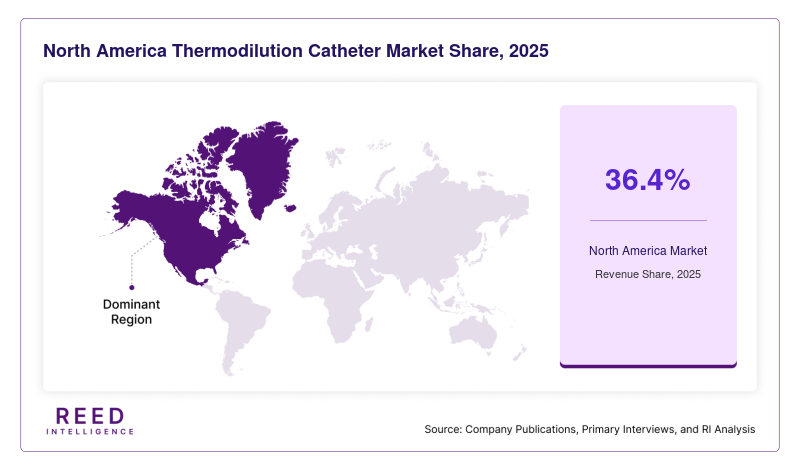
North America held a dominant share of 36.4% in 2025 and is expected to maintain steady growth at a CAGR of 8.7% during the forecast period. The region benefits from a well-established healthcare infrastructure and high adoption of advanced medical technologies. The presence of leading market players and strong reimbursement frameworks further supports market growth. Additionally, the increasing prevalence of cardiovascular diseases continues to drive demand for thermodilution catheters in hospitals and specialized care centers.
The United States remains the dominant country in this region due to its advanced healthcare system and high healthcare expenditure. A unique growth factor is the widespread use of advanced monitoring systems in intensive care units, supported by continuous technological innovation. The country’s focus on improving patient outcomes through precision medicine is further accelerating the adoption of thermodilution catheters.
Europe
Europe accounted for a significant share of 28.1% in 2025 and is projected to grow at a CAGR of 8.9% through 2034. The region’s growth is driven by increasing healthcare investments and a rising aging population. Countries across Europe are focusing on enhancing critical care infrastructure, which supports the adoption of advanced monitoring technologies.
Germany is the dominant country in this region, supported by its strong healthcare system and emphasis on medical technology innovation. A unique growth factor is the increasing collaboration between research institutions and medical device manufacturers, leading to the development of improved catheter solutions.
Asia Pacific
Asia Pacific is expected to witness the fastest growth, with a CAGR of 11.6% during the forecast period. The region accounted for 22.5% of the market in 2025, driven by rapid urbanization and increasing healthcare expenditure. The expansion of hospital networks and rising awareness of advanced medical technologies are key factors contributing to market growth.
China is the leading country in this region, supported by large-scale healthcare reforms and infrastructure development. A unique growth factor is the government’s focus on expanding access to advanced medical care in rural areas, which is boosting the adoption of thermodilution catheters.
Middle East & Africa
The Middle East & Africa region held a smaller share of 7.3% in 2025 but is expected to grow at a CAGR of 9.2% through 2034. The market is driven by increasing investments in healthcare infrastructure and the establishment of modern hospitals and clinics. Governments are focusing on improving healthcare services, which is supporting market growth.
Saudi Arabia is the dominant country in this region, driven by its investments in healthcare modernization. A unique growth factor is the development of specialized cardiac care centers, which are increasing the demand for advanced monitoring devices such as thermodilution catheters.
Latin America
Latin America accounted for 5.7% of the market in 2025 and is projected to grow at a CAGR of 9.0% during the forecast period. The region is witnessing gradual improvements in healthcare infrastructure and increased adoption of advanced medical technologies.
Brazil is the leading country in this region, supported by its growing healthcare sector. A unique growth factor is the increasing focus on public healthcare initiatives aimed at improving access to critical care services, which is driving demand for thermodilution catheters.
Competitive Landscape
The thermodilution catheter market is characterized by the presence of several established players competing based on product innovation, quality, and pricing strategies. Leading companies are focusing on research and development to introduce advanced catheter solutions with improved accuracy and safety. Strategic collaborations, mergers, and acquisitions are also common as companies aim to expand their market presence.
A leading player in the market is Edwards Lifesciences Corporation, known for its strong portfolio of hemodynamic monitoring solutions. The company has recently introduced advanced catheter systems integrated with digital monitoring platforms, enhancing clinical efficiency. Other key players are also investing in product innovation and expanding their global footprint to strengthen their competitive position.
Key Players
- Edwards Lifesciences Corporation
- Teleflex Incorporated
- ICU Medical, Inc.
- Becton, Dickinson and Company
- Medtronic plc
- Getinge AB
- Boston Scientific Corporation
- Abbott Laboratories
- Smiths Medical
- Argon Medical Devices
- Merit Medical Systems
- Vygon SA
- Cook Medical
- Terumo Corporation
- AngioDynamics, Inc.
Recent Developments
- A major medical device company launched an advanced thermodilution catheter with integrated digital monitoring features to enhance real-time data accuracy.
- A leading manufacturer expanded its production capacity to meet the growing demand for disposable catheters in global markets.
- A strategic partnership between two healthcare companies focused on developing next-generation catheter technologies with improved safety and efficiency.
Thermodilution Catheter Market Segments
Type
- Pulmonary Artery Catheters
- Disposable Catheters
- Reusable Catheters
- Specialized Thermodilution Catheters
Application
- Cardiac Output Monitoring
- Critical Care Monitoring
- Pulmonary Pressure Monitoring
- Surgical and Diagnostic Procedures
End-Use
- Hospitals
- Ambulatory Surgical Centers
- Specialty Clinics
- Research and Academic Institutes
By Region
- North America
- Europe
- APAC
- Middle East and Africa
- LATAM