Thiamine Hydrochloride Injection Market Size, Share & Demand Report By Application (Deficiency Treatment, Critical Care/Emergency Use, Nutritional Support), By End-Use (Hospitals, Clinics, Ambulatory Surgical Centers), By Distribution Channel (Hospital Pharmacies, Retail Pharmacies, Online Pharmacies), By Region & Segment Forecasts, 2025–2034
USD 3950
Market Overview
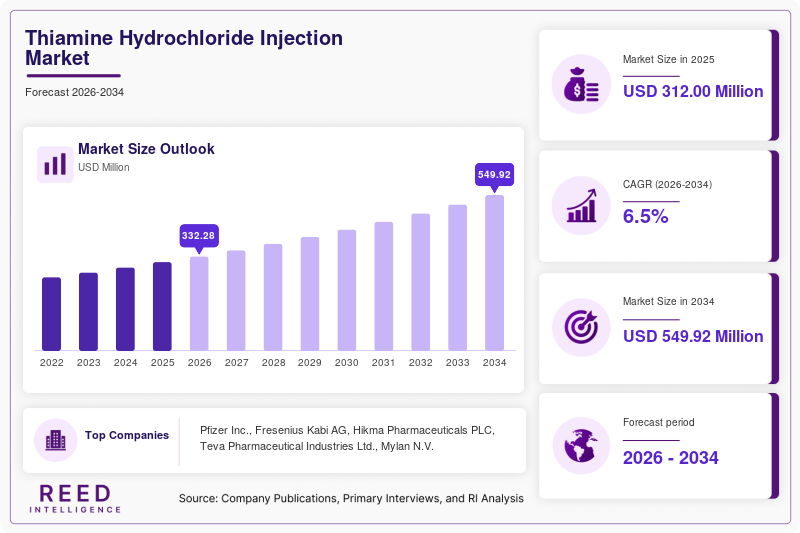
The global Thiamine Hydrochloride Injection Market size was valued at approximately USD 312 million in 2025 and is projected to reach USD 548 million by 2034, expanding at a CAGR of 6.5% during the forecast period (2025–2034). The market growth is being supported by the rising prevalence of vitamin B1 deficiencies associated with malnutrition, chronic alcoholism, and metabolic disorders, particularly in developing and underserved regions. Increasing clinical awareness regarding early diagnosis and treatment of neurological conditions such as Wernicke’s encephalopathy has also contributed to the demand for injectable thiamine formulations.
Additionally, the growing adoption of parenteral nutrition in hospital settings has strengthened the role of thiamine hydrochloride injections in emergency and critical care. The expansion of healthcare infrastructure across emerging economies and improved access to essential medicines are further influencing market growth. Pharmaceutical manufacturers are also focusing on enhancing product availability through improved distribution networks and regulatory approvals.
Key Highlights
- North America dominated the market with a 36.8% share in 2025, while Asia Pacific is expected to register the fastest CAGR of 7.9% during the forecast period.
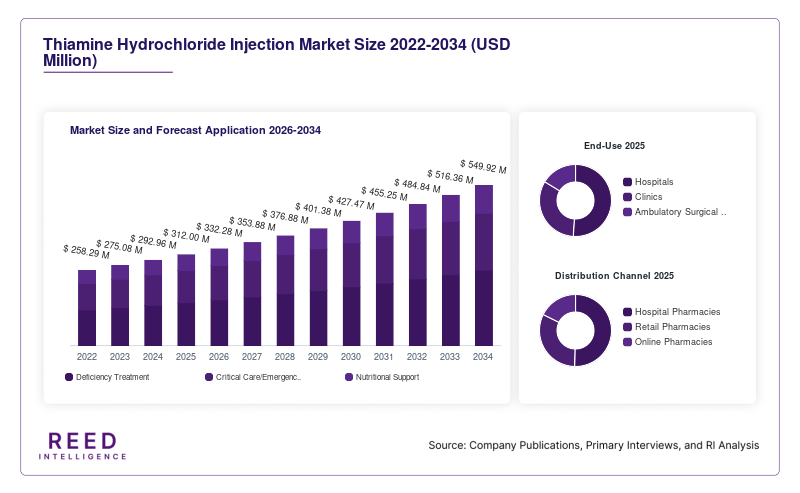
- By application, deficiency treatment held the largest share of 48.2%, while critical care/emergency use is anticipated to grow at a CAGR of 7.6%.
- By end-use, hospitals accounted for the highest share of 55.4%, whereas ambulatory surgical centers are projected to expand at a CAGR of 7.2%.
- The United States remained the dominant country with market values of USD 102 million in 2025 and USD 108 million in 2026.
Market Trends
Increasing Integration in Emergency Care Protocols
A notable trend in the Thiamine Hydrochloride Injection Market is the growing integration of thiamine injections into emergency care protocols, particularly for patients presenting with altered mental status, sepsis, or suspected nutritional deficiencies. Healthcare providers are increasingly administering thiamine alongside other treatments to prevent neurological complications. This shift is enhancing the routine use of injectable thiamine in acute care settings, thereby expanding its clinical scope.
Expansion of Generic Injectable Manufacturing
Another important trend is the expansion of generic injectable drug manufacturing. Several pharmaceutical companies are investing in cost-effective production of thiamine hydrochloride injections to meet rising global demand. This trend is improving affordability and accessibility, especially in low- and middle-income countries. As regulatory pathways for generics become more streamlined, the availability of multiple suppliers is expected to intensify competition and support market growth.
Market Drivers
Rising Incidence of Nutritional Deficiencies
The increasing prevalence of nutritional deficiencies, particularly vitamin B1 deficiency, is a key driver of the Thiamine Hydrochloride Injection Market. Factors such as poor dietary habits, chronic illnesses, and alcohol dependence contribute to widespread deficiency cases. Injectable thiamine is often preferred in severe conditions due to its rapid absorption and effectiveness, thereby driving demand.
Growth in Hospital-Based Treatments
The expanding number of hospital admissions and the growing reliance on intravenous therapies are significantly boosting the demand for thiamine hydrochloride injections. Hospitals require immediate and effective treatment options for patients with acute deficiencies, making injectable formulations a critical component of treatment protocols. This trend is further supported by advancements in hospital infrastructure and increasing healthcare expenditure globally.
Market Restraint
Limited Awareness in Low-Income Regions
One of the major challenges facing the Thiamine Hydrochloride Injection Market is the limited awareness regarding vitamin B1 deficiency and its complications in low-income and rural regions. In many parts of the world, symptoms of deficiency are often misdiagnosed or overlooked, leading to delayed treatment. This lack of awareness restricts the adoption of thiamine injections, despite their clinical importance.
Additionally, inadequate healthcare infrastructure and limited access to injectable drugs further constrain market growth in these regions. The absence of trained healthcare professionals capable of administering intravenous therapies also contributes to underutilization. While global health organizations are working to address these gaps, progress remains uneven, thereby impacting the overall market expansion.
Market Opportunities
Expansion in Emerging Healthcare Markets
Emerging economies present significant growth opportunities for the Thiamine Hydrochloride Injection Market. Rapid urbanization, improving healthcare systems, and increasing government initiatives to address malnutrition are creating a favorable environment for market expansion. Pharmaceutical companies can leverage these opportunities by strengthening distribution channels and forming strategic partnerships.
Development of Combination Injectable Therapies
The development of combination therapies that include thiamine along with other essential vitamins and nutrients is another promising opportunity. Such formulations are increasingly being used in critical care and nutritional therapy, offering enhanced clinical benefits. This innovation is expected to attract healthcare providers seeking comprehensive treatment solutions, thereby boosting market growth.
Segmental Analysis
By Application
The deficiency treatment segment dominated the Thiamine Hydrochloride Injection Market in 2025, accounting for 48.2% of the total share. This dominance was attributed to the high prevalence of vitamin B1 deficiency conditions and the widespread use of injections for immediate therapeutic effect.
The critical care/emergency use segment is expected to grow at the fastest CAGR of 7.6% during the forecast period. The increasing need for rapid intervention in acute conditions, such as neurological disorders and severe malnutrition, will drive the growth of this segment.
By End-Use
Hospitals held the largest share of 55.4% in 2025, owing to the high volume of patient admissions and the availability of advanced treatment facilities. Hospitals remain the primary setting for administering injectable therapies.
Ambulatory surgical centers are projected to grow at a CAGR of 7.2%. The shift towards outpatient care and cost-effective treatment options is expected to drive the adoption of thiamine injections in these facilities.
By Distribution Channel
Hospital pharmacies dominated the market with a share of 52.1% in 2025. The availability of a wide range of injectable drugs and direct access to patients contributed to this dominance.
Online pharmacies are expected to witness the fastest growth at a CAGR of 8.1%. The increasing adoption of digital healthcare platforms and the convenience of online purchasing are key factors driving this segment.
Regional Analysis
North America
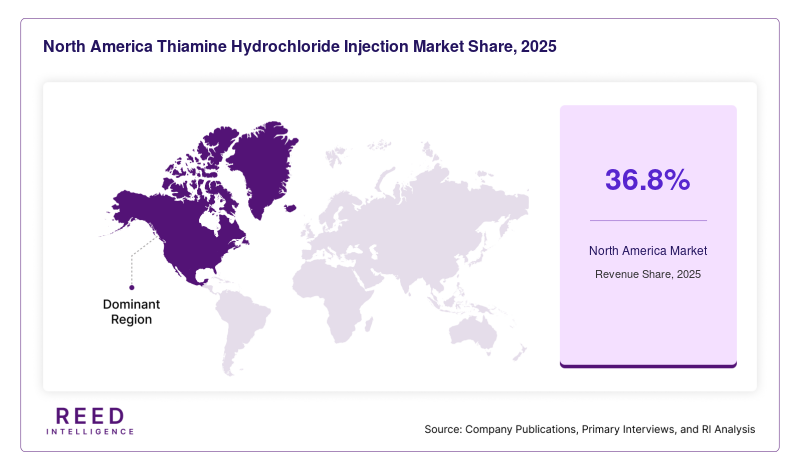
North America accounted for 36.8% of the Thiamine Hydrochloride Injection Market share in 2025 and is expected to grow at a CAGR of 5.9% during the forecast period. The region’s growth is driven by advanced healthcare infrastructure and high awareness regarding nutritional deficiencies.
The United States dominated the regional market due to the widespread use of injectable therapies in hospitals. A key growth factor is the increasing adoption of preventive healthcare practices, where early intervention using thiamine injections helps reduce complications associated with deficiencies.
Europe
Europe held a 27.4% share of the market in 2025 and is projected to grow at a CAGR of 6.1%. The region benefits from strong regulatory frameworks and well-established healthcare systems.
Germany emerged as the dominant country, driven by its focus on clinical research and efficient healthcare delivery. The country’s emphasis on early diagnosis and treatment of metabolic disorders has contributed to increased demand for thiamine injections.
Asia Pacific
Asia Pacific captured 21.6% of the market in 2025 and is anticipated to register the fastest CAGR of 7.9%. The region’s growth is fueled by rising healthcare investments and increasing awareness of nutritional health.
China led the regional market due to its large population and expanding healthcare infrastructure. Government initiatives to combat malnutrition and improve access to essential medicines have significantly boosted demand for thiamine hydrochloride injections.
Middle East & Africa
The Middle East & Africa accounted for 7.2% of the market share in 2025 and is expected to grow at a CAGR of 6.8%. Growth in this region is supported by improving healthcare facilities and increasing focus on public health programs.
Saudi Arabia dominated the region, driven by its investments in healthcare modernization. The country’s efforts to enhance hospital capacity and introduce advanced treatment options have supported market growth.
Latin America
Latin America held a 7.0% share of the market in 2025 and is projected to grow at a CAGR of 6.4%. The region is witnessing steady growth due to improving healthcare access and rising awareness of nutritional deficiencies.
Brazil emerged as the leading country, supported by its expanding healthcare sector. Increased government initiatives to address malnutrition and improve medical infrastructure have contributed to the demand for thiamine injections.
Competitive Landscape
The Thiamine Hydrochloride Injection Market is characterized by the presence of several global and regional players focusing on product quality, regulatory compliance, and distribution expansion. The market remains moderately fragmented, with companies competing on pricing and availability.
A leading player in the market has been actively investing in expanding its injectable portfolio and strengthening its global supply chain. Recent developments include the introduction of improved formulations designed for enhanced stability and longer shelf life.
Other key players are focusing on partnerships and collaborations to increase their market presence. Continuous efforts in research and development, along with strategic expansions into emerging markets, are shaping the competitive landscape.
Key Players List
- Pfizer Inc.
- Fresenius Kabi AG
- Hikma Pharmaceuticals PLC
- Teva Pharmaceutical Industries Ltd.
- Mylan N.V.
- Baxter International Inc.
- Aurobindo Pharma Limited
- Cipla Limited
- Zydus Lifesciences Limited
- Sun Pharmaceutical Industries Ltd.
- Dr. Reddy’s Laboratories Ltd.
- Amneal Pharmaceuticals Inc.
- Lupin Limited
- Torrent Pharmaceuticals Ltd.
- Alkem Laboratories Ltd.
Recent Developments
- Expansion of generic injectable production facilities by key pharmaceutical companies to meet global demand.
- Introduction of improved packaging solutions to enhance drug stability and shelf life.
- Strategic collaborations between manufacturers and healthcare providers to improve supply chain efficiency.
- Increased regulatory approvals for generic thiamine hydrochloride injections in emerging markets.
- Investment in research for combination injectable therapies targeting critical care applications.
Thiamine Hydrochloride Injection Market Segments
Application
- Deficiency Treatment
- Critical Care/Emergency Use
- Nutritional Support
End-Use
- Hospitals
- Clinics
- Ambulatory Surgical Centers
Distribution Channel
- Hospital Pharmacies
- Retail Pharmacies
- Online Pharmacies
By Region
- North America
- Europe
- APAC
- Middle East and Africa
- LATAM