Thin Papers Market Size, Share & Demand Report By Product Type (Cigarette Papers, Decorative Papers, Bible Papers, Tracing Papers), By Material Type (Wood Pulp, Recycled Fiber), By Application (Printing & Publishing, Packaging, Tobacco Products), By End-Use Industry (Publishing Industry, Packaging Industry, Tobacco Industry, Construction & Interiors, Commercial Printing), By Region & Segment Forecasts, 2026–2034
USD 3950
Market Overview
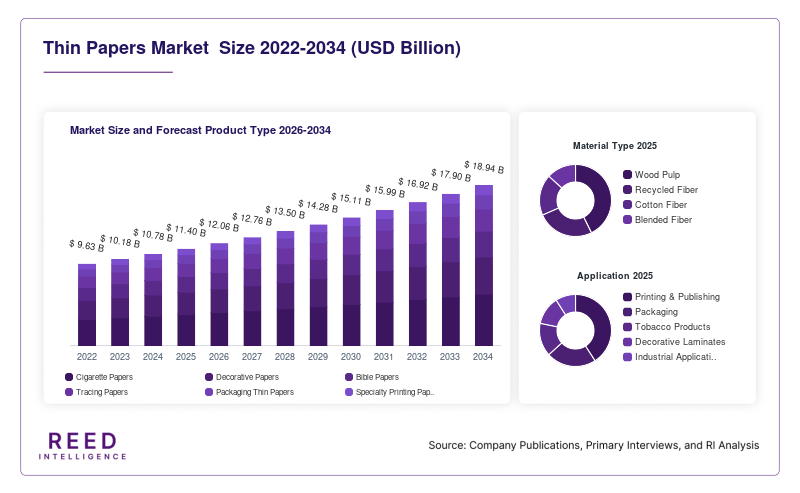
The Thin Papers Market size was valued at USD 11.4 billion in 2026 and is projected to reach USD 17.9 billion by 2034, expanding at a CAGR of 5.8% during the forecast period (2026–2034). The market growth has been supported by the increasing demand for lightweight, sustainable, and cost-efficient paper materials across packaging, printing, labeling, food wrapping, and specialty industrial applications. Thin papers are widely used in cigarette papers, bible papers, lightweight packaging sheets, decorative laminates, release liners, and tissue-grade products because of their low basis weight, flexibility, and improved printability.
The global transition toward sustainable packaging materials and eco-friendly paper-based alternatives has significantly contributed to the expansion of the Thin Papers Market. Manufacturers are increasingly developing recyclable and biodegradable paper products to reduce dependence on plastic-based flexible packaging materials. The rapid growth of e-commerce, food delivery services, premium packaging applications, and specialty printing industries has also strengthened the market outlook across developed and emerging economies.
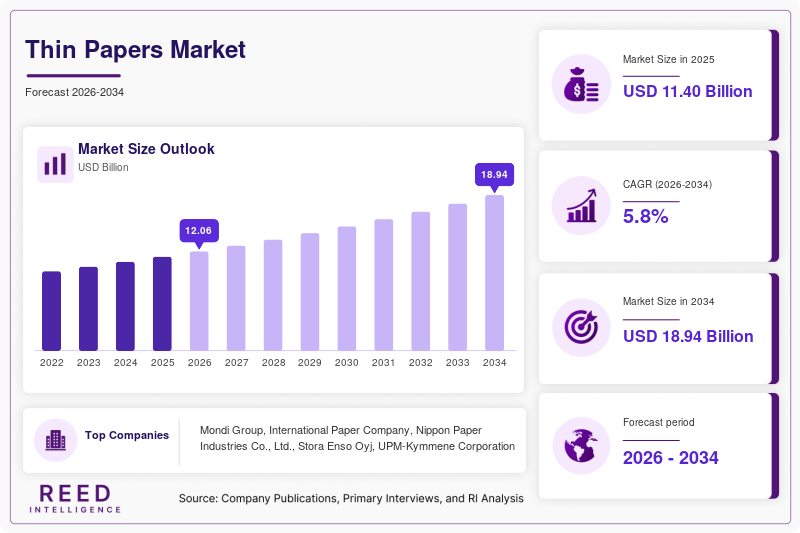
Key Highlights
- Europe accounted for 32.6% of the global Thin Papers Market share in 2025, while Asia Pacific is projected to register the fastest CAGR of 6.9% during 2026–2034.
- By product type, cigarette papers held the largest market share of 28.9% in 2025, whereas specialty packaging papers are expected to grow at a CAGR of 7.2% during the forecast period.
- By material type, wood pulp-based thin papers accounted for 61.3% of the market share in 2025, while recycled fiber papers are projected to witness a CAGR of 6.8%.
- By application, packaging applications represented 34.5% of the global market share in 2025, while healthcare and hygiene applications are anticipated to expand at a CAGR of 7.1%.
- Germany dominated the European Thin Papers Market with market values of USD 1.14 billion in 2024 and USD 1.19 billion in 2025.
Market Trends
Rising Demand for Sustainable Lightweight Packaging
Packaging manufacturers are increasingly adopting thin paper materials as sustainable alternatives to plastic films and multilayer packaging materials. Lightweight thin papers help reduce packaging weight, transportation costs, and material usage while supporting recycling objectives. Food packaging, retail wrapping, and consumer goods applications are increasingly shifting toward biodegradable thin paper solutions due to changing environmental regulations and consumer preferences for eco-friendly packaging.
Growing Adoption of Specialty Thin Papers in Premium Printing
The commercial printing and publishing industries are increasingly utilizing thin papers with enhanced opacity and print quality for catalogs, religious books, premium inserts, and lightweight publications. Manufacturers are developing ultra-thin papers with improved brightness and smoothness to support high-speed printing applications. The demand for lightweight yet durable printing substrates is expected to remain strong in publishing and advertising sectors.
Market Drivers
Expansion of Flexible Packaging Industry
The rapid expansion of the global flexible packaging sector has significantly supported the growth of the Thin Papers Market. Thin paper materials are increasingly being used in wrapping, pouches, labels, and laminated packaging applications due to their lightweight characteristics and sustainability advantages. Food processing companies, personal care brands, and retail packaging manufacturers are investing in paper-based flexible packaging formats to reduce environmental impact and improve recyclability.
Increasing Preference for Recyclable Paper Products
Governments and industries across multiple regions are promoting the use of recyclable and biodegradable packaging materials. Thin papers manufactured using sustainable pulp sources and recycled fibers are gaining widespread acceptance among industrial users and consumers. Growing awareness regarding environmental sustainability and waste reduction is accelerating the adoption of thin paper products in commercial and industrial applications.
Market Restraint
Volatility in Raw Material and Energy Costs
Fluctuations in pulp prices, energy costs, and transportation expenses continue to challenge thin paper manufacturers. The paper production process remains energy intensive, and rising operational costs can affect profit margins and product pricing. Small and medium-sized manufacturers are particularly vulnerable to raw material supply instability and increasing production expenses.
Market Opportunities
Development of High-Performance Specialty Papers
Manufacturers are investing in advanced thin paper grades with improved moisture resistance, printability, barrier properties, and durability. Specialty thin papers designed for industrial filtration, medical packaging, and premium labeling applications are expected to create new revenue opportunities for market participants during the forecast period.
Growth of E-Commerce Packaging Applications
The rapid expansion of e-commerce platforms and online retail activities is increasing the demand for lightweight and sustainable protective packaging materials. Thin paper solutions are increasingly used in wrapping, cushioning, and branded packaging inserts. Rising investments in sustainable e-commerce packaging infrastructure are expected to support market growth globally.
Segmental Analysis
By Product Type
Based on product type, the market is segmented into cigarette papers, decorative papers, bible papers, tissue papers, specialty packaging papers, and others.
Cigarette papers accounted for the largest market share of 28.9% in 2025 due to their extensive usage in tobacco manufacturing and rolling paper applications. These papers require precise thickness, porosity, and combustion characteristics, leading to stable industrial demand across multiple countries.
Specialty packaging papers are projected to witness the fastest CAGR of 7.2% during the forecast period. The growth will be supported by increasing adoption of sustainable packaging solutions across retail, food service, and e-commerce industries. Their lightweight and biodegradable properties are expected to drive wider commercial acceptance.
By Material Type
Based on material type, the market is categorized into wood pulp-based papers, recycled fiber papers, cotton fiber papers, and blended specialty fibers.
Wood pulp-based papers dominated the market with a 61.3% share in 2025 because of their superior printability, availability, and cost efficiency. These materials are extensively used in packaging, decorative laminates, and printing applications due to their consistent quality and production scalability.
Recycled fiber papers are anticipated to register the fastest CAGR of 6.8% during 2026–2034. Rising environmental concerns and growing recycling initiatives will increase the demand for sustainable thin paper products manufactured from post-consumer waste materials. Corporate sustainability commitments are also expected to support segment growth.
By Application
Based on application, the market is divided into packaging, printing & publishing, healthcare & hygiene, industrial applications, and others.
Packaging applications accounted for the largest market share of 34.5% in 2025 due to increasing demand for lightweight wrapping materials and sustainable packaging formats. Thin papers are widely used for food wrapping, labels, pouches, and protective inserts because of their flexibility and eco-friendly characteristics.
Healthcare & hygiene applications are expected to grow at the fastest CAGR of 7.1% during the forecast period. The growth will be supported by rising usage of thin papers in medical packaging, disposable hygiene products, and sterilization wraps. Increasing healthcare infrastructure investments are anticipated to strengthen segment demand globally.
By Distribution Channel
Based on distribution channel, the market is segmented into direct sales, distributors & wholesalers, specialty paper suppliers, and online channels.
Direct sales held the dominant market share of 46.2% in 2025 because large industrial buyers and packaging manufacturers preferred long-term procurement agreements directly with paper producers. This channel allowed customers to ensure stable product quality and bulk supply availability.
Online channels are forecast to witness the fastest CAGR of 6.6% during 2026–2034. Increasing digital procurement practices and expansion of B2B e-commerce platforms are expected to support online sales of specialty thin paper products among small and medium-sized businesses.
Regional Analysis
North America
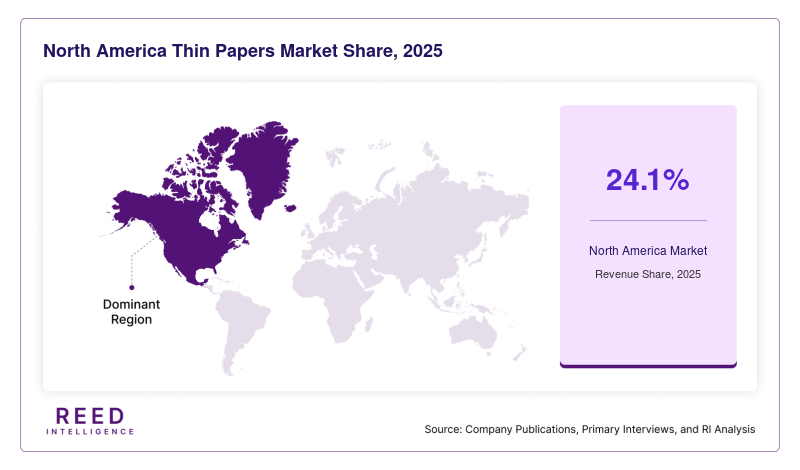
North America accounted for 24.1% of the global Thin Papers Market share in 2025 and is projected to grow at a CAGR of 5.3% during 2026–2034. The regional market growth was supported by increasing demand for recyclable packaging materials and specialty printing papers. The United States remained the dominant country due to strong demand from food packaging, publishing, and healthcare industries. The rising adoption of sustainable packaging solutions among consumer goods manufacturers further accelerated the market expansion across the region.
Europe
Europe held 32.6% of the global Thin Papers Market share in 2025 and is expected to expand at a CAGR of 5.5% during the forecast period. Strict environmental regulations and strong adoption of biodegradable packaging materials contributed significantly to regional market growth. Germany dominated the market because of its advanced paper manufacturing industry and increasing investments in specialty paper production technologies. The region also benefited from strong recycling infrastructure and sustainable forestry management practices.
Asia Pacific
Asia Pacific represented 27.8% of the global Thin Papers Market share in 2025 and is forecast to register the fastest CAGR of 6.9% during 2026–2034. Rapid industrialization, urbanization, and expanding packaging industries supported regional market growth. China emerged as the dominant country due to large-scale paper manufacturing capabilities and growing demand from food packaging and consumer goods industries. Increasing investments in e-commerce packaging and tissue paper production also strengthened the regional outlook.
Middle East & Africa
Middle East & Africa accounted for 8.3% of the global market share in 2025 and is anticipated to grow at a CAGR of 5.7% during the forecast period. Expanding retail packaging industries and rising demand for food-grade wrapping papers supported regional market development. Saudi Arabia dominated the regional market owing to increasing investments in packaging production facilities and consumer goods manufacturing operations. The growing retail sector also contributed to higher consumption of lightweight paper materials.
Latin America
Latin America captured 7.2% of the global Thin Papers Market share in 2025 and is projected to expand at a CAGR of 5.2% during 2026–2034. Increasing adoption of sustainable packaging materials and growth in food processing industries supported regional market expansion. Brazil remained the dominant country because of its strong pulp and paper manufacturing sector and increasing investments in recyclable packaging materials. Rising export activities in packaged food products further strengthened market demand.
Competitive Landscape
The Thin Papers Market remains moderately competitive with the presence of multinational paper manufacturers and regional specialty paper suppliers focusing on sustainability, product innovation, and production efficiency. Companies are investing in advanced papermaking technologies to produce lightweight papers with improved opacity, tensile strength, and environmental performance.
Mondi Group remained one of the leading participants in the Thin Papers Market due to its diversified specialty paper portfolio and strong global distribution network. The company recently expanded its sustainable packaging paper production capabilities to address growing demand from retail and food packaging industries.
UPM-Kymmene Corporation continued investing in recyclable specialty paper solutions for flexible packaging applications. Nippon Paper Industries focused on developing lightweight thin papers for healthcare and industrial uses. Delfortgroup AG expanded its thin paper manufacturing capacity for tobacco and food packaging sectors, while Ahlstrom strengthened its specialty fiber-based paper product portfolio targeting industrial filtration and medical packaging applications.
Key Players List
- Mondi Group
- UPM-Kymmene Corporation
- Nippon Paper Industries Co., Ltd.
- Delfortgroup AG
- Ahlstrom Corporation
- Stora Enso Oyj
- Glatz Group
- Schweitzer-Mauduit International, Inc.
- Oji Holdings Corporation
- ITC Limited
- Domtar Corporation
- Krpa Paper Mills Ltd.
- Miquel y Costas & Miquel S.A.
- Twin Rivers Paper Company
- Asia Pulp & Paper
Recent Developments
- In February 2026, Mondi Group expanded its sustainable thin paper production line for lightweight packaging applications in Europe.
- In May 2025, UPM-Kymmene Corporation introduced recyclable specialty thin papers designed for flexible food packaging solutions.
- In July 2025, Delfortgroup AG increased its cigarette paper manufacturing capacity to meet rising international demand.
- In October 2025, Nippon Paper Industries launched high-opacity thin paper grades for premium publishing applications.
- In January 2026, Ahlstrom Corporation introduced advanced fiber-based thin papers for healthcare and filtration applications.
Thin Papers Market Segments
Product Type
- Cigarette Papers
- Decorative Papers
- Bible Papers
- Tracing Papers
- Packaging Thin Papers
- Specialty Printing Papers
Material Type
- Wood Pulp
- Recycled Fiber
- Cotton Fiber
- Blended Fiber
Application
- Printing & Publishing
- Packaging
- Tobacco Products
- Decorative Laminates
- Industrial Applications
Distribution Channel
- Direct Sales
- Distributors & Wholesalers
- Online Sales
- Specialty Stores
End-Use Industry
- Publishing Industry
- Packaging Industry
- Tobacco Industry
- Construction & Interiors
- Commercial Printing
By Region
- North America
- Europe
- APAC
- Middle East and Africa
- LATAM