Thioester Market Size, Share & Demand Report By Product Type (Dilauryl Thiodipropionate (DLTDP), Distearyl Thiodipropionate (DSTDP)), By Form (Powder Thioesters, Liquid Thioesters, Granular Thioesters), By Application (Polymer Stabilization, Lubricant Additives, Rubber Processing, Adhesives and Sealants), By End-Use Industry (Plastics and Packaging, Automotive, Industrial Manufacturing) By Region & Segment Forecasts, 2026–2034
USD 3950
Market Overview
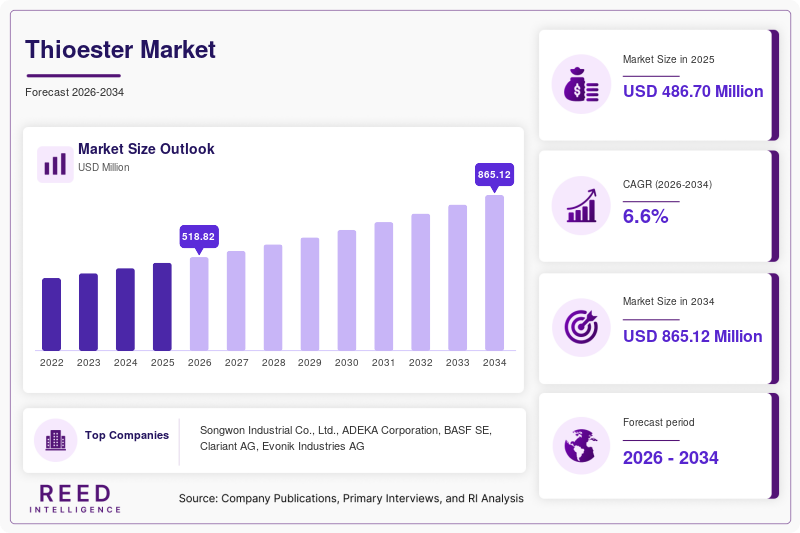
The Thioester Market size was valued at USD 486.7 million in 2026 and is projected to reach USD 812.4 million by 2034, expanding at a CAGR of 6.6% during the forecast period from 2026 to 2034. The global Thioester Market growth has been supported by increasing demand for high-performance antioxidant stabilizers across polymer manufacturing and industrial processing industries. Rising use of thioester compounds in plastics, rubber, lubricants, adhesives, and specialty chemical formulations has strengthened market penetration across developed and emerging economies.
Thioesters are sulfur-containing organic compounds widely used as secondary antioxidants and heat stabilizers in industrial materials. These compounds help improve thermal stability, oxidation resistance, and product durability in polymer applications. The growing production of polyethylene, polypropylene, synthetic rubber, and engineering plastics has accelerated the demand for thioester-based additives in manufacturing operations.
Key Highlights
- Asia Pacific accounted for 41.3% of the global Thioester Market share in 2025, while Middle East & Africa is expected to register the fastest CAGR of 7.4% during 2026–2034.
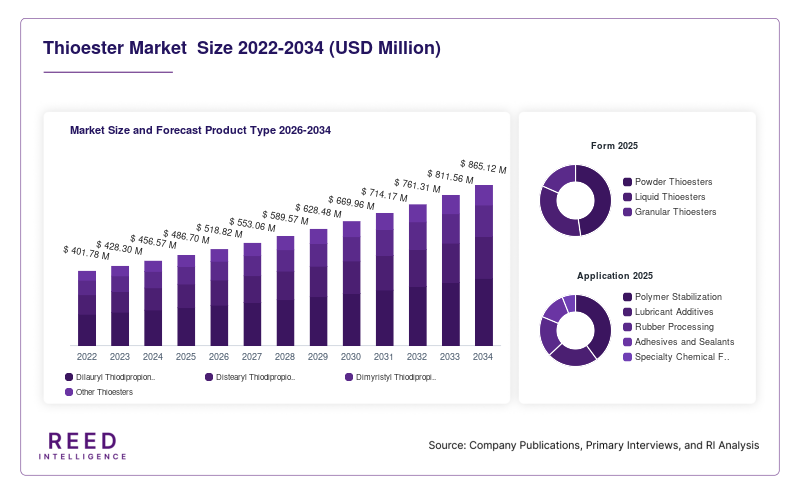
- By product type, dilauryl thiodipropionate (DLTDP) held the largest share of 38.6% in 2025, whereas distearyl thiodipropionate (DSTDP) is projected to expand at the fastest CAGR of 7.1% through 2034.
- By form, powder thioesters dominated with 44.8% market share in 2025, while liquid thioesters are expected to grow at a CAGR of 6.9%.
- By application, polymer stabilization represented the largest share of 47.5% in 2025, whereas lubricant additives are forecast to grow at a CAGR of 7.2%.
- By end-use industry, plastics and packaging led the market with 34.2% share in 2025, while automotive applications are expected to witness the fastest CAGR of 7.5%.
- China remained the dominant country in the market and was valued at USD 84.6 million in 2024, increasing to USD 90.8 million in 2025 due to rising polymer production and increasing industrial additive consumption.
Market Trends
Increasing Demand for Heat-Resistant Polymer Additives
The Thioester Market has been witnessing rising demand for heat-resistant polymer additives across industrial manufacturing sectors. Polymer producers are increasingly using thioester stabilizers to improve oxidation resistance and maintain product integrity under high-temperature operating conditions. Growing use of engineering plastics and advanced polymer blends in industrial applications has accelerated adoption of high-performance antioxidant systems.
Expansion of Specialty Chemical Manufacturing
The expansion of specialty chemical manufacturing has emerged as another important trend shaping the Thioester Market. Chemical companies are investing in advanced additive technologies and customized stabilizer formulations to address evolving industrial requirements. Increasing demand for high-purity and application-specific thioester compounds has encouraged manufacturers to strengthen research and product development activities.
Market Drivers
Rising Production of Polyolefin Plastics
The increasing production of polyolefin plastics has significantly supported the growth of the Thioester Market. Polyethylene and polypropylene manufacturers require efficient stabilizer systems to improve thermal performance and processing efficiency. Thioester compounds are widely utilized as secondary antioxidants in polymer processing applications, supporting increased consumption across the plastics industry.
Growing Demand from Automotive Material Applications
The rising use of lightweight polymer materials in automotive manufacturing has accelerated demand for thioester additives. Automotive manufacturers increasingly rely on durable plastic components and heat-resistant materials for vehicle interiors, electrical systems, and under-the-hood applications. This trend has strengthened the need for advanced polymer stabilization technologies across automotive production operations.
Market Restraint
Volatility in Raw Material Availability
One of the major restraints affecting the Thioester Market is volatility in raw material availability and pricing. Thioester production depends on sulfur-based chemicals and specialty intermediates, which are subject to fluctuations in global supply chains. Variability in feedstock pricing can increase production costs and affect profit margins for manufacturers.
Market Opportunities
Increasing Use in Sustainable Packaging Materials
The growing development of sustainable packaging materials presents favorable opportunities for the Thioester Market. Manufacturers are incorporating advanced antioxidant systems into recyclable and lightweight plastic packaging solutions to improve product durability and shelf stability. Increasing demand for sustainable industrial materials is expected to support future thioester consumption.
Expansion of Industrial Lubricant Applications
The increasing use of specialty lubricant additives is creating another emerging opportunity for market participants. Industrial machinery and heavy equipment manufacturers are focusing on improving lubrication efficiency and oxidation stability in high-temperature operating environments. Thioester compounds are expected to witness rising demand in industrial lubricant formulations due to their thermal stabilization capabilities.
Segmental Analysis
By Product Type
Based on product type, the Thioester Market is segmented into dilauryl thiodipropionate (DLTDP), distearyl thiodipropionate (DSTDP), dimyristyl thiodipropionate (DMTDP), and other thioesters.
Dilauryl thiodipropionate (DLTDP) dominated the market with a 38.6% share in 2025 due to its strong antioxidant performance and widespread use in polymer stabilization applications. Manufacturers adopted DLTDP extensively in polyolefin processing and plastic additive formulations because of its thermal stabilization efficiency.
Distearyl thiodipropionate (DSTDP) is expected to witness the fastest CAGR of 7.1% during the forecast period. The growth will be driven by increasing demand for high-temperature polymer processing applications and improved long-term oxidation resistance in engineering plastics.
By Form
Based on form, the market is categorized into powder thioesters, liquid thioesters, and granular thioesters.
Powder thioesters accounted for the largest market share of 44.8% in 2025 owing to their ease of handling, storage stability, and widespread compatibility with polymer compounding operations. These products gained significant adoption across plastics manufacturing and industrial additive processing applications.
Liquid thioesters are projected to grow at the fastest CAGR of 6.9% from 2026 to 2034. The segment growth will be supported by increasing demand for efficient blending processes and rising adoption in industrial lubricant formulations.
By Application
Based on application, the Thioester Market is segmented into polymer stabilization, lubricant additives, rubber processing, adhesives and sealants, and specialty chemical formulations.
Polymer stabilization held the dominant market share of 47.5% in 2025 due to increasing demand for heat-resistant and oxidation-resistant plastic materials. Polymer manufacturers widely adopted thioester compounds to improve product durability and processing efficiency.
Lubricant additives are anticipated to grow at the fastest CAGR of 7.2% during the forecast period. Rising industrial machinery operations and increasing need for high-performance oxidation stabilizers in lubricants will strengthen future demand for thioester additives.
By End-Use Industry
Based on end-use industry, the market is divided into plastics and packaging, automotive, industrial manufacturing, chemicals, construction, and electronics.
Plastics and packaging dominated the market with a 34.2% share in 2025 because of increasing demand for durable polymer packaging materials and advanced stabilizer systems. Packaging manufacturers adopted thioester additives to improve thermal resistance and product lifespan.
Automotive applications are expected to expand at the fastest CAGR of 7.5% through 2034. Increasing use of lightweight polymers and heat-resistant plastic components in vehicle manufacturing will support growing adoption of thioester stabilization technologies.
Regional Analysis
North America
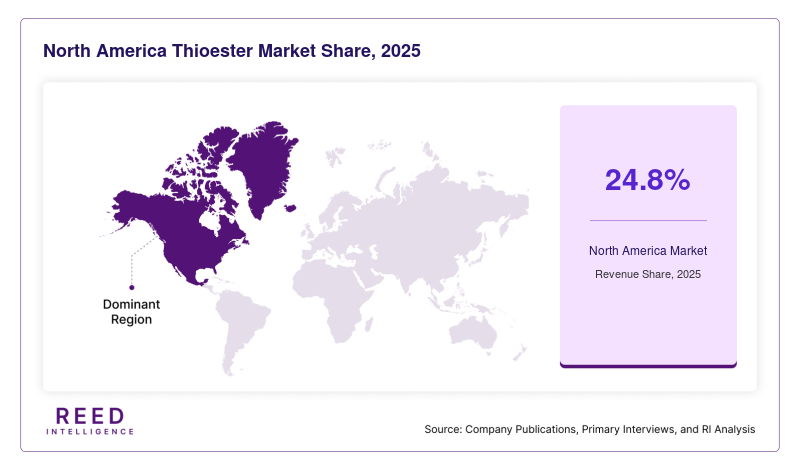
North America held 24.8% of the global Thioester Market share in 2025 and is expected to expand at a CAGR of 6.1% during the forecast period. The region benefited from increasing specialty chemical production and rising demand for polymer stabilizers across industrial sectors. The United States dominated the regional market due to expanding packaging material manufacturing and increasing use of advanced polymer additives in automotive applications.
Europe
Europe accounted for 22.6% of the global Thioester Market share in 2025 and is projected to grow at a CAGR of 5.9% from 2026 to 2034. The region experienced stable market growth due to increasing demand for high-performance industrial materials and specialty additives. Germany emerged as the dominant country because of its strong chemical manufacturing infrastructure and rising production of engineering plastics.
Asia Pacific
Asia Pacific represented 41.3% of the global Thioester Market share in 2025 and is forecast to grow at a CAGR of 6.8% through 2034. The region benefited from rapid industrialization, expanding polymer production capacity, and increasing demand for plastic additives. China dominated the regional market owing to strong manufacturing activity and rising investments in specialty chemical production facilities.
Middle East & Africa
The Middle East & Africa accounted for 5.9% of the global Thioester Market share in 2025 and is anticipated to register the fastest CAGR of 7.4% during the forecast period. Market growth in the region was supported by expanding petrochemical investments and increasing industrial processing activities. Saudi Arabia emerged as the leading country due to rising downstream chemical manufacturing and growing polymer production infrastructure.
Latin America
Latin America held 5.4% of the global Thioester Market share in 2025 and is projected to grow at a CAGR of 6.0% from 2026 to 2034. The region witnessed gradual market expansion due to increasing industrial packaging demand and rising plastic processing activities. Brazil dominated the regional market because of expanding polymer manufacturing operations and increasing industrial additive consumption.
Competitive Landscape
The Thioester Market remains moderately competitive with the presence of specialty chemical manufacturers and polymer additive suppliers focusing on product quality and industrial performance enhancement. Companies are investing in production capacity expansion, customized stabilizer technologies, and environmentally compliant additive formulations to strengthen market positioning.
Songwon Industrial Co., Ltd. emerged as one of the leading players in the market due to its broad antioxidant product portfolio and strong presence in polymer stabilization applications. The company recently expanded its specialty additive production capabilities to support increasing demand from plastics and industrial manufacturing sectors.
ADEKA Corporation continued to strengthen its market position through advanced stabilizer technologies and customized additive formulations. BASF SE focused on high-performance antioxidant systems for industrial polymer applications. Clariant AG expanded its specialty additive solutions for packaging and automotive materials, while Evonik Industries AG invested in advanced chemical processing technologies to improve additive performance and operational efficiency.
Manufacturers are increasingly emphasizing low-volatility stabilizers, sustainable additive technologies, and enhanced oxidation resistance capabilities. Strategic partnerships between chemical companies and polymer manufacturers are also supporting innovation across the Thioester Market.
Key Players List
- Songwon Industrial Co., Ltd.
- ADEKA Corporation
- BASF SE
- Clariant AG
- Evonik Industries AG
- Lanxess AG
- Dover Chemical Corporation
- SI Group, Inc.
- Mayzo, Inc.
- PMC Group, Inc.
- Solvay S.A.
- Akrochem Corporation
- Addivant USA LLC
- Nouryon
- Double Bond Chemical Ind. Co., Ltd.
Recent Developments
- In February 2026, Songwon Industrial Co., Ltd. expanded its thioester antioxidant production capacity to support rising polymer additive demand.
- In July 2025, ADEKA Corporation introduced advanced thermal stabilizer formulations for high-performance plastic processing applications.
- In October 2025, BASF SE launched new antioxidant additive solutions targeting automotive polymer manufacturing industries.
- In January 2026, Clariant AG developed low-volatility thioester additives designed for sustainable packaging materials.
- In April 2026, Evonik Industries AG invested in specialty additive processing technologies to improve oxidation resistance and industrial material performance.
Thioester Market Segments
Product Type
- Dilauryl Thiodipropionate (DLTDP)
- Distearyl Thiodipropionate (DSTDP)
- Dimyristyl Thiodipropionate (DMTDP)
- Other Thioesters
Form
- Powder Thioesters
- Liquid Thioesters
- Granular Thioesters
Application
- Polymer Stabilization
- Lubricant Additives
- Rubber Processing
- Adhesives and Sealants
- Specialty Chemical Formulations
End-Use Industry
- Plastics and Packaging
- Automotive
- Industrial Manufacturing
- Chemicals
- Construction
- Electronics
By Region
- North America
- Europe
- APAC
- Middle East and Africa
- LATAM