Thioglycolate Market Size, Share & Demand Report By Type (Ammonium Thioglycolate, Calcium Thioglycolate, Potassium Thioglycolate, Sodium Thioglycolate), By Application (Personal Care, Industrial Cleaning, Chemical Processing, Others), By End-Use Industry (Cosmetics, Oil & Gas, Pharmaceuticals, Manufacturing), By Form (Liquid, Powder), By Region & Segment Forecasts, 2026–2034
USD 3950
Market Overview
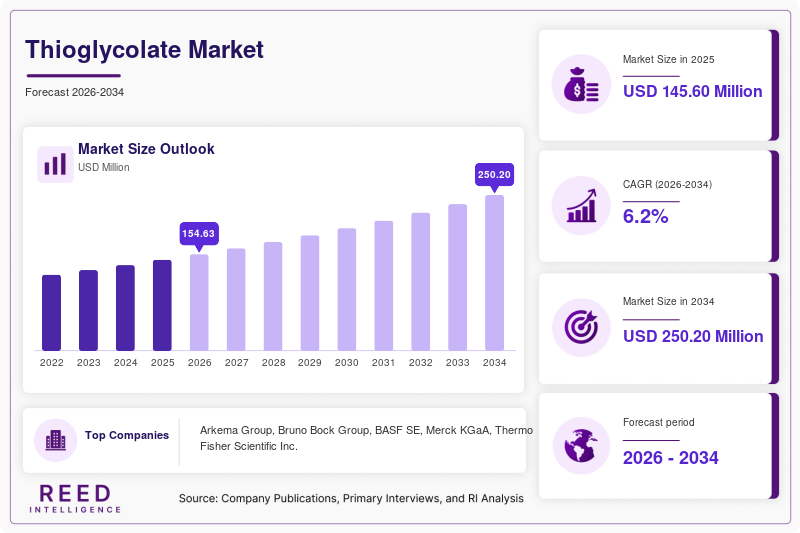
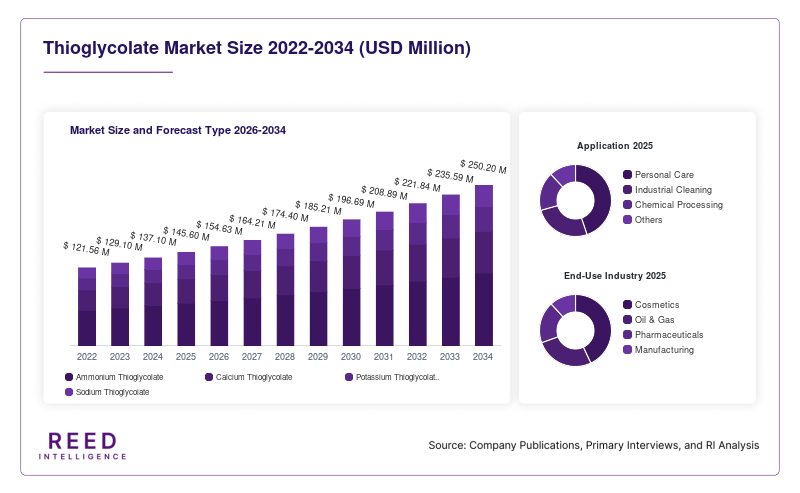
The global Thioglycolate Market size was valued at USD 145.6 million in 2026 and is projected to reach USD 236.4 million by 2034, expanding at a CAGR of 6.2% during the forecast period (2026–2034). The market growth is supported by increasing utilization of thioglycolates across personal care formulations, chemical synthesis, and industrial cleaning applications. Rising demand for hair treatment products, particularly depilatories and perming solutions, continues to sustain consumption patterns globally.
A major global factor driving the Thioglycolate Market is the expansion of the cosmetics and personal care industry. Increasing consumer spending on grooming products, especially in emerging economies, has amplified demand for chemical agents such as ammonium thioglycolate and calcium thioglycolate. Additionally, technological advancements in formulation chemistry have improved product safety and performance, further supporting adoption across end-use industries.
Key Highlights:
- Asia Pacific dominated the market with a 38.5% share in 2025, while it is expected to remain the fastest-growing region at a CAGR of 7.4% through 2034.
- By type, ammonium thioglycolate held the leading share at 42.1% in 2025, whereas potassium thioglycolate is projected to grow fastest at a CAGR of 7.1%.
- By application, personal care led with 46.3% share, while industrial cleaning is expected to expand fastest at a CAGR of 6.9%.
- China, the dominant country, recorded market values of USD 28.4 million in 2024 and USD 30.1 million in 2025.
Market Trends
Rising Demand for Safer Cosmetic Ingredients
The Thioglycolate Market is witnessing a shift toward safer and dermatologically tested formulations in cosmetic applications. Manufacturers are focusing on reducing skin irritation caused by thioglycolate-based products while maintaining efficacy. This has led to the development of low-odor and less aggressive formulations, particularly in depilatory creams and hair straightening products. Regulatory scrutiny across developed regions has further encouraged companies to innovate and adopt safer chemical compositions.
Increasing Industrial Applications in Metal Treatment
Another notable trend shaping the Thioglycolate Market is the expanding use of thioglycolates in metal treatment and industrial cleaning processes. Thioglycolates act as effective chelating agents and are widely used for rust removal and surface conditioning. Growth in manufacturing and infrastructure sectors has increased demand for efficient cleaning chemicals. Furthermore, the integration of thioglycolates into eco-friendly cleaning solutions is gaining traction, aligning with environmental sustainability goals.
Market Drivers
Growth in Personal Care and Grooming Industry
The expanding global personal care sector remains a primary driver for the Thioglycolate Market. Thioglycolates are essential components in hair removal creams and hair restructuring products. Rising urbanization, increasing disposable income, and changing consumer lifestyles have boosted the demand for grooming products. Additionally, the popularity of at-home beauty treatments has increased consumption of thioglycolate-based formulations, contributing to sustained market growth.
Expanding Use in Chemical Processing and Oil & Gas
Thioglycolates are widely used as reducing agents and stabilizers in chemical processing industries. Their application in oilfield chemicals, particularly for scale removal and corrosion control, is driving demand. As industrial activities expand globally, especially in developing economies, the need for efficient and cost-effective chemical agents is increasing. This has positioned thioglycolates as a critical component in various industrial processes.
Market Restraint
Health and Environmental Concerns Associated with Chemical Use
One of the major restraints affecting the Thioglycolate Market is the growing concern over potential health risks and environmental impact. Thioglycolates, particularly in high concentrations, can cause skin irritation and allergic reactions. Increasing regulatory scrutiny regarding chemical safety and disposal is limiting the widespread adoption of these compounds. Additionally, environmental concerns related to wastewater contamination and chemical toxicity are encouraging industries to explore alternative solutions. These factors may restrict market growth, especially in regions with stringent environmental regulations.
Market Opportunities
Development of Bio-Based Thioglycolates
The growing emphasis on sustainability presents a significant opportunity for the Thioglycolate Market. Manufacturers are exploring bio-based alternatives derived from renewable sources to reduce environmental impact. The development of biodegradable thioglycolates can help companies comply with regulatory standards while appealing to environmentally conscious consumers. This shift is expected to open new growth avenues in both personal care and industrial applications.
Expansion in Emerging Markets
Emerging economies offer substantial growth potential for the Thioglycolate Market due to rapid industrialization and rising consumer demand for personal care products. Countries in Asia Pacific, Latin America, and Africa are experiencing increased adoption of grooming products and industrial chemicals. Improved distribution networks and growing awareness about personal hygiene are further supporting market expansion. Companies focusing on localized production and cost-effective solutions are likely to benefit from these opportunities.
Segmental Analysis
By Type
Ammonium thioglycolate dominated the Thioglycolate Market in 2025, accounting for 42.1% of the share. Its widespread use in hair perming and straightening products made it the preferred choice among manufacturers.
Potassium thioglycolate is expected to grow at the fastest CAGR of 7.1% during the forecast period. Its improved stability and effectiveness in industrial applications are likely to drive its adoption.
By Application
The personal care segment held the largest share of 46.3% in 2025 within the Thioglycolate Market. High demand for depilatory creams and hair treatment products contributed to its dominance.
The industrial cleaning segment is projected to grow at a CAGR of 6.9%. Increasing use of thioglycolates in metal cleaning and rust removal applications is expected to support growth.
By End-Use Industry
The cosmetics industry dominated the Thioglycolate Market in 2025 with a share of 44.7%. The extensive use of thioglycolates in hair care products supported its leading position.
The oil & gas industry is expected to witness the fastest growth at a CAGR of 6.8%. Rising demand for chemical solutions in drilling and maintenance operations is likely to drive growth.
By Form
Liquid thioglycolates accounted for the largest share of 61.2% in 2025 due to ease of formulation and application.
Powder form is anticipated to grow at a CAGR of 6.5%, driven by its longer shelf life and suitability for industrial use.
Regional Analysis
North America
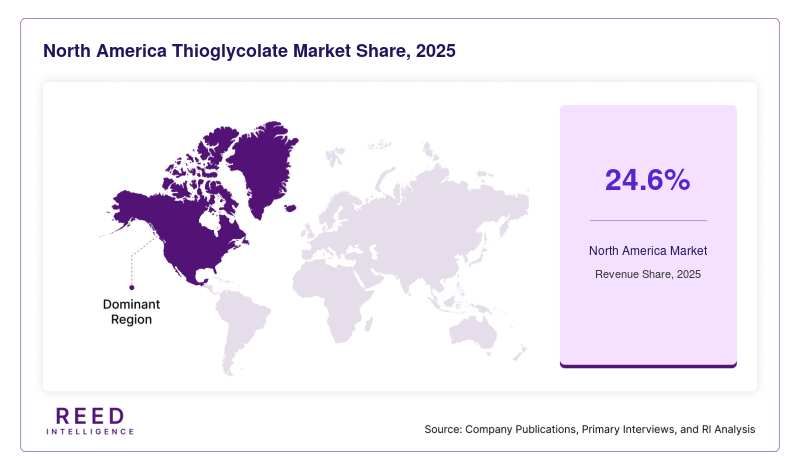
North America accounted for 24.6% of the Thioglycolate Market share in 2025 and is projected to grow at a CAGR of 5.3% during the forecast period. The region’s growth is driven by established personal care industries and steady demand for industrial chemicals.
The United States dominated the regional market due to its advanced cosmetic manufacturing sector. Increasing demand for premium grooming products and technological innovation in formulation chemistry contributed to its market leadership.
Europe
Europe held a 21.8% share of the Thioglycolate Market in 2025 and is expected to grow at a CAGR of 5.5% through 2034. Stringent regulatory frameworks have influenced product innovation and safety standards across the region.
Germany emerged as the dominant country, driven by its strong chemical manufacturing base. The country’s focus on sustainable and high-performance chemical solutions has supported the adoption of thioglycolates in industrial applications.
Asia Pacific
Asia Pacific led the Thioglycolate Market with a 38.5% share in 2025 and is projected to grow at a CAGR of 7.4%. Rapid urbanization and expanding middle-class populations are driving demand for personal care products.
China dominated the region due to its large-scale manufacturing capabilities and growing consumer base. The country’s increasing production of cosmetics and industrial chemicals has significantly boosted thioglycolate consumption.
Middle East & Africa
The Middle East & Africa accounted for 7.1% of the Thioglycolate Market share in 2025 and is anticipated to grow at a CAGR of 5.9%. Growth is supported by expanding industrial activities and infrastructure development.
Saudi Arabia led the regional market, primarily due to its oil and gas sector. The use of thioglycolates in oilfield chemicals has contributed to steady demand in the country.
Latin America
Latin America held an 8.0% share of the Thioglycolate Market in 2025 and is expected to grow at a CAGR of 6.1%. Increasing awareness about personal grooming and rising disposable income are driving market growth.
Brazil dominated the region due to its strong cosmetics industry. The country’s high demand for hair care products has significantly contributed to the consumption of thioglycolates.
Competitive Landscape
The Thioglycolate Market is moderately fragmented, with several global and regional players competing based on product quality, pricing, and innovation. Key companies are focusing on expanding production capacities and developing safer formulations to meet regulatory standards.
Arkema Group is identified as a leading player in the market, owing to its strong product portfolio and global distribution network. The company recently introduced an advanced thioglycolate formulation aimed at reducing odor and improving performance in cosmetic applications.
Other players are emphasizing strategic partnerships and regional expansion to strengthen their market presence. Continuous investment in research and development remains a key strategy for maintaining competitiveness.
Key Players List
- Arkema Group
- Bruno Bock Group
- Merck KGaA
- BASF SE
- Thermo Fisher Scientific Inc.
- Tokyo Chemical Industry Co., Ltd.
- Swan Chemical Inc.
- HiMedia Laboratories
- Santa Cruz Biotechnology, Inc.
- Shandong Xintai Water Treatment Technology Co., Ltd.
- WeylChem Group
- Triveni Chemicals
- Haihang Industry Co., Ltd.
- Jiangsu Jinma Chemical Co., Ltd.
- Spectrum Chemical Manufacturing Corp.
Recent Developments
- 2025: Arkema Group launched a low-odor thioglycolate variant for cosmetic applications.
- 2024: Bruno Bock Group expanded its production facility to increase output capacity.
- 2024: BASF SE invested in research for sustainable thioglycolate alternatives.
- 2023: Merck KGaA introduced high-purity thioglycolates for laboratory applications.
- 2023: WeylChem Group entered a strategic partnership to expand distribution in Asia Pacific.
Thioglycolate Market Segments
Type
- Ammonium Thioglycolate
- Calcium Thioglycolate
- Potassium Thioglycolate
- Sodium Thioglycolate
Application
- Personal Care
- Industrial Cleaning
- Chemical Processing
- Others
End-Use Industry
- Cosmetics
- Oil & Gas
- Pharmaceuticals
- Manufacturing
Form
- Liquid
- Powder
By Region
- North America
- Europe
- APAC
- Middle East and Africa
- LATAM