Thorium Market Size, Share & Demand Report By Type (Monazite-Derived Thorium, Thorium Oxide, Others), By Application (Nuclear Fuel, Medical Isotopes, Industrial Applications), By End-Use Industry (Energy, Healthcare, Aerospace, Research & Development), By Form (Solid, Liquid, Powder), By Region & Segment Forecasts, 2025–2034
USD 3950
Market Overview
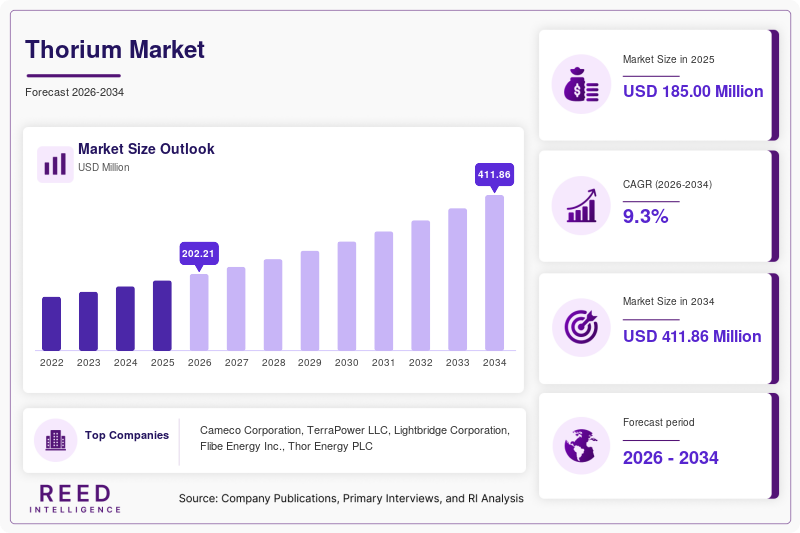
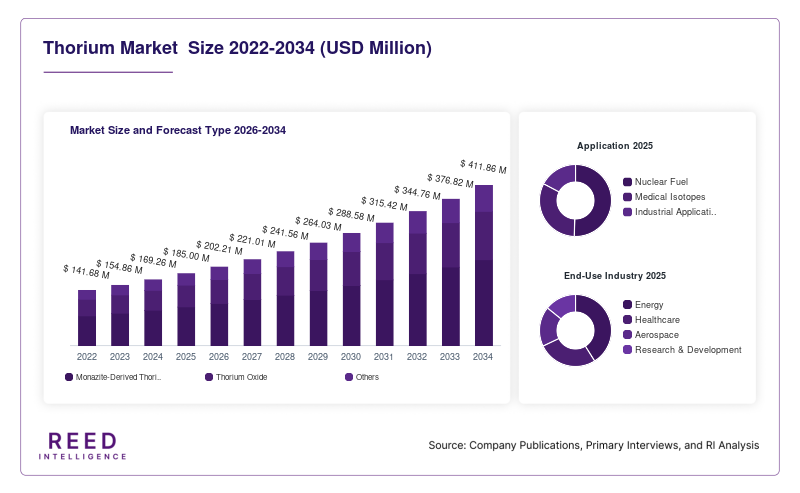
The global Thorium Market size was valued at approximately USD 185 million in 2025 and is projected to reach USD 412 million by 2034, expanding at a CAGR of 9.3% during the forecast period (2025–2034). Thorium, a naturally occurring radioactive metal, is gaining traction as a potential alternative nuclear fuel due to its abundance and favorable safety profile compared to uranium. Increasing interest in next-generation nuclear technologies has played a key role in driving market expansion.
A major global factor supporting the growth of the Thorium Market is the rising focus on clean energy transition. Governments and energy stakeholders are exploring thorium-based nuclear reactors as part of long-term decarbonization strategies. Compared to conventional fuels, thorium offers reduced nuclear waste and enhanced safety features, which strengthens its appeal amid tightening environmental regulations.
Key Highlights
- Asia Pacific dominated the market with a 41.2% share in 2025, while it is expected to be the fastest-growing region at a CAGR of 10.5%.
- By application, nuclear fuel was the leading subsegment with a 46.8% share, while medical isotopes are projected to grow at the fastest CAGR of 11.2%.
- By type, monazite-derived thorium held the dominant share of 52.6%, whereas thorium oxide is expected to grow at a CAGR of 10.1%.
- The United States remained the dominant country, with market values of USD 48 million in 2025 and USD 52 million in 2026.
Market Trends
Advancement in Thorium-Based Reactor Technologies
Growing research into advanced nuclear reactor designs, such as molten salt reactors (MSRs), is shaping the Thorium Market. These reactors utilize thorium fuel cycles that offer higher efficiency and lower waste generation. Public and private investments in prototype development and pilot projects are accelerating commercialization timelines. This trend reflects a broader shift toward safer and more sustainable nuclear energy systems.
Rising Strategic Stockpiling and Resource Exploration
Countries are increasingly focusing on securing rare earth and nuclear fuel resources, including thorium. Exploration of thorium-rich minerals such as monazite is expanding, especially in regions with abundant deposits. Strategic stockpiling initiatives are also emerging as nations aim to strengthen energy independence. This trend supports long-term supply stability and encourages upstream investments in mining and processing infrastructure.
Market Drivers
Growing Demand for Alternative Nuclear Fuels
The increasing need for reliable and low-carbon energy sources is driving interest in thorium as an alternative to uranium. Thorium-based fuel cycles are considered more efficient and generate less long-lived radioactive waste. This makes them attractive for countries seeking sustainable nuclear energy solutions while addressing safety and environmental concerns.
Government Support for Nuclear Innovation
Policy frameworks and funding programs aimed at advancing nuclear technologies are boosting the Thorium Market. Several governments are investing in research institutions and pilot projects focused on thorium utilization. Incentives for clean energy development, combined with regulatory support, are encouraging innovation and facilitating market growth.
Market Restraint
Limited Commercialization of Thorium Reactors
Despite its potential advantages, the Thorium Market faces a major challenge due to the limited commercial deployment of thorium-based reactors. Most nuclear infrastructure worldwide is designed for uranium fuel cycles, and transitioning to thorium requires significant technological and financial investments. Additionally, regulatory frameworks for thorium usage are still evolving, which creates uncertainty for investors and stakeholders.
The absence of a fully established supply chain and standardized processing methods further slows adoption. Research and development efforts are ongoing, but the lack of large-scale operational projects restricts immediate demand growth. As a result, the market remains in a developmental phase, with commercialization expected to gradually increase over the forecast period.
Market Opportunities
Expansion of Small Modular Reactors (SMRs)
The emergence of small modular reactors presents a promising opportunity for the Thorium Market. These compact reactors are designed for flexibility, scalability, and enhanced safety. Integrating thorium fuel into SMR designs could accelerate adoption, particularly in regions with limited infrastructure for large nuclear plants.
Increasing Use in Medical and Industrial Applications
Thorium is gaining attention beyond energy applications, particularly in medical imaging and industrial processes. The development of thorium-based isotopes for cancer treatment and diagnostic imaging is creating new revenue streams. Additionally, its use in high-temperature ceramics and aerospace components offers diversification opportunities, supporting overall market expansion.
Segmental Analysis
By Type
Monazite-derived thorium dominated the Thorium Market, accounting for 52.6% of the market share in 2025. This dominance was attributed to the widespread availability of monazite sands and established extraction processes. Monazite serves as a primary source of thorium, making it a preferred raw material for production.
Thorium oxide is expected to be the fastest-growing subsegment, expanding at a CAGR of 10.1% during the forecast period. Its growth will be driven by increasing applications in nuclear fuel cycles and advanced ceramics. The compound’s stability and efficiency in high-temperature environments will support its rising demand.
By Application
Nuclear fuel represented the largest application segment, holding a 46.8% share in 2025. This dominance was driven by growing research into thorium-based reactors and the potential for safer nuclear energy generation. The segment continues to attract investments from governments and energy companies.
Medical isotopes are projected to be the fastest-growing application, with a CAGR of 11.2%. The increasing use of thorium-derived isotopes in cancer treatment and diagnostic imaging will drive this growth. Advancements in medical technology and rising healthcare demand will further support this segment.
By End-Use Industry
The energy sector dominated the Thorium Market, accounting for 49.3% of the market share in 2025. This was due to the extensive use of thorium in nuclear energy research and development. The sector remains the primary consumer of thorium resources.
The healthcare industry is expected to grow at the fastest CAGR of 10.8%. The increasing adoption of advanced diagnostic tools and therapeutic applications will drive demand. Innovations in nuclear medicine will further enhance the role of thorium in this sector.
By Form
Solid thorium held the dominant share of 57.1% in 2025, owing to its ease of storage and transportation. Solid forms are widely used in industrial and research applications, contributing to their market leadership.
Liquid thorium-based compounds are anticipated to grow at a CAGR of 9.9%. Their application in advanced reactor designs, particularly molten salt reactors, will drive demand. The efficiency and safety advantages of liquid fuel systems will support this growth.
Regional Analysis
North America
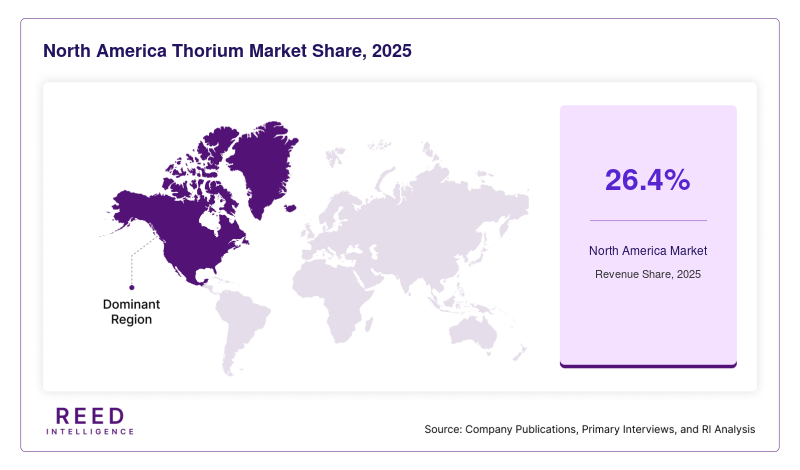
North America accounted for 26.4% of the Thorium Market share in 2025 and is projected to grow at a CAGR of 8.7% during the forecast period. The region’s market growth is supported by ongoing research activities and a well-established nuclear energy sector. Technological advancements and increasing interest in alternative nuclear fuels are expected to sustain growth.
The United States dominated the regional market due to its strong research ecosystem and investment in advanced reactor technologies. Government-backed initiatives focusing on next-generation nuclear systems have contributed to the country’s leadership. The presence of key research institutions and pilot projects has further strengthened its position in the Thorium Market.
Europe
Europe held a 21.8% share of the Thorium Market in 2025 and is expected to expand at a CAGR of 8.9% through 2034. The region’s focus on reducing carbon emissions and transitioning to sustainable energy sources has supported thorium research and development. Collaborative projects among European nations have also contributed to market growth.
Germany emerged as the dominant country in the region, driven by its strong emphasis on clean energy innovation and advanced material research. The country’s expertise in engineering and nuclear science has facilitated progress in thorium-based technologies, positioning it as a key contributor to regional market development.
Asia Pacific
Asia Pacific dominated the Thorium Market with a 41.2% share in 2025 and is projected to grow at the fastest CAGR of 10.5% during the forecast period. The region benefits from abundant thorium reserves and increasing investments in nuclear energy infrastructure. Rapid industrialization and rising energy demand further support market expansion.
India led the regional market due to its significant thorium reserves and long-term nuclear energy strategy. The country has been actively developing thorium-based reactor programs as part of its three-stage nuclear power plan. Strong government commitment and resource availability have positioned India as a major player in the Thorium Market.
Middle East & Africa
The Middle East & Africa region accounted for 6.9% of the Thorium Market in 2025 and is expected to grow at a CAGR of 9.1% over the forecast period. Increasing energy demand and diversification efforts are driving interest in alternative energy sources, including thorium.
South Africa dominated the regional market, supported by its mining capabilities and focus on advanced materials research. The country’s investments in nuclear technology and resource development have contributed to its leadership position. Efforts to enhance energy security are expected to drive further growth in the region.
Latin America
Latin America held a 3.7% share of the Thorium Market in 2025 and is projected to grow at a CAGR of 8.4% during the forecast period. The region’s market growth is influenced by increasing exploration of mineral resources and gradual adoption of nuclear technologies.
Brazil emerged as the dominant country, benefiting from its natural resource base and growing interest in nuclear energy. Government initiatives aimed at energy diversification and infrastructure development have supported the country’s position in the Thorium Market.
Competitive Landscape
The Thorium Market is moderately fragmented, with a mix of established players and emerging companies focusing on research and development. Leading companies are investing in advanced nuclear technologies and expanding their resource portfolios.
A key market leader is Cameco Corporation, which has been actively exploring opportunities in alternative nuclear fuels. The company recently announced initiatives to support next-generation reactor technologies, strengthening its position in the Thorium Market.
Other players are focusing on partnerships, technological innovation, and resource development to enhance their market presence. Strategic collaborations between industry participants and research institutions are expected to accelerate commercialization and drive competitive dynamics.
Key Players
- Cameco Corporation
- TerraPower LLC
- Lightbridge Corporation
- Flibe Energy Inc.
- Thor Energy PLC
- Indian Rare Earths Limited
- China National Nuclear Corporation
- Canadian Nuclear Laboratories
- Moltex Energy
- Terrestrial Energy Inc.
- Ultra Safe Nuclear Corporation
- NuScale Power
- Rolls-Royce SMR Ltd.
- Orano SA
- Kazatomprom
Recent Developments
- 2024: Several pilot projects for molten salt reactors utilizing thorium entered advanced testing phases.
- 2023: Increased funding initiatives were announced to support thorium-based nuclear research programs globally.
- 2024: Strategic collaborations between energy companies and research institutions accelerated technology development.
- 2025: Expansion of thorium extraction facilities was observed in resource-rich regions.
- 2025: New medical research initiatives explored thorium-based isotopes for cancer treatment.
Thorium Market Segments
Type
- Monazite-Derived Thorium
- Thorium Oxide
- Others
Application
- Nuclear Fuel
- Medical Isotopes
- Industrial Applications
End-Use Industry
- Energy
- Healthcare
- Aerospace
- Research & Development
Form
- Solid
- Liquid
- Powder
By Region
- North America
- Europe
- APAC
- Middle East and Africa
- LATAM