Three Phase Shunt Reactor Market Size, Share & Demand Report By Type (Oil-Immersed Reactors, Air-Core Reactors), By Application (Transmission Systems, Distribution Systems, Renewable Energy Integration), By End-Use (Utilities, Industrial, Commercial), By Region & Segment Forecasts, 2026–2034
USD 3950
Market Overview
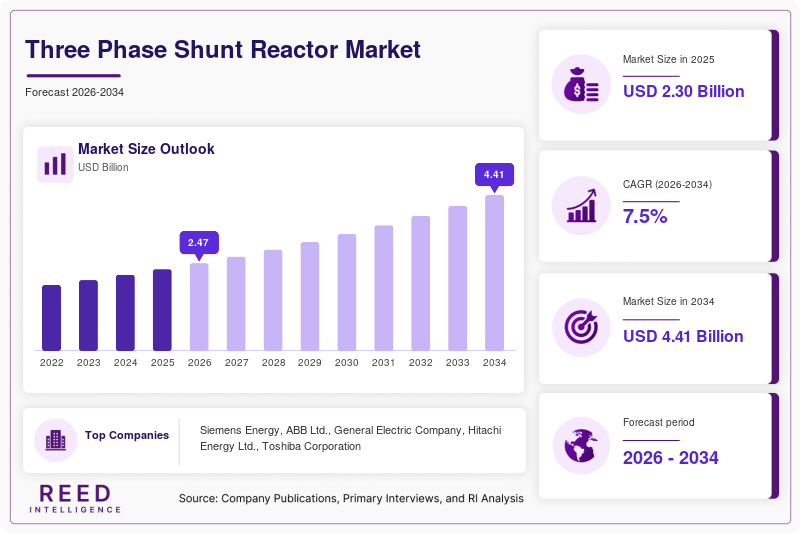
The Three Phase Shunt Reactor Market size was valued at approximately USD 2.3 billion in 2026 and is projected to reach around USD 4.1 billion by 2034, expanding at a CAGR of 7.5% during the forecast period (2026–2034). The market growth is supported by increasing investments in high-voltage transmission infrastructure and grid stabilization technologies across emerging and developed economies. As power networks expand to accommodate renewable energy sources such as wind and solar, the need for reactive power compensation has intensified, driving the adoption of three phase shunt reactors.
A key global factor supporting this growth is the rapid expansion of renewable energy integration into national grids. Renewable sources often introduce voltage fluctuations due to their intermittent nature. Three phase shunt reactors play a critical role in maintaining voltage stability and improving power quality, making them essential components in modern transmission systems. Utilities and grid operators are increasingly prioritizing efficient grid management solutions, which has further accelerated demand.
Key Highlights
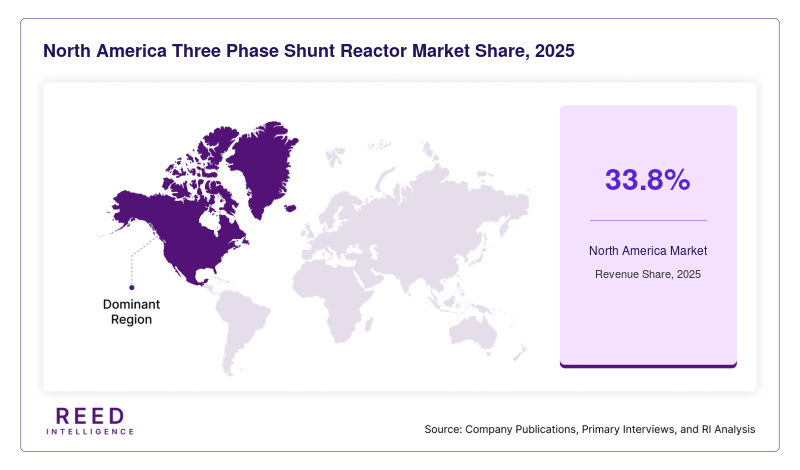
- North America dominated the market with a 33.8% share in 2025.
- Asia Pacific is expected to grow at the fastest CAGR of 9.2% during 2026–2034.
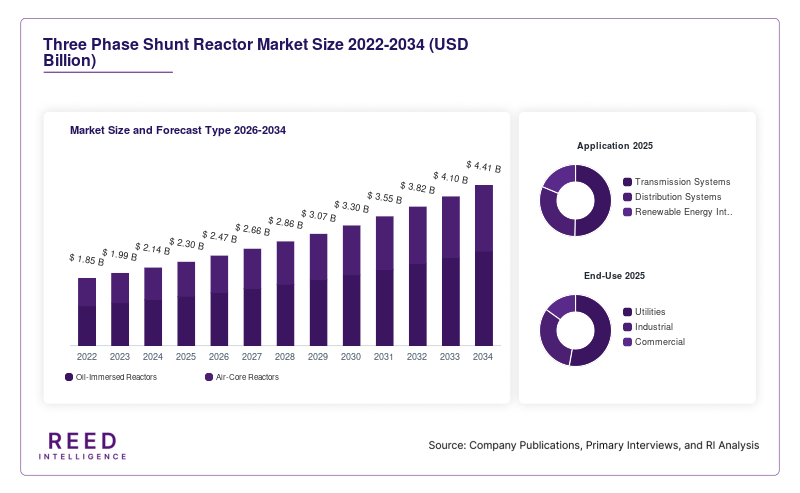
- By type, oil-immersed reactors accounted for the largest share of 61.4%, while air-core reactors are projected to grow at a CAGR of 8.6%.
- By application, transmission systems led with a 47.9% share, whereas renewable integration applications are expected to expand at a CAGR of 9.5%.
- The United States remained the dominant country, with market values of USD 480 million in 2024 and USD 525 million in 2025.
Market Trends
Increasing Adoption of Smart Grid Technologies
The growing implementation of smart grid infrastructure has significantly influenced the Three Phase Shunt Reactor Market. Utilities are transitioning toward intelligent grid systems that allow real-time monitoring, automation, and improved energy efficiency. In this context, shunt reactors are being integrated with advanced sensors and monitoring tools to ensure optimal performance and predictive maintenance. This trend has enhanced operational reliability while reducing downtime and maintenance costs. Additionally, digital substations are becoming more prevalent, and the inclusion of advanced reactors within these systems is improving voltage control capabilities. As governments continue to invest in smart grid projects, demand for technologically advanced three phase shunt reactors is expected to rise steadily.
Expansion of Ultra-High Voltage Transmission Networks
Another notable trend is the expansion of ultra-high voltage (UHV) transmission networks, particularly in regions with large-scale power generation and consumption gaps. Countries are increasingly adopting UHV systems to transmit electricity over long distances with minimal losses. Three phase shunt reactors are essential in these systems to manage reactive power and maintain voltage levels. This trend is particularly evident in Asia Pacific and parts of Europe, where cross-border electricity transmission projects are gaining traction. The deployment of UHV networks has created a strong demand for high-capacity reactors, prompting manufacturers to develop more efficient and durable solutions tailored to these advanced grid systems.
Market Drivers
Rising Demand for Reliable Power Transmission Infrastructure
The increasing demand for reliable and efficient power transmission infrastructure is a primary driver of the Three Phase Shunt Reactor Market. Rapid urbanization and industrialization have significantly increased electricity consumption worldwide, necessitating the expansion of transmission networks. As grids become more complex, maintaining voltage stability becomes critical to prevent power losses and outages. Three phase shunt reactors help manage reactive power, ensuring efficient energy flow across long distances. Governments and utilities are investing heavily in upgrading aging infrastructure, particularly in developed regions, which has boosted the adoption of advanced reactor systems. This ongoing modernization is expected to sustain market growth over the forecast period.
Integration of Renewable Energy Sources into Power Grids
The integration of renewable energy sources into power grids is another key driver fueling market growth. Renewable energy generation is inherently variable, leading to fluctuations in voltage and power quality. Three phase shunt reactors are essential for mitigating these issues by absorbing excess reactive power and stabilizing the grid. As countries strive to meet their sustainability targets and reduce carbon emissions, investments in renewable energy projects are increasing. This has created a parallel demand for grid stabilization equipment, including shunt reactors. The continuous expansion of solar and wind energy installations is expected to drive consistent demand for these systems.
Market Restraint
High Initial Investment and Maintenance Costs
One of the major restraints in the Three Phase Shunt Reactor Market is the high initial investment and ongoing maintenance costs associated with these systems. Installing three phase shunt reactors requires significant capital expenditure, particularly for large-scale transmission projects. Additionally, maintenance involves specialized expertise and equipment, which adds to operational costs. For smaller utilities and developing regions, these financial constraints can limit adoption. In some cases, utilities may opt for alternative voltage control solutions that require lower upfront investment. This cost barrier can slow market penetration, especially in regions with limited funding or infrastructure development challenges. Addressing cost efficiency through technological innovation remains crucial for market expansion.
Market Opportunities
Growth in Emerging Economies
Emerging economies present substantial opportunities for the Three Phase Shunt Reactor Market due to increasing investments in power infrastructure. Countries in Asia Pacific, Latin America, and Africa are experiencing rapid urban growth and industrial expansion, leading to higher electricity demand. Governments in these regions are focusing on improving grid reliability and expanding transmission networks. This creates a strong demand for reactive power compensation solutions. Additionally, international funding and public-private partnerships are supporting infrastructure development, further boosting market prospects. As these regions continue to modernize their energy systems, the adoption of three phase shunt reactors is expected to accelerate.
Technological Advancements in Reactor Design
Advancements in reactor design and materials offer another significant opportunity for market growth. Manufacturers are developing more compact, efficient, and environmentally friendly reactors to meet evolving industry requirements. Innovations such as dry-type reactors, improved insulation systems, and digital monitoring solutions are enhancing performance and reducing maintenance needs. These advancements not only improve operational efficiency but also address environmental concerns associated with traditional oil-based systems. As utilities seek sustainable and cost-effective solutions, the adoption of advanced reactor technologies is likely to increase. This trend is expected to open new avenues for manufacturers and drive long-term market growth.
Segmental Analysis
By Type
Oil-immersed reactors dominated the Three Phase Shunt Reactor Market in 2024, accounting for approximately 61.4% of the total share. These reactors are widely used due to their high efficiency, reliability, and ability to handle large power loads. They are particularly suitable for high-voltage transmission systems, where effective heat dissipation is critical. Utilities prefer oil-immersed reactors for their durability and long operational life. Additionally, advancements in insulation technology have improved their performance and safety, further supporting their dominance in the market.
Air-core reactors are expected to be the fastest-growing subsegment, with a CAGR of 8.6% during the forecast period. These reactors offer advantages such as lower maintenance requirements and reduced environmental risks compared to oil-based systems. The absence of oil eliminates the risk of leakage and fire hazards, making them suitable for urban and environmentally sensitive areas. As sustainability becomes a key focus, the adoption of air-core reactors is increasing. Their lightweight design and ease of installation also contribute to their growing popularity in modern grid systems.
By Application
Transmission systems held the largest share in 2024, accounting for approximately 47.9% of the market. Three phase shunt reactors are essential in transmission networks to manage reactive power and maintain voltage stability. The expansion of high-voltage transmission lines has significantly increased demand for these systems. Utilities rely on shunt reactors to ensure efficient power flow and reduce energy losses. This segment continues to dominate due to the ongoing development of large-scale transmission infrastructure.
Renewable energy integration is the fastest-growing application segment, with a CAGR of 9.5%. The increasing adoption of wind and solar energy has created a need for advanced grid stabilization solutions. Shunt reactors help manage voltage fluctuations caused by intermittent energy generation. Governments worldwide are investing in renewable energy projects, which has boosted demand for these systems. This trend is expected to continue as countries focus on achieving their sustainability goals.
By End-Use
Utilities represented the dominant end-use segment in 2024, accounting for around 58.2% of the market. Power utilities are the primary users of three phase shunt reactors, as they are responsible for maintaining grid stability and reliability. The expansion of transmission networks and the integration of renewable energy sources have increased the demand for these systems. Utilities are also investing in advanced technologies to improve operational efficiency, further supporting market growth.
The industrial sector is projected to be the fastest-growing end-use segment, with a CAGR of 8.9%. Industries require stable and reliable power supply for their operations, making voltage control essential. The adoption of shunt reactors in industrial applications helps prevent equipment damage and improve energy efficiency. As industrialization continues to expand, particularly in emerging economies, the demand for these systems is expected to increase significantly.
Regional Analysis
North America
North America accounted for a significant share of the Three Phase Shunt Reactor Market in 2025, holding approximately 33.8% of the global market. The region is expected to grow at a CAGR of 6.8% during the forecast period. This growth is driven by ongoing investments in grid modernization and the integration of renewable energy sources. The presence of well-established power infrastructure and supportive government policies has further contributed to market expansion. Utilities in the region are increasingly adopting advanced reactor technologies to enhance grid reliability and efficiency.
The United States dominates the North American market due to its extensive transmission network and high electricity demand. A key growth factor in the country is the modernization of aging infrastructure, which requires advanced voltage control solutions. Investments in renewable energy projects, particularly wind and solar, have also increased the need for shunt reactors. This combination of infrastructure upgrades and renewable integration continues to drive market growth in the region.
Europe
Europe held a notable share of the market in 2025 and is expected to grow at a CAGR of 7.1% during the forecast period. The region’s focus on renewable energy integration and cross-border electricity transmission has significantly influenced market growth. European countries are investing in advanced grid technologies to support their energy transition goals. The increasing adoption of UHV transmission systems has further boosted demand for three phase shunt reactors.
Germany is the dominant country in the European market, driven by its strong commitment to renewable energy. A unique growth factor in the country is its extensive wind energy capacity, which requires efficient grid stabilization solutions. The need to balance intermittent energy supply with demand has increased the adoption of shunt reactors. This trend is expected to continue as the country expands its renewable energy infrastructure.
Asia Pacific
Asia Pacific is the fastest-growing region in the Three Phase Shunt Reactor Market, with a projected CAGR of 9.2% from 2026 to 2034. The region’s rapid industrialization and urbanization have led to a significant increase in electricity demand. Governments are investing heavily in power infrastructure development, including the expansion of transmission networks. This has created a strong demand for reactive power compensation solutions.
China leads the Asia Pacific market due to its large-scale power generation and transmission projects. A key growth factor is the country’s focus on ultra-high voltage transmission systems, which require advanced shunt reactors for voltage control. Additionally, the integration of renewable energy sources has further increased demand. These factors make China a major contributor to regional market growth.
Middle East & Africa
The Middle East & Africa region is experiencing steady growth in the Three Phase Shunt Reactor Market, with a projected CAGR of 7.6%. Investments in power infrastructure and the expansion of transmission networks are key drivers. Countries in the region are focusing on improving electricity access and reliability, which has increased the adoption of advanced grid technologies.
Saudi Arabia is a leading market in the region, driven by its ongoing energy diversification initiatives. A unique growth factor is the country’s investment in large-scale renewable energy projects, particularly solar power. These projects require efficient voltage control solutions, which has boosted demand for shunt reactors. The region’s focus on infrastructure development continues to support market growth.
Latin America
Latin America accounted for a moderate share of the market in 2025 and is expected to grow at a CAGR of 7.3%. The region’s growth is driven by increasing electricity demand and investments in transmission infrastructure. Governments are focusing on improving grid reliability and reducing power losses, which has led to higher adoption of shunt reactors.
Brazil is the dominant country in the region, supported by its extensive hydropower capacity. A key growth factor is the integration of renewable energy sources into the grid, which requires efficient voltage regulation. The expansion of transmission networks to connect remote generation sites has further increased demand for three phase shunt reactors, contributing to overall market growth.
Competitive Landscape
The Three Phase Shunt Reactor Market is moderately competitive, with several global and regional players focusing on product innovation and strategic partnerships. Leading companies are investing in research and development to enhance product efficiency and reliability. The market is characterized by the presence of established manufacturers with strong distribution networks and technical expertise.
One of the leading players in the market is Siemens Energy, which has maintained a strong position through continuous innovation and expansion of its product portfolio. The company recently introduced advanced digital monitoring solutions for shunt reactors, improving performance and maintenance efficiency. Other key players are also focusing on expanding their presence in emerging markets to capitalize on growing demand.
Key Players
- ABB Ltd.
- Siemens Energy
- General Electric Company
- Toshiba Corporation
- Hitachi Energy Ltd.
- Hyosung Heavy Industries
- Nissin Electric Co., Ltd.
- Fuji Electric Co., Ltd.
- CG Power and Industrial Solutions Ltd.
- Hyundai Electric & Energy Systems
- SGB-SMIT Group
- WEG S.A.
- TBEA Co., Ltd.
- Meidensha Corporation
- Zaporozhtransformator
Recent Developments
- Several companies have expanded their manufacturing capabilities to meet increasing global demand for shunt reactors.
- New product launches focusing on eco-friendly and energy-efficient reactor designs have been introduced by key market players.
- Strategic collaborations between utilities and manufacturers have been established to develop advanced grid stabilization solutions.
Three Phase Shunt Reactor Market Segments
Type
- Oil-Immersed Reactors
- Air-Core Reactors
Application
- Transmission Systems
- Distribution Systems
- Renewable Energy Integration
End-Use
- Utilities
- Industrial
- Commercial
By Region
- North America
- Europe
- APAC
- Middle East and Africa
- LATAM