Time Delay Integration Camera Market Size, Share & Demand Report By Type (Line Scan Cameras, Multi-line TDI Cameras), By Technology (CCD-based, CMOS-based), By Application (Semiconductor Inspection, Industrial Inspection, Life Sciences Imaging, Printing & Packaging), By End-Use Industry (Electronics, Healthcare, Manufacturing, Automotive), By Region & Segment Forecasts, 2025–2034
USD 3950
Market Overview
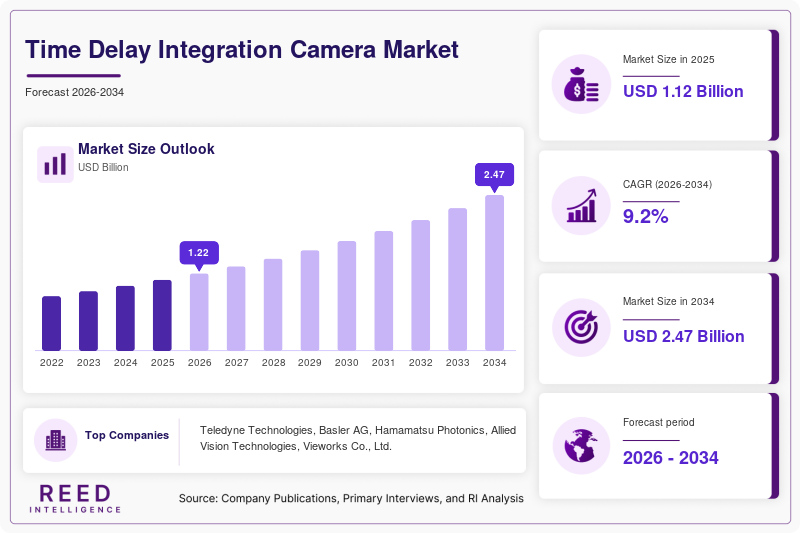
The Time Delay Integration Camera Market size was valued at approximately USD 1.12 billion in 2025 and is projected to reach USD 2.48 billion by 2034, expanding at a CAGR of 9.2% during the forecast period (2025–2034). The market has demonstrated steady expansion due to increasing demand for high-speed imaging solutions across industrial inspection, semiconductor manufacturing, and life sciences applications. Time delay integration (TDI) cameras enable superior image quality in low-light and high-speed environments, making them essential in precision-driven industries.
A major global factor supporting market growth is the rapid advancement of automated inspection systems. As manufacturing processes become increasingly digitized and reliant on real-time quality control, TDI cameras have emerged as a preferred imaging technology due to their ability to capture high-resolution images of moving objects without motion blur.
Key Highlights:
- North America dominated the market with a 34% share in 2025, while Asia Pacific is projected to grow at the fastest CAGR of 10.6%.
- Line scan cameras accounted for the largest share among types at 58%, while multi-line TDI cameras are expected to grow fastest at a CAGR of 10.8%.
- Semiconductor inspection led applications with a 41% share, while life sciences imaging is projected to grow at 11.2% CAGR.
- The U.S. remained the dominant country with a market value of USD 410 million in 2025 and is estimated to reach USD 445 million in 2026.
Market Trends
Integration of AI-Driven Imaging Systems
A significant trend shaping the Time Delay Integration Camera Market is the integration of artificial intelligence (AI) and machine vision algorithms into imaging systems. AI-enabled TDI cameras enhance defect detection accuracy and enable predictive maintenance in industrial environments. Manufacturers are increasingly embedding deep learning capabilities into imaging platforms, enabling automated classification and anomaly detection. This trend is particularly prominent in semiconductor and electronics manufacturing, where precision and speed are critical.
Rising Adoption in Life Sciences and Medical Imaging
Another notable trend is the growing use of TDI cameras in life sciences applications, including genomics, microscopy, and pharmaceutical inspection. These cameras provide high sensitivity and low noise imaging, making them suitable for capturing detailed biological samples. The increasing investment in biomedical research and diagnostics is driving demand for advanced imaging solutions. Additionally, TDI technology is being incorporated into next-generation diagnostic equipment, supporting enhanced imaging resolution and throughput.
Market Drivers
Increasing Demand for High-Speed Inspection Systems
The expansion of automated production lines has significantly increased the need for high-speed inspection systems. TDI cameras provide continuous imaging of fast-moving objects with enhanced signal-to-noise ratio, making them ideal for industries such as packaging, printing, and electronics. Their ability to capture precise images without compromising speed supports quality assurance processes, thereby driving market growth.
Advancements in Semiconductor Manufacturing Technologies
The growing complexity of semiconductor fabrication processes has led to higher demand for advanced inspection tools. TDI cameras are widely used for wafer inspection and defect detection due to their high resolution and sensitivity. As semiconductor nodes shrink and manufacturing precision becomes more critical, the reliance on TDI imaging systems is expected to increase, contributing to overall market expansion.
Market Restraint
High Initial Cost and Complex Integration
One of the primary restraints affecting the Time Delay Integration Camera Market is the high cost associated with these imaging systems. TDI cameras are technologically advanced and require specialized components, which increases their overall cost compared to conventional imaging solutions. Additionally, integrating TDI cameras into existing systems can be complex, requiring technical expertise and customized configurations.
This complexity often limits adoption among small and medium-sized enterprises that may lack the resources to implement such advanced technologies. Furthermore, the need for precise alignment and synchronization with moving objects adds to operational challenges. These factors collectively hinder widespread adoption, particularly in cost-sensitive industries, thereby restraining market growth to some extent.
Market Opportunities
Expansion in Smart Manufacturing and Industry 4.0
The transition toward smart manufacturing presents significant opportunities for the Time Delay Integration Camera Market. Industry 4.0 initiatives emphasize automation, real-time monitoring, and data-driven decision-making, all of which require advanced imaging technologies. TDI cameras can play a critical role in enabling efficient production processes by providing accurate and high-speed imaging data.
Growth in Emerging Economies
Emerging economies in Asia Pacific and Latin America are witnessing rapid industrialization and infrastructure development. This creates opportunities for TDI camera manufacturers to expand their presence in these regions. Increasing investments in manufacturing, electronics, and healthcare sectors are expected to drive demand for advanced imaging solutions. Additionally, government initiatives supporting technological adoption further enhance growth prospects in these markets.
Segmental Analysis
By Type
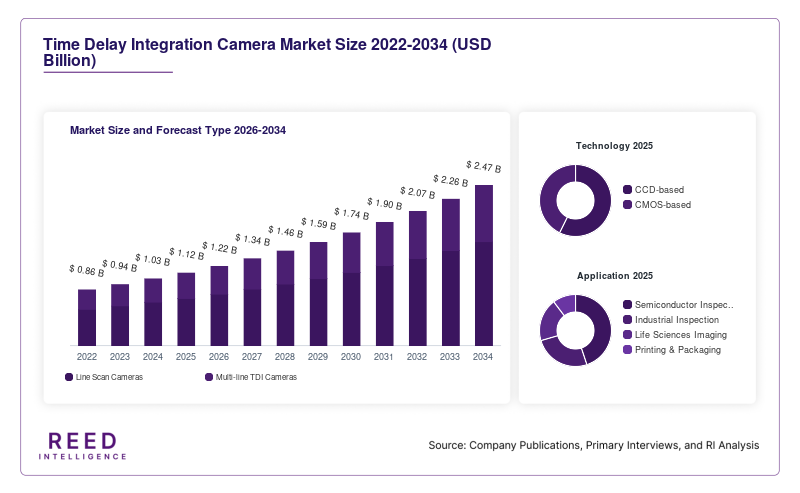
Line scan cameras dominated the Time Delay Integration Camera Market with a 58% share in 2025. Their ability to capture continuous images of moving objects made them highly suitable for industrial inspection applications.
Multi-line TDI cameras will grow at the fastest CAGR of 10.8% due to their enhanced imaging capabilities and improved sensitivity. These cameras will gain traction in applications requiring higher resolution and multi-dimensional imaging.
By Application
Semiconductor inspection accounted for the largest share of 41% in 2025. The need for precise defect detection and quality assurance in semiconductor manufacturing drove the adoption of TDI cameras.
Life sciences imaging is projected to grow at a CAGR of 11.2%, supported by increasing research activities and demand for high-resolution imaging in medical diagnostics. The ability of TDI cameras to capture detailed images in low-light conditions will drive their adoption.
By End-Use Industry
The electronics industry held the dominant share of 38% in 2025, driven by the need for high-speed inspection systems in production lines.
Healthcare will emerge as the fastest-growing segment with a CAGR of 10.9%, supported by advancements in medical imaging technologies and increasing investment in healthcare infrastructure.
By Technology
CCD-based TDI cameras dominated the market with a 63% share in 2025 due to their superior image quality and reliability.
CMOS-based TDI cameras will grow at a CAGR of 11.0%, driven by advancements in sensor technology and lower power consumption. Their flexibility and cost-effectiveness will enhance adoption across various applications.
Regional Analysis
North America
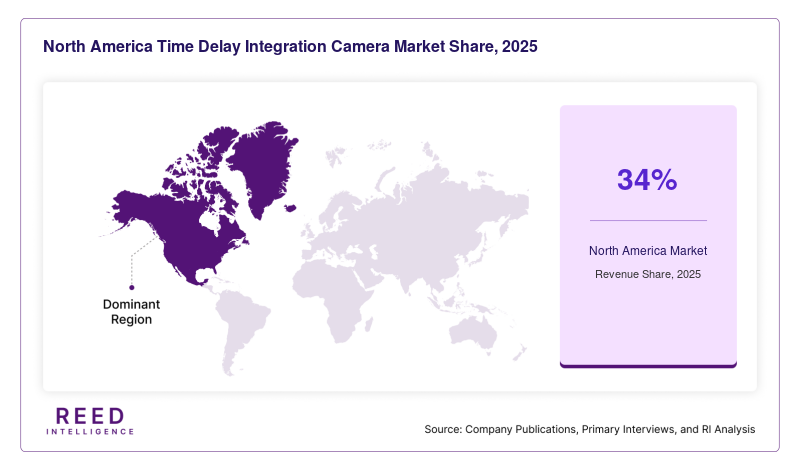
North America accounted for approximately 34% of the Time Delay Integration Camera Market share in 2025 and will grow at a CAGR of 8.7% during the forecast period. The region has a well-established industrial base and strong adoption of advanced imaging technologies.
The United States dominated the regional market due to its robust semiconductor and electronics manufacturing sector. The presence of leading technology companies and high investment in automation technologies contributed to sustained demand for TDI cameras.
Europe
Europe held around 27% of the market share in 2025 and will expand at a CAGR of 8.9% through 2034. The region has a strong focus on precision manufacturing and quality control systems.
Germany emerged as the dominant country, driven by its advanced automotive and industrial manufacturing sectors. The adoption of high-performance imaging systems in production lines has significantly supported market growth.
Asia Pacific
Asia Pacific represented nearly 24% of the market in 2025 and is expected to grow at the fastest CAGR of 10.6%. Rapid industrialization and expanding electronics manufacturing are key growth contributors.
China led the region due to its large-scale manufacturing ecosystem and increasing investments in semiconductor production. The growing demand for automated inspection systems further accelerated adoption of TDI cameras.
Middle East & Africa
The Middle East & Africa accounted for about 8% of the market share in 2025 and will grow at a CAGR of 7.8%. The region is gradually adopting advanced industrial technologies.
The United Arab Emirates dominated the regional market due to its focus on technological innovation and infrastructure development. Investments in smart manufacturing initiatives supported market expansion.
Latin America
Latin America held approximately 7% of the market share in 2025 and will grow at a CAGR of 8.1%. Increasing industrial activities and modernization efforts are driving demand.
Brazil led the region due to its expanding manufacturing sector and adoption of automation technologies. The need for improved quality control processes has contributed to the growth of TDI camera adoption.
Competitive Landscape
The Time Delay Integration Camera Market is characterized by the presence of established players focusing on innovation and product development. The market leader, Teledyne Technologies, has maintained a strong position through continuous advancements in imaging solutions and strategic acquisitions. The company recently introduced a new generation of high-resolution TDI cameras designed for semiconductor inspection applications.
Other key players are investing in research and development to enhance imaging performance and expand their product portfolios. Companies are also forming partnerships to strengthen their market presence and address evolving customer requirements. The competitive landscape remains moderately consolidated, with players focusing on technological differentiation and global expansion strategies.
Key Players List
- Teledyne Technologies
- Basler AG
- Hamamatsu Photonics
- Allied Vision Technologies
- Vieworks Co., Ltd.
- DALSA Corporation
- JAI A/S
- Toshiba Teli Corporation
- Baumer Group
- Cognex Corporation
- Keyence Corporation
- Sony Corporation
- Omron Corporation
- Hikvision
- IDS Imaging Development Systems
Recent Developments
- Teledyne Technologies launched a new high-speed TDI camera series aimed at semiconductor manufacturing.
- Basler AG introduced enhanced AI-enabled imaging solutions for industrial automation.
- Hamamatsu Photonics expanded its TDI camera portfolio with improved sensitivity models.
- Allied Vision partnered with automation firms to integrate TDI cameras into smart manufacturing systems.
- JAI A/S developed next-generation multi-line TDI cameras for high-resolution applications.
Time Delay Integration Camera Market Segments
Type
- Line Scan Cameras
- Multi-line TDI Cameras
Technology
- CCD-based
- CMOS-based
Application
- Semiconductor Inspection
- Industrial Inspection
- Life Sciences Imaging
- Printing & Packaging
End-Use Industry
- Electronics
- Healthcare
- Manufacturing
- Automotive
By Region
- North America
- Europe
- APAC
- Middle East and Africa
- LATAM