Tin Fluoborate Market Size, Share & Demand Report By Type (Liquid, Powder), By Application (Electroplating, Soldering, Others), By End-Use Industry (Electronics, Automotive, Industrial Manufacturing, Others), By Region & Segment Forecasts, 2025–2034
USD 3950
Market Overview
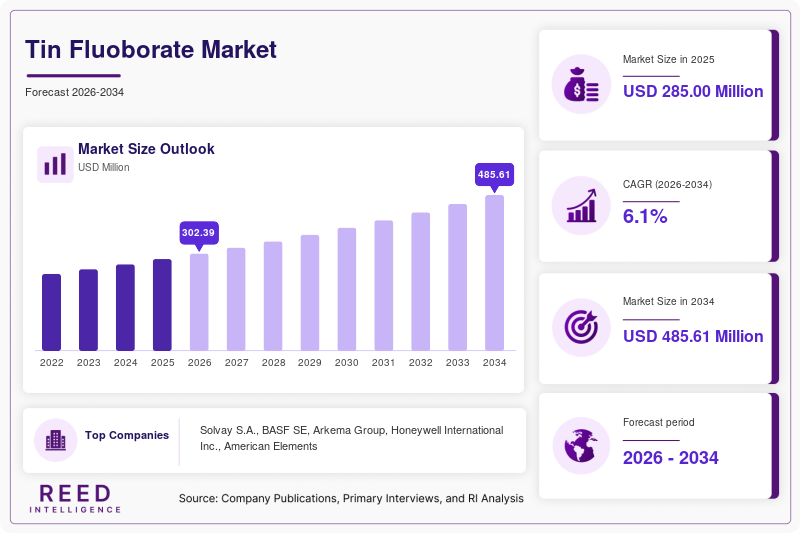
The global Tin Fluoborate Market size is experiencing steady expansion, driven by its increasing use in electroplating, printed circuit boards (PCBs), and advanced industrial coatings. Tin fluoborate, a key compound used in plating solutions, offers high conductivity and improved deposit quality, making it essential in electronics and metal finishing industries. In 2025, the market size is estimated at USD 285 million and is projected to reach approximately USD 305 million in 2026. By 2034, the market is forecast to expand to around USD 525 million, registering a CAGR of 6.1%during the period 2025–2034.
The market’s growth trajectory is supported by rising demand from the electronics manufacturing sector, where tin fluoborate is used in soldering and coating applications. As miniaturization trends in electronics continue, the need for precise and high-quality electroplating chemicals has increased significantly. Additionally, the automotive sector’s transition toward electric vehicles has amplified demand for reliable conductive coatings, further supporting market growth.
Key Highlights
- Market size projected to reach USD 525 million by 2034
- CAGR of 6.1% from 2025 to 2034
- Strong demand from electronics and automotive industries
- Rising adoption in corrosion-resistant coatings
- Increasing use in advanced electroplating processes
Market Trends
Increasing Integration in Advanced Electronics Manufacturing
The Tin Fluoborate Market is witnessing a significant shift toward advanced electronics manufacturing, particularly in high-density interconnect PCBs and semiconductor components. As devices become more compact and complex, manufacturers require precise and uniform metal deposition, which tin fluoborate-based solutions provide. The trend is further supported by the expansion of consumer electronics, telecommunications infrastructure, and data centers. These sectors demand high-performance materials that ensure conductivity and reliability. Additionally, the proliferation of 5G networks and IoT devices is accelerating the need for efficient electroplating chemicals, positioning tin fluoborate as a preferred solution in next-generation electronics production.
Shift Toward Sustainable and Efficient Chemical Processes
Sustainability is becoming a key focus area across chemical industries, and the tin fluoborate market is no exception. Manufacturers are increasingly adopting eco-efficient plating solutions to reduce environmental impact and comply with stringent regulations. Tin fluoborate formulations are being optimized to minimize waste generation and improve recyclability. This trend is also driven by cost considerations, as efficient chemical usage reduces operational expenses. Furthermore, research into alternative formulations with reduced toxicity is gaining traction, enhancing the appeal of tin fluoborate in regulated markets. As industries aim to balance performance with environmental responsibility, this trend is expected to shape future product innovations.
Market Drivers
Growing Demand from Electronics and PCB Manufacturing
The rapid expansion of the electronics industry is a major driver of the Tin Fluoborate Market. Tin fluoborate is widely used in electroplating processes for PCBs, connectors, and other electronic components. With increasing demand for smartphones, laptops, and wearable devices, manufacturers are scaling up production, thereby boosting the need for plating chemicals. The compound’s ability to provide smooth and uniform coatings enhances product quality and reliability. Additionally, advancements in semiconductor technologies are creating new opportunities for high-precision electroplating solutions, further driving market growth.
Expansion of Automotive and Electric Vehicle Industry
The automotive industry, particularly the electric vehicle segment, is contributing significantly to market growth. Tin fluoborate is used in plating applications for battery components, connectors, and electrical systems. As EV adoption increases globally, the demand for efficient and durable conductive coatings is rising. The compound’s properties, such as corrosion resistance and conductivity, make it suitable for automotive applications. Furthermore, government incentives promoting EV adoption are encouraging manufacturers to invest in advanced materials, thereby supporting the growth of the tin fluoborate market.
Market Restraint
Environmental and Regulatory Challenges
One of the primary restraints affecting the Tin Fluoborate Market is the increasing stringency of environmental regulations related to chemical usage and disposal. Tin fluoborate, like many industrial chemicals, requires careful handling and waste management to prevent environmental contamination. Regulatory bodies across regions are imposing stricter guidelines on chemical emissions, effluent treatment, and worker safety. Compliance with these regulations often leads to higher operational costs for manufacturers, which can limit market expansion.
For example, electroplating facilities must invest in advanced wastewater treatment systems to meet regulatory standards, increasing capital expenditure. Smaller manufacturers may find it challenging to adopt these measures, leading to reduced market participation. Additionally, the push for greener alternatives may result in substitution risks over time. While tin fluoborate remains effective, ongoing regulatory pressure could slow its adoption in certain regions, particularly where environmental compliance costs are high.
Market Opportunities
Rising Demand in Emerging Economies
Emerging economies present significant growth opportunities for the Tin Fluoborate Market. Rapid industrialization and urbanization in countries across Asia, Latin America, and Africa are driving demand for electronics, automotive components, and infrastructure materials. These sectors rely heavily on electroplating processes, increasing the need for tin fluoborate. Governments in these regions are also investing in manufacturing capabilities, which supports the expansion of local industries. As production capacities grow, the demand for high-quality plating chemicals is expected to rise, creating new avenues for market players.
Technological Advancements in Electroplating Processes
Technological innovations in electroplating are opening new opportunities for the market. Advanced plating techniques, such as pulse plating and nano-coating, require specialized chemicals that can deliver precise results. Tin fluoborate is being adapted to meet these evolving requirements, enhancing its applicability in high-tech industries. Additionally, the integration of automation and digital monitoring in plating processes is improving efficiency and reducing waste. These advancements are encouraging manufacturers to adopt modern solutions, thereby increasing demand for high-performance chemicals like tin fluoborate.
Segmental Analysis
By Type
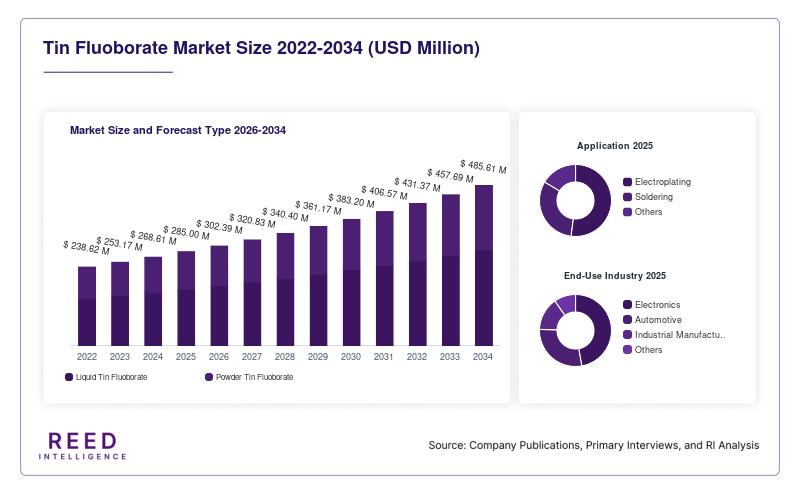
The liquid form of tin fluoborate dominated the market in 2024, accounting for nearly 65% of the total share. This dominance is attributed to its ease of use and compatibility with various electroplating processes. Liquid formulations provide consistent performance and are widely used in industrial applications due to their stability and efficiency. Manufacturers prefer liquid forms as they simplify handling and reduce preparation time, making them suitable for large-scale production environments.
The powder form is expected to be the fastest-growing subsegment, with a CAGR of 6.8% during the forecast period. Growth is driven by its longer shelf life and ease of transportation. Powder formulations are gaining popularity in regions with limited access to advanced storage facilities. Additionally, advancements in formulation technology are improving the solubility and performance of powder-based products, enhancing their adoption.
By Application
Electroplating is the dominant application segment, holding approximately 70% of the market share in 2024. Tin fluoborate is extensively used in plating processes for electronics, automotive parts, and industrial equipment. Its ability to produce smooth and uniform coatings makes it a preferred choice for manufacturers. The growing demand for high-quality metal finishes is further supporting this segment’s dominance.
The soldering application segment is expected to grow at the fastest CAGR of 6.5%. This growth is driven by increasing demand for reliable soldering materials in electronics manufacturing. Tin fluoborate-based solutions enhance solder joint quality and durability, making them suitable for advanced electronic devices. The expansion of the semiconductor industry is also contributing to this segment’s growth.
By End-Use Industry
The electronics industry dominated the market in 2024, accounting for around 60% of the total share. The widespread use of tin fluoborate in PCB manufacturing and component plating drives this dominance. The continuous growth of consumer electronics and communication devices is further boosting demand in this segment.
The automotive industry is projected to be the fastest-growing end-use segment, with a CAGR of 6.7%. The increasing adoption of electric vehicles and advanced automotive technologies is driving demand for high-performance plating solutions. Tin fluoborate’s properties, such as conductivity and corrosion resistance, make it suitable for automotive applications, supporting its growth in this segment.
Regional Analysis
North America
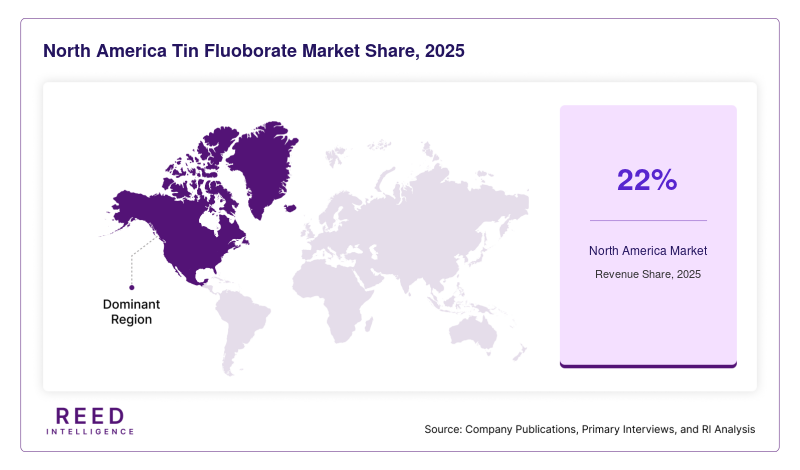
North America accounted for approximately 22% of the Tin Fluoborate Market share in 2025 and is expected to grow at a CAGR of 5.4% during the forecast period. The region’s growth is driven by advanced manufacturing capabilities and strong demand from the electronics and automotive industries. The presence of established industrial infrastructure and ongoing investments in research and development further support market expansion.
The United States dominates the regional market, supported by its robust electronics manufacturing sector. A key growth factor is the increasing adoption of electric vehicles, which requires high-performance plating solutions. This trend is encouraging manufacturers to invest in advanced materials, including tin fluoborate.
Europe
Europe held around 20% of the global market share in 2025 and is projected to grow at a CAGR of 5.2%. The region benefits from a strong focus on sustainable manufacturing practices and technological innovation. Regulatory frameworks promoting eco-friendly processes are influencing market dynamics and encouraging the adoption of efficient plating solutions.
Germany leads the European market due to its well-established automotive and industrial sectors. A unique growth factor is the region’s emphasis on precision engineering, which requires high-quality electroplating chemicals. This focus is driving demand for tin fluoborate in specialized applications.
Asia Pacific
Asia Pacific dominated the Tin Fluoborate Market with a share of approximately 38% in 2025 and is expected to grow at a CAGR of 7.2%. The region’s growth is fueled by rapid industrialization, expanding electronics manufacturing, and increasing investments in infrastructure development.
China is the dominant country in this region, driven by its large-scale manufacturing base. A key growth factor is the expansion of consumer electronics production, which significantly increases demand for electroplating chemicals. This trend is expected to continue, supporting long-term market growth.
Middle East & Africa
The Middle East & Africa region accounted for about 10% of the market share in 2025 and is projected to grow at a CAGR of 5.8%. Growth is supported by increasing industrial activities and infrastructure development across the region. Investments in manufacturing sectors are also contributing to market expansion.
Saudi Arabia leads the regional market, driven by its industrial diversification initiatives. A unique growth factor is the development of new industrial zones, which require advanced materials and chemicals for manufacturing processes, including tin fluoborate.
Latin America
Latin America held approximately 10% of the global market share in 2025 and is expected to grow at a CAGR of 5.6%. The region’s growth is driven by expanding manufacturing sectors and increasing demand for electronics and automotive components.
Brazil dominates the market in this region, supported by its growing industrial base. A key growth factor is the rising demand for corrosion-resistant coatings in infrastructure projects, which is boosting the adoption of tin fluoborate in electroplating applications.
Competitive Landscape
The Tin Fluoborate Market is moderately consolidated, with several global and regional players competing based on product quality, innovation, and pricing strategies. Leading companies are focusing on expanding their product portfolios and improving formulation efficiency to meet evolving industry requirements. Strategic collaborations and investments in research and development are common approaches adopted by market participants.
One of the leading players is Solvay S.A., known for its strong presence in specialty chemicals and advanced materials. The company has been investing in sustainable solutions to align with industry trends. Other key players are focusing on enhancing production capabilities and expanding their geographic reach to strengthen their market position.
Recent developments include the introduction of eco-efficient formulations and the expansion of manufacturing facilities in emerging markets. These initiatives aim to meet growing demand while addressing environmental concerns. Competitive dynamics are expected to intensify as companies continue to innovate and adapt to changing market conditions.
Key Players
- Solvay S.A.
- BASF SE
- Arkema Group
- Honeywell International Inc.
- American Elements
- Sigma-Aldrich Corporation
- Thermo Fisher Scientific Inc.
- Harshil Industries
- Reaxis Inc.
- Strem Chemicals Inc.
- Noah Technologies Corporation
- Toronto Research Chemicals
- Loba Chemie Pvt. Ltd.
- Finetech Industry Limited
- Central Drug House
Recent Developments
- In 2024, a major chemical manufacturer introduced a new eco-efficient tin fluoborate formulation designed to reduce waste generation in electroplating processes.
- In 2023, a leading player expanded its production facility in Asia Pacific to meet rising demand from electronics manufacturers.
- In 2024, a strategic partnership was formed between two chemical companies to develop advanced plating solutions for electric vehicle applications.
Tin Fluoborate Market Segments
Type
- Liquid Tin Fluoborate
- Powder Tin Fluoborate
Application
- Electroplating
- Soldering
- Others
End-Use Industry
- Electronics
- Automotive
- Industrial Manufacturing
- Others
By Region
- North America
- Europe
- APAC
- Middle East and Africa
- LATAM