Tissue Scaffolds Market Size, Share & Demand Report By Material Type (Natural Polymer Scaffolds, Synthetic Polymer Scaffolds, Composite Scaffolds), By Application (Orthopedic Tissue Engineering, Skin and Wound Healing, Cardiovascular Tissue Engineering, Neural Tissue Engineering), By End-Use (Hospitals and Surgical Centers, Research Laboratories, Biotechnology Companies), By Region & Segment Forecasts, 2025–2034
USD 3950
Market Overview
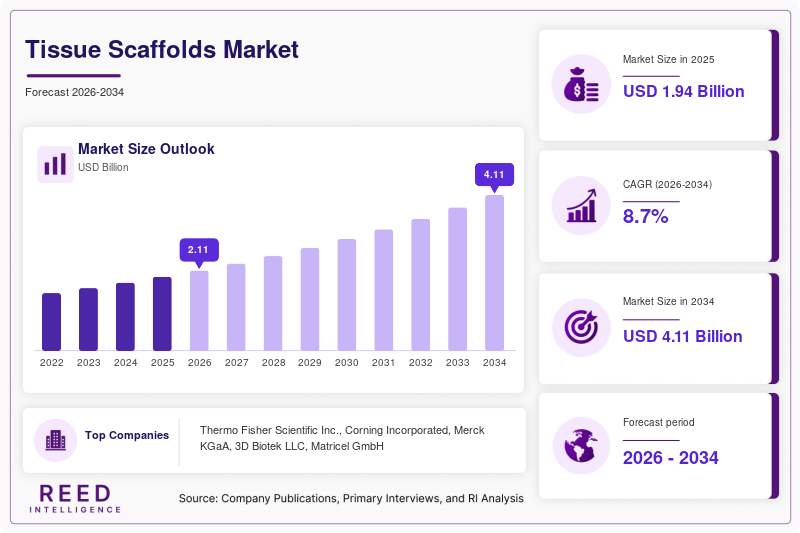
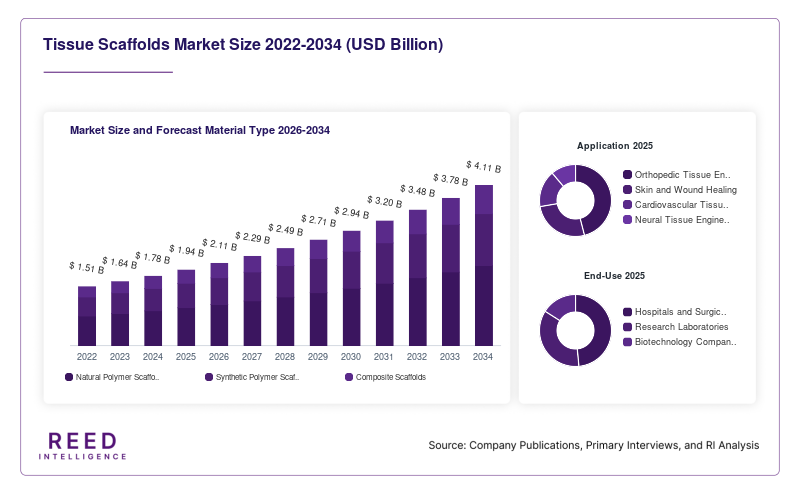
The global Tissue Scaffolds Market size was valued at USD 1.94 billion in 2025 and is projected to reach USD 4.12 billion by 2033, expanding at a CAGR of 8.7% during the forecast period (2025–2034). Tissue scaffolds are three-dimensional biomaterial structures used in regenerative medicine to support cell growth, tissue repair, and organ regeneration. These scaffolds provide a framework that enables cells to attach, proliferate, and differentiate, facilitating the development of functional tissue structures. Tissue scaffolding technologies are widely used in applications such as orthopedics, wound healing, cardiovascular tissue engineering, and skin regeneration.
A major global factor supporting the growth of the Tissue Scaffolds Marketis the increasing demand for regenerative medicine therapies. Healthcare providers are increasingly focusing on treatments that promote natural tissue repair rather than relying solely on conventional surgical interventions or organ transplantation. Tissue scaffolds play a crucial role in regenerative therapies by providing structural support for cell-based treatments and tissue engineering procedures. Advances in biomaterials, biotechnology, and biomedical engineering have contributed to the development of innovative scaffold materials with improved biocompatibility and structural stability.
Key Highlights
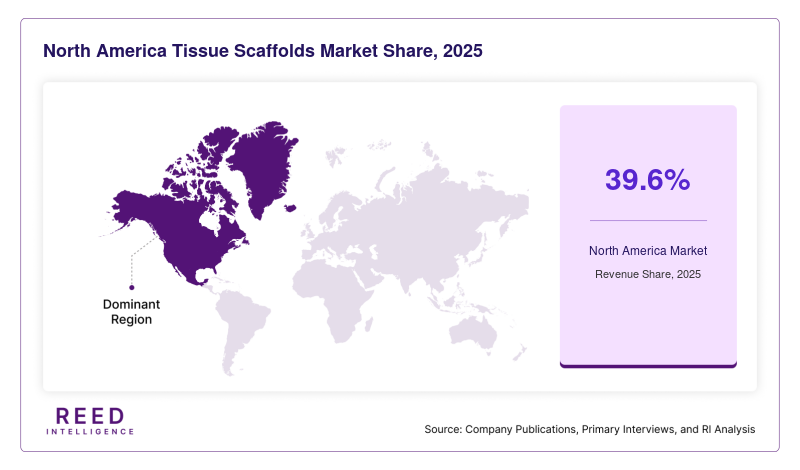
- North America dominated the Tissue Scaffolds Market with a 39.6% share in 2025, while Asia Pacific is projected to register the fastest CAGR of 9.4% during 2025–2034.
- By material type, natural polymer scaffolds accounted for the largest share of 44.8% in 2025, while composite scaffolds are projected to grow fastest at a CAGR of 9.6%.
- By application, orthopedic tissue engineering held the leading share of 36.5% in 2025, while cardiovascular tissue engineering is expected to grow at a CAGR of 9.8%.
- The United States remained the dominant country, with the market valued at USD 622.3 million in 2025 and projected to reach USD 667.9 million in 2026.
Market Trends
Increasing Adoption of 3D Bioprinting in Tissue Engineering
One of the notable trends shaping the Tissue Scaffolds Marketis the increasing adoption of 3D bioprinting technologies for scaffold fabrication. Researchers and biotechnology companies are using 3D bioprinting techniques to create customized scaffold structures with precise pore sizes and mechanical properties. These scaffolds can be tailored to match specific tissue structures, enabling improved integration with patient cells. The ability to design complex biomaterial architectures using digital modeling has expanded the possibilities of regenerative medicine.
Development of Bioactive and Smart Scaffold Materials
Another emerging trend in the Tissue Scaffolds Marketis the development of bioactive scaffolds that interact with cells and biological signals. Modern scaffolds are increasingly designed with biochemical cues that promote cell attachment and tissue regeneration. Some advanced materials are capable of releasing growth factors or therapeutic agents in a controlled manner. These smart scaffolds enhance the efficiency of tissue regeneration processes and support improved clinical outcomes.
Market Drivers
Rising Demand for Regenerative Medicine Therapies
The growing interest in regenerative medicine has significantly influenced the Tissue Scaffolds Market. Medical researchers and clinicians are exploring therapies that stimulate the body's natural ability to repair damaged tissues. Tissue scaffolds serve as structural frameworks for regenerative treatments and cell-based therapies. As regenerative medicine continues to expand across multiple medical disciplines, the demand for advanced scaffold materials is expected to increase.
Increasing Prevalence of Orthopedic and Chronic Diseases
The rising incidence of orthopedic injuries and chronic diseases has also supported the growth of the Tissue Scaffolds Market. Conditions such as osteoarthritis, bone fractures, and degenerative tissue disorders often require advanced treatment solutions. Tissue scaffolds provide structural support for bone and cartilage regeneration, enabling more effective recovery processes. Healthcare providers increasingly incorporate tissue engineering technologies into treatment strategies for complex injuries.
Market Restraint
High Development Costs and Complex Manufacturing Processes
One of the primary challenges affecting the Tissue Scaffolds Marketis the high cost associated with scaffold development and manufacturing. Producing tissue scaffolds requires advanced biomaterials, specialized laboratory equipment, and precise fabrication techniques. These processes can be expensive and time-consuming, particularly when developing customized scaffolds for clinical applications. In addition, strict regulatory requirements for biomedical products can extend product development timelines. These factors may limit the adoption of tissue scaffold technologies in certain healthcare systems.
Market Opportunities
Expansion of Stem Cell-Based Therapies
The growth of stem cell research presents a significant opportunity for the Tissue Scaffolds Market. Stem cells require supportive structures to grow and differentiate into functional tissues. Tissue scaffolds provide a suitable environment for stem cell proliferation and tissue formation. As stem cell-based therapies gain wider acceptance in clinical practice, the demand for compatible scaffold materials is expected to increase.
Development of Personalized Tissue Engineering Solutions
Another opportunity lies in the development of personalized tissue engineering treatments. Advances in biomedical imaging and computational modeling allow researchers to design patient-specific scaffold structures. Personalized scaffolds can be engineered to match the anatomical and biological characteristics of individual patients. This approach improves tissue integration and therapeutic outcomes, making it an attractive area of research for healthcare innovators.
Segmental Analysis
By Material Type
The Tissue Scaffolds Marketis segmented by material type into natural polymer scaffolds, synthetic polymer scaffolds, and composite scaffolds. Natural polymer scaffolds accounted for the largest share of 44.8% in 2025. These materials are derived from biological sources such as collagen, chitosan, and gelatin. Natural polymers provide excellent biocompatibility and promote cell adhesion, making them suitable for tissue engineering applications.
The composite scaffold segmentis projected to grow at the fastest CAGR of 9.6% during the forecast period. Composite scaffolds combine multiple biomaterials to achieve improved mechanical strength and biological functionality. These materials provide structural support while maintaining favorable biological properties. As research in biomaterial engineering advances, composite scaffolds are expected to gain wider adoption.
By Application
The Tissue Scaffolds Marketis segmented into orthopedic tissue engineering, skin and wound healing, cardiovascular tissue engineering, and neural tissue engineering. Orthopedic tissue engineering accounted for the largest share of 36.5% in 2025. Tissue scaffolds are commonly used to support bone and cartilage regeneration in orthopedic treatments. These scaffolds provide structural support that facilitates the repair of damaged bone tissues.
The cardiovascular tissue engineering segmentis expected to grow at the fastest CAGR of 9.8% during the forecast period. Cardiovascular diseases often require advanced tissue regeneration therapies. Tissue scaffolds can be used to develop artificial blood vessels and cardiac tissue constructs. Increasing research in cardiovascular regenerative medicine will support the growth of this segment.
By End-Use
Based on end-use, the Tissue Scaffolds Marketincludes hospitals and surgical centers, research laboratories, and biotechnology companies. Research laboratories accounted for the largest share of 41.2% in 2025. Academic institutions and biomedical research centers conduct extensive studies on scaffold materials and regenerative medicine applications. These organizations play a key role in developing new tissue engineering technologies.
The biotechnology companies segmentis expected to grow at the fastest CAGR of 9.3% during the forecast period. Biotechnology firms are increasingly investing in regenerative medicine and advanced biomaterials research. Many companies are developing commercial tissue engineering products designed for clinical applications.
Regional Analysis
North America
North America accounted for 39.6% of the global Tissue Scaffolds Market share in 2025. The region benefited from strong biotechnology research infrastructure and significant investments in regenerative medicine technologies. The regional market will grow at a CAGR of 8.4% during the forecast period. Universities, research institutes, and biotechnology companies across the region actively participate in tissue engineering research.
The United Statesdominated the regional market due to its well-developed biomedical research ecosystem and advanced healthcare infrastructure. Numerous biotechnology firms and academic institutions conduct research on scaffold materials and regenerative therapies. Government funding programs supporting biomedical innovation have also contributed to the development of new tissue engineering technologies.
Europe
Europe accounted for 27.8% of the global Tissue Scaffolds Market share in 2025. The regional market is projected to grow at a CAGR of 8.5% during 2025–2034. European healthcare systems emphasize research in regenerative medicine and advanced biomedical technologies. Several research institutions across the region focus on developing innovative biomaterials for tissue engineering applications.
Germanyemerged as the leading country within the European market. The country has a strong medical technology industry and a well-established biomedical research environment. German research institutes and biotechnology companies are actively involved in developing scaffold materials for tissue regeneration. Collaboration between academic institutions and healthcare organizations has supported innovation in tissue engineering technologies.
Asia Pacific
Asia Pacific represented 21.3% of the global Tissue Scaffolds Market share in 2025and is expected to register the fastest CAGR of 9.4% during the forecast period. Rapid growth in biotechnology research and increasing healthcare investments have supported the expansion of tissue engineering technologies in the region.
Chinaremained the dominant country in the Asia Pacific market. The country has expanded its biotechnology sector and increased investments in regenerative medicine research. Universities and biotechnology startups are exploring innovative scaffold fabrication methods. Government initiatives supporting biomedical innovation have encouraged the development of tissue engineering technologies.
Middle East & Africa
The Middle East & Africaaccounted for 6.0% of the global Tissue Scaffolds Market share in 2025. The regional market is projected to grow at a CAGR of 8.2% during the forecast period. Healthcare modernization programs and research initiatives have encouraged the adoption of advanced medical technologies in several countries across the region.
Saudi Arabiarepresented the dominant country within the regional market. The country has been investing in healthcare infrastructure and medical research programs. Hospitals and research institutions are increasingly adopting regenerative medicine technologies, including tissue scaffolding solutions.
Latin America
Latin America held 5.3% of the global Tissue Scaffolds Market share in 2025and is projected to grow at a CAGR of 8.6% during 2025–2034. Increasing healthcare investments and research initiatives have supported the development of biomedical technologies across the region.
Brazilremained the leading country in the Latin American market. The country’s healthcare research institutions are actively exploring tissue engineering and regenerative medicine technologies. Collaborative research programs between universities and biotechnology companies have contributed to innovation in scaffold materials.
Competitive Landscape
The Tissue Scaffolds Marketincludes several biotechnology companies and biomedical research organizations that specialize in regenerative medicine technologies. Market participants focus on developing innovative biomaterials and scaffold fabrication techniques to support tissue regeneration therapies.
Thermo Fisher Scientific Inc.remains one of the notable participants in the market due to its extensive portfolio of biomedical research products. The company provides advanced biomaterials and laboratory technologies used in tissue engineering research. Recent developments include the expansion of regenerative medicine product lines designed for cell culture and tissue scaffold applications.Other companies continue to collaborate with research institutions and healthcare providers to develop new scaffold technologies and expand their presence in the regenerative medicine industry.
Key Players
- Thermo Fisher Scientific Inc.
- Corning Incorporated
- Merck KGaA
- 3D Biotek LLC
- Matricel GmbH
- REPROCELL Inc.
- Avacta Life Sciences Ltd.
- PolyNovo Limited
- Organovo Holdings Inc.
- Becton, Dickinson and Company
- CollPlant Biotechnologies Ltd.
- Cytori Therapeutics Inc.
- Vericel Corporation
- Athersys Inc.
- Xeltis AG
Recent Developments
- In 2024, biotechnology companies introduced advanced 3D bioprinting platforms designed to produce customized tissue scaffolds for regenerative medicine applications.
- In 2023, several biomedical research organizations developed composite scaffold materials that combine natural and synthetic polymers to improve mechanical performance.
- In 2023, regenerative medicine startups expanded collaborations with research institutions to develop scaffold-based therapies for orthopedic and cardiovascular tissue repair.
Tissue Scaffolds Market Segments
Material Type
- Natural Polymer Scaffolds
- Synthetic Polymer Scaffolds
- Composite Scaffolds
Application
- Orthopedic Tissue Engineering
- Skin and Wound Healing
- Cardiovascular Tissue Engineering
- Neural Tissue Engineering
End-Use
- Hospitals and Surgical Centers
- Research Laboratories
- Biotechnology Companies
By Region
- North America
- Europe
- APAC
- Middle East and Africa
- LATAM