Tissue Sectioning Market Size, Share & Demand Report By Equipment Type (Microtomes, Cryostats, Ultramicrotomes), By Application (Diagnostic Laboratories, Research Institutes, Academic Institutions), By End-Use (Hospitals, Pharmaceutical & Biotechnology Companies, Contract Research Organizations), By Region & Segment Forecasts, 2026–2034
USD 3950
Market Overview
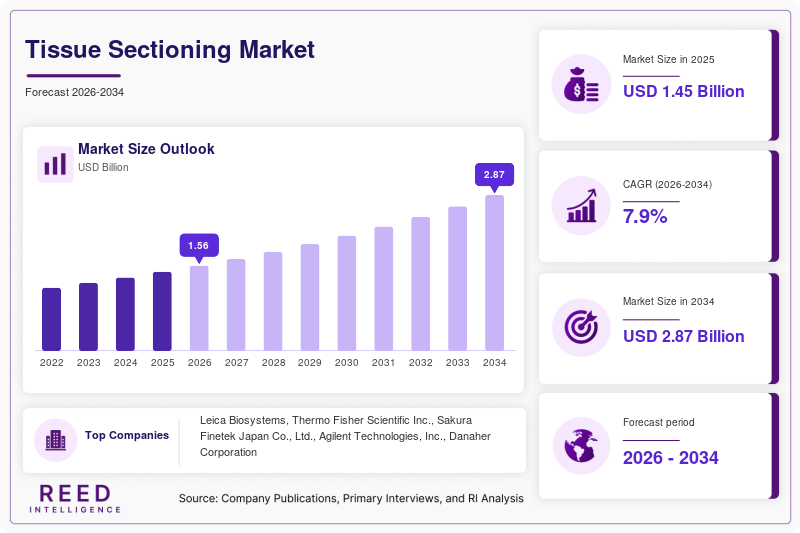
The global Tissue Sectioning Market was valued at approximately USD 1.45 billion in 2026 and is projected to reach USD 2.68 billion by 2034, expanding at a compound annual growth rate (CAGR) of 7.9% from 2026 to 2034. The market is witnessing consistent expansion due to the rising demand for accurate histopathological diagnostics, advancements in precision medicine, and increased research activities in life sciences. Tissue sectioning plays a critical role in pathology, enabling detailed microscopic examination of biological samples, which is essential for disease diagnosis, drug development, and academic research.
A key global factor supporting market growth is the increasing prevalence of chronic diseases such as cancer, cardiovascular disorders, and neurological conditions. These diseases require extensive tissue analysis for early diagnosis and treatment planning, thereby driving demand for advanced sectioning equipment such as microtomes, cryostats, and ultramicrotomes. Furthermore, the integration of automation and digital pathology systems is enhancing workflow efficiency, encouraging laboratories to upgrade their equipment.
Key Highlights
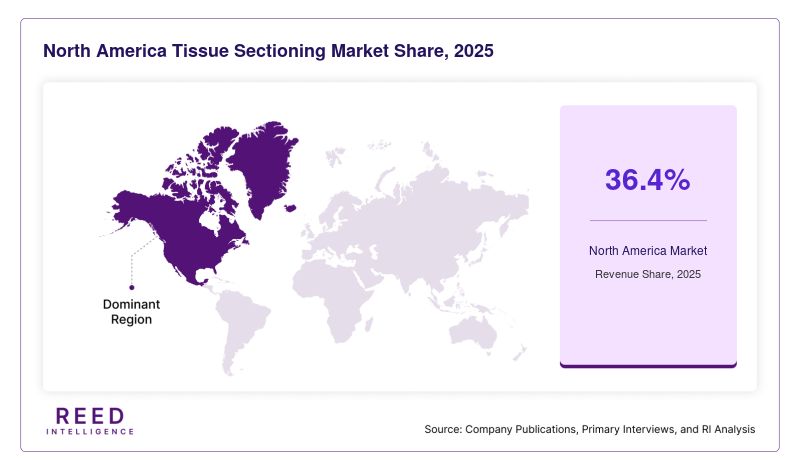
- North America dominated the market with a 36.4% share in 2025.
- Asia Pacific is expected to grow at the fastest CAGR of 9.8% during 2026–2034.
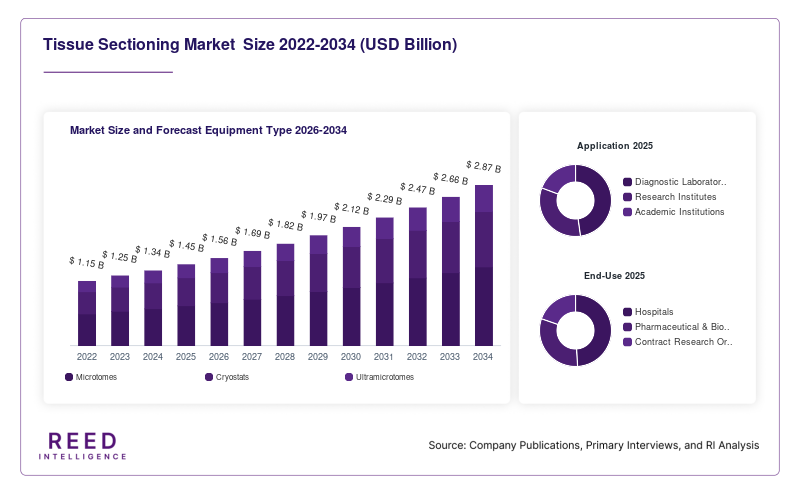
- By equipment type, microtomes accounted for the largest share of 42.1%, while cryostats are projected to grow at a CAGR of 8.7%.
- By application, diagnostic laboratories led with a 44.5% share, whereas research institutes are expected to expand at a CAGR of 8.9%.
- The United States remained the dominant country, with market values of USD 520 million in 2024 and USD 575 million in 2025.
Market Trends
Increasing Adoption of Automated Tissue Sectioning Systems
Automation is emerging as a key trend in the Tissue Sectioning Market, driven by the need for higher precision, reproducibility, and reduced manual intervention in laboratory workflows. Automated microtomes and cryostats are increasingly being adopted in diagnostic laboratories and research facilities to improve operational efficiency and minimize human error. These systems offer programmable settings, uniform section thickness, and integration with digital imaging platforms, which enhance the quality of tissue analysis. The growing shortage of skilled laboratory professionals is also pushing healthcare institutions to adopt automation solutions. In addition, automated systems support high-throughput processing, making them suitable for large hospitals and centralized diagnostic centers. As healthcare systems continue to prioritize accuracy and efficiency, the demand for automated tissue sectioning equipment is expected to rise steadily.
Integration with Digital Pathology and AI-Based Analysis
The integration of tissue sectioning technologies with digital pathology platforms and artificial intelligence is reshaping the market landscape. Laboratories are increasingly digitizing tissue samples to enable remote diagnostics, data sharing, and advanced image analysis. Tissue sectioning equipment that is compatible with digital workflows allows seamless transition from sample preparation to image analysis. AI-powered tools can analyze digitized slides to detect abnormalities, improving diagnostic accuracy and reducing turnaround time. This trend is particularly significant in oncology research and clinical diagnostics, where precise tissue evaluation is critical. As digital health infrastructure expands globally, the demand for advanced sectioning equipment that supports digital integration is expected to grow significantly.
Market Drivers
Rising Prevalence of Chronic and Infectious Diseases
The increasing burden of chronic diseases, including cancer, diabetes, and cardiovascular disorders, is a major driver of the Tissue Sectioning Market. These conditions require detailed tissue examination for accurate diagnosis, staging, and treatment planning. Tissue sectioning enables pathologists to analyze cellular structures and identify disease markers, making it an essential component of modern diagnostics. Additionally, the rise in infectious diseases and emerging pathogens has further increased the demand for laboratory testing and tissue analysis. Governments and healthcare organizations are investing heavily in diagnostic infrastructure to address these challenges, which is boosting the adoption of tissue sectioning equipment across hospitals and laboratories.
Growth in Life Sciences Research and Drug Development
The expansion of life sciences research and pharmaceutical development is significantly contributing to market growth. Tissue sectioning is widely used in preclinical and clinical research to study disease mechanisms, evaluate drug efficacy, and conduct toxicity assessments. The increasing number of research projects, clinical trials, and academic studies is driving the demand for advanced sectioning tools. Furthermore, biotechnology companies are focusing on personalized medicine, which requires detailed tissue analysis for biomarker identification. The availability of funding for research activities and the establishment of new research institutes are further supporting the growth of the Tissue Sectioning Market.
Market Restraint
High Cost of Advanced Equipment and Maintenance
One of the primary challenges in the Tissue Sectioning Market is the high cost associated with advanced sectioning equipment and its maintenance. Automated microtomes, cryostats, and ultramicrotomes involve significant initial investment, which can be a barrier for small laboratories and healthcare facilities with limited budgets. In addition to the purchase cost, these systems require regular maintenance, calibration, and skilled technicians for operation, further increasing operational expenses. This cost burden can limit the adoption of advanced technologies, particularly in developing regions where healthcare infrastructure is still evolving. For example, smaller diagnostic centers may continue using conventional manual equipment due to cost constraints, which can impact efficiency and accuracy. Moreover, the need for continuous upgrades to keep up with technological advancements adds to the financial pressure on institutions. As a result, cost-related challenges may hinder the widespread adoption of advanced tissue sectioning solutions, especially in price-sensitive markets.
Market Opportunities
Expansion of Healthcare Infrastructure in Emerging Economies
Emerging economies present significant growth opportunities for the Tissue Sectioning Market due to ongoing investments in healthcare infrastructure. Countries in Asia Pacific, Latin America, and the Middle East are expanding their diagnostic and research capabilities to address growing healthcare needs. Governments are focusing on improving access to healthcare services, which includes the establishment of new hospitals, laboratories, and research centers. This expansion is driving the demand for tissue sectioning equipment, as accurate diagnostics become a priority. Additionally, increasing awareness about early disease detection and preventive healthcare is encouraging the adoption of advanced diagnostic technologies in these regions.
Advancements in Precision Medicine and Personalized Healthcare
The growing emphasis on precision medicine is creating new opportunities in the Tissue Sectioning Market. Personalized treatment approaches rely on detailed analysis of patient-specific tissue samples to identify genetic and molecular characteristics. Tissue sectioning plays a crucial role in preparing samples for advanced diagnostic techniques such as molecular pathology and genomic analysis. As healthcare providers shift toward individualized treatment plans, the demand for high-quality tissue sections is expected to increase. Furthermore, advancements in biotechnology and genomics are enabling more accurate and targeted therapies, which require precise tissue analysis. This trend is likely to drive innovation and investment in tissue sectioning technologies, opening new avenues for market growth.
Segmental Analysis
By Equipment Type
The microtomes segment dominated the Tissue Sectioning Market in 2024, accounting for approximately 42.1% of the total market share. Microtomes are widely used in histology laboratories for cutting thin tissue sections for microscopic examination. Their popularity is attributed to their precision, ease of use, and versatility in handling different types of tissues. These instruments are essential in both clinical diagnostics and research applications, making them a standard tool in laboratories worldwide. The availability of various types of microtomes, including rotary, sliding, and vibrating models, further enhances their adoption across different settings.
Cryostats are expected to be the fastest-growing subsegment, with a projected CAGR of 8.7% during the forecast period. The growth of this segment is driven by the increasing demand for rapid tissue analysis, particularly in intraoperative diagnostics. Cryostats allow for quick freezing and sectioning of tissues, enabling immediate examination. This capability is critical in surgical procedures where timely decision-making is required. Additionally, advancements in cryostat technology, such as improved temperature control and automation features, are contributing to their growing adoption in modern laboratories.
By Application
Diagnostic laboratories held the largest share of the Tissue Sectioning Market in 2024, accounting for approximately 44.5%. These laboratories rely heavily on tissue sectioning for disease diagnosis, particularly in oncology, where detailed tissue analysis is essential. The increasing number of diagnostic tests and the rising prevalence of chronic diseases are driving the demand for tissue sectioning equipment in this segment. Furthermore, the shift toward centralized diagnostic services is increasing the volume of samples processed, further boosting the need for efficient sectioning solutions.
Research institutes are expected to be the fastest-growing subsegment, with a CAGR of 8.9% during the forecast period. The growth is driven by increasing investments in biomedical research and the rising number of academic and industrial research projects. Tissue sectioning is a fundamental step in various research applications, including drug development, disease modeling, and genetic studies. The expansion of research funding and the establishment of new research facilities are further supporting the growth of this segment.
By End-Use
Hospitals dominated the Tissue Sectioning Market in 2024, accounting for approximately 39.8% of the total share. Hospitals require tissue sectioning equipment for diagnostic and surgical applications, particularly in pathology departments. The increasing number of hospital admissions and surgical procedures is driving the demand for tissue sectioning technologies. Additionally, hospitals are investing in advanced equipment to improve diagnostic accuracy and patient outcomes, which is contributing to the growth of this segment.
Pharmaceutical and biotechnology companies are projected to be the fastest-growing subsegment, with a CAGR of 9.1% during the forecast period. These companies use tissue sectioning in drug development and research activities to study the effects of new therapies on biological tissues. The growing focus on personalized medicine and the increasing number of clinical trials are driving the demand for tissue sectioning equipment in this segment. Furthermore, advancements in biotechnology and the development of innovative therapies are expected to support the growth of this segment.
Regional Analysis
North America
North America accounted for the largest share of the Tissue Sectioning Market, representing approximately 36.4% in 2025, and is expected to maintain steady growth with a CAGR of 7.5% during the forecast period. The region benefits from advanced healthcare infrastructure, high adoption of innovative technologies, and strong presence of leading market players. The demand for tissue sectioning equipment is driven by the increasing prevalence of chronic diseases and the need for accurate diagnostic solutions.
The United States dominates the regional market due to its well-established healthcare system and significant investments in research and development. A key growth factor in the country is the widespread adoption of digital pathology and automation in laboratories. This trend is supported by government initiatives and funding programs aimed at improving diagnostic accuracy and efficiency.
Europe
Europe held a significant share of the Tissue Sectioning Market in 2025, accounting for approximately 28.1%, with a projected CAGR of 7.2% from 2026 to 2034. The region’s growth is supported by strong healthcare systems, increasing research activities, and rising demand for advanced diagnostic tools. Countries in Western Europe are leading adopters of automated and digital pathology solutions.
Germany is the dominant country in the European market, driven by its robust healthcare infrastructure and focus on medical research. A unique growth factor in Germany is the emphasis on technological innovation and precision diagnostics, which is encouraging the adoption of advanced tissue sectioning equipment in both clinical and research settings.
Asia Pacific
Asia Pacific is expected to witness the fastest growth in the Tissue Sectioning Market, with a CAGR of 9.8% during the forecast period. The region accounted for approximately 21.6% of the market share in 2025. Rapid urbanization, increasing healthcare expenditure, and growing awareness about early disease diagnosis are key factors driving market growth.
China is the leading country in the region, supported by significant investments in healthcare infrastructure and research facilities. A unique growth factor in China is the expansion of biotechnology and pharmaceutical industries, which is increasing the demand for tissue sectioning equipment for research and development purposes.
Middle East & Africa
The Middle East & Africa region held a smaller share of the Tissue Sectioning Market in 2025, accounting for around 7.4%, but is expected to grow at a CAGR of 6.8% during the forecast period. The market is gradually expanding due to improvements in healthcare infrastructure and increasing investments in diagnostic services.
Saudi Arabia is the dominant country in the region, driven by government initiatives to modernize healthcare systems. A key growth factor is the increasing focus on early disease detection and the establishment of advanced diagnostic laboratories, which is boosting the demand for tissue sectioning technologies.
Latin America
Latin America accounted for approximately 6.5% of the Tissue Sectioning Market in 2025 and is projected to grow at a CAGR of 6.9% during the forecast period. The region is experiencing gradual growth due to rising healthcare awareness and increasing investments in medical infrastructure.
Brazil is the leading country in the region, supported by its large population and expanding healthcare sector. A unique growth factor in Brazil is the increasing adoption of private healthcare services, which is driving demand for advanced diagnostic equipment, including tissue sectioning systems.
Competitive Landscape
The Tissue Sectioning Market is moderately competitive, with several established players focusing on product innovation, strategic partnerships, and geographic expansion to strengthen their market position. Leading companies are investing in research and development to introduce advanced and automated tissue sectioning solutions that enhance efficiency and accuracy.
One of the leading players in the market is Leica Biosystems, which has a strong presence in the global pathology equipment industry. The company focuses on developing innovative solutions that integrate tissue sectioning with digital pathology systems. A recent development includes the launch of an advanced automated microtome designed to improve workflow efficiency and precision in laboratory settings.
Other key players are also expanding their product portfolios and entering emerging markets to capitalize on growth opportunities. Strategic collaborations with research institutes and healthcare providers are further helping companies to strengthen their market presence and enhance their technological capabilities.
Key Players
- Leica Biosystems
- Thermo Fisher Scientific Inc.
- Sakura Finetek Japan Co., Ltd.
- Agilent Technologies, Inc.
- Danaher Corporation
- MEDITE Medical GmbH
- Amos Scientific Pty Ltd
- Boeckeler Instruments, Inc.
- RMC Boeckeler
- Diapath S.p.A.
- Bright Instruments Ltd
- Jinhua YIDI Medical Appliance Co., Ltd.
- Slee Medical GmbH
- Milestone Medical
- Labtron Equipment Ltd
Recent Developments
- In 2025, a leading manufacturer introduced a next-generation automated microtome with enhanced precision control and digital integration capabilities.
- In 2024, a major company expanded its manufacturing facility in Asia Pacific to meet the growing regional demand for tissue sectioning equipment.
- In 2025, a strategic partnership was formed between a biotechnology firm and a medical equipment provider to develop advanced tissue analysis solutions.
Tissue Sectioning Market Segments
Equipment Type
- Microtomes
- Cryostats
- Ultramicrotomes
Application
- Diagnostic Laboratories
- Research Institutes
- Academic Institutions
End-Use
- Hospitals
- Pharmaceutical & Biotechnology Companies
- Contract Research Organizations
By Region
- North America
- Europe
- APAC
- Middle East and Africa
- LATAM