Titanium Diboride Powders Market Size, Share & Demand Report By Type (High-Purity Titanium Diboride Powders, Nano-Sized Titanium Diboride Powders, Standard Grade Titanium Diboride Powders), By Application (Wear-Resistant Components, Conductive Ceramics, Cutting Tools, Protective Coatings), By End-Use Industry (Metallurgy, Electronics, Aerospace, Industrial Manufacturing), By Region & Segment Forecasts, 2025–2033
USD 3950
Market Overview
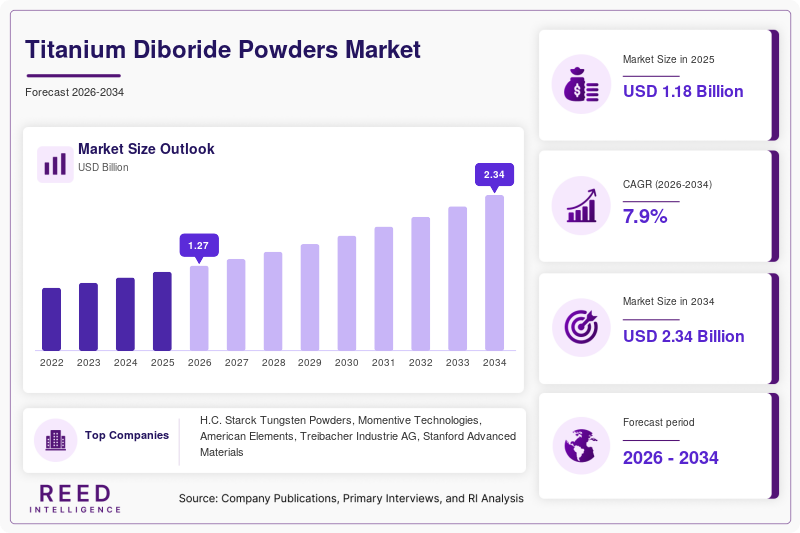
The Titanium Diboride Powders Market size was valued at USD 1.18 billion in 2025 and is projected to reach USD 2.36 billion by 2034, expanding at a CAGR of 7.9% during 2025–2034. Titanium diboride powders are advanced ceramic materials recognized for their high hardness, electrical conductivity, and chemical stability. These characteristics make them suitable for demanding industrial applications such as metal processing, wear-resistant coatings, and high-performance composites.
The Titanium Diboride Powders Market size has expanded steadily as industries increasingly seek materials capable of operating in high-temperature and corrosive environments. Titanium diboride powders demonstrate strong resistance to molten metals, enabling their use in aluminum smelting equipment, cutting tools, and conductive ceramics. In addition, the rising integration of advanced materials into aerospace and electronics manufacturing has strengthened the market outlook.
Key Highlights
- Asia Pacific dominated the Titanium Diboride Powders Market with 41% share in 2025, while Latin America will register the fastest CAGR of 8.6% through 2034.
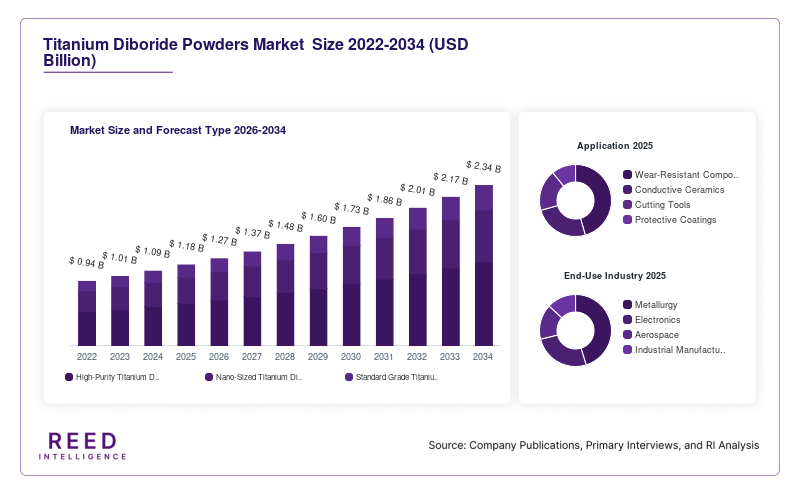
- By type, high-purity titanium diboride powders accounted for 48% share, while nano-sized powders are projected to grow at 9.1% CAGR.
- By application, wear-resistant components led with 34% share, while conductive ceramics applications will grow at 8.8% CAGR.
- China represented the dominant country, with the market valued at USD 305 million in 2025 and projected to reach USD 329 million in 2026.
Market Trends
Expansion of Nano-Structured Ceramic Materials
The shift toward nano-engineered materials is influencing the Titanium Diboride Powders Market. Manufacturers are increasingly developing nano-sized titanium diboride powders with controlled particle size and improved surface area. These powders provide enhanced mechanical strength, electrical conductivity, and sintering performance. As industries require lighter and more durable components, nano-scale ceramic powders have become a preferred material for high-performance composites and coatings. The trend is particularly visible in precision engineering and electronics manufacturing.
Integration of Advanced Powder Processing Technologies
Another key trend shaping the Titanium Diboride Powders Market growth is the adoption of advanced powder production techniques such as plasma synthesis and high-energy milling. These processes allow manufacturers to achieve better purity levels and particle uniformity. Improved processing technologies also reduce production defects and improve powder consistency, which is essential for applications involving structural ceramics and conductive components. As industries increasingly demand specialized material properties, the adoption of advanced powder processing technologies will remain a defining trend in the market forecast.
Market Drivers
Rising Demand for High-Performance Ceramics
The growing need for materials capable of withstanding extreme temperatures and mechanical stress has increased the demand for high-performance ceramics. Titanium diboride powders are widely used in structural ceramics and composite materials due to their exceptional hardness and thermal stability. Manufacturers in sectors such as metallurgy and industrial equipment rely on these powders to enhance component durability and operational efficiency. As industrial processes become more demanding, the Titanium Diboride Powders Market size is expected to benefit from the rising adoption of advanced ceramic materials.
Increasing Applications in Metal Processing Equipment
Another major driver of the Titanium Diboride Powders Market growth is their extensive use in metal processing equipment. Titanium diboride exhibits strong resistance to molten aluminum and other metals, making it suitable for cathodes, crucibles, and protective coatings used in smelting operations. With the global metals industry expanding to support construction, automotive, and infrastructure development, the demand for durable materials used in metal production equipment is increasing. Consequently, titanium diboride powders have become an essential material in improving equipment lifespan and efficiency.
Market Restraint
High Production Costs of Advanced Ceramic Powders
One of the primary restraints affecting the Titanium Diboride Powders Market is the relatively high cost associated with producing advanced ceramic powders. Manufacturing titanium diboride powders requires specialized synthesis processes, high-temperature equipment, and controlled environments to maintain purity and particle size consistency. These requirements increase operational costs for producers.
Additionally, the raw materials used in the production process can be expensive, particularly when manufacturers aim to achieve high purity levels for advanced applications. Small-scale manufacturers often face challenges in maintaining competitive pricing due to these production complexities.
The high cost structure can limit adoption in cost-sensitive industries, particularly in regions where alternative materials are readily available. Some manufacturers may prefer lower-cost ceramics or metal alloys for certain applications where the superior properties of titanium diboride are not essential.
Furthermore, the Titanium Diboride Powders Market analysis suggests that supply chain fluctuations in raw materials could further increase production costs. Until manufacturing technologies become more efficient and cost-effective, the high cost of production will remain a significant constraint influencing the overall market outlook.
Market Opportunities
Growth in Advanced Aerospace Materials
The aerospace sector is increasingly adopting advanced ceramic materials to enhance component performance. Titanium diboride powders offer high stiffness, low density, and strong thermal stability, making them suitable for specialized aerospace components and protective coatings. As aircraft manufacturers focus on improving fuel efficiency and durability, the demand for lightweight yet robust materials is expected to increase. This trend will create new opportunities for manufacturers operating in the Titanium Diboride Powders Market.
Development of Conductive Ceramic Components
Another promising opportunity in the Titanium Diboride Powders Market forecast lies in conductive ceramic applications. Unlike many traditional ceramics, titanium diboride exhibits strong electrical conductivity while maintaining high hardness. This unique combination of properties makes it suitable for electrodes, electronic components, and specialized conductive coatings. As electronics manufacturing continues to evolve toward high-performance materials, the adoption of conductive ceramics is expected to expand, supporting long-term market growth.
Segmental Analysis
By Type
High-purity titanium diboride powders represented the dominant subsegment in the Titanium Diboride Powders Market, accounting for 48% share in 2025. These powders are widely used in industrial applications that require consistent material properties and high thermal stability. High purity levels ensure improved conductivity and resistance to chemical degradation, making them suitable for use in metal processing equipment and wear-resistant components. Manufacturers prefer high-purity powders because they provide better performance in demanding industrial environments.
Nano-sized titanium diboride powders will emerge as the fastest-growing subsegment, expanding at a CAGR of 9.1% through 2034. The increasing demand for advanced materials with enhanced mechanical and electrical properties will drive adoption of nano-scale powders. These powders offer improved surface area and superior sintering characteristics compared with conventional particle sizes. As research and development activities continue to focus on nano-engineered materials, the nano powder segment will experience strong growth in the Titanium Diboride Powders Market forecast.
By Application
Wear-resistant components held the largest share of the Titanium Diboride Powders Market at 34% in 2025. Titanium diboride powders are commonly used to manufacture durable coatings and components designed to withstand abrasion and mechanical stress. Industrial equipment manufacturers rely on these materials to improve the lifespan of machinery used in harsh operating environments. The ability of titanium diboride to maintain structural integrity under extreme conditions makes it a preferred material for wear-resistant applications.
Conductive ceramics will represent the fastest-growing application segment, expanding at a CAGR of 8.8% through 2034. Titanium diboride powders possess a rare combination of ceramic hardness and electrical conductivity. These properties will support the development of specialized ceramic components used in electronic devices and conductive coatings. As electronics manufacturers explore materials capable of handling high electrical loads while maintaining mechanical stability, conductive ceramic applications will gain increasing importance.
By End-Use Industry
The metallurgy industry accounted for the largest share of the Titanium Diboride Powders Market at 39% in 2025. Titanium diboride powders are widely used in equipment associated with aluminum smelting and metal processing due to their resistance to molten metals. Their durability helps extend the operational life of critical industrial components. As global metal production continues to grow, demand from the metallurgy sector has remained a major contributor to the market size.
The electronics industry will register the fastest CAGR of 8.7% during the forecast period. Titanium diboride powders will increasingly be used in conductive components and specialized electronic substrates. Electronics manufacturers are exploring advanced ceramic materials that can improve component performance in high-temperature and high-current environments. This technological shift will create strong opportunities for titanium diboride powders in emerging electronic applications.
Regional Analysis
North America
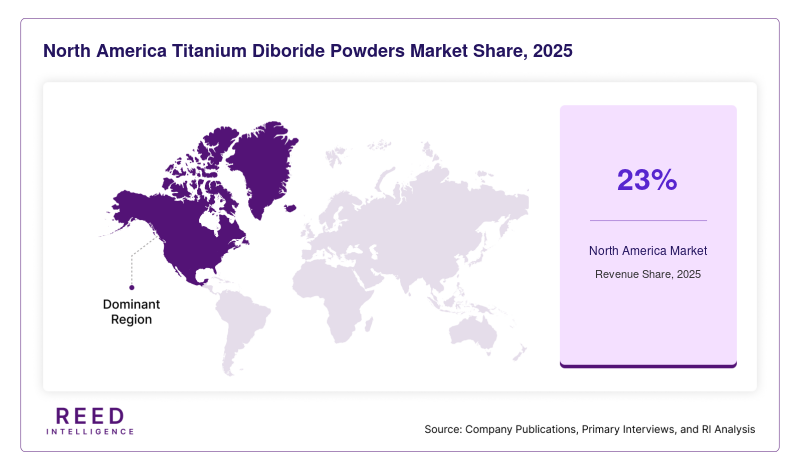
North America accounted for 23% share of the Titanium Diboride Powders Market in 2025, supported by a strong presence of advanced materials research institutions and industrial manufacturers. The region will expand at a CAGR of 7.4% between 2025 and 2034 as demand for specialized ceramic powders increases across high-technology industries. The United States and Canada host several advanced materials laboratories and powder metallurgy companies that contribute to technological development in ceramic powders.
The United States dominated the regional Titanium Diboride Powders Market due to its well-established aerospace and defense manufacturing ecosystem. Titanium diboride powders are increasingly utilized in precision machining tools and high-temperature structural components produced within these industries. Government funding for advanced materials research programs has also contributed to the development of improved powder synthesis technologies. This focus on technological innovation continues to support steady demand for titanium diboride powders across North America.
Europe
Europe held 21% of the Titanium Diboride Powders Market share in 2025 and will register a CAGR of 7.1% during the forecast period. The region has a strong industrial base that includes advanced ceramics manufacturing, automotive engineering, and metallurgical processing industries. European manufacturers are actively integrating high-performance ceramic powders into specialized industrial components to improve operational reliability and durability.
Germany emerged as the dominant country in the European Titanium Diboride Powders Market. The country’s advanced manufacturing infrastructure and emphasis on engineering innovation have encouraged the adoption of high-performance materials. Titanium diboride powders are commonly used in precision tooling and industrial equipment used in manufacturing facilities across Germany. The presence of leading materials research institutes also supports the development of new ceramic powder applications within the region.
Asia Pacific
Asia Pacific represented the largest regional share of the Titanium Diboride Powders Market at 41% in 2025. The region will expand at a CAGR of 8.3% through 2034, driven by rapid industrialization and expanding manufacturing capabilities. Countries across Asia Pacific have increased investments in advanced materials production to support large-scale industrial sectors including electronics, metal processing, and heavy machinery manufacturing.
China dominated the Asia Pacific Titanium Diboride Powders Market, supported by its large manufacturing base and expanding materials science sector. Chinese manufacturers have significantly increased production of advanced ceramic powders to meet domestic demand from metal smelting and industrial equipment manufacturing industries. Government initiatives supporting advanced materials research have further strengthened the country’s position as a leading producer and consumer of titanium diboride powders.
Middle East & Africa
The Middle East & Africa accounted for 8% of the Titanium Diboride Powders Market in 2025 and will grow at a CAGR of 7.2% during the forecast period. The region’s growth is associated with expanding industrial infrastructure and investments in metallurgy and heavy industry. Countries within the region are gradually adopting advanced materials to enhance operational efficiency in manufacturing and resource processing sectors.
Saudi Arabia emerged as the dominant country in the regional Titanium Diboride Powders Market. The country has increased investments in industrial diversification and advanced manufacturing capabilities. Titanium diboride powders are increasingly used in specialized equipment for metal processing and industrial applications within the country’s growing manufacturing sector. Government-led industrial development programs have also encouraged the adoption of advanced ceramic materials.
Latin America
Latin America represented 7% of the Titanium Diboride Powders Market share in 2025 and is expected to record the fastest CAGR of 8.6% through 2034. Industrial development and increasing investments in materials processing industries are supporting regional market expansion. Several countries are strengthening their manufacturing infrastructure to support domestic production of high-performance industrial materials.
Brazil dominated the Latin American Titanium Diboride Powders Market due to its expanding industrial sector and strong metallurgical industry. Titanium diboride powders are increasingly utilized in specialized coatings and components used in industrial machinery within the country. As Brazil continues to expand its industrial capabilities, demand for advanced ceramic powders is expected to grow steadily throughout the forecast period.
Competitive Landscape
The Titanium Diboride Powders Market features a moderately competitive landscape characterized by the presence of global advanced materials manufacturers and specialized ceramic powder producers. Companies focus on product innovation, powder purity enhancement, and strategic partnerships with industrial end users to strengthen their market presence.
Leading manufacturers invest in research and development to improve particle size control and enhance the performance characteristics of titanium diboride powders. Collaborative projects with research institutes and industrial partners are also common in the market.
H.C. Starck Tungsten Powders is considered a leading participant in the Titanium Diboride Powders Market due to its strong expertise in advanced ceramic powders and powder metallurgy technologies. The company recently expanded its advanced materials portfolio by introducing refined titanium diboride powder grades designed for specialized industrial applications.
Other major companies continue to expand production capacities and improve supply chains to meet the increasing demand for advanced ceramic powders worldwide.
Key Players in the Titanium Diboride Powders Market
- H.C. Starck Tungsten Powders
- Momentive Technologies
- American Elements
- Treibacher Industrie AG
- Stanford Advanced Materials
- 3M Advanced Materials Division
- Materion Corporation
- SkySpring Nanomaterials
- Nanografi Nanotechnology
- Reinste Nano Ventures
- Shanghai Xinglu Chemical Technology
- Advanced Engineering Materials Limited
- Tokuyama Corporation
- Japan New Metals Co., Ltd.
- Nanostructured & Amorphous Materials Inc.
- Ereztech LLC
- Atlantic Equipment Engineers
Recent Developments
- 2024: Several advanced materials manufacturers introduced improved synthesis technologies to produce high-purity titanium diboride powders with more uniform particle distribution.
- 2024: Research collaborations between powder producers and electronics manufacturers increased to explore conductive ceramic applications.
- 2023: New nano-structured titanium diboride powder grades were launched to support high-performance ceramic composites.
- 2023: Industrial equipment manufacturers expanded the use of titanium diboride coatings for wear-resistant machinery components.
- 2022: Advanced powder metallurgy companies increased investments in production facilities to meet rising global demand for ceramic powders.
Titanium Diboride Powders Market Segments
Type
- High-Purity Titanium Diboride Powders
- Nano-Sized Titanium Diboride Powders
- Standard Grade Titanium Diboride Powders
Application
- Wear-Resistant Components
- Conductive Ceramics
- Cutting Tools
- Protective Coatings
End-Use Industry
- Metallurgy
- Electronics
- Aerospace
- Industrial Manufacturing
By Region
- North America
- Europe
- APAC
- Middle East and Africa
- LATAM