Toast Maker Market Size, Share Demand Report By Product Type (Pop-up Toasters, Sandwich Toasters, Conveyor Toasters), By End-Use (Residential, Commercial), By Distribution Channel (Online Retail, Offline Retail), By Region & Segment Forecasts, 2026–2034
USD 3950
Market Overview
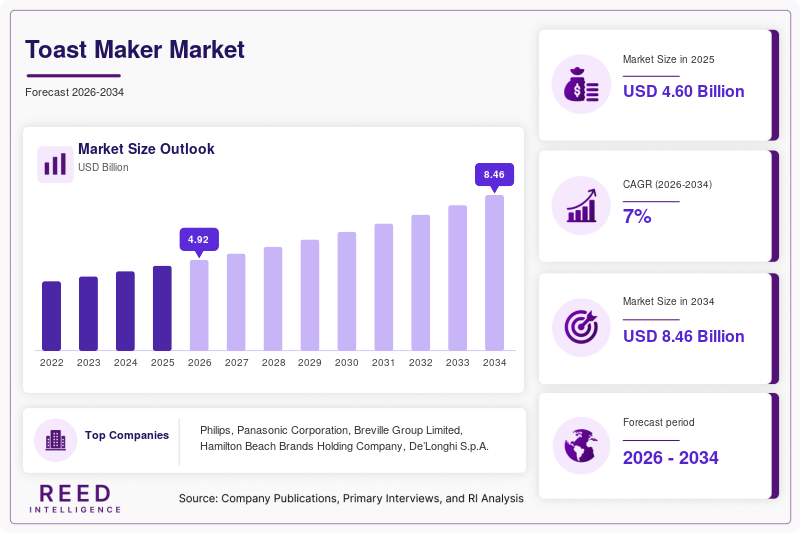
The global Toast Maker Market size was valued at approximately USD 4.6 billion in 2026 and is projected to reach USD 7.9 billion by 2034, expanding at a CAGR of 7.0% during the forecast period (2026–2034). The market continues to grow steadily due to the increasing demand for convenient kitchen appliances that support fast-paced lifestyles and urban living patterns. Rising consumer preference for time-saving cooking solutions has significantly contributed to the adoption of toast makers across residential and commercial sectors.
A key global factor supporting market growth is the expanding urban population coupled with changing dietary habits. Consumers are increasingly shifting toward quick breakfast options such as toasted bread, sandwiches, and ready-to-eat meals, particularly in metropolitan regions. Additionally, the rising influence of compact kitchen appliances in smaller living spaces has encouraged manufacturers to innovate in terms of size, efficiency, and multifunctionality, thereby boosting product demand.
Key Highlights
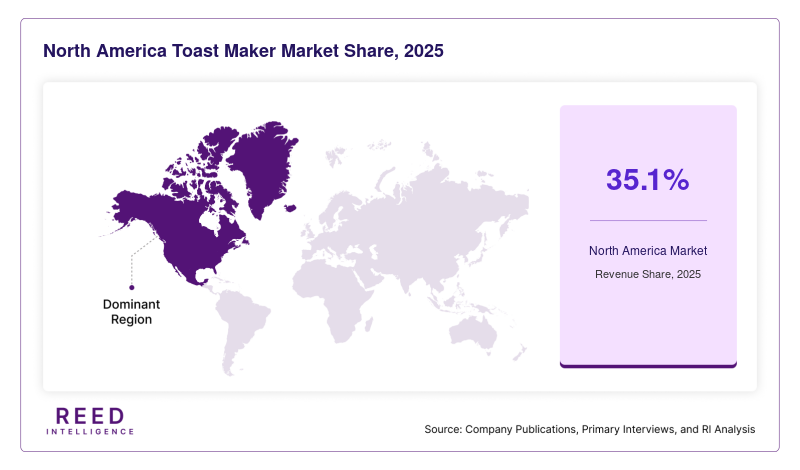
- North America dominated the market with a 35.1% share in 2025.
- Asia Pacific is expected to grow at the fastest CAGR of 9.4% during 2026–2034.
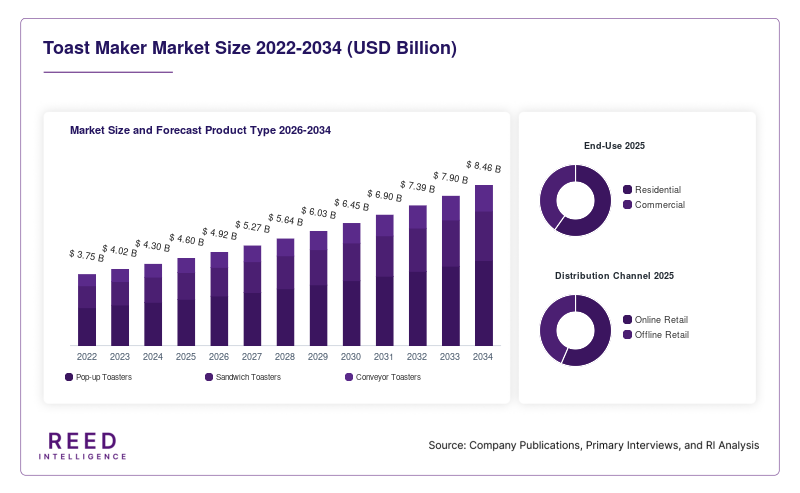
- By product type, pop-up toasters accounted for the largest share of 42.8%.
- while sandwich toasters are projected to grow at a CAGR of 8.6%.
- By distribution channel, offline retail led with a 61.3% share, whereas online retail is expected to expand at a CAGR of 10.2%.
- The United States remained the dominant country, with market values of USD 1.1 billion in 2024 and USD 1.2 billion in 2025.
Market Trends
Increasing adoption of smart and connected kitchen appliances
The Toast Maker Market is witnessing a growing shift toward smart appliances integrated with advanced features such as digital controls, temperature sensors, and app connectivity. Consumers are increasingly inclined toward devices that offer automation and precision, allowing them to customize toasting levels and cooking durations. The integration of IoT-enabled features in kitchen appliances has created a new segment of premium toast makers designed for modern households. Manufacturers are also incorporating voice control compatibility with smart home ecosystems, enhancing user convenience and operational efficiency.
Furthermore, the rise of smart kitchens in developed economies has accelerated the demand for intelligent appliances. These products often include energy-saving modes, safety shut-offs, and multifunctional capabilities, which align with evolving consumer expectations. As technology becomes more accessible, mid-range product categories are also adopting these features, making them more widely available. This trend is expected to drive innovation and product differentiation, encouraging brands to invest in research and development.
Growing demand for multifunctional and compact appliances
Another prominent trend in the Toast Maker Market is the increasing preference for multifunctional appliances that combine multiple cooking functionalities into a single unit. Consumers are seeking products that can toast, grill, and prepare sandwiches, reducing the need for multiple devices in compact kitchens. This trend is particularly strong in urban apartments where space optimization is a priority. Manufacturers are responding by designing versatile toast makers with interchangeable plates and adjustable settings.
Additionally, portability and aesthetic design have become important purchasing factors. Compact and lightweight models are gaining traction among young consumers and working professionals who prioritize convenience. The use of durable materials and modern finishes has also enhanced product appeal. This trend reflects a broader shift toward efficient and space-saving solutions, which is expected to continue influencing product development strategies in the market.
Market Drivers
Rising urbanization and fast-paced lifestyles
The increasing pace of urbanization across emerging and developed economies has significantly contributed to the growth of the Toast Maker Market. Urban consumers often face time constraints due to busy work schedules, leading to a higher reliance on quick meal preparation solutions. Toast makers provide a convenient and efficient way to prepare breakfast and snacks, making them an essential appliance in modern households. The demand is particularly strong among working professionals and nuclear families who prioritize speed and ease of use.
Moreover, the expansion of urban housing and smaller living spaces has driven the adoption of compact kitchen appliances. Toast makers are relatively affordable and easy to use, which makes them accessible to a wide consumer base. The growing number of dual-income households has further increased disposable income, enabling consumers to invest in modern kitchen appliances. This driver is expected to sustain long-term demand, particularly in densely populated urban regions.
Expansion of e-commerce and retail distribution channels
The rapid growth of e-commerce platforms has played a crucial role in expanding the reach of toast maker products. Online retail channels offer a wide range of options, competitive pricing, and convenience, making it easier for consumers to compare and purchase products. The availability of customer reviews and detailed product descriptions has enhanced consumer confidence, leading to increased online sales. Manufacturers are also leveraging digital marketing strategies to target specific consumer segments.
In addition to online platforms, organized retail chains and specialty appliance stores continue to support market growth by providing hands-on product experiences. Promotional campaigns, discounts, and bundled offers have further stimulated demand. The integration of omnichannel retail strategies has enabled brands to maintain a strong presence across both online and offline platforms. This driver is expected to remain significant as digital adoption continues to rise globally.
Market Restraint
Price sensitivity and availability of low-cost alternatives
One of the key challenges in the Toast Maker Market is the high level of price sensitivity among consumers, particularly in developing regions. While premium products offer advanced features and improved durability, a significant portion of consumers continues to prefer low-cost alternatives. The presence of unorganized and local manufacturers offering inexpensive toast makers has intensified price competition, affecting profit margins for established brands.
This restraint has also led to product commoditization, where differentiation becomes difficult in the mid-range segment. Consumers often prioritize price over brand value, especially in markets with lower purchasing power. Additionally, frequent product replacements due to lower durability in budget segments can impact brand perception. To address this issue, manufacturers must focus on balancing affordability with quality while enhancing value propositions through innovative features and improved product lifespan.
Market Opportunities
Increasing penetration in emerging economies
The Toast Maker Market presents significant growth opportunities in emerging economies where appliance penetration remains relatively low. Rapid economic development, rising disposable incomes, and improving living standards are driving demand for modern kitchen appliances in these regions. Countries in Asia Pacific, Latin America, and Africa are experiencing a shift toward urban lifestyles, creating a favorable environment for market expansion.
Manufacturers can capitalize on this opportunity by offering affordable and region-specific products tailored to local preferences. Strategic partnerships with local distributors and retailers can further enhance market reach. Additionally, government initiatives promoting electrification and infrastructure development are expected to support appliance adoption. This opportunity provides a strong growth avenue for both global and regional players seeking to expand their presence.
Product innovation and sustainability initiatives
Innovation in product design and sustainability presents another key opportunity in the Toast Maker Market. Consumers are increasingly conscious of energy consumption and environmental impact, leading to a demand for eco-friendly appliances. Manufacturers are responding by developing energy-efficient models with reduced power consumption and recyclable materials. These initiatives not only address environmental concerns but also align with regulatory standards in various regions.
Furthermore, continuous innovation in features such as non-stick coatings, adjustable settings, and safety mechanisms enhances product appeal. The introduction of aesthetically pleasing designs and customizable options can attract a broader consumer base. Companies investing in sustainable practices and advanced technologies are likely to gain a competitive advantage. This opportunity is expected to drive long-term growth and differentiation in the market.
Segmental Analysis
By Product Type
Pop-up toasters emerged as the dominant subsegment in 2024, accounting for a market share of 42.8%. These products are widely preferred due to their simplicity, affordability, and ease of use. They are commonly used in households for basic toasting needs and are available in a variety of designs and price ranges. The strong demand for pop-up toasters is driven by their reliability and minimal maintenance requirements. Additionally, their compact size makes them suitable for small kitchens, further contributing to their popularity.
Sandwich toasters are expected to be the fastest-growing subsegment, with a projected CAGR of 8.6% during the forecast period. The growth of this segment is attributed to the increasing demand for versatile cooking appliances that can prepare a variety of snacks. Sandwich toasters often come with interchangeable plates, allowing users to grill and toast different food items. This multifunctionality enhances their appeal, particularly among younger consumers seeking convenience and variety.
By Distribution Channel
Offline retail dominated the market in 2024, accounting for a share of 61.3%. Physical stores allow consumers to evaluate product features and quality before making a purchase. Retail outlets such as supermarkets, specialty stores, and appliance showrooms play a significant role in driving sales. The availability of in-store promotions and customer assistance further enhances the shopping experience.
Online retail is the fastest-growing subsegment, with a CAGR of 10.2%. The growth of e-commerce platforms has transformed the way consumers purchase appliances. Online channels offer convenience, competitive pricing, and a wide range of options. The increasing use of smartphones and digital payment systems has further accelerated online sales. This segment is expected to continue expanding as digital adoption increases.
By End-Use
The residential segment held the largest share of 68.5% in 2024, driven by widespread adoption in households. Toast makers are considered essential kitchen appliances due to their convenience and efficiency. The increasing number of nuclear families and working professionals has boosted demand in this segment. Additionally, the availability of affordable models has made these products accessible to a broader consumer base.
The commercial segment is projected to grow at the fastest CAGR of 8.1% during the forecast period. The expansion of the food service industry, including cafes, restaurants, and hotels, has increased demand for high-capacity toast makers. These establishments require durable and efficient appliances to meet customer demand. The growth of quick-service restaurants and breakfast chains is a key factor driving this segment.
Regional Analysis
North America
North America accounted for a significant share of 35.1% in the Toast Maker Market in 2025 and is projected to grow at a CAGR of 6.5% during the forecast period. The region benefits from high consumer awareness and widespread adoption of modern kitchen appliances. Strong purchasing power and a preference for convenience-driven products continue to support market growth. The presence of established brands and continuous product innovation further contribute to the region’s dominance.
The United States remains the leading country in this region, driven by high demand for smart kitchen appliances. A unique growth factor is the increasing integration of connected devices within households, encouraging the adoption of advanced toast makers. The trend toward home cooking and premium kitchen setups has also boosted demand, making the country a key revenue contributor.
Europe
Europe held a considerable market share of 27.4% in 2025 and is expected to grow at a CAGR of 6.8% from 2026 to 2034. The region is characterized by a strong preference for high-quality and energy-efficient appliances. Consumers in Europe prioritize durability and design, which has led to the popularity of premium toast maker models. Regulatory standards related to energy efficiency also influence product development.
Germany is the dominant country in this region, supported by its strong manufacturing base and consumer demand for advanced appliances. A unique growth factor is the emphasis on sustainability, which drives the adoption of energy-efficient and eco-friendly toast makers. This focus has encouraged manufacturers to innovate and align their products with environmental regulations.
Asia Pacific
Asia Pacific is the fastest-growing region, with a CAGR of 9.4% during the forecast period and a market share of 22.8% in 2025. Rapid urbanization, population growth, and rising disposable incomes are key factors driving demand. The increasing influence of Western dietary habits has also contributed to the adoption of toast makers in this region.
China dominates the Asia Pacific market due to its large consumer base and expanding middle class. A unique growth factor is the rapid expansion of e-commerce platforms, which has made appliances more accessible to consumers. Local manufacturing capabilities and competitive pricing further support market growth in the country.
Middle East & Africa
The Middle East & Africa region accounted for 7.3% of the market share in 2025 and is projected to grow at a CAGR of 7.2%. The market is gradually expanding due to improving living standards and increasing urbanization. The demand for convenient kitchen appliances is rising, particularly in urban areas where consumers seek time-saving solutions.
The United Arab Emirates is the dominant country in this region, driven by a high standard of living and strong retail infrastructure. A unique growth factor is the growing hospitality sector, which increases demand for commercial-grade toast makers. The expansion of hotels and restaurants has contributed to steady market growth.
Latin America
Latin America held a market share of 7.4% in 2025 and is expected to grow at a CAGR of 7.0% during the forecast period. The region is experiencing gradual economic development, leading to increased consumer spending on household appliances. The demand for affordable and multifunctional products is particularly strong.
Brazil leads the market in this region, supported by its large population and expanding middle class. A unique growth factor is the rising influence of modern retail channels, which has improved product availability. The growth of online shopping platforms has further enhanced consumer access to a wide range of toast makers.
Competitive Landscape
The Toast Maker Market is characterized by the presence of several established players competing on the basis of product quality, innovation, and pricing. Leading companies focus on expanding their product portfolios and enhancing technological capabilities to maintain their market position. Strategic partnerships, mergers, and acquisitions are also common strategies adopted to strengthen market presence.
A key market leader is Philips, known for its wide range of kitchen appliances and strong global presence. The company has recently introduced advanced toast makers with improved energy efficiency and smart features, reflecting its focus on innovation. Other major players are investing in research and development to introduce multifunctional products that cater to evolving consumer needs. The competitive landscape remains dynamic, with both global and regional players striving to capture market share.
Key Players List
- Philips
- Panasonic Corporation
- Breville Group Limited
- Hamilton Beach Brands Holding Company
- De’Longhi S.p.A.
- Black+Decker
- Cuisinart
- Morphy Richards
- Bajaj Electricals Ltd.
- Prestige (TTK Group)
- Kenwood Limited
- Russell Hobbs
- Sunbeam Products
- Smeg S.p.A.
- Havells India Ltd.
Recent Developments
- Philips launched a new range of smart toast makers with app connectivity and energy-saving features in 2025.
- Breville introduced a multifunctional toaster with interchangeable plates designed for grilling and toasting in 2024.
- Bajaj Electricals expanded its product portfolio with affordable toast makers targeting emerging markets in 2025.
Toast Maker Market Segments
Product Type
- Pop-up Toasters
- Sandwich Toasters
- Conveyor Toasters
End-Use
- Residential
- Commercial
Distribution Channel
- Online Retail
- Offline Retail
By Region
- North America
- Europe
- APAC
- Middle East and Africa
- LATAM