Toilet Partitions Market Size, Share & Trends Analysis Report By Material (Stainless Steel, Powder-Coated Steel, High-Density Polyethylene, Phenolic & Compact Laminate, Other Materials), By Installation Type (Floor-Mounted, Ceiling-Hung, Floor-to-Ceiling, Wall-Mounted), By Application (Commercial, Hospitality, Education, Healthcare, Transportation & Public Facilities), By Distribution Channel (Direct Sales, Specialty Distributors, Contractors & Specifiers, Online Channels) and By Region (North A
USD 3950
Toilet Partitions Market Size
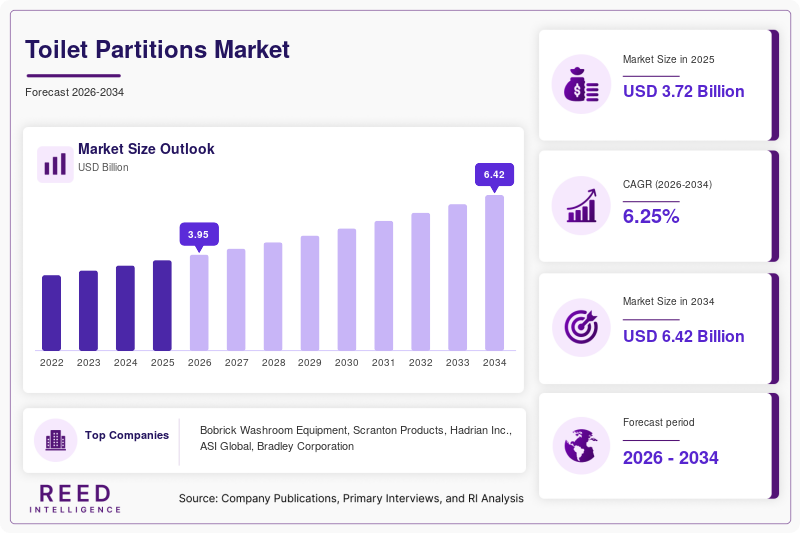
The toilet partitions market was valued at USD 3.72 billion in 2025 and is estimated to reach USD 3.95 billion in 2026. The market is projected to reach USD 6.42 billion by 2034, representing a 6.25% CAGR during 2026–2034.
The toilet partitions market is increasingly shaped by restroom renovation, accessibility requirements, durability specifications and demand for higher privacy, rather than by restroom construction alone. Commercial and institutional projects require partition systems that can withstand repeated use while meeting dimensional, accessibility and design requirements.
Accessibility requirements create a recurring specification requirement. Under the U.S. 2010 ADA Standards, toilet compartments must meet defined clearance, door, approach and accessibility requirements, while facilities with six or more toilet compartments or a combined six or more water closets and urinals require additional accessible compartment provisions.
Toilet Partitions Market Drivers
Renovation of Commercial and Institutional Restrooms Creates Replacement Demand
Restroom partitions have a replacement cycle that is tied not only to new buildings but also to renovation of existing facilities. Commercial construction categories tracked by the U.S. Census Bureau include offices, retail, healthcare and educational buildings, all of which contain restroom facilities requiring partitions.
The market mechanism is particularly relevant when facility owners renovate restrooms to improve durability, accessibility, privacy or appearance. Replacement projects can therefore generate demand even where total building construction is unchanged. Manufacturers are responding with broader material and configuration portfolios, including stainless steel, HDPE, phenolic and powder-coated systems.
The counterbalance is that partition replacement can be deferred when building owners postpone non-essential capital expenditure.
Accessibility and Privacy Specifications Increase Product Requirements
Accessibility standards affect partition dimensions, door placement, clearances and compartment configurations. The ADA standards specify minimum dimensions for wheelchair-accessible and ambulatory-accessible toilet compartments, making compliant design an important part of the specification process.
At the same time, manufacturers are developing higher-privacy configurations. Bobrick offers partitions with privacy-oriented configurations, while Hadrian provides extended panels, full-height channels and no-sightline options.
This creates demand for products that combine accessibility with privacy rather than treating partitions as simple dividers. The impact is strongest in offices, hospitality, healthcare and public facilities where user experience and compliance are important procurement criteria.
Demand for Durable Materials Is Increasing Product Differentiation
High-traffic facilities place greater emphasis on resistance to impact, moisture, vandalism and repeated cleaning. Scranton Products positions HDPE partitions for commercial, education, retail, hospitality and industrial environments, while Hadrian identifies HDPE as suitable for high-traffic facilities such as schools, stadiums, parks and airports.
Stainless steel provides another durability pathway, with Hadrian highlighting corrosion resistance, fire resistance and recycled content in its stainless-steel partition systems.
The resulting market mechanism favors materials with lower lifecycle maintenance requirements, although premium materials can face higher upfront procurement costs.
Toilet Partitions Market Restraints
Material and Installation Costs Can Shift Projects Toward Lower-Specification Systems
Partition procurement is sensitive to the total installed cost rather than the panel price alone. Stainless steel, phenolic and specialized high-privacy configurations can command higher project costs than standard powder-coated systems.
Manufacturers consequently offer multiple material tiers. Hadrian, for example, positions powder-coated partitions as an entry-level value option while offering stainless steel, HDPE and phenolic alternatives for different project requirements.
This creates a segmentation mechanism in which schools, public facilities and high-abuse environments may prioritize lifecycle durability, while cost-sensitive projects can favor conventional metal systems.
Construction Project Delays Can Defer Partition Procurement
Toilet partitions are generally installed as part of a larger construction or renovation project. Delays in commercial, hospitality, education or institutional projects can therefore postpone the purchase and installation of partitions even when the underlying project remains active.
The effect is more pronounced for specification-driven projects because architects, contractors and facility managers must coordinate partition dimensions, hardware, accessibility layouts and finishes with other restroom components. The market can therefore experience timing differences between building activity and partition revenue.
Toilet Partitions Market Opportunities
High-Privacy Partitions Create Premium Specification Demand
Privacy is becoming a differentiating feature rather than simply a functional requirement. Bobrick offers European-style cubicles and partition systems with privacy-focused configurations, while Hadrian provides extended panels, full-height channels and no-sightline solutions.
The opportunity lies in supplying partitions that improve privacy without compromising accessibility or restroom circulation. Hotels, corporate offices, healthcare facilities and premium retail environments are particularly relevant because restroom design contributes to the overall customer or occupant experience.
The constraint is price sensitivity, as higher panels, additional hardware and customized configurations increase installed costs.
Recycled and Durable Materials Support Sustainable Building Specifications
Material characteristics are becoming part of restroom product selection. Hadrian states that its stainless-steel partitions contain 91% recycled content, including post-consumer and pre-consumer material.
This creates an opportunity for manufacturers to differentiate products through recycled content, durability and longer replacement intervals. The commercial mechanism is strongest where architects and building owners evaluate materials as part of broader sustainability objectives.
However, sustainability claims must be supported by project-specific documentation and may not outweigh cost, lead time or performance requirements.
Modular and Configurable Systems Expand Retrofit Potential
Manufacturers increasingly provide multiple installation configurations, including floor-mounted, ceiling-hung, floor-to-ceiling and headrail-braced systems. Hadrian's product portfolio illustrates this configuration flexibility across stainless steel, powder-coated and HDPE partitions.
This creates an opportunity in renovation projects where existing restroom layouts restrict the use of standardized systems. Configurable products can reduce redesign requirements and allow facility managers to upgrade privacy or durability without completely rebuilding the restroom.
Toilet Partitions Market Material Segment Analysis
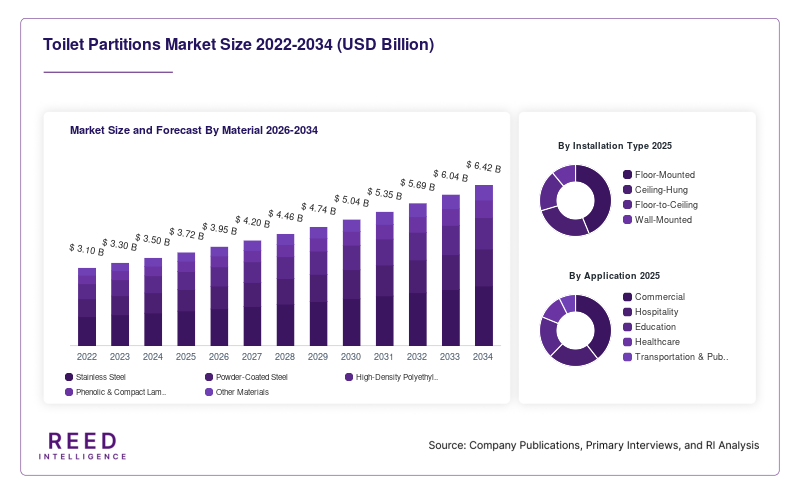
Stainless steel is internally modeled as the largest material segment, representing approximately 28.0% of the 2025 market, or USD 1.04 billion. Its position reflects demand from commercial, institutional, transportation and high-traffic environments where corrosion resistance, appearance, fire performance and long service life influence procurement.
Hadrian offers stainless-steel partitions in floor-mounted, ceiling-hung, headrail-braced and floor-to-ceiling configurations, demonstrating the material's adaptability to different architectural requirements.
The stainless-steel segment is internally modeled to reach USD 1.73 billion by 2034, corresponding to approximately 27.0% share and a modeled 5.82% CAGR. Its share moderates slightly because alternative materials are gaining adoption in high-abuse and design-oriented applications.
Phenolic and compact laminate is internally modeled at 18.0% of the 2025 market, equivalent to USD 670 million. The material serves projects where moisture resistance, durability, color, texture and architectural appearance are important.
Hadrian offers phenolic partitions designed to resist moisture and heavy use, while Bobrick offers HPL, compact-grade laminate and solid phenolic systems.
The segment is modeled to reach approximately USD 1.41 billion by 2034, increasing its share to about 22.0%. This implies a modeled 8.65% CAGR, the fastest among the major material categories. Growth is associated with premium commercial, hospitality, healthcare and design-led projects.
Toilet Partitions Market Installation Type Analysis
Floor-mounted partitions are internally modeled as the largest installation category, representing approximately 38% of the 2025 market, or USD 1.41 billion. They remain widely applicable because the configuration can be used across conventional restroom layouts and different building heights.
Ceiling-hung systems account for approximately 24% of the 2025 market, or USD 893 million. They can create a more open visual floor area and simplify floor cleaning because partition supports are concentrated above the floor. Hadrian offers ceiling-hung systems in both stainless steel and solid plastic.
Floor-to-ceiling partitions represent approximately 23% of the 2025 market, equivalent to USD 856 million. Their appeal is strongest where privacy, security and resistance to heavy use are priorities. Hadrian specifically identifies floor-to-ceiling stainless-steel partitions as suitable for high-traffic environments such as schools.
Wall-mounted and other specialized configurations account for approximately 15% of the 2025 market, or USD 558 million. They are used where project layouts, structural conditions or space constraints favor alternative support arrangements.
Toilet Partitions Market Application Analysis
Commercial facilities represent approximately 36% of the 2025 market, or USD 1.34 billion. Offices, retail facilities, restaurants and other commercial buildings require partitions that balance durability, privacy, appearance and installation cost.
Hospitality accounts for approximately 20% of the 2025 market, equivalent to USD 744 million. Hotels and hospitality venues place greater emphasis on aesthetics and privacy because restroom design forms part of the broader guest experience.
Education represents approximately 17% of the 2025 market, or USD 632 million. Schools and universities place particular emphasis on vandal resistance, durability and maintenance. HDPE partitions are explicitly marketed for high-traffic educational environments.
Healthcare facilities account for approximately 15% of the 2025 market, equivalent to USD 558 million. Healthcare projects require durable, cleanable and specification-compliant restroom systems, with material selection influenced by frequent use and maintenance requirements.
Transportation and public facilities represent approximately 12% of the 2025 market, or USD 446 million. Airports, stadiums, parks and other public facilities experience high user volumes and therefore favor materials and hardware designed for repeated use and vandal resistance.
Toilet Partitions Market Distribution Channel Analysis
Direct sales represent approximately 32% of the 2025 market, or USD 1.19 billion. Large projects often require direct specification support, customized configurations and coordination with architects and contractors.
Specialty distributors account for approximately 30% of the 2025 market, equivalent to USD 1.12 billion. Distribution networks remain important because partitions must be supplied together with hardware, accessories and installation components.
Contractors and specification-driven procurement represent approximately 27% of the 2025 market, or USD 1.00 billion. Architects, contractors and project managers influence material, configuration and compliance decisions before the purchasing stage.
Online channels account for approximately 11% of the 2025 market, or USD 409 million. Their role is stronger for standardized components, replacement parts and smaller projects than for complex multi-stall commercial installations.
Toilet Partitions Market Regional Analysis
Asia-Pacific Represents the Largest Regional Market and Has the Fastest Expansion Potential
Asia-Pacific is internally modeled as the largest regional market, accounting for approximately 31% of global revenue in 2025, or USD 1.15 billion. Its share is modeled to increase to approximately 33.5% by 2034, with the regional market reaching about USD 2.15 billion and a modeled 7.17% CAGR.
Demand is linked to commercial buildings, hospitality facilities, education infrastructure, transportation projects and public-facility development. The region also has a significant manufacturing base for metal, laminate and plastic building products.
The future market mechanism is the combination of new facility construction and modernization of existing public and commercial restrooms. Local manufacturing can also support cost-sensitive projects where transport costs influence partition procurement.
The main constraint is market fragmentation. Product specifications, building standards, material preferences and purchasing structures vary significantly between countries.
North America Represents a Mature High-Value Market Supported by Renovation and Specification Standards
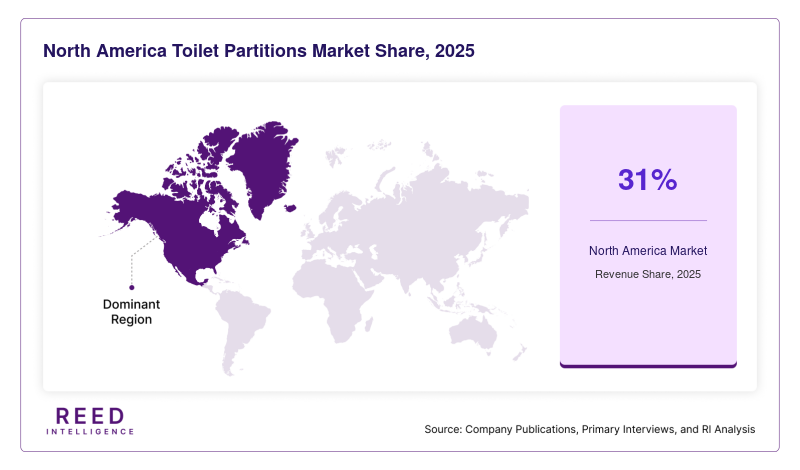
North America represents approximately 29% of 2025 revenue, or USD 1.08 billion. The share is internally modeled to moderate to 27.5% by 2034, while the market reaches approximately USD 1.77 billion, representing a modeled 5.63% CAGR.
The region has a mature commercial restroom-partition industry, with established suppliers including Bobrick, Scranton Products, Hadrian and others. Scranton Products offers HDPE systems across education, commercial, retail, hospitality and industrial applications.
Accessibility requirements are also an important specification mechanism. U.S. ADA requirements establish detailed provisions for accessible toilet compartments, including dimensions, doors, approach and grab-bar requirements.
Renovation, replacement and premium privacy products provide continued demand, while slower new-building cycles and higher installation costs can moderate expansion.
Europe Maintains a Strong Specification-Oriented Market
Europe represents approximately 24% of global revenue in 2025, equivalent to USD 893 million. Its share is internally modeled at 23% by 2034, with market value reaching approximately USD 1.48 billion and a modeled 5.75% CAGR.
European restroom projects often emphasize architectural integration, privacy and design flexibility. Bobrick's Thrislington Cubicles portfolio, for example, offers European-style cubicles in multiple materials and serves commercial and institutional environments.
Demand is supported by hospitality, commercial buildings, healthcare and public infrastructure renovation. Material sustainability and lifecycle performance can also influence specifications.
The principal constraint is the diversity of national building requirements and procurement practices, which can increase product customization requirements.
Middle East and Africa Is Supported by Hospitality and Large Public Infrastructure Projects
The Middle East and Africa account for approximately 8% of the 2025 market, or USD 298 million. The share is internally modeled to increase to 8.5% by 2034, with market value reaching approximately USD 546 million and a modeled 6.97% CAGR.
Hospitality developments, airports, shopping centers, commercial facilities and public infrastructure provide the principal demand base. The requirement for visually consistent, durable and high-privacy restroom systems is particularly relevant to premium hospitality and transportation facilities.
The market mechanism is project-led procurement, meaning large infrastructure and hospitality developments can create substantial individual orders.
Project cycles, import dependence for specialized materials and variations in construction investment can constrain the pace of adoption.
Latin America Represents a Smaller Market with Demand Concentrated in Commercial and Public Facilities
Latin America represents approximately 8% of the 2025 market, or USD 298 million. Its share is internally modeled at 7.5% by 2034, with market value reaching approximately USD 482 million and a modeled 5.49% CAGR.
Commercial construction, hospitality, education and public infrastructure support partition demand. Cost remains an important procurement factor, creating space for powder-coated metal and other value-oriented materials alongside stainless steel and premium laminate products.
The main constraint is construction-cycle volatility and differences in purchasing power across national markets.
Toilet Partitions Market Competitive Landscape
The competitive environment combines established washroom-equipment manufacturers, specialized partition companies and regional manufacturers. Competition is primarily based on material performance, durability, privacy, configuration flexibility, design options, distribution coverage, specification support and lead times.
Bobrick maintains a broad portfolio covering toilet partitions, cubicles and restroom accessories. Its brands include PRIVADA and Thrislington Cubicles, allowing the company to serve both conventional commercial projects and design-oriented restroom applications.
Scranton Products focuses heavily on HDPE and positions its products around durability, resistance to dents, scratches, corrosion, graffiti and mildew. Its distribution network covers North American and international markets.
Key Market Players
- Bobrick Washroom Equipment
- Scranton Products
- Hadrian Inc.
- ASI Global
- Bradley Corporation
- Inpro Corporation
- General Partitions
- Knickerbocker Partition
- Metpar
- Jialifu
Toilet Partitions Market Recent Developments
- In 2025, Scranton Products announced the acquisition of certain assets of Metpar Corp. The transaction adds manufacturing assets and product capabilities to Scranton Products and strengthens its position in restroom-partition manufacturing.
- Bobrick states that it acquired its long-standing Indian partner and established Bobrick India on July 9, 2024, adding dedicated local sales, technical expertise, project consultation and after-sales support. The development improves its ability to serve India's commercial washroom projects locally rather than relying solely on an international distribution structure.
Toilet Partitions Market Segments
By Material
- Stainless Steel
- Powder-Coated Steel
- High-Density Polyethylene (HDPE)
- Phenolic & Compact Laminate
- Other Materials
By Installation Type
- Floor-Mounted
- Ceiling-Hung
- Floor-to-Ceiling
- Wall-Mounted
By Application
- Commercial
- Hospitality
- Education
- Healthcare
- Transportation & Public Facilities
By Distribution Channel
- Direct Sales
- Specialty Distributors
- Contractors & Specifiers
- Online Channels
By Region
- North America
- Europe
- APAC
- Middle East and Africa
- LATAM