Tomato Seed Oil Market Size, Share & Demand Report By Extraction Method (Cold-Pressed, Solvent Extraction), By Application (Cosmetics & Personal Care, Food & Beverages, Nutraceuticals), By End-Use Industry (Personal Care Industry, Food Industry, Pharmaceutical Industry), By Distribution Channel (Online Retail, Offline Retail) By Region & Segment Forecasts, 2025–2034
USD 3950
Market Overview
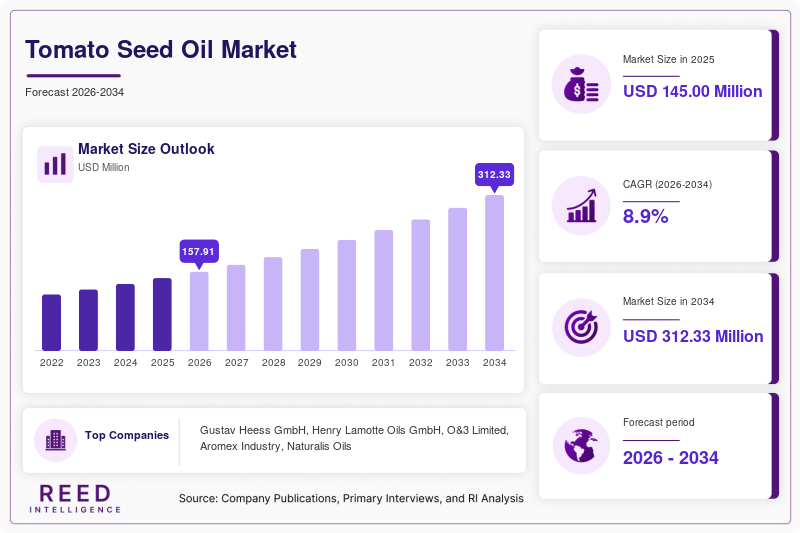
The global Tomato Seed Oil Market size was valued at USD 145 million in 2025 and is projected to reach USD 312 million by 2034, expanding at a CAGR of 8.9% during the forecast period (2025–2034). The market has experienced steady expansion due to the rising utilization of plant-based oils across cosmetics, food processing, and nutraceutical industries. Increasing consumer inclination toward natural, cold-pressed, and sustainable ingredients has significantly supported the market’s upward trajectory.
A key global factor contributing to growth is the growing awareness of circular economy practices, where by-products of tomato processing are repurposed into high-value oils. This not only reduces waste but also enhances the economic viability of tomato processing industries, thereby strengthening the Tomato Seed Oil Market outlook globally.
Key Highlights
- Europe dominated the Tomato Seed Oil Market with a 34% share in 2025, while Asia Pacific is expected to grow at the fastest CAGR of 10.2%.
- By extraction method, cold-pressed oil led with a 61% share, while solvent extraction is projected to grow at a CAGR of 9.5%.
- By application, cosmetics & personal care held the largest share at 48%, while nutraceuticals are expected to expand at a CAGR of 10.8%.
- The U.S. remained the dominant country, with market values of USD 38 million in 2025 and USD 41 million in 2026.
Market Trends
Rising Demand for Natural Cosmetic Ingredients
The increasing preference for plant-derived and chemical-free cosmetic ingredients is shaping the Tomato Seed Oil Market trends. Tomato seed oil, known for its moisturizing and antioxidant properties, is gaining traction in skincare formulations such as serums, facial oils, and anti-aging creams. Consumers are actively seeking products with transparent ingredient sourcing, which is encouraging manufacturers to incorporate tomato seed oil into premium product lines. This trend is particularly visible in Europe and North America, where clean beauty movements are well established.
Expansion of Upcycled Ingredients in Food Industry
Another notable trend is the integration of upcycled ingredients into food products. Tomato seed oil, extracted from tomato processing waste, is increasingly used in gourmet cooking oils and functional foods. Food manufacturers are leveraging its nutritional profile and sustainability appeal to differentiate their offerings. This trend aligns with global sustainability goals and is expected to influence long-term Tomato Seed Oil Market growth by opening new application areas beyond cosmetics.
Market Drivers
Increasing Demand for Functional and Nutrient-Rich Oils
The rising awareness of health and wellness is driving demand for oils rich in essential fatty acids and antioxidants. Tomato seed oil contains high levels of linoleic acid, which supports cardiovascular health and skin nourishment. This has led to its growing use in dietary supplements and functional food products, positively impacting the Tomato Seed Oil Market size.
Growth of Organic and Clean-Label Product Segments
The expansion of organic and clean-label product categories is another key driver. Consumers are increasingly avoiding synthetic additives, leading to higher demand for naturally sourced oils. Tomato seed oil fits well within this category due to its minimal processing and natural origin. Manufacturers are capitalizing on this trend by promoting organic certifications and eco-friendly sourcing practices, thereby boosting market growth.
Market Restraint
Limited Availability of Raw Materials and High Processing Costs
A significant restraint in the Tomato Seed Oil Market is the limited availability of raw materials and the relatively high cost of extraction. Tomato seeds are a by-product of tomato processing, and their availability depends heavily on seasonal production cycles and processing volumes. This creates supply inconsistencies, which can affect pricing and market stability.
Additionally, the extraction of high-quality oil, especially through cold-press methods, requires specialized equipment and processes, leading to higher production costs. These costs are often passed on to end consumers, making tomato seed oil products relatively expensive compared to other vegetable oils. This price sensitivity can limit adoption in price-conscious markets, thereby restraining overall market expansion.
Market Opportunities
Expansion into Emerging Nutraceutical Applications
The growing interest in preventive healthcare and dietary supplementation presents a significant opportunity for the Tomato Seed Oil Market. The oil’s rich nutrient profile makes it suitable for capsules, functional beverages, and fortified foods. As consumers increasingly prioritize health benefits in their diets, manufacturers can explore innovative product formulations to capture this emerging demand.
Growth in Sustainable Packaging and Branding
Sustainability is becoming a critical factor in purchasing decisions. Companies can leverage eco-friendly packaging and transparent sourcing practices to differentiate their offerings. By highlighting the upcycled nature of tomato seed oil and adopting biodegradable packaging, brands can attract environmentally conscious consumers. This approach not only enhances brand value but also supports long-term market growth.
Segmental Analysis
By Extraction Method
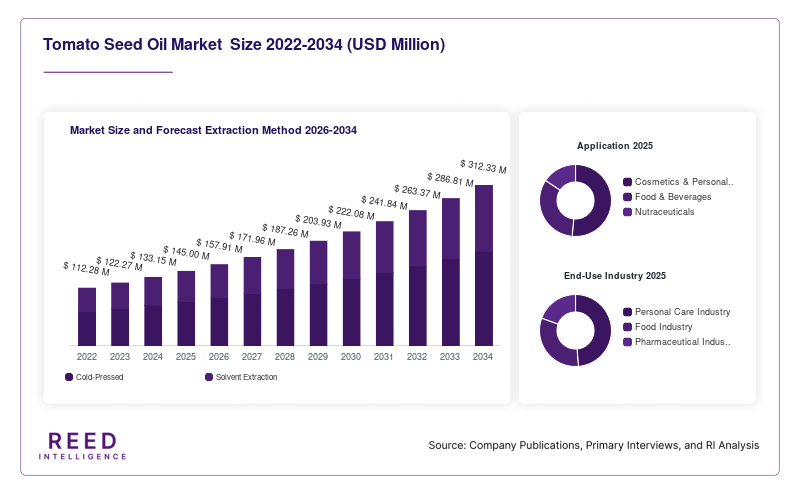
Cold-pressed oil dominated the Tomato Seed Oil Market in 2025, accounting for approximately 61% of the total share. This dominance was attributed to the increasing preference for minimally processed oils that retain their natural nutrients and aroma. Consumers in premium segments favored cold-pressed variants for their perceived health benefits and superior quality.
Solvent extraction is expected to be the fastest-growing segment, with a projected CAGR of 9.5% during the forecast period. This growth will be driven by its cost-effectiveness and ability to produce higher yields. Manufacturers focusing on large-scale production are likely to adopt this method to meet growing demand.
By Application
The cosmetics & personal care segment held the largest share of 48% in 2025. The widespread use of tomato seed oil in skincare products, including moisturizers and anti-aging formulations, contributed to its dominance. The oil’s antioxidant properties made it a preferred ingredient among manufacturers.
The nutraceuticals segment is projected to grow at the fastest CAGR of 10.8%. This growth will be driven by increasing consumer awareness of health benefits and the rising demand for dietary supplements. The incorporation of tomato seed oil into capsules and functional foods will further support segment expansion.
By End-Use Industry
The personal care industry dominated the Tomato Seed Oil Market with a 45% share in 2025. The growing demand for natural and organic beauty products has significantly contributed to this segment’s growth.
The food & beverage industry is expected to witness the fastest growth, with a CAGR of 9.7%. The use of tomato seed oil as a specialty cooking oil and ingredient in gourmet products will drive demand.
By Distribution Channel
Offline retail channels accounted for 58% of the market share in 2025. Supermarkets, specialty stores, and pharmacies played a crucial role in product distribution, particularly in developed regions.
Online retail is projected to grow at the fastest CAGR of 11.2%. The increasing penetration of e-commerce platforms and consumer preference for convenient shopping experiences will support this growth.
Regional Analysis
North America
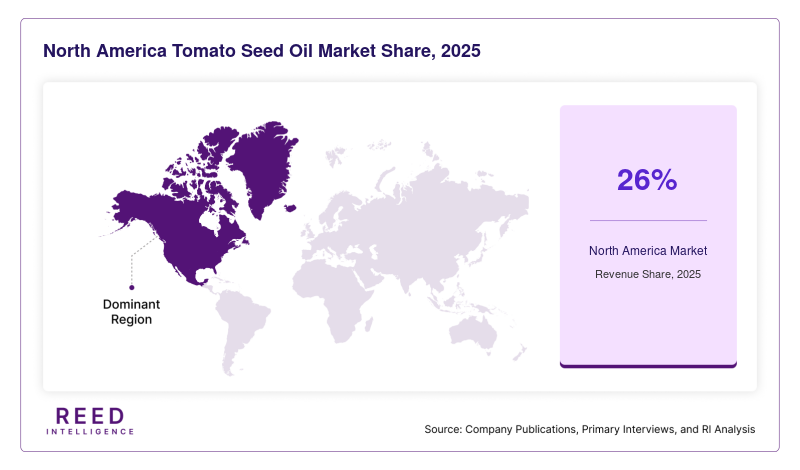
North America accounted for approximately 26% of the Tomato Seed Oil Market share in 2025 and is expected to grow at a CAGR of 8.1% through 2034. The region’s growth will be driven by increasing demand for natural and organic products across cosmetics and food industries.
The United States dominated the regional market due to strong consumer awareness regarding clean-label products. The presence of established cosmetic brands incorporating plant-based oils has significantly contributed to market expansion.
Europe
Europe held the largest share of 34% in 2025 and is projected to grow at a CAGR of 8.5% during the forecast period. The region’s established regulatory framework supporting organic and sustainable products has supported market growth.
Germany emerged as the leading country, driven by its strong cosmetics industry and emphasis on sustainability. The demand for premium skincare products has significantly boosted the adoption of tomato seed oil.
Asia Pacific
Asia Pacific represented 22% of the Tomato Seed Oil Market in 2025 and is expected to register the fastest CAGR of 10.2% through 2034. Rapid urbanization and increasing disposable incomes are key factors driving market growth.
China dominated the region due to its large-scale tomato production and expanding food processing industry. The availability of raw materials and growing demand for functional foods have supported market expansion.
Middle East & Africa
The Middle East & Africa held a 9% share in 2025 and is anticipated to grow at a CAGR of 7.6%. The market is gradually expanding due to increasing awareness of natural oils in personal care applications.
The UAE led the region, supported by rising demand for premium beauty products and the presence of a growing retail sector. The adoption of imported specialty oils has also contributed to market growth.
Latin America
Latin America accounted for 9% of the Tomato Seed Oil Market in 2025 and is expected to grow at a CAGR of 8.3%. The region’s strong agricultural base provides a favorable environment for market development.
Brazil dominated the regional market due to its large tomato production and increasing focus on value-added agricultural products. The integration of tomato seed oil into local food and cosmetic industries has driven growth.
Competitive Landscape
The Tomato Seed Oil Market is moderately fragmented, with several regional and global players competing based on product quality, pricing, and sustainability practices. Key companies are focusing on expanding their product portfolios and investing in advanced extraction technologies.
A leading player in the market is Gustav Heess GmbH, which has established a strong presence through its extensive product offerings and global distribution network. The company recently introduced a new range of organic tomato seed oil products, targeting premium cosmetic applications.
Other players are emphasizing partnerships and collaborations to strengthen their market position and expand their geographic reach. The focus on sustainable sourcing and eco-friendly packaging is also becoming a key competitive strategy.
Key Players
- Gustav Heess GmbH
- Henry Lamotte Oils GmbH
- O&3 Limited
- Aromex Industry
- Naturalis Oils
- The Kerfoot Group
- Earthoil Plantations
- BioAdorates
- Kanta Enterprises Pvt. Ltd.
- AG Industries
- Jedwards International
- AOS Products Pvt. Ltd.
- Green Source Organics
- ConnOils LLC
- Akoma Cooperative
Recent Developments
- In 2024, Gustav Heess GmbH expanded its organic oil portfolio with certified tomato seed oil for cosmetic applications.
- In 2023, O&3 Limited introduced a cold-pressed tomato seed oil targeting premium skincare brands.
- In 2023, Henry Lamotte Oils GmbH enhanced its extraction capabilities to improve yield efficiency.
- In 2024, AOS Products Pvt. Ltd. launched a new range of nutraceutical-grade tomato seed oil.
- In 2023, Jedwards International expanded its distribution network in North America to strengthen market presence.
Tomato Seed Oil Market Segments
Extraction Method
- Cold-Pressed
- Solvent Extraction
Application
- Cosmetics & Personal Care
- Food & Beverages
- Nutraceuticals
End-Use Industry
- Personal Care Industry
- Food Industry
- Pharmaceutical Industry
Distribution Channel
- Online Retail
- Offline Retail (Supermarkets, Specialty Stores, Pharmacies)
By Region
- North America
- Europe
- APAC
- Middle East and Africa
- LATAM