Tongue Depressors Market Size, Share Demand Report By Material (Wooden Tongue Depressors, Plastic Tongue Depressors), By Type (Sterile Tongue Depressors, Non-Sterile Tongue Depressors), By End-Use (Hospitals, Clinics, Home Healthcare), By Distribution Channel (B2B, B2C) By Region & Segment Forecasts, 2026–2034
USD 3950
Market Overview
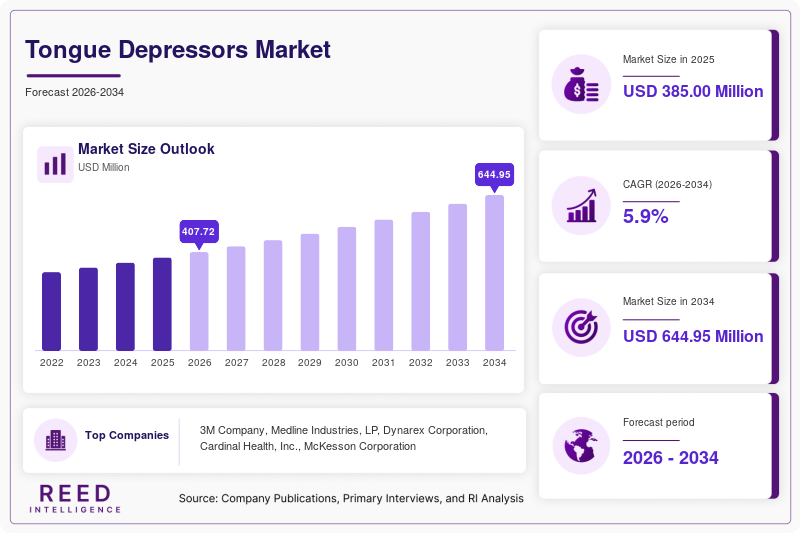
The global Tongue Depressors Market size was valued at approximately USD 385 million in 2026 and is projected to reach USD 612 million by 2034, expanding at a CAGR of 5.9% during the forecast period (2026–2034). The market continues to witness stable demand driven by the widespread use of tongue depressors in medical examinations, diagnostic procedures, and oral healthcare practices. These simple yet essential tools are widely utilized across hospitals, clinics, and home care settings, ensuring consistent consumption across regions.
A key global factor supporting the Tongue Depressors Market growth is the increasing focus on infection prevention and hygiene in healthcare environments. The rising adoption of disposable medical products to minimize cross-contamination has significantly boosted demand for single-use tongue depressors, particularly in clinical and diagnostic settings.
Key Highlights
- North America dominated the market with 38.1% share in 2025, while Asia Pacific is projected to grow at the fastest CAGR of 6.8%
- Wooden tongue depressors segment led with 64.5% share, while plastic tongue depressors are expected to grow at a CAGR of 6.5%
- Hospitals segment held 52.7% share, while home healthcare is forecasted to grow at a CAGR of 6.6%
- The United States market was valued at USD 150 million in 2024 and reached USD 158 million in 2025
Market Trends
Shift Toward Eco-Friendly and Biodegradable Materials
Growing environmental concerns are influencing the adoption of biodegradable and sustainable materials in medical products. Manufacturers are increasingly focusing on wooden tongue depressors sourced from sustainable forestry, reducing the environmental impact of disposable medical supplies and shaping Tongue Depressors Market trends.
Increasing Use in Home Healthcare Settings
The expansion of home healthcare services has led to increased use of basic medical tools, including tongue depressors. Consumers are purchasing these products for home-based diagnostics and care, supported by the growth of online medical supply platforms.
Market Drivers
Rising Demand for Disposable Medical Supplies
The increasing emphasis on hygiene and infection control in healthcare facilities has driven demand for disposable medical tools. Tongue depressors, being low-cost and single-use, are widely adopted to ensure patient safety and prevent contamination.
Growth in Healthcare Infrastructure
Expansion of hospitals, clinics, and diagnostic centers, particularly in developing regions, has increased the consumption of basic medical instruments. This trend has significantly contributed to the growth of the Tongue Depressors Market.
Market Restraint
Availability of Reusable Alternatives
The presence of reusable medical instruments in certain healthcare settings may limit the demand for disposable tongue depressors. Cost considerations and sustainability concerns can influence purchasing decisions in some regions.
Market Opportunities
Expansion in Emerging Markets
Developing regions offer significant growth potential due to improving healthcare access and rising awareness of hygiene practices. Increased investments in healthcare infrastructure are expected to support market expansion.
Innovation in Product Design
Manufacturers are exploring improved designs, such as flavored or ergonomic tongue depressors, to enhance patient comfort and usability. These innovations present new opportunities for differentiation in the Tongue Depressors Market.
Segmental Analysis
By Material
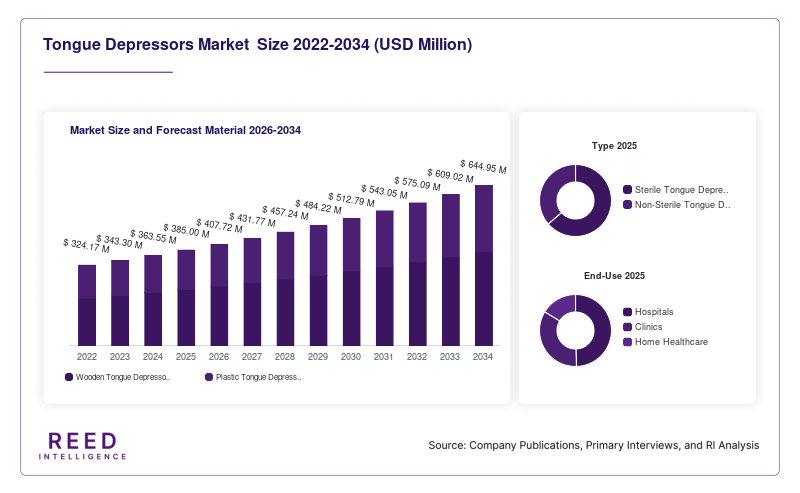
The wooden segment dominated the Tongue Depressors Market with 64.5% share in 2025 due to its biodegradability and cost-effectiveness. The plastic segment is expected to grow at the fastest CAGR of 6.5%, driven by durability and availability in sterile packaging.
By Type
The sterile tongue depressors segment held the largest share of 57.8% in 2025, supported by high usage in clinical settings. The non-sterile segment is projected to grow at a CAGR of 6.2%, driven by demand in home care and non-critical applications.
By End-Use
The hospitals segment dominated with 52.7% share in 2025 due to high patient volumes and frequent medical examinations. The home healthcare segment is expected to grow at a CAGR of 6.6%, supported by increasing adoption of home-based care solutions.
By Distribution Channel
The B2B segment accounted for 61.9% share in 2025, as healthcare institutions are primary buyers. The B2C segment is projected to grow at a CAGR of 6.3%, driven by online sales and retail availability.
Regional Analysis
North America
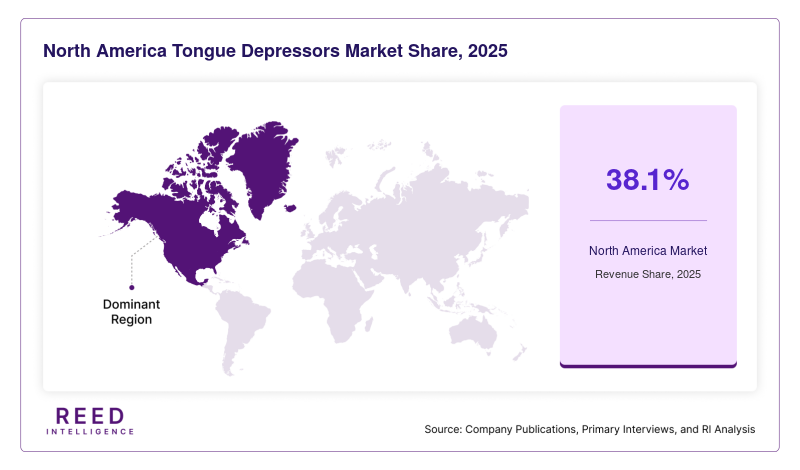
North America accounted for 38.1% of the Tongue Depressors Market share in 2025 and is expected to grow at a CAGR of 5.4% through 2034. The United States dominated the region due to advanced healthcare infrastructure and high adoption of disposable medical products.
Europe
Europe held 27.6% share in 2025 and is projected to expand at a CAGR of 5.3%. Germany led the regional market, supported by strict hygiene regulations and increasing demand for eco-friendly medical supplies.
Asia Pacific
Asia Pacific captured 21.9% share in 2025 and is expected to grow at the fastest CAGR of 6.8%. China dominated the region due to expanding healthcare facilities and rising population.
Middle East & Africa
The Middle East & Africa region held 6.8% share in 2025 and is projected to grow at a CAGR of 5.9%. The UAE led the market due to increasing investments in healthcare infrastructure.
Latin America
Latin America accounted for 5.6% share in 2025 and is expected to grow at a CAGR of 6.0%. Brazil dominated the region, supported by improving healthcare services and rising demand for disposable products.
Competitive Landscape
The Tongue Depressors Market is characterized by the presence of numerous global and regional players focusing on product quality and distribution expansion. Key companies are emphasizing cost efficiency and sustainable sourcing of raw materials. One leading manufacturer has recently introduced biodegradable tongue depressors made from certified sustainable wood, enhancing its market presence.
Other players are adopting strategies such as partnerships and regional expansion to strengthen their distribution networks. The focus on compliance with healthcare standards and environmental regulations is influencing competitive dynamics. As demand remains steady, companies are prioritizing innovation and operational efficiency to maintain their market position.
Key Players List
- 3M Company
- Medline Industries, LP
- Dynarex Corporation
- Cardinal Health, Inc.
- McKesson Corporation
- Henry Schein, Inc.
- Fazzini S.r.l.
- VWR International, LLC
- Sklar Surgical Instruments
- Hu-Friedy Mfg. Co., LLC
- GPC Medical Ltd.
- Romsons Group of Industries
- Narula Udyog
- AdvaCare Pharma
- Jiangsu Yongfa Medical Equipment Technology Co., Ltd.
Recent Developments
- In 2025, a leading manufacturer introduced biodegradable wooden tongue depressors sourced from sustainable forestry
- In 2024, companies expanded production capacity to meet rising global demand
- In 2025, partnerships were established to enhance distribution networks in emerging markets
- In 2024, new sterile packaging solutions improved product safety and shelf life
- In 2025, investments in eco-friendly manufacturing processes increased across the industry
Tongue Depressors Market Segments
Material
- Wooden Tongue Depressors
- Plastic Tongue Depressors
Type
- Sterile Tongue Depressors
- Non-Sterile Tongue Depressors
End-Use
- Hospitals
- Clinics
- Home Healthcare
Distribution Channel
- B2B
- B2C
By Region
- North America
- Europe
- APAC
- Middle East and Africa
- LATAM