Tonsil and Adenoid Removal Product Market Size, Share, Growth Report By Product Type (Electrosurgical Devices, Radiofrequency Ablation Systems, Surgical Instruments, Visualization Systems, Disposable ENT Accessories), By Procedure Type (Tonsillectomy, Adenoidectomy, Combined Tonsillectomy and Adenoidectomy), By End Use (Hospitals, Ambulatory Surgical Centers, Specialty ENT Clinics), By Region & Segment Forecasts, 2026–2034
USD 3950
Market Overview
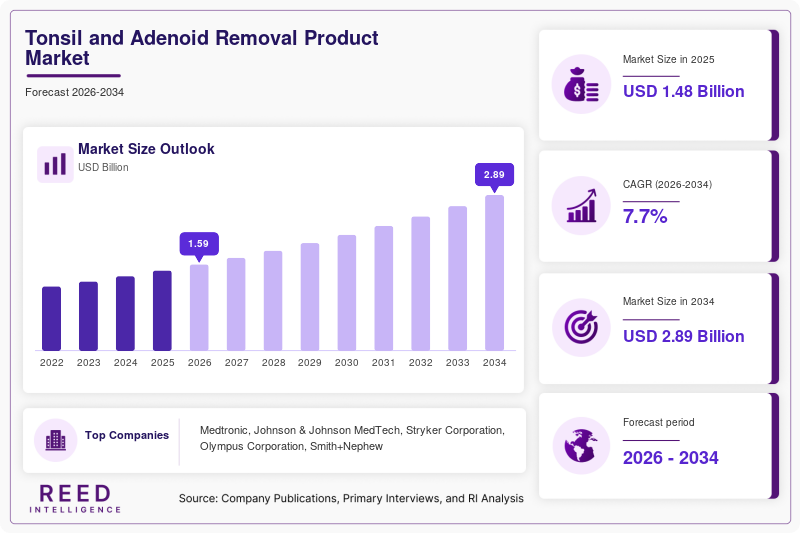
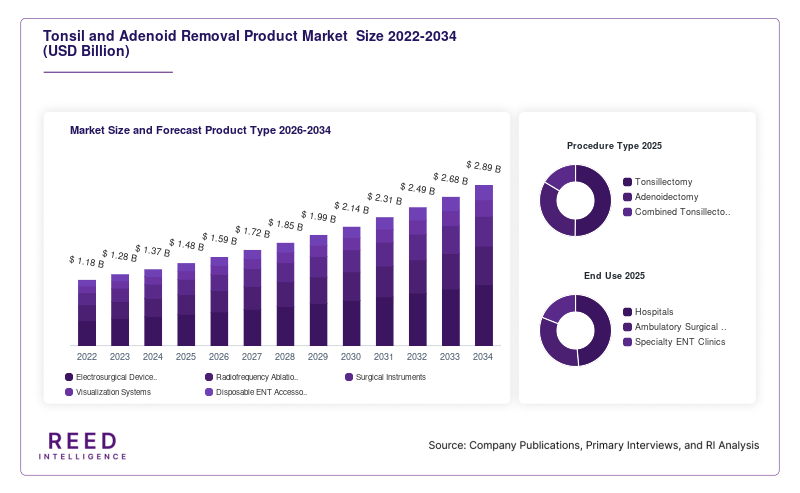
The global Tonsil and Adenoid Removal Product Market size was valued at approximately USD 1.48 billion in 2026 and is projected to reach nearly USD 2.67 billion by 2034, expanding at a CAGR of 7.7% during the forecast period from 2026 to 2034. The market continues to witness steady expansion due to the growing prevalence of recurrent tonsillitis, obstructive sleep apnea, chronic throat infections, and pediatric ENT disorders across both developed and developing economies. Increasing healthcare expenditure, higher surgical procedure volumes, and the adoption of minimally invasive surgical technologies are also supporting market growth globally.
The rising number of outpatient ENT procedures has emerged as a major factor contributing to market expansion. Hospitals and ambulatory surgical centers are increasingly adopting advanced electrosurgical systems, radiofrequency ablation devices, and powered surgical instruments to improve procedural precision and reduce recovery time. In addition, favorable reimbursement frameworks in several developed countries are encouraging patients to undergo tonsillectomy and adenoidectomy procedures at earlier stages of diagnosis. Technological innovation in surgical visualization systems and disposable surgical accessories is further improving clinical outcomes and operational efficiency for healthcare providers.
Key Highlights
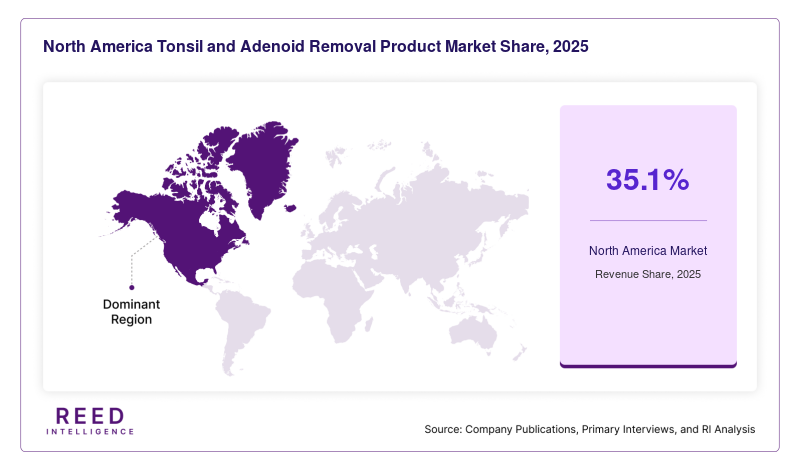
- North America dominated the Tonsil and Adenoid Removal Product Market with a 35.1% share in 2025.
- Asia Pacific is expected to grow at the fastest CAGR of 9.8% during 2026–2034.
- By product type, electrosurgical devices accounted for the largest share of 39.4%, while radiofrequency ablation systems are projected to grow at a CAGR of 10.2%.
- By end use, hospitals led with a 48.6% share, whereas ambulatory surgical centers are expected to expand at a CAGR of 9.5%.
- The United States remained the dominant country, with market values of USD 462 million in 2024 and USD 503 million in 2025.
Market Trends
Growing Preference for Minimally Invasive ENT Procedures
The increasing preference for minimally invasive surgical procedures is shaping the evolution of the Tonsil and Adenoid Removal Product Market. Healthcare providers are increasingly adopting advanced technologies that reduce intraoperative bleeding, shorten hospital stays, and improve patient recovery outcomes. Radiofrequency ablation systems, coblation devices, and laser-assisted surgical tools are becoming widely accepted in ENT departments due to their precision and reduced tissue damage. Pediatric patients and elderly populations are particularly benefiting from minimally invasive techniques because they lower postoperative complications and pain levels. Hospitals are also integrating advanced visualization systems and disposable surgical accessories to improve workflow efficiency and infection control. The trend toward minimally invasive procedures is expected to continue as healthcare systems focus on cost optimization and improved patient satisfaction across outpatient and ambulatory care settings.
Increasing Adoption of Single-Use Surgical Instruments
The market is witnessing a growing transition toward single-use and disposable ENT surgical instruments due to increasing concerns regarding infection prevention and sterilization efficiency. Healthcare facilities are emphasizing patient safety and compliance with infection-control standards, especially after heightened awareness regarding hospital-acquired infections. Disposable suction devices, surgical blades, and electrosurgical accessories are gaining strong demand among hospitals and ambulatory surgical centers. Manufacturers are also introducing cost-effective disposable product portfolios designed specifically for pediatric tonsillectomy and adenoidectomy procedures. This trend is further supported by growing procedural volumes in outpatient settings where operational turnaround time is critical. The demand for single-use products is expected to remain strong as healthcare providers prioritize reduced contamination risks, simplified workflow management, and improved surgical consistency in ENT procedures.
Market Drivers
Rising Incidence of Pediatric ENT Disorders
The growing prevalence of pediatric ENT disorders is a major factor driving the Tonsil and Adenoid Removal Product Market. Conditions such as chronic tonsillitis, recurrent throat infections, enlarged adenoids, and obstructive sleep apnea are becoming increasingly common among children worldwide. Urban pollution, changing dietary patterns, and higher exposure to respiratory infections are contributing to the increasing number of pediatric ENT consultations. Hospitals and specialty ENT clinics are reporting higher surgical volumes for tonsillectomy and adenoidectomy procedures, particularly in densely populated urban regions. Governments and healthcare organizations are also investing in pediatric healthcare infrastructure and ENT screening programs. The increasing awareness among parents regarding early diagnosis and treatment of sleep-related breathing disorders is further supporting the adoption of advanced tonsil and adenoid removal products across healthcare facilities.
Technological Advancements in Surgical Equipment
Continuous technological advancements in ENT surgical systems are significantly supporting market growth. Manufacturers are developing innovative electrosurgical systems, powered surgical instruments, and radiofrequency devices that improve procedural accuracy and reduce surgical complications. Advanced systems now offer improved thermal control, reduced tissue trauma, and better hemostatic performance, allowing surgeons to perform procedures more efficiently. Integration of digital imaging and surgical navigation systems is also improving procedural precision during complex ENT surgeries. Healthcare facilities are increasingly investing in modern surgical equipment to enhance patient outcomes and operational productivity. Additionally, the expansion of outpatient surgical centers has increased the demand for compact, portable, and easy-to-use ENT surgical devices. These innovations are expected to support wider adoption of technologically advanced tonsil and adenoid removal products during the forecast period.
Market Restraint
High Procedure Costs and Limited Access in Developing Economies
The high cost associated with advanced tonsil and adenoid removal procedures remains a significant restraint for market growth, particularly in low-income and developing economies. Modern surgical systems such as coblation devices, laser-assisted instruments, and radiofrequency ablation equipment require substantial capital investment and ongoing maintenance expenses. Many small hospitals and rural healthcare centers face budget limitations that restrict adoption of advanced ENT technologies. In addition, the cost burden for patients remains high in countries with limited reimbursement support or underdeveloped healthcare insurance systems. Delayed diagnosis and lack of access to specialized ENT surgeons also reduce procedural volumes in several emerging regions. For example, many public healthcare facilities in parts of Africa and Southeast Asia continue to rely on conventional surgical methods due to affordability concerns. These financial and infrastructure limitations may slow the widespread adoption of technologically advanced tonsil and adenoid removal products.
Market Opportunities
Expansion of Ambulatory Surgical Centers
The rapid expansion of ambulatory surgical centers presents a strong growth opportunity for the Tonsil and Adenoid Removal Product Market. Ambulatory care facilities are becoming increasingly preferred for ENT procedures because they offer lower treatment costs, shorter patient waiting times, and faster postoperative recovery. Tonsillectomy and adenoidectomy procedures are highly suitable for outpatient environments due to advances in minimally invasive surgical technologies and anesthesia management. Healthcare providers are investing in compact electrosurgical systems and portable visualization devices specifically designed for ambulatory settings. In addition, favorable reimbursement policies for same-day surgeries in several countries are encouraging healthcare providers to shift procedures away from traditional inpatient hospitals. This transition is expected to generate higher demand for efficient, cost-effective, and disposable ENT surgical products over the coming years.
Growing Healthcare Investments in Emerging Economies
Emerging economies are creating substantial opportunities for market participants due to rising healthcare investments and improving access to ENT care services. Countries across Asia Pacific, Latin America, and the Middle East are expanding healthcare infrastructure and increasing spending on specialized surgical departments. Governments are also supporting initiatives aimed at improving pediatric healthcare and reducing untreated respiratory disorders. The increasing presence of private hospitals and specialty ENT clinics is further accelerating demand for advanced surgical systems and accessories. Medical tourism in countries such as India, Thailand, and the United Arab Emirates is also supporting procedural growth by attracting international patients seeking affordable ENT surgeries. Manufacturers are responding by expanding distribution networks, establishing regional partnerships, and launching cost-effective product lines tailored to price-sensitive healthcare markets.
Segmental Analysis
By Product Type
Electrosurgical devices dominated the Tonsil and Adenoid Removal Product Market in 2024, accounting for approximately 39.4% of total market revenue. These devices are widely used across hospitals and specialty ENT clinics because they provide effective tissue dissection, coagulation, and bleeding control during tonsillectomy and adenoidectomy procedures. Surgeons increasingly prefer electrosurgical systems due to their ability to improve procedural precision and reduce operation time. The growing demand for minimally invasive surgical approaches has also supported adoption of advanced bipolar and monopolar electrosurgical systems. In addition, hospitals are investing in upgraded ENT operating rooms equipped with integrated electrosurgical platforms and visualization systems. The broad availability of electrosurgical accessories and strong manufacturer support further contribute to the segment’s market leadership across both developed and emerging healthcare markets.
Radiofrequency ablation systems are projected to witness the fastest growth during the forecast period, expanding at a CAGR of 10.2%. These systems are gaining popularity because they reduce thermal damage to surrounding tissue and support faster patient recovery. Pediatric ENT specialists are increasingly using radiofrequency technologies to minimize postoperative pain and reduce bleeding complications. The rising number of outpatient procedures has further accelerated demand for compact and portable radiofrequency devices suitable for ambulatory settings. Manufacturers are also introducing technologically advanced systems with improved energy control and ergonomic designs to enhance surgical efficiency. In addition, growing physician awareness regarding the clinical advantages of radiofrequency-assisted procedures is expected to support broader adoption across hospitals and ambulatory surgical centers worldwide.
By Procedure Type
Tonsillectomy procedures represented the largest segment in 2024, capturing nearly 57.2% of the global Tonsil and Adenoid Removal Product Market. The high prevalence of recurrent tonsillitis, obstructive sleep apnea, and chronic throat infections among pediatric patients continues to drive procedural demand worldwide. Hospitals and ENT clinics perform large volumes of tonsillectomy surgeries annually, particularly in North America and Europe where awareness and healthcare accessibility remain high. Technological advancements in surgical devices have also improved patient outcomes by reducing recovery periods and postoperative discomfort. Surgeons are increasingly utilizing minimally invasive surgical systems and advanced electrosurgical tools to improve precision and procedural safety. Furthermore, rising awareness among parents regarding sleep-disordered breathing conditions is contributing to increased diagnosis and surgical intervention rates among children globally.
Combined tonsillectomy and adenoidectomy procedures are expected to register the fastest growth rate during the forecast period, with a CAGR of 9.4%. The increasing prevalence of pediatric obstructive sleep apnea and recurrent upper respiratory infections is encouraging physicians to perform combined procedures for comprehensive treatment outcomes. Combined surgeries reduce the need for multiple hospital visits and lower overall healthcare costs for patients and providers. Healthcare facilities are increasingly adopting integrated ENT surgical systems capable of supporting multiple procedures within a single operative setting. The growing availability of specialized pediatric ENT centers and outpatient surgery programs is also supporting segment growth. In addition, favorable reimbursement coverage for combined procedures in developed healthcare systems is expected to encourage wider adoption over the coming years.
By End Use
Hospitals accounted for the largest share of the Tonsil and Adenoid Removal Product Market in 2024, representing approximately 48.6% of global revenue. Large hospitals continue to dominate the market because they possess advanced surgical infrastructure, experienced ENT specialists, and access to comprehensive postoperative care facilities. High patient admission volumes and availability of sophisticated surgical technologies further strengthen hospital dominance within the market. Hospitals are increasingly investing in advanced electrosurgical systems, disposable ENT instruments, and digital visualization equipment to improve procedural efficiency and patient safety. In addition, the growing prevalence of pediatric ENT disorders and increasing demand for same-day surgical procedures are supporting continuous expansion of ENT departments within tertiary healthcare institutions across major global markets.
Ambulatory surgical centers are anticipated to witness the fastest growth during the forecast period, expanding at a CAGR of 9.5%. These facilities are becoming increasingly popular because they offer lower operational costs, shorter waiting times, and faster patient discharge compared to traditional hospitals. The rising adoption of minimally invasive surgical technologies has made tonsillectomy and adenoidectomy procedures more suitable for outpatient settings. Healthcare providers are investing in portable surgical systems and single-use instruments designed specifically for ambulatory care environments. Patients and insurers are also favoring outpatient procedures due to reduced treatment costs and improved convenience. Furthermore, favorable reimbursement policies and increasing healthcare decentralization are expected to accelerate expansion of
Regional Analysis
North America
North America accounted for the largest share of the Tonsil and Adenoid Removal Product Market in 2025, representing approximately 35.1% of global revenue. The region is expected to maintain steady expansion at a CAGR of 6.9% during the forecast period. High procedural volumes, strong healthcare infrastructure, and widespread adoption of minimally invasive ENT technologies continue to support market growth across the region. Hospitals and ambulatory surgical centers are rapidly integrating advanced electrosurgical and radiofrequency systems to improve procedural outcomes. Favorable reimbursement frameworks and increasing healthcare expenditure are also contributing to market expansion.
The United States remained the dominant country within North America due to its advanced healthcare ecosystem and high prevalence of pediatric ENT disorders. The country recorded strong demand for coblation devices, surgical visualization systems, and disposable ENT accessories across hospitals and outpatient centers. Increasing awareness regarding obstructive sleep apnea and recurrent tonsillitis among children has significantly increased surgical procedure volumes. Additionally, the strong presence of leading medical device manufacturers and ongoing technological innovation continue to strengthen the regional market outlook.
Europe
Europe represented a substantial share of the Tonsil and Adenoid Removal Product Market in 2025 and is projected to grow at a CAGR of 6.8% through 2034. The region benefits from strong public healthcare systems, high adoption of advanced surgical instruments, and increasing investments in ENT specialty departments. Countries across Western Europe are emphasizing early diagnosis and treatment of chronic throat infections and sleep-related respiratory disorders. Demand for minimally invasive tonsillectomy procedures has increased due to growing preference for reduced postoperative recovery time and lower complication rates.
Germany emerged as the leading country in the European market due to its advanced medical infrastructure and strong focus on surgical innovation. Hospitals in Germany are increasingly adopting powered surgical systems and radiofrequency technologies for pediatric ENT procedures. The country also benefits from high healthcare spending and extensive training programs for ENT specialists. Rising demand for outpatient surgical procedures and infection-control solutions is encouraging hospitals to invest in disposable surgical products and next-generation electrosurgical devices across the region.
Asia Pacific
Asia Pacific is expected to register the fastest growth in the Tonsil and Adenoid Removal Product Market, with a projected CAGR of 9.8% during 2026–2034. The region is benefiting from rapid urbanization, rising healthcare expenditure, and a growing pediatric population affected by respiratory infections and ENT disorders. Expanding healthcare infrastructure in countries such as China, India, and Southeast Asian nations is increasing access to ENT surgical procedures. The growing presence of private hospitals and specialty clinics is also accelerating demand for advanced surgical systems and accessories.
China dominated the Asia Pacific market due to its large patient population and rapidly expanding healthcare sector. The country is witnessing increasing adoption of minimally invasive surgical technologies within urban hospitals and specialty ENT centers. Government initiatives aimed at improving pediatric healthcare services and expanding insurance coverage are also supporting market growth. In addition, rising awareness regarding sleep apnea and chronic throat infections is contributing to higher diagnosis and treatment rates among both children and adults across the country.
Middle East & Africa
The Middle East & Africa region is experiencing gradual growth in the Tonsil and Adenoid Removal Product Market and is projected to expand at a CAGR of 7.1% through 2034. Increasing healthcare modernization initiatives and rising investments in specialty surgical services are supporting regional market development. Governments across Gulf countries are strengthening hospital infrastructure and encouraging adoption of advanced medical technologies. The market is also benefiting from increasing awareness regarding pediatric ENT disorders and improved access to specialized healthcare facilities in urban areas.
Saudi Arabia emerged as the leading country in the region due to its expanding healthcare infrastructure and increasing investments in advanced surgical technologies. Hospitals across the country are adopting modern electrosurgical and radiofrequency systems to improve ENT procedural efficiency. The rise in lifestyle-related respiratory disorders and growing pediatric healthcare demand are contributing to higher surgical volumes. In addition, medical tourism initiatives and government-backed healthcare transformation programs are creating favorable conditions for continued market growth.
Latin America
Latin America accounted for a moderate share of the Tonsil and Adenoid Removal Product Market in 2025 and is anticipated to grow at a CAGR of 7.3% during the forecast period. Improving healthcare access, rising urbanization, and increasing awareness regarding ENT disorders are contributing to regional market expansion. Public and private healthcare providers are investing in advanced surgical equipment to improve treatment quality and reduce hospitalization duration. The region is also witnessing increasing adoption of minimally invasive tonsillectomy procedures in urban healthcare centers.
Brazil remained the dominant country within Latin America due to its large healthcare network and increasing procedural demand for pediatric ENT surgeries. The country is witnessing growing adoption of disposable surgical accessories and advanced electrosurgical systems in both public and private hospitals. Rising healthcare spending and government efforts to improve access to specialty surgical services are further supporting market growth. Expanding medical education programs for ENT specialists are also contributing to greater adoption of modern tonsil and adenoid removal technologies.
Competitive Landscape
The Tonsil and Adenoid Removal Product Market remains moderately consolidated, with several multinational medical device companies competing through product innovation, strategic partnerships, and geographic expansion initiatives. Leading market participants are focusing on the development of minimally invasive surgical technologies, disposable ENT instruments, and advanced electrosurgical systems to strengthen their competitive positioning. Companies are also investing in physician training programs and hospital collaborations to increase product adoption across emerging healthcare markets.
Medtronic remained a leading player in the global market due to its extensive ENT surgical portfolio and strong global distribution network. The company continues to invest in advanced radiofrequency and electrosurgical technologies aimed at improving procedural precision and reducing patient recovery time. Other major companies are also expanding their research and development activities to introduce cost-effective and technologically advanced ENT surgical systems.
Key Players
- Medtronic
- Johnson & Johnson MedTech
- Stryker Corporation
- Olympus Corporation
- Smith+Nephew
- ConMed Corporation
- Karl Storz
- B. Braun
- Cook Medical
- Integra LifeSciences
- Fujifilm Healthcare
- Welch Allyn
- ATMOS MedizinTechnik
- Richard Wolf GmbH
- Teleflex Incorporated
Recent Developments
- In 2025, Medtronic expanded its ENT surgical portfolio with an upgraded radiofrequency ablation platform designed for pediatric tonsillectomy procedures.
- In 2024, Stryker Corporation introduced an advanced surgical visualization system aimed at improving precision during minimally invasive ENT surgeries.
- In 2025, Olympus Corporation announced expansion of its disposable ENT accessory manufacturing capabilities to support increasing outpatient procedure demand.
Tonsil and Adenoid Removal Product Market Segments
Product Type
- Electrosurgical Devices
- Radiofrequency Ablation Systems
- Surgical Instruments
- Visualization Systems
- Disposable ENT Accessories
Procedure Type
- Tonsillectomy
- Adenoidectomy
- Combined Tonsillectomy and Adenoidectomy
End Use
- Hospitals
- Ambulatory Surgical Centers
- Specialty ENT Clinics
By Region
- North America
- Europe
- APAC
- Middle East and Africa
- LATAM