Tooling Board Market Size, Share, Demand Report By Type (Polyurethane Tooling Boards, Epoxy Tooling Boards, High-Density Tooling Board), By Application (Automotive Prototyping, Aerospace Tooling, Marine Engineering, Wind Energy Manufacturin), By End-Use Industry (Automotive, Aerospace & Defense, Marine, Renewable Energy, Industrial Manufacturing) By Region & Segment Forecasts, 2026–2034
USD 3950
Market Overview
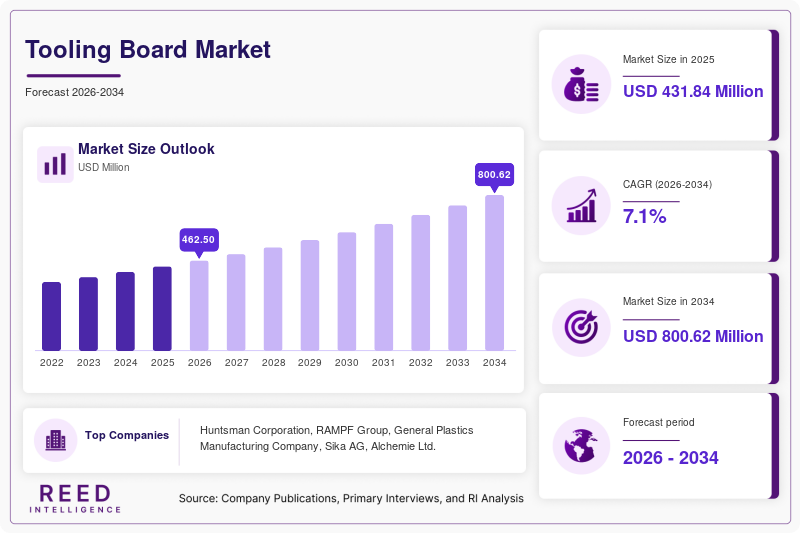
The Tooling Board Market size is estimated at USD 462.5 million, and it is projected to reach USD 798.3 million by 2034, growing at a CAGR of 7.1% (2026–2034). One of the primary global factors driving the Tooling Board Market growth is the rapid shift toward lightweight composite manufacturing in aerospace, automotive, and wind energy sectors. Manufacturers are increasingly replacing traditional metal tooling with advanced polyurethane and epoxy tooling boards due to their dimensional stability, machinability, and cost efficiency.
The Tooling Board Market analysis indicates a strong transition toward digital manufacturing and CNC machining processes, which significantly enhance precision and reduce production cycles. Additionally, increasing demand for rapid prototyping in electric vehicle development is further accelerating market adoption.
Key Highlights
- Dominant Region Share (2025): Asia Pacific held approximately 38.2% of the global Tooling Board Market share
- Fastest-Growing Region CAGR (2026–2034): Middle East & Africa at 8.2%
- Leading Type Segment (2025): Polyurethane tooling boards dominated with 44.5% share
- Fastest-Growing Type Segment CAGR: Epoxy tooling boards at 7.8%
- Dominant Application Segment (2025): Automotive prototyping accounted for 32.6% share
- Fastest-Growing Application Segment CAGR: Aerospace tooling applications at 7.6%
- Dominant Country (2024–2025 Market Value):
- United States: USD 120.4 million (2024)
- United States: USD 128.7 million (2025)
Market Trends
Increasing Adoption of CNC-Compatible Tooling Boards
The Tooling Board Market trends show a strong shift toward CNC-machinable materials. Manufacturers are prioritizing tooling boards that offer high stability under high-speed machining conditions. This trend is particularly significant in aerospace and automotive prototyping, where precision is critical. Advanced polyurethane tooling boards are increasingly engineered for compatibility with multi-axis CNC systems, reducing waste and improving production efficiency.
Expansion of Lightweight Composite Manufacturing
Another key trend shaping the Tooling Board Market outlook is the rapid expansion of composite material usage in end-use industries. Tooling boards are being widely adopted in the production of molds for carbon fiber and fiberglass components. This is particularly evident in wind energy and aerospace sectors, where lightweight structural components are essential for performance optimization and fuel efficiency.
Market Drivers
Rising Demand for Rapid Prototyping in Manufacturing
The growing need for rapid product development cycles is significantly boosting the Tooling Board Market growth. Industries such as automotive and consumer electronics rely heavily on tooling boards for quick mold development and design validation. Their ability to reduce lead times compared to traditional metal tooling is a major growth catalyst.
Expansion of Aerospace and Wind Energy Industries
The increasing production of aircraft components and wind turbine blades is driving demand for high-performance tooling materials. Tooling boards provide thermal stability and ease of machining, making them essential for large-scale composite manufacturing. This industrial expansion is a key contributor to the long-term Tooling Board Market forecast.
Market Restraint
High Material Cost and Limited Recycling Capability
Despite strong demand, the Tooling Board Market analysis indicates that high raw material costs and limited recyclability remain major restraints. Advanced polyurethane and epoxy tooling boards require specialized manufacturing processes, increasing overall production costs. Additionally, disposal challenges associated with thermoset materials create environmental concerns, restricting adoption in cost-sensitive markets.
Market Opportunities
Growth in Electric Vehicle Manufacturing
The expansion of the electric vehicle (EV) industry presents a significant opportunity for the Tooling Board Market. EV manufacturers require rapid prototyping solutions for battery housings, aerodynamic components, and lightweight structures. Tooling boards are increasingly used in EV development cycles due to their design flexibility and reduced production time.
Integration of Digital Manufacturing Technologies
The integration of Industry 4.0 technologies, including CAD/CAM systems and digital twin modeling, is creating new opportunities. Tooling boards compatible with advanced simulation and machining software are gaining traction. This digital transformation is expected to enhance production efficiency and reduce design iteration cycles.
Segmental Analysis
By Type
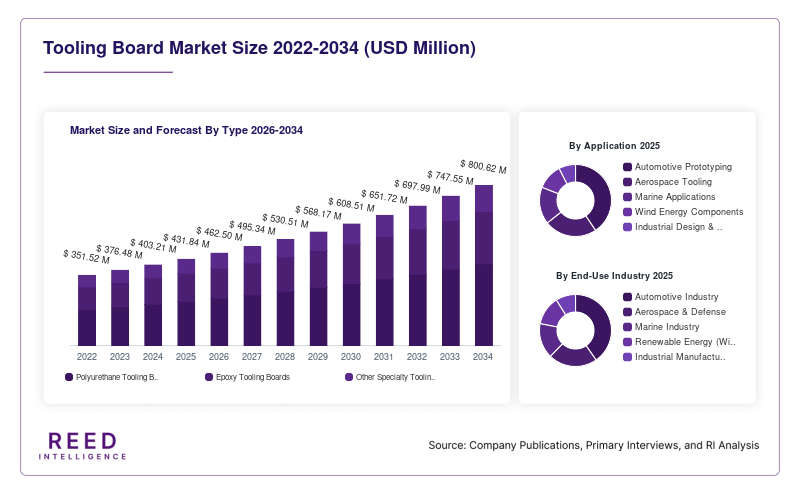
The Tooling Board Market is segmented into polyurethane tooling boards, epoxy tooling boards, and others. Polyurethane tooling boards dominated the market with 44.5% share in 2025, driven by their superior machinability and dimensional stability. Epoxy tooling boards are projected to grow at a CAGR of 7.8%, supported by rising demand for high-temperature resistance applications in aerospace tooling.
By Application
Applications include automotive prototyping, aerospace tooling, marine, wind energy, and industrial design. Automotive prototyping held the largest share of 32.6% in 2025, due to increasing vehicle design iterations and EV development. Aerospace tooling is expected to grow at the fastest CAGR of 7.6%, driven by lightweight composite component manufacturing.
By End-Use Industry
The Tooling Board Market segmentation includes automotive, aerospace & defense, marine, wind energy, and others. Aerospace & defense dominated with 35.1% share in 2025, supported by high-precision tooling requirements. Wind energy is projected to grow at a CAGR of 7.9%, due to rising turbine blade production and renewable energy investments.
Regional Analysis
North America
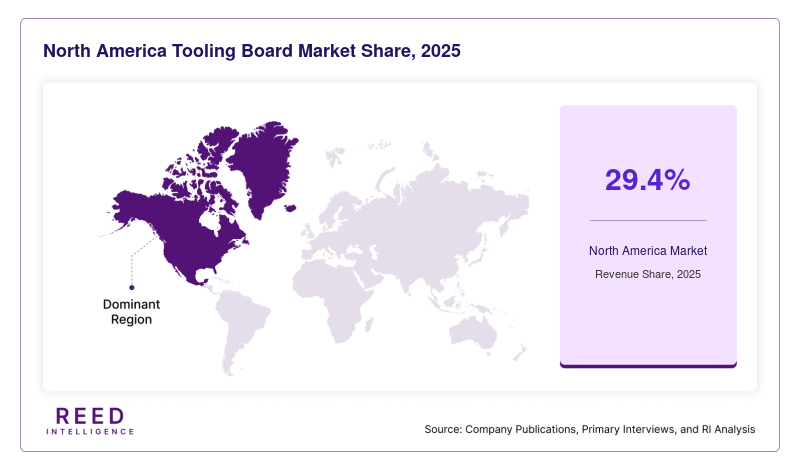
North America accounted for 29.4% share of the Tooling Board Market in 2025, and is projected to grow at a CAGR of 6.6% (2026–2034). The region benefits from strong aerospace and automotive manufacturing bases. The United States remains the dominant country, driven by advanced prototyping infrastructure and high adoption of composite materials in industrial applications.
Europe
Europe held 27.1% market share in 2025, with a forecast CAGR of 6.4% through 2034. Strong demand from Germany, France, and the UK supports regional growth. Germany dominates due to its advanced automotive engineering ecosystem and increasing use of tooling boards in electric vehicle production.
Asia Pacific
Asia Pacific dominated the global landscape with 38.2% share in 2025, and is expected to expand at a CAGR of 7.5% (2026–2034). China leads the region due to large-scale manufacturing capabilities, rapid industrialization, and expansion of aerospace and wind energy sectors. Increasing investments in composite manufacturing infrastructure are further supporting Tooling Board Market expansion.
Middle East & Africa
Middle East & Africa accounted for 3.8% share in 2025, and is projected to grow at the fastest CAGR of 8.2% (2026–2034). Growth is driven by diversification into aerospace manufacturing and renewable energy projects, particularly in the UAE and Saudi Arabia.
Latin America
Latin America held 1.5% share in 2025, with a projected CAGR of 6.2% (2026–2034). Brazil dominates the region due to expanding automotive manufacturing and increasing adoption of composite tooling solutions in industrial applications.
Competitive Landscape
The Tooling Board Market is moderately consolidated, with key players focusing on product innovation, material performance enhancement, and global expansion strategies. Major companies include Huntsman Corporation, RAMPF Group, General Plastics Manufacturing Company, Alchemie Ltd., and Sika AG. These players are actively investing in advanced polyurethane and epoxy formulations to improve machinability and thermal stability.
Huntsman Corporation maintains a strong position due to its diversified polymer solutions and continuous innovation in tooling materials for aerospace applications. Recent developments include the expansion of its composite materials division to support EV and wind energy tooling applications.
Other players are focusing on expanding distribution networks and introducing CNC-optimized tooling boards. Strategic collaborations with aerospace OEMs and automotive manufacturers are becoming increasingly common, enhancing competitive positioning in the global Tooling Board Market.
Key Players List
- Huntsman Corporation
- RAMPF Group
- General Plastics Manufacturing Company
- Sika AG
- Alchemie Ltd.
- Diab Group
- Axson Technologies
- DUNA-Corradini S.p.A.
- BCC Products Inc.
- Easy Composites Ltd.
- Curbell Plastics Inc.
- Armacell International S.A.
- Polytek Development Corp.
- Trelleborg AB
- CoreLite Inc.
Recent Developments
- In 2025, leading manufacturers expanded CNC-optimized tooling board production lines to support aerospace prototyping demand.
- Several companies introduced next-generation polyurethane tooling boards with improved thermal resistance for EV applications.
- Strategic partnerships between composite material suppliers and wind energy OEMs increased to support large-scale turbine blade manufacturing.
- Investments in sustainable tooling materials research increased, focusing on recyclability and reduced environmental impact in industrial applications.
- Asia Pacific manufacturers expanded export capabilities, strengthening their position in the global Tooling Board Market supply chain.
Tooling Board Market Segments
By Type
- Polyurethane Tooling Boards
- Epoxy Tooling Boards
- Other Specialty Tooling Boards
By Application
- Automotive Prototyping
- Aerospace Tooling
- Marine Applications
- Wind Energy Components
- Industrial Design & Modeling
By End-Use Industry
- Automotive Industry
- Aerospace & Defense
- Marine Industry
- Renewable Energy (Wind Energy)
- Industrial Manufacturing
By Manufacturing Process
- CNC Machining Compatible Boards
- Hand-Processed Tooling Boards
- Hybrid Processing Systems
By Region
- North America
- Europe
- APAC
- Middle East and Africa
- LATAM