Total Carbon Analyzer Market Size, Share & Demand Report By Type (Benchtop Analyzers, Portable Analyzers), By Technology (Combustion-Based, UV Oxidation), By Application (Water Treatment, Pharmaceuticals, Chemicals, Food & Beverage, Environmental Monitoring), By End-Use Industry (Industrial Manufacturing, Healthcare & Life Sciences, Energy & Utilities, Research Laboratories), By Region & Segment Forecasts, 2025–2034
USD 3950
Market Overview
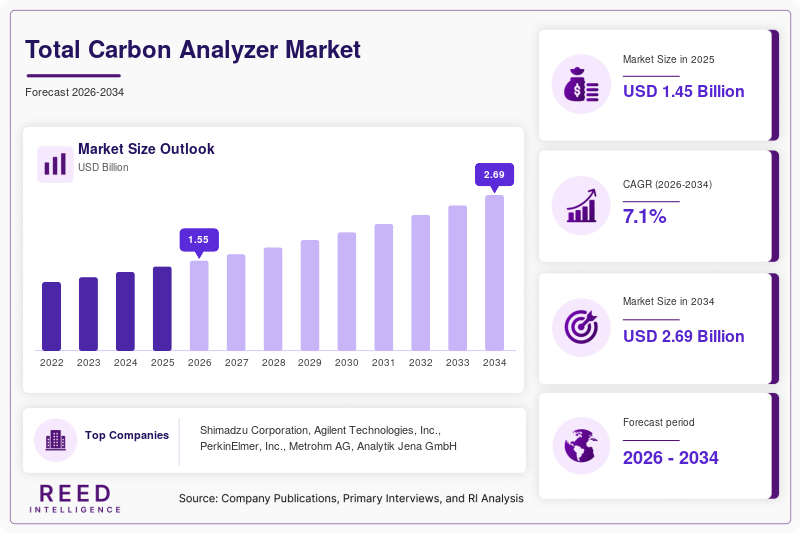
The Total Carbon Analyzer Market size was valued at approximately USD 1.45 billion in 2025 and is projected to reach USD 2.68 billion by 2034, growing at a compound annual growth rate (CAGR) of 7.1% during the forecast period (2025–2034). The market growth is being supported by the increasing emphasis on environmental monitoring and water quality assessment across industrial and municipal sectors. Governments and regulatory bodies worldwide are implementing stricter guidelines for wastewater discharge and environmental compliance, which has significantly boosted the adoption of total carbon analyzers in laboratories and industrial facilities.
Total carbon analyzers play a critical role in measuring total organic carbon (TOC) and total inorganic carbon (TIC), helping industries maintain compliance and improve operational efficiency. Their application in pharmaceuticals, chemicals, power generation, and food & beverage industries has expanded steadily due to the need for precise carbon measurement and process control.
Key Highlights
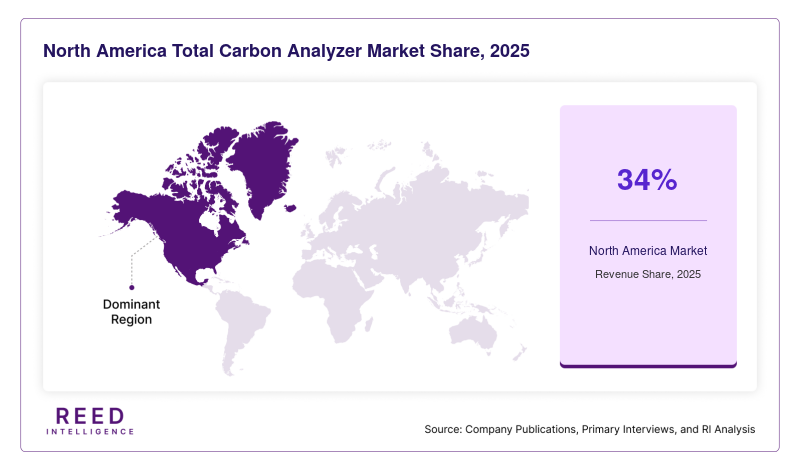
- North America dominated the market with a 34% share in 2025, while Asia Pacific is projected to be the fastest-growing region with a CAGR of 8.6%.
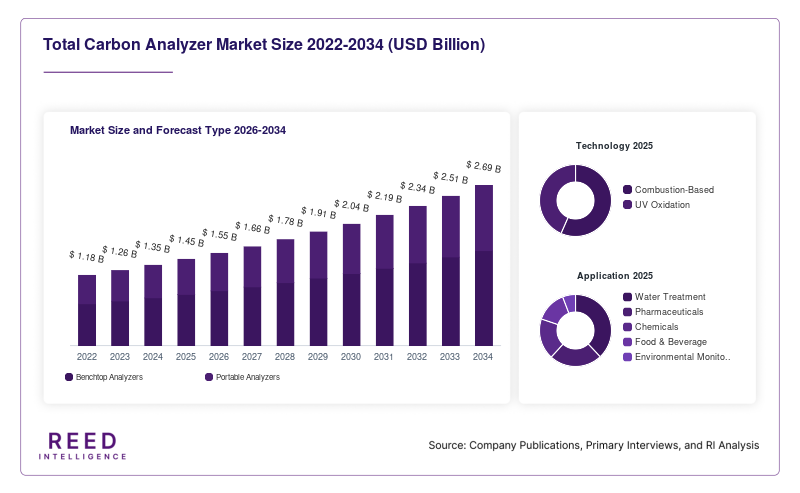
- Among types, benchtop analyzers led with a 52% share, whereas portable analyzers are expected to grow fastest at a CAGR of 8.9%.
- In applications, water treatment held the largest share at 41%, while pharmaceutical applications are projected to expand at a CAGR of 9.2%.
- The United States remained the dominant country with a market value of USD 420 million in 2025, expected to reach USD 450 million in 2026.
Market Trends
Integration of Automation and Digital Technologies
Automation is increasingly being integrated into total carbon analyzers to enhance accuracy, efficiency, and ease of use. Modern analyzers are equipped with advanced software, real-time monitoring capabilities, and automated calibration systems. These features reduce human intervention and minimize errors, making them suitable for continuous industrial operations. The adoption of cloud-based data management and IoT-enabled devices is further transforming how data is collected, analyzed, and reported.
Rising Demand for Portable and Field-Based Analyzers
The market is witnessing a growing demand for portable total carbon analyzers due to their flexibility and ease of deployment. Industries such as environmental monitoring and field research require on-site testing solutions that deliver quick and reliable results. Portable analyzers are becoming more compact and user-friendly while maintaining high analytical performance. This trend is particularly prominent in emerging economies where infrastructure limitations make centralized testing less feasible.
Market Drivers
Increasing Environmental Regulations
Stringent environmental regulations are a major driver for the Total Carbon Analyzer Market. Governments worldwide are enforcing stricter policies regarding wastewater discharge, air quality monitoring, and industrial emissions. Industries are required to monitor carbon levels continuously to comply with these regulations, leading to increased adoption of total carbon analyzers.
Growing Demand in Pharmaceutical and Biotechnology Industries
The pharmaceutical and biotechnology sectors are increasingly utilizing total carbon analyzers to ensure product quality and regulatory compliance. These analyzers are essential in validating cleaning processes and monitoring water purity. The expansion of pharmaceutical manufacturing, particularly in emerging markets, is driving demand for high-precision analytical instruments.
Market Restraint
High Initial Investment and Maintenance Costs
One of the primary challenges in the Total Carbon Analyzer Market is the high cost associated with acquiring and maintaining these instruments. Advanced analyzers equipped with automation and digital features can be expensive, limiting their adoption among small and medium-sized enterprises. Additionally, maintenance requirements, including regular calibration, replacement of components, and skilled personnel for operation, further increase the total cost of ownership.
This financial burden can deter organizations from investing in advanced analyzers, especially in cost-sensitive markets. Moreover, the availability of alternative testing methods at lower costs also affects the market growth to some extent. Despite these challenges, ongoing technological advancements are expected to gradually reduce costs and improve accessibility.
Market Opportunities
Expansion in Emerging Economies
Emerging economies present significant growth opportunities for the Total Carbon Analyzer Market. Rapid industrialization, urbanization, and increasing environmental awareness are driving demand for water and air quality monitoring solutions. Governments in these regions are investing in infrastructure development and environmental protection initiatives, creating a favorable market environment.
Advancements in Analytical Technologies
Continuous innovation in analytical technologies is opening new avenues for market growth. Developments such as miniaturization, enhanced sensitivity, and integration with advanced software are improving the performance and usability of total carbon analyzers. These advancements are expanding their applications across various industries, including research and development, environmental monitoring, and industrial process control.
Segmental Analysis
By Type
Benchtop analyzers dominated the Total Carbon Analyzer Market with a 52% share in 2025. Their widespread use in laboratories and industrial facilities contributed to their leading position due to their high accuracy and reliability.
Portable analyzers are projected to be the fastest-growing subsegment, with a CAGR of 8.9%. Their ability to provide on-site analysis and quick results will drive adoption, particularly in environmental monitoring applications.
By Component
Hardware components held the largest share of 61% in 2025, driven by the demand for advanced analytical instruments. The high cost of equipment contributed to the dominance of this segment.
Software solutions are expected to grow at the fastest rate, with a CAGR of 8.4%, due to increasing integration of data analytics and automation features.
By Application
Water treatment applications accounted for the largest share of 41% in 2025, reflecting the importance of monitoring water quality across industries.
Pharmaceutical applications are anticipated to grow at the highest CAGR of 9.2%, driven by stringent quality control requirements and increasing production activities.
By End-Use Industry
Industrial manufacturing dominated the market with a 38% share in 2025, owing to the need for process monitoring and quality control.
The healthcare and life sciences sector is expected to witness the fastest growth, with a CAGR of 9.0%, due to rising demand for precise analytical tools.
By Technology
Combustion-based analyzers held the largest share of 55% in 2025, attributed to their high accuracy and widespread use.
UV oxidation technology is projected to grow at the fastest CAGR of 8.7%, driven by its efficiency and lower operational costs.
Regional Analysis
North America
North America accounted for 34% of the Total Carbon Analyzer Market share in 2025 and will grow at a CAGR of 6.5% during the forecast period. The region’s established industrial base and strong regulatory framework contributed to its leading position.
The United States dominated the regional market due to the presence of advanced laboratory infrastructure and stringent environmental monitoring requirements. The country’s focus on water quality management and industrial compliance has driven widespread adoption of total carbon analyzers.
Europe
Europe held a 27% market share in 2025 and is projected to expand at a CAGR of 6.8% through 2034. The region’s emphasis on sustainability and environmental protection has supported market growth.
Germany emerged as the leading country, driven by its strong manufacturing sector and commitment to environmental standards. The adoption of advanced analytical technologies in industrial and research applications has further strengthened market demand.
Asia Pacific
Asia Pacific represented 23% of the market in 2025 and will witness the fastest growth at a CAGR of 8.6%. Rapid industrialization and increasing environmental concerns are key growth factors in the region.
China dominated the regional market due to its expanding industrial base and government initiatives aimed at pollution control. The increasing adoption of advanced monitoring technologies is expected to drive further growth.
Middle East & Africa
The Middle East & Africa accounted for 9% of the market in 2025 and is expected to grow at a CAGR of 7.2%. The region’s focus on water management and industrial development has contributed to market expansion.
Saudi Arabia led the regional market, driven by investments in water treatment and desalination projects. The need for efficient monitoring solutions has increased the demand for total carbon analyzers.
Latin America
Latin America held a 7% market share in 2025 and is projected to grow at a CAGR of 7.0% during the forecast period. Increasing environmental awareness and regulatory initiatives are supporting market growth.
Brazil dominated the regional market due to its large industrial sector and growing focus on environmental compliance. The adoption of advanced analytical instruments is expected to increase in the coming years.
Competitive Landscape
The Total Carbon Analyzer Market is moderately fragmented, with several global and regional players competing based on product innovation and technological advancements. Leading companies focus on expanding their product portfolios and enhancing analytical capabilities.
A prominent market leader is Shimadzu Corporation, known for its advanced analytical instruments and strong global presence. The company has recently introduced upgraded total carbon analyzers with enhanced automation and improved sensitivity, strengthening its competitive position.
Other key players are investing in research and development to introduce innovative solutions and expand their market reach. Strategic partnerships, mergers, and acquisitions are also common strategies adopted by companies to gain a competitive edge.
Key Players List
- Shimadzu Corporation
- Agilent Technologies, Inc.
- PerkinElmer, Inc.
- Metrohm AG
- Analytik Jena GmbH
- Hach Company
- Mettler-Toledo International Inc.
- Teledyne Technologies Incorporated
- Xylem Inc.
- GE Analytical Instruments
- Skalar Analytical B.V.
- Elementar Analysensysteme GmbH
- Endress+Hauser Group
- LAR Process Analysers AG
- Horiba Ltd.
Recent Developments
- Shimadzu Corporation launched a next-generation total carbon analyzer with enhanced automation features in 2024.
- Agilent Technologies expanded its analytical instrument portfolio with improved TOC measurement capabilities.
- Metrohm AG introduced compact portable analyzers targeting field applications.
- Mettler-Toledo enhanced its software integration for real-time data analysis.
- Endress+Hauser invested in digital monitoring solutions to improve analyzer performance.
Total Carbon Analyzer Market Segments
Type
- Benchtop Analyzers
- Portable Analyzers
Technology
- Combustion-Based
- UV Oxidation
Application
- Water Treatment
- Pharmaceuticals
- Chemicals
- Food & Beverage
- Environmental Monitoring
End-Use Industry
- Industrial Manufacturing
- Healthcare & Life Sciences
- Energy & Utilities
- Research Laboratories
Component
- Hardware
- Software
- Services
By Region
- North America
- Europe
- APAC
- Middle East and Africa
- LATAM