Towing Winches Market Size, Share & Demand Report By Type (Hydraulic Towing Winches, Electric Towing Winches), By Capacity (Up to 10 Ton, 10–50 Ton, Above 50 Ton), By Application (Vehicle Recovery & Towing Services, Marine Towing Operations, Construction Equipment Handling), By End User (Transportation & Logistics, Marine & Shipping, Construction) and By Region & Segment Forecasts, 2026–2034
USD 3950
Market Overview
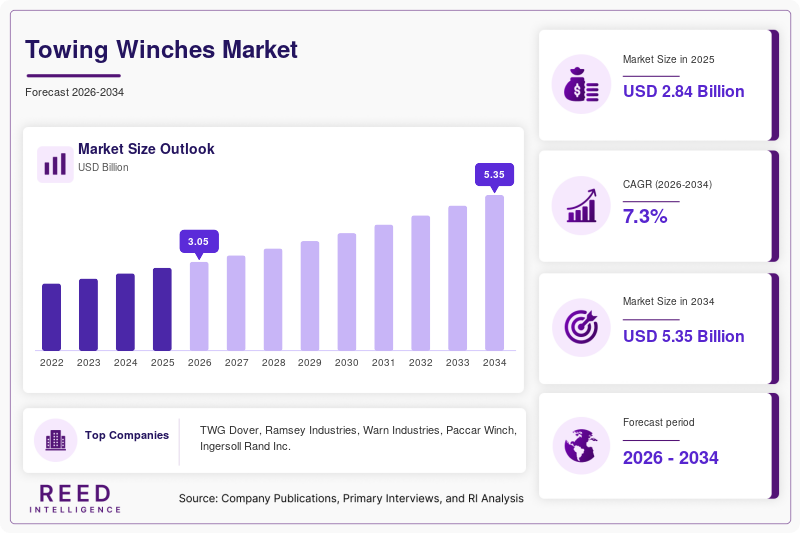
The Towing Winches Market size was valued at USD 2.84 billion in 2026 and is projected to reach USD 4.98 billion by 2034, expanding at a CAGR of 7.3% during the forecast period (2026–2034). One of the major global factors supporting market expansion is the growing investment in transportation infrastructure and heavy-duty logistics operations. Governments and private operators are investing in highway development, mining projects, offshore facilities, and industrial construction activities that require reliable towing and pulling equipment. Towing winches play an essential role in vehicle recovery, cargo handling, vessel maneuvering, and heavy-load positioning, making them indispensable across multiple industries.
Technological developments have also improved product efficiency, safety, and durability. Manufacturers are introducing electronically controlled winches, remote-operated systems, corrosion-resistant materials, and intelligent load-monitoring features to enhance operational performance. Demand for automated and high-capacity towing systems continues to increase as operators seek improved productivity and workplace safety. The expansion of commercial vehicle fleets, maritime transportation activities, and industrial automation projects is expected to create sustained opportunities throughout the forecast period.
Key Highlights
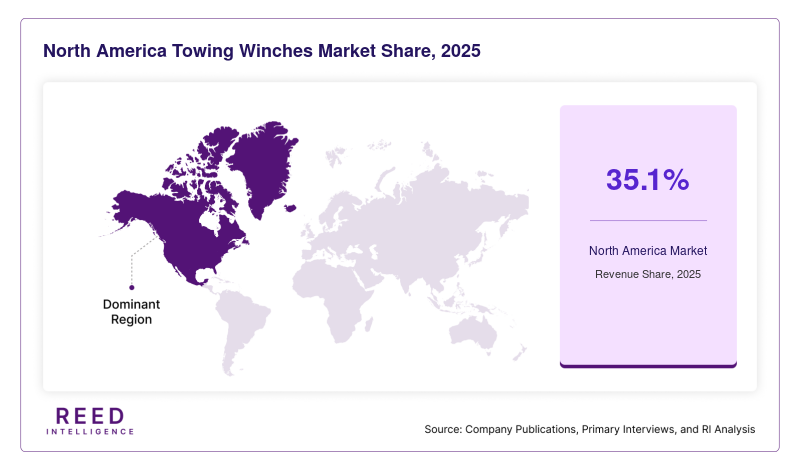
- North America accounted for the largest market share of 35.1% in 2025, while Asia Pacific is projected to register the fastest CAGR of 8.6% during 2026–2034.
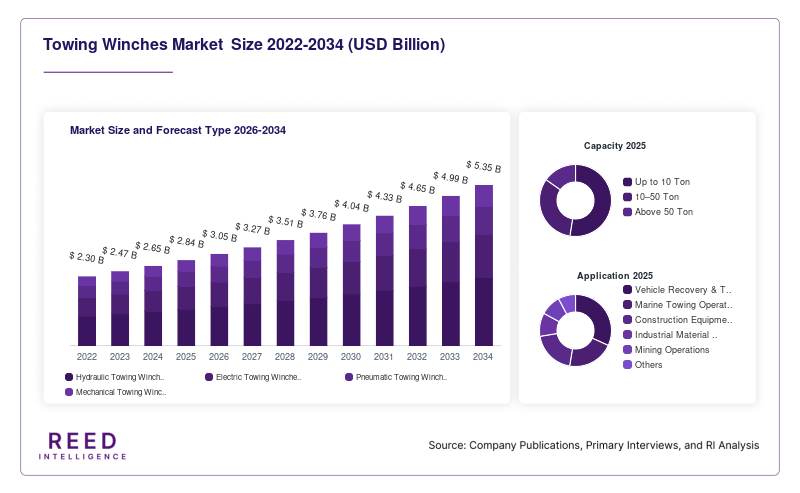
- By Type, Hydraulic Towing Winches held the dominant share of 48.4% in 2025, whereas Electric Towing Winches are expected to grow at a CAGR of 8.9% through 2034.
- By Capacity, 10–50 Ton Winches represented 42.7% market share in 2025, while Above 50 Ton Winches are forecast to expand at 8.4% CAGR.
- By Application, Vehicle Recovery & Towing Services captured 38.9% of the market in 2025, whereas Marine Towing Operations are anticipated to register a CAGR of 8.8%.
- By End User, Transportation & Logistics remained the leading segment with 33.8% share in 2025, while Oil & Gas Operations are forecast to grow at 8.5% CAGR.
- The United States remained the dominant country, with market values of USD 598 million in 2024 and USD 641 million in 2025.
Market Trends
Integration of Smart Monitoring and Remote-Control Technologies
A significant trend shaping the Towing Winches Market is the integration of digital monitoring systems and wireless control technologies. Modern towing winches are increasingly equipped with sensors capable of tracking cable tension, operational load, motor temperature, and maintenance requirements in real time. Remote-control capabilities allow operators to manage towing activities from safer positions while improving operational precision. These developments are helping organizations reduce downtime and improve equipment utilization rates across transportation, construction, and marine sectors.
Growing Adoption of Lightweight High-Strength Materials
Manufacturers are increasingly utilizing advanced alloys, synthetic ropes, and corrosion-resistant materials in towing winch production. Lightweight designs reduce overall equipment weight while maintaining load-bearing performance. These innovations are particularly valuable for mobile recovery vehicles, offshore vessels, and portable industrial systems where weight reduction contributes to fuel efficiency and operational flexibility. The trend is expected to influence future product development across both commercial and industrial applications.
Market Drivers
Expansion of Commercial Vehicle Recovery Infrastructure
The continuous growth of commercial transportation networks has increased demand for efficient vehicle recovery and roadside assistance equipment. Rising freight movement, larger trucking fleets, and increasing highway traffic volumes require advanced towing solutions capable of handling heavy-duty recovery operations. Towing winches provide controlled pulling power and operational reliability, supporting their adoption among towing service providers and fleet operators worldwide.
Increasing Investments in Marine and Offshore Operations
Marine transportation and offshore energy activities continue to require specialized towing equipment for vessel positioning, anchoring assistance, cargo handling, and emergency recovery applications. Growing investments in port modernization projects and offshore infrastructure development are creating sustained demand for high-capacity towing winches capable of operating in demanding environmental conditions. Their reliability and load-control capabilities make them essential components in maritime operations.
Market Restraint
High Installation and Maintenance Costs
Advanced towing winches often involve significant acquisition, installation, and maintenance expenses. High-capacity hydraulic systems require specialized components, routine servicing, and skilled personnel for operation. These cost factors may limit adoption among smaller operators and businesses with constrained capital budgets, particularly in developing regions.
Market Opportunities
Expansion of Renewable Energy Construction Projects
Large-scale renewable energy projects require heavy equipment movement, turbine installation support, and transportation of oversized components. Towing winches are increasingly utilized in wind farm construction and infrastructure development activities. Growing investments in renewable energy facilities are expected to create new demand opportunities throughout the forecast period.
Growing Demand from Mining Operations
Mining companies require heavy-duty winching systems for equipment relocation, material handling, and vehicle recovery in challenging environments. Expansion of mineral extraction projects and modernization of mining operations are expected to increase demand for durable towing winches capable of handling extreme operational conditions while maintaining productivity and safety standards.
Segmental Analysis
By Type
The market is segmented into:
- Hydraulic Towing Winches
- Electric Towing Winches
- Pneumatic Towing Winches
- Mechanical Towing Winches
Hydraulic Towing Winches dominated the market with 48.4% share in 2025. Their widespread utilization was attributed to superior pulling capacity, operational reliability, and suitability for demanding industrial and marine environments. These systems remain preferred for heavy-duty applications requiring continuous performance under high-load conditions.
Electric Towing Winches are expected to witness the fastest growth at a CAGR of 8.9% during the forecast period. Increasing preference for compact equipment, simplified installation, and compatibility with automated control systems will drive adoption. Enhanced energy efficiency and ease of operation will further support segment expansion.
By Capacity
The market is categorized into:
- Up to 10 Ton
- 10–50 Ton
- Above 50 Ton
10–50 Ton Winches accounted for 42.7% market share in 2025 due to their versatility across transportation, industrial, and marine applications. Their balanced load capacity and operational flexibility contributed to broad deployment.
Above 50 Ton Winches are anticipated to record the highest CAGR of 8.4% through 2034. Growing demand from offshore operations, mining projects, and large-scale infrastructure developments will support adoption. Their ability to manage extreme load requirements will continue driving segment growth.
By Application
The market includes:
- Vehicle Recovery & Towing Services
- Marine Towing Operations
- Construction Equipment Handling
- Industrial Material Movement
- Mining Operations
- Others
Vehicle Recovery & Towing Services held the largest share of 38.9% in 2025. Extensive use across roadside assistance providers, fleet operators, and emergency recovery services contributed to segment leadership. Consistent demand for efficient vehicle retrieval solutions supported growth.
Marine Towing Operations are forecast to grow at a CAGR of 8.8% during the assessment period. Expanding maritime trade activities and increasing vessel support requirements will accelerate adoption. Enhanced operational capabilities in offshore environments will contribute to segment expansion.
By End User
The market is segmented into:
- Transportation & Logistics
- Marine & Shipping
- Construction
- Oil & Gas
- Mining
- Industrial Manufacturing
Transportation & Logistics accounted for 33.8% share in 2025 owing to increasing deployment of towing and recovery equipment across freight transportation networks and fleet management operations.
Oil & Gas is anticipated to register a CAGR of 8.5% during the forecast period. Rising requirements for heavy-load handling equipment in drilling sites and energy infrastructure projects will strengthen demand for advanced towing winch systems.
Regional Analysis
North America
North America held 35.1% of the Towing Winches Market share in 2025 and will likely expand at a CAGR of 6.8% during 2026–2034. Demand remained supported by established transportation infrastructure, extensive commercial trucking operations, and widespread deployment of recovery equipment. Industrial maintenance activities and marine transportation operations also contributed to regional growth.
The United States dominated the regional market due to the presence of a large commercial vehicle fleet and strong demand for specialized towing and recovery services. Continuous investment in transportation support infrastructure further strengthened market development.
Europe
Europe accounted for 27.6% market share in 2025 and is projected to grow at a CAGR of 6.7% through 2034. The region benefited from increasing modernization of maritime facilities, industrial equipment upgrades, and infrastructure maintenance activities. Demand for advanced towing systems remained consistent across transportation and industrial sectors.
Germany led the European market owing to its extensive industrial manufacturing base and significant logistics infrastructure. The country's emphasis on operational efficiency and equipment modernization supported continued adoption of advanced towing winches.
Asia Pacific
Asia Pacific represented 24.2% of the global market in 2025 and is forecast to register the fastest CAGR of 8.6% during the forecast period. The region experienced rising demand from expanding logistics networks, infrastructure construction projects, and industrial development programs. Increased investment in transportation connectivity supported market expansion.
China emerged as the dominant country due to large-scale infrastructure construction activities and extensive industrial operations requiring heavy-duty towing equipment. Ongoing expansion of transportation corridors and logistics hubs contributed significantly to regional demand.
Middle East & Africa
The Middle East & Africa captured 7.0% market share in 2025 and is anticipated to expand at a CAGR of 7.1% through 2034. Market growth was supported by ongoing infrastructure projects, industrial diversification initiatives, and maritime logistics activities. Demand remained particularly notable in energy-related operations.
Saudi Arabia maintained regional leadership owing to investments in large-scale industrial development programs and transportation infrastructure projects. Growing demand for specialized heavy-duty equipment supported market growth.
Latin America
Latin America accounted for 6.1% of global market share in 2025 and is expected to grow at a CAGR of 7.0% during the assessment period. The region witnessed increasing utilization of towing equipment in mining, transportation, and industrial operations. Infrastructure improvements also contributed to market expansion.
Brazil remained the dominant market due to ongoing industrial development and expansion of transportation networks. Growth in logistics activities and resource extraction projects supported demand for towing winches across multiple sectors.
Competitive Landscape
The Towing Winches Market remains moderately fragmented, with manufacturers focusing on product reliability, automation technologies, durability enhancements, and capacity expansion. Companies are investing in advanced control systems, corrosion-resistant designs, and remote operation technologies to strengthen their competitive positioning.
TWG Dover remained a leading participant due to its broad portfolio of industrial and marine winching solutions. The company recently introduced an upgraded intelligent towing winch platform featuring enhanced load-monitoring capabilities and predictive maintenance functionality for industrial users.
Ingersoll Rand continues to focus on rugged winching systems designed for industrial and offshore environments.
Ramsey Industries emphasizes high-performance towing and recovery solutions for commercial vehicle applications.
Warn Industries maintains strong market presence through continuous innovation in electric winch technologies for vehicle recovery systems.
Paccar Winch remains active in expanding heavy-duty winch solutions tailored for construction, mining, and industrial operations.
Key Players List
- TWG Dover
- Ramsey Industries
- Warn Industries
- Paccar Winch
- Ingersoll Rand Inc.
- Thern Inc.
- Braden Winch
- Markey Machinery Company
- Trelleborg Marine Systems
- KONGSBERG Maritime
- MacGregor
- Huisman Equipment B.V.
- DMT Marine Equipment
- Rapp Marine Group
- TTS Group
Towing Winches Market Segments
Type
- Hydraulic Towing Winches
- Electric Towing Winches
- Pneumatic Towing Winches
- Mechanical Towing Winches
Capacity
- Up to 10 Ton
- 10–50 Ton
- Above 50 Ton
Application
- Vehicle Recovery & Towing Services
- Marine Towing Operations
- Construction Equipment Handling
- Industrial Material Movement
- Mining Operations
- Others
End User
- Transportation & Logistics
- Marine & Shipping
- Construction
- Oil & Gas
- Mining
- Industrial Manufacturing
By Region
- North America
- Europe
- APAC
- Middle East and Africa
- LATAM