Trace Minerals in Feed Market Size, Share & Demand Report By Mineral Type (Zinc, Iron, Copper, Manganese, Selenium, Chromium), By Source (Organic Trace Minerals, Inorganic Trace Minerals), By Livestock (Poultry, Ruminants, Swine, Aquaculture), By Form (Powder, Granules, Liquid), By Distribution Channel (Direct Sales, Feed Distributors, Online Sales, Veterinary Supply Stores) By Region & Segment Forecasts, 2026–2034
USD 3950
Market Overview
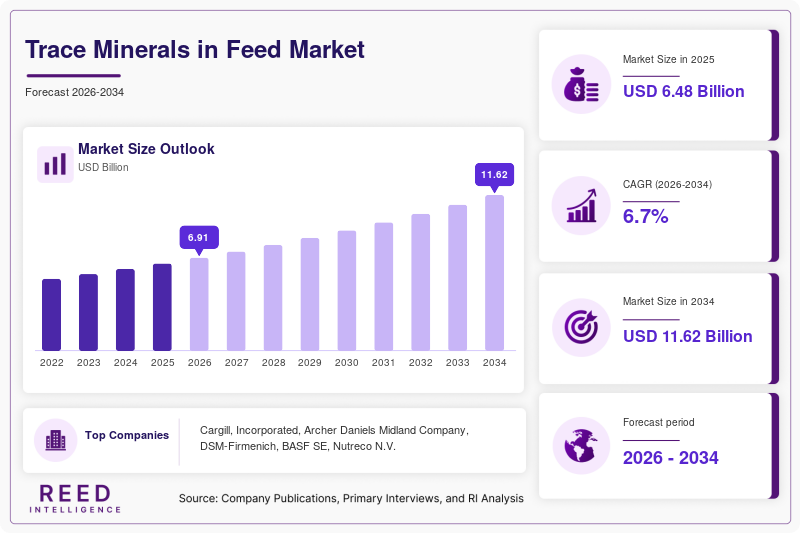
The Trace Minerals in Feed Market was valued at approximately USD 6.48 billion in 2026 and is projected to reach nearly USD 10.92 billion by 2034, expanding at a CAGR of 6.7% during the forecast period from 2026 to 2034. The global Trace Minerals in Feed Market is witnessing stable growth due to increasing demand for nutritionally balanced animal feed, rising commercial livestock production, and growing awareness regarding animal health management. Trace minerals are essential micronutrients added to animal feed to improve immunity, reproductive performance, feed conversion efficiency, and overall livestock productivity. Increasing emphasis on high-quality meat, dairy, poultry, and aquaculture products is contributing significantly to the expansion of the market.
A major global factor supporting the growth of the Trace Minerals in Feed Market is the rapid increase in industrial livestock farming and commercial feed manufacturing worldwide. Feed producers are increasingly integrating advanced mineral supplementation programs to improve animal performance and reduce disease risks. Growing demand for protein-rich food products, expansion of intensive animal farming systems, and rising investments in precision nutrition technologies are positively influencing the long-term market outlook. In addition, increasing regulatory focus on feed quality and animal nutrition standards is encouraging wider adoption of trace mineral additives across the global feed industry.
Market Trends
Increasing Adoption of Organic Trace Minerals
One of the major trends shaping the Trace Minerals in Feed Market is the increasing adoption of organic trace minerals in livestock nutrition. Feed manufacturers are shifting toward organic mineral formulations due to their improved bioavailability, higher absorption efficiency, and reduced environmental discharge compared to inorganic alternatives. Organic trace minerals are increasingly being used in poultry and dairy feed formulations to improve immunity, reproductive performance, and feed utilization efficiency.
Livestock producers are also focusing on precision nutrition strategies to reduce mineral wastage and improve animal productivity. This trend is encouraging feed additive manufacturers to develop advanced chelated mineral products and amino acid-complexed mineral formulations. Growing awareness regarding sustainable feed practices is expected to strengthen the demand for organic trace mineral products during the forecast period.
Expansion of Precision Livestock Farming Technologies
Another important trend in the Trace Minerals in Feed Market is the growing integration of precision livestock farming technologies with animal nutrition management systems. Livestock operators are increasingly using digital monitoring platforms, smart feeding systems, and real-time animal health tracking solutions to optimize mineral supplementation strategies.
Advanced feed analytics and nutritional software tools are enabling producers to customize trace mineral inclusion based on animal species, age, growth cycle, and production targets. The integration of data-driven nutrition management is improving feed efficiency and reducing operational costs for commercial livestock farms. This trend is expected to support long-term market growth across industrial farming operations.
Market Drivers
Rising Demand for High-Quality Animal Protein
The increasing consumption of meat, dairy, poultry products, and seafood is a major factor driving the growth of the Trace Minerals in Feed Market. Population growth, urbanization, and changing dietary preferences are increasing the need for efficient livestock production systems capable of delivering high-quality animal protein products.
Trace minerals are essential for maintaining animal metabolism, skeletal development, immune response, and reproductive performance. Livestock producers are increasingly investing in nutritionally balanced feed formulations to improve animal productivity and maintain product quality standards. Growing commercial livestock farming activities are expected to continue supporting market demand during the forecast period.
Growing Focus on Animal Health and Disease Prevention
Another key driver supporting the Trace Minerals in Feed Market is the increasing focus on preventive animal healthcare and disease management. Trace minerals such as zinc, copper, manganese, iron, and selenium play an important role in strengthening immunity and reducing the risk of infections and metabolic disorders in livestock animals.
Feed manufacturers and veterinary nutrition specialists are increasingly recommending mineral-enriched feed products to improve animal resilience and reduce mortality rates. Rising concerns regarding livestock disease outbreaks and productivity losses are encouraging greater adoption of scientifically formulated mineral feed additives across the agriculture industry.
Market Restraint
Fluctuating Raw Material Prices and Supply Chain Challenges
One of the major restraints affecting the Trace Minerals in Feed Market is the volatility in raw material prices and supply chain disruptions associated with mineral extraction and processing activities. Price fluctuations in zinc, copper, selenium, and other essential minerals can increase feed production costs and affect profit margins for feed manufacturers. In addition, transportation challenges and regulatory restrictions related to mining activities may create supply instability in certain regions.
Market Opportunities
Growth of Sustainable Animal Nutrition Solutions
The increasing emphasis on sustainable livestock production presents strong opportunities for the Trace Minerals in Feed Market. Feed producers are focusing on environmentally responsible mineral formulations that improve nutrient utilization while minimizing mineral excretion and environmental contamination.
The adoption of sustainable farming practices and precision feeding technologies is expected to increase demand for high-efficiency organic trace minerals and customized nutritional blends. Companies investing in low-emission feed solutions and environmentally optimized mineral additives are likely to benefit from future market expansion.
Rising Expansion of Aquaculture Feed Industry
The rapid growth of the aquaculture industry is creating additional opportunities for the market. Aquaculture producers are increasingly incorporating trace minerals into fish and shrimp feed formulations to improve growth performance, disease resistance, and feed conversion efficiency.
The growing global demand for seafood products and increasing investments in commercial aquaculture farming are expected to accelerate the adoption of advanced feed additives. Trace mineral manufacturers are increasingly developing species-specific nutritional products tailored for aquatic animals, which is likely to support future industry growth.
Segmental Analysis
By Mineral Type
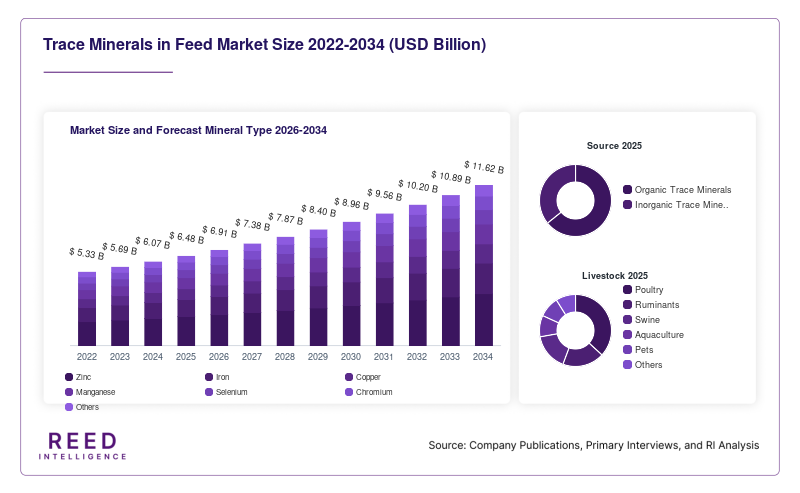
Based on mineral type, the Trace Minerals in Feed Market is segmented into zinc, iron, copper, manganese, selenium, and others. Zinc dominated the market with approximately 29% share in 2025 due to its extensive role in animal immunity, growth performance, enzyme activity, and skin health. Selenium is expected to witness the fastest growth at a CAGR of 7.8% during the forecast period because of increasing awareness regarding its antioxidant properties and role in improving reproductive health and disease resistance in livestock animals.
By Source
By source, the market is segmented into inorganic trace minerals and organic trace minerals. Inorganic trace minerals accounted for the largest market share of 61% in 2025 because of their cost efficiency, broad availability, and widespread use across commercial feed manufacturing operations. Organic trace minerals are projected to grow at a CAGR of 7.6% through 2034 owing to increasing demand for highly bioavailable nutritional additives that improve mineral absorption and reduce environmental waste.
By Livestock
Based on livestock, the market includes poultry, ruminants, swine, aquaculture, and companion animals. Poultry held the dominant share of approximately 38% in 2025 due to increasing global poultry meat consumption and rising adoption of nutritionally fortified feed products in commercial broiler and layer farming operations. Aquaculture is expected to witness a CAGR of 7.9% during the forecast period because of rapid expansion of fish and shrimp farming industries and increasing focus on feed efficiency optimization in aquatic animal production.
By Form
The market is segmented into powder, liquid, and granules. Powder form accounted for approximately 48% share in 2025 due to its ease of mixing, storage efficiency, and compatibility with large-scale feed manufacturing systems. Liquid trace minerals are projected to expand at a CAGR of 7.1% during the forecast period because of their improved dispersion characteristics and growing adoption in precision feeding applications.
Regional Analysis
North America
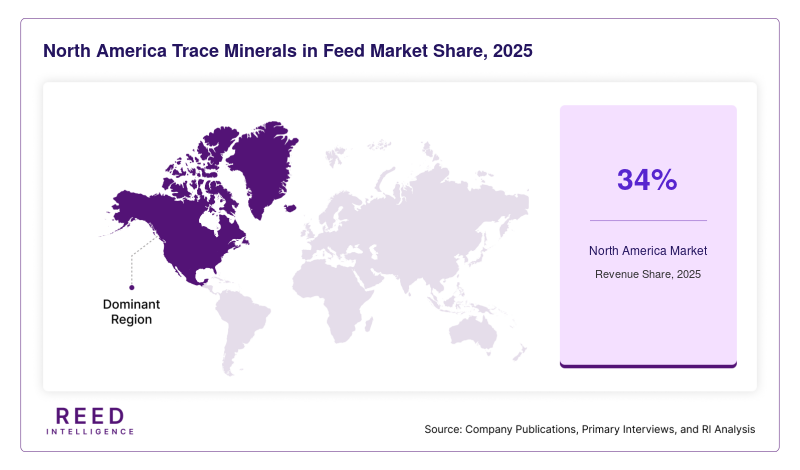
North America accounted for approximately 34% share of the Trace Minerals in Feed Market in 2025 and is projected to grow at a CAGR of 6.1% during the forecast period. The region benefits from advanced livestock farming infrastructure, high feed quality standards, and strong adoption of precision animal nutrition technologies. The United States dominated the regional market due to increasing commercial poultry and cattle farming activities and rising investment in animal health management programs.
Europe
Europe held around 27% market share in 2025 and is expected to expand at a CAGR of 5.9% through 2034. The region is witnessing increasing demand for sustainable feed additives and environmentally optimized livestock nutrition solutions. Germany remained the dominant country market because of strong feed manufacturing capabilities and growing focus on improving livestock productivity through balanced nutritional programs.
Asia Pacific
Asia Pacific represented nearly 24% share in 2025 and is projected to witness the fastest growth at a CAGR of 7.4% during the forecast period. Rising meat consumption, expanding poultry farming, and increasing investments in commercial aquaculture production are supporting strong regional market growth. China remained the leading regional contributor due to its large livestock population and growing feed production industry. Increasing modernization of animal farming operations is further accelerating regional demand for trace mineral feed additives.
Middle East & Africa
The Middle East & Africa accounted for approximately 8% share in 2025 and is expected to grow at a CAGR of 5.7% during the forecast period. Growing investments in dairy farming, poultry production, and food security initiatives are supporting market expansion across the region. Saudi Arabia dominated the regional market because of increasing demand for nutritionally fortified feed products and modernization of commercial livestock farming operations.
Latin America
Latin America held nearly 7% market share in 2025 and is projected to expand at a CAGR of 5.8% through 2034. Brazil remained the dominant country market due to its strong beef and poultry export industry and increasing adoption of feed efficiency improvement strategies. Rising investments in livestock productivity enhancement and commercial feed manufacturing are contributing to regional market growth.
Competitive Landscape
The Trace Minerals in Feed Market is moderately competitive with the presence of global feed additive manufacturers, animal nutrition companies, and specialty mineral suppliers focusing on product innovation, sustainable feed technologies, and strategic partnerships. Market participants are emphasizing research and development activities to improve mineral bioavailability and strengthen their product portfolios.
Cargill Incorporated remained one of the leading participants in the market due to its extensive animal nutrition business and broad feed additive portfolio. The company recently expanded its precision nutrition solutions with advanced organic trace mineral formulations designed to improve feed efficiency and livestock productivity.
Archer Daniels Midland Company continues to strengthen its market position through customized feed ingredient solutions and nutritional technology development. DSM-Firmenich is focusing on sustainable mineral feed additives and precision nutrition strategies, while Alltech Inc. and Nutreco N.V. are expanding their presence through advanced chelated mineral products and species-specific feed formulations.
Key Players List
- Cargill Incorporated
- Archer Daniels Midland Company
- DSM-Firmenich
- Alltech Inc.
- Nutreco N.V.
- BASF SE
- Kemin Industries, Inc.
- Novus International, Inc.
- Zinpro Corporation
- Tanke International Group
- Biochem Zusatzstoffe Handels- und Produktionsgesellschaft mbH
- Balchem Corporation
- Orffa International Holding B.V.
- Phibro Animal Health Corporation
- Adisseo France SAS
Recent Developments
- In 2024, Cargill Incorporated expanded its organic trace mineral feed additive portfolio to support sustainable livestock nutrition and improved feed efficiency.
- In 2024, DSM-Firmenich introduced advanced selenium-enriched nutritional solutions focused on improving animal immunity and reproductive performance.
- In 2025, Nutreco N.V. launched precision mineral nutrition products designed for commercial poultry and aquaculture applications.
- In 2025, Alltech Inc. strengthened its animal nutrition business with advanced chelated mineral technologies for high-performance livestock farming.
- In 2025, Archer Daniels Midland Company expanded its specialty feed ingredient operations with customized trace mineral blends for commercial feed manufacturers.
Trace Minerals in Feed Market Segments
Mineral Type
- Zinc
- Iron
- Copper
- Manganese
- Selenium
- Chromium
- Others
Source
- Organic Trace Minerals
- Inorganic Trace Minerals
Livestock
- Poultry
- Ruminants
- Swine
- Aquaculture
- Pets
- Others
Form
- Powder
- Granules
- Liquid
Distribution Channel
- Direct Sales
- Feed Distributors
- Online Sales
- Veterinary Supply Stores
By Region
- North America
- Europe
- APAC
- Middle East and Africa
- LATAM