Trace Oxygen Analyzer Market Size, Share & Demand Report By Type (Electrochemical, Zirconia, Paramagnetic, Others), By Technology (Inline Analyzers, Portable Analyzers), By Application (Industrial Process Monitoring, Semiconductor Manufacturing, Environmental Monitoring, Others), By End-Use Industry (Oil & Gas, Chemicals, Healthcare & Pharmaceuticals, Energy & Power, Electronics), By Region & Segment Forecasts, 2026–2034
USD 3950
Market Overview
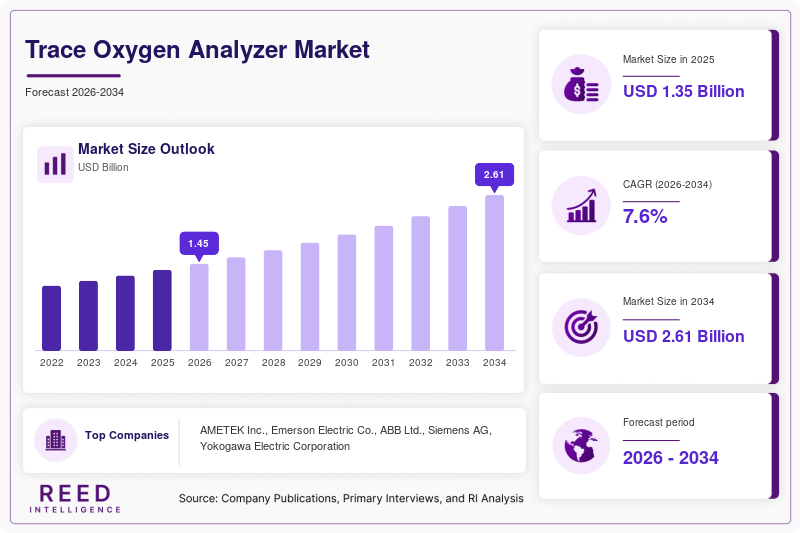
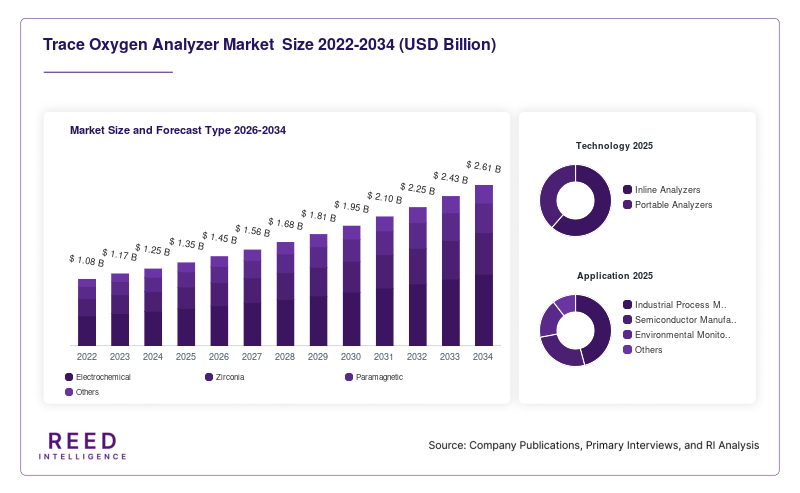
The global Trace Oxygen Analyzer Market was valued at approximately USD 1.35 billion in 2026 and is projected to reach USD 2.42 billion by 2034, expanding at a CAGR of 7.6% during the forecast period (2026–2034). The market growth is primarily supported by increasing demand for ultra-low oxygen detection across industries such as electronics, pharmaceuticals, chemicals, and energy. A key global factor driving the market is the rising emphasis on process optimization and safety in industrial environments, where precise oxygen monitoring plays a critical role in preventing contamination, ensuring product quality, and maintaining regulatory compliance.
Trace oxygen analyzers are widely adopted in applications requiring parts-per-million (ppm) or parts-per-billion (ppb) level oxygen measurement. The integration of digital sensing technologies and automation systems has enhanced their accuracy and reliability, further boosting market adoption. Additionally, increasing investments in clean energy and semiconductor manufacturing are creating sustained demand for high-performance analyzers.
Key Highlights:
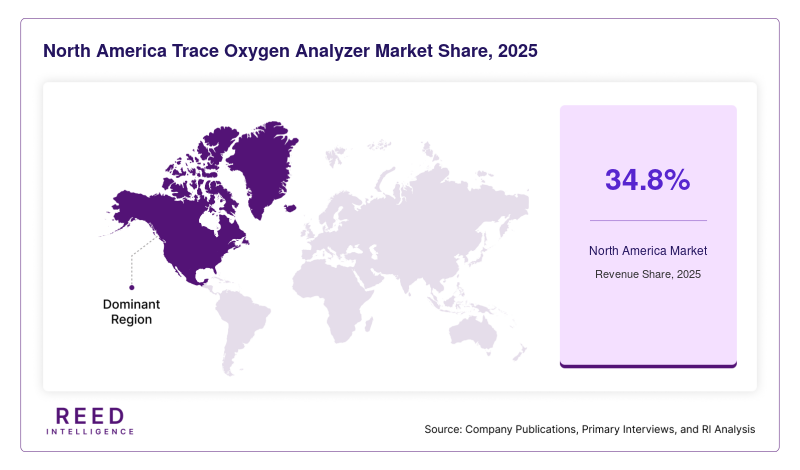
- North America dominated the market with a 34.8% share in 2025, while Asia Pacific is expected to grow at the fastest CAGR of 9.1%.
- Electrochemical analyzers led the type segment with a 41.2% share, while zirconia-based analyzers are projected to grow fastest at a CAGR of 8.8%.
- Industrial process monitoring accounted for the largest application share (38.5%), whereas semiconductor manufacturing is expected to grow fastest at 9.6% CAGR.
- The United States market was valued at USD 410 million in 2024 and USD 438 million in 2025.
Market Trends
Integration of Smart and IoT-Enabled Analyzers
The Trace Oxygen Analyzer Market is experiencing a shift toward smart analyzers integrated with IoT and cloud-based monitoring systems. These advanced systems enable real-time data collection, remote diagnostics, and predictive maintenance, improving operational efficiency. Industries are increasingly adopting digital analyzers that can seamlessly integrate with centralized control systems, allowing better decision-making and reduced downtime. This trend is particularly strong in chemical processing and energy sectors, where continuous monitoring is critical.
Rising Adoption in Clean Energy Applications
The transition toward clean energy sources, including hydrogen production and carbon capture systems, is significantly influencing market trends. Trace oxygen analyzers are essential in hydrogen purity monitoring and ensuring safe operation in fuel cells and electrolysis systems. As governments and private sectors invest in renewable energy infrastructure, demand for high-precision oxygen measurement devices is increasing. This trend is expected to accelerate as hydrogen economies expand globally, creating new growth avenues for market players.
Market Drivers
Stringent Industrial Safety and Quality Regulations
Increasing regulatory standards across industries such as pharmaceuticals, food processing, and petrochemicals are driving the adoption of trace oxygen analyzers. Regulatory bodies mandate strict control over oxygen levels to prevent oxidation, contamination, and hazardous conditions. This has compelled industries to deploy high-accuracy analyzers capable of detecting minute oxygen concentrations. As compliance requirements continue to evolve, the demand for reliable monitoring equipment is expected to rise steadily.
Expansion of Semiconductor and Electronics Manufacturing
The rapid growth of semiconductor manufacturing has significantly contributed to the Trace Oxygen Analyzer Market. Semiconductor fabrication processes require ultra-low oxygen environments to ensure product integrity and yield efficiency. With increasing global demand for electronic devices and chips, manufacturers are expanding production facilities, particularly in Asia Pacific. This expansion is driving the need for advanced oxygen monitoring solutions, thereby supporting market growth.
Market Restraint
High Initial Cost and Maintenance Complexity
One of the primary challenges in the Trace Oxygen Analyzer Market is the high initial investment and maintenance requirements associated with advanced analyzers. High-precision instruments, especially those capable of ppb-level detection, often involve sophisticated components and calibration processes. This increases both capital expenditure and operational costs for end users.
Additionally, maintenance complexity can be a concern, as analyzers require periodic calibration, sensor replacement, and technical expertise for proper functioning. Small and medium-sized enterprises may find it difficult to justify such investments, limiting market penetration in cost-sensitive regions. While technological advancements are gradually reducing costs, the affordability barrier remains a key restraint affecting widespread adoption.
Market Opportunities
Growth in Hydrogen Economy
The emerging hydrogen economy presents a significant opportunity for the Trace Oxygen Analyzer Market. Hydrogen production, storage, and transportation processes require precise oxygen monitoring to ensure safety and efficiency. As governments invest in hydrogen infrastructure and green energy initiatives, demand for trace oxygen analyzers is expected to increase. This creates opportunities for manufacturers to develop specialized analyzers tailored for hydrogen applications.
Increasing Demand in Pharmaceutical Manufacturing
The pharmaceutical industry offers strong growth potential due to its stringent quality control requirements. Oxygen-sensitive drug formulations and packaging processes require precise monitoring to maintain product stability. The growing global demand for pharmaceuticals, coupled with increasing regulatory scrutiny, is expected to drive the adoption of trace oxygen analyzers. Companies focusing on developing compact and highly accurate analyzers for pharmaceutical applications are likely to benefit from this opportunity.
Segmental Analysis
By Type
Electrochemical analyzers dominated the Trace Oxygen Analyzer Market in 2025, accounting for approximately 41.2% of the total share. Their widespread adoption was attributed to cost-effectiveness, ease of use, and suitability for a wide range of applications. These analyzers are commonly used in industrial processes where moderate accuracy is sufficient.
Zirconia-based analyzers are expected to be the fastest-growing subsegment, with a projected CAGR of 8.8%. Their ability to operate at high temperatures and provide rapid response times makes them suitable for demanding applications such as combustion monitoring and energy production. Increasing demand for high-performance analyzers is expected to drive their growth.
By Technology
Inline analyzers held the largest share of 58.6% in 2025 due to their ability to provide continuous real-time monitoring. These systems are widely used in industrial processes where uninterrupted measurement is critical for maintaining efficiency and safety.
Portable analyzers are projected to grow at the fastest CAGR of 9.3%. Their flexibility and ease of deployment make them ideal for field applications and maintenance activities. Increasing demand for on-site analysis and troubleshooting is expected to support their growth.
By Application
Industrial process monitoring dominated the market with a 38.5% share in 2025. The need for maintaining product quality and ensuring operational safety has driven the adoption of trace oxygen analyzers in this segment.
Semiconductor manufacturing is expected to grow at the fastest CAGR of 9.6%. The requirement for ultra-low oxygen environments in fabrication processes is driving demand for highly sensitive analyzers in this segment.
By End-Use Industry
The oil & gas industry accounted for the largest share of 32.4% in 2025. The need for oxygen monitoring in refining and processing operations has supported the widespread use of analyzers in this sector.
The healthcare and pharmaceuticals segment is projected to grow at a CAGR of 8.7%. Increasing demand for quality control and regulatory compliance in drug manufacturing is driving the adoption of trace oxygen analyzers.
Regional Analysis
North America
North America accounted for approximately 34.8% of the Trace Oxygen Analyzer Market share in 2025 and is expected to grow at a CAGR of 6.8% during the forecast period. The region’s established industrial base and early adoption of advanced monitoring technologies contributed to its leading position. Strong demand from oil & gas, healthcare, and electronics industries supported market expansion.
The United States dominated the regional market due to its advanced semiconductor manufacturing sector. The presence of major fabrication facilities and continuous investments in research and development have driven the demand for precise oxygen monitoring systems. Additionally, strict environmental and safety regulations have further encouraged the adoption of trace oxygen analyzers across industries.
Europe
Europe held a 26.5% share of the Trace Oxygen Analyzer Market in 2025 and is projected to grow at a CAGR of 6.9% from 2026 to 2034. The region’s focus on industrial automation and sustainability initiatives contributed to steady growth. Increasing adoption of analyzers in renewable energy and chemical processing sectors supported market demand.
Germany emerged as the dominant country due to its strong manufacturing sector and emphasis on precision engineering. The country’s focus on energy efficiency and environmental compliance has led to increased deployment of oxygen analyzers in industrial applications, particularly in chemical and energy industries.
Asia Pacific
Asia Pacific accounted for 22.7% of the market share in 2025 and is expected to witness the fastest growth at a CAGR of 9.1% during the forecast period. Rapid industrialization, expanding electronics manufacturing, and increasing investments in energy infrastructure are key factors driving regional growth.
China dominated the region due to its large-scale manufacturing base and growing semiconductor industry. Government initiatives to strengthen domestic production capabilities and investments in clean energy projects have significantly boosted demand for trace oxygen analyzers in the country.
Middle East & Africa
The Middle East & Africa region held a 9.3% share in 2025 and is projected to grow at a CAGR of 7.2% from 2026 to 2034. The region’s oil & gas sector played a crucial role in supporting market growth. Increasing investments in refining and petrochemical facilities contributed to the adoption of oxygen analyzers.
Saudi Arabia emerged as the leading country due to its extensive oil & gas operations. The need for precise monitoring in refining processes and safety compliance has driven the demand for trace oxygen analyzers across the country’s industrial sector.
Latin America
Latin America accounted for 6.7% of the Trace Oxygen Analyzer Market share in 2025 and is expected to grow at a CAGR of 6.5% during the forecast period. The region’s growth was supported by expanding industrial activities and increasing focus on process optimization.
Brazil dominated the regional market due to its growing chemical and energy sectors. Investments in industrial modernization and infrastructure development have led to increased adoption of advanced monitoring solutions, including trace oxygen analyzers.
Competitive Landscape
The Trace Oxygen Analyzer Market is moderately fragmented, with several global and regional players competing based on product innovation, accuracy, and reliability. Leading companies are focusing on technological advancements and strategic collaborations to strengthen their market presence.
The market leader, AMETEK Inc., has maintained its position through continuous innovation and expansion of its product portfolio. The company recently introduced advanced digital analyzers with enhanced sensitivity and connectivity features, catering to evolving industry requirements.
Other key players are also investing in research and development to introduce cost-effective and high-performance solutions. Strategic partnerships and acquisitions are common strategies adopted by companies to expand their geographic footprint and customer base.
Key Players List
- AMETEK Inc.
- Emerson Electric Co.
- ABB Ltd.
- Siemens AG
- Yokogawa Electric Corporation
- Honeywell International Inc.
- Servomex Group Limited
- Mettler-Toledo International Inc.
- Teledyne Technologies Incorporated
- Fuji Electric Co., Ltd.
- Nova Analytical Systems
- Process Insights Inc.
- Hach Company
- Analytical Industries Inc.
- GE Measurement & Control Solutions
Recent Developments
- In 2025, AMETEK Inc. launched a next-generation trace oxygen analyzer with enhanced digital integration capabilities.
- In 2024, ABB Ltd. expanded its analyzer portfolio with advanced zirconia-based solutions for energy applications.
- In 2025, Emerson Electric Co. introduced portable oxygen analyzers designed for field diagnostics.
- In 2024, Yokogawa Electric Corporation enhanced its process analyzers with AI-based monitoring features.
- In 2025, Siemens AG invested in research to develop high-precision analyzers for semiconductor applications.
Trace Oxygen Analyzer Market Segments
Type
- Electrochemical
- Zirconia
- Paramagnetic
- Others
Technology
- Inline Analyzers
- Portable Analyzers
Application
- Industrial Process Monitoring
- Semiconductor Manufacturing
- Environmental Monitoring
- Others
End-Use Industry
- Oil & Gas
- Chemicals
- Healthcare & Pharmaceuticals
- Energy & Power
- Electronics
By Region
- North America
- Europe
- APAC
- Middle East and Africa
- LATAM