Track Lighting Market Size, Share & Trends Analysis Report By Product Type (Linear Track Lighting, Flexible Track Lighting), By Application (Retail, Hospitality, Residential), By Light Source, By Track System, By Installation Type, By Distribution Channel and By Region (North America, Europe, APAC, Middle East and Africa, LATAM) Forecasts, 2026-2034
USD 3950
Track Lighting Market Size
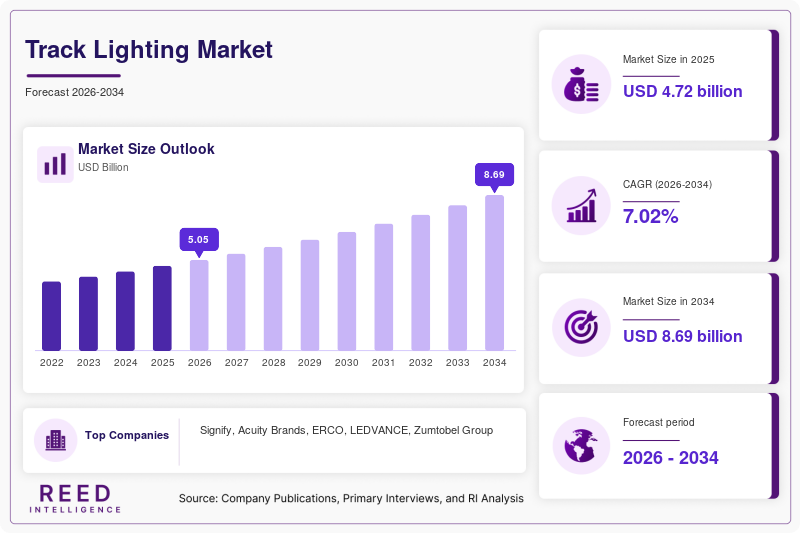
The global track lighting market was valued at USD 4.72 billion in 2025 and is projected to grow from USD 5.05 billion in 2026 to USD 8.69 billion by 2034, registering a CAGR of 7.02% during 2026–2034.
Track lighting is shifting from a relatively simple fixture-and-rail product toward a configurable lighting infrastructure. The strongest demand mechanism is the need to illuminate changing spaces without repeatedly redesigning the ceiling electrical infrastructure. This characteristic is particularly relevant in retail, hospitality, museums and flexible workplaces, where merchandise, layouts, displays and work zones can change over time. ERCO describes repositionability as a central attribute of track lighting and has expanded track systems beyond conventional spotlights into general-purpose downlights and wallwashers.
LED technology has also changed the economics of the category. The U.S. Department of Energy identifies LED lighting as energy-efficient, long-lived and compatible with dimming and automated controls, reducing both operating and maintenance requirements.
Track Lighting Market Drivers
Flexible Retail and Hospitality Layouts Increase Demand for Reconfigurable Lighting
Retail is structurally suited to track lighting because merchandise positioning, promotional displays and store layouts change without necessarily changing the underlying building envelope. Track infrastructure allows luminaires to be repositioned or exchanged rather than requiring a complete ceiling rewiring. ERCO's recent retail projects demonstrate this use of track lighting for changing product presentations, while Zumtobel positions configurable track systems around changing retail concepts and targeted product illumination.
The commercial mechanism is therefore straightforward: a flexible ceiling infrastructure lowers the disruption associated with changing the lighting arrangement. This supports recurring demand for replacement heads, upgraded optics, controls and additional luminaires. Retail and hospitality are consequently expected to remain major demand pools in the internal market model.
The counterbalance is that premium architectural systems can carry higher upfront costs, making simpler fixed luminaires more attractive where layouts remain stable.
LED Efficiency and Controls Shift Purchasing Toward Higher-Value Systems
LED adoption is changing the purchasing decision from simply selecting a lamp to evaluating efficacy, lifetime, controllability, optical performance and maintenance. The U.S. Department of Energy highlights the compatibility of LED luminaires with occupancy sensing, dimming and other control strategies.
The IEA's 2026 lighting analysis also identifies a continuing second wave of LED deployment, with further efficiency improvements available from replacing older installed products with more efficient and smarter systems.
For track lighting, this creates a mechanism beyond energy savings: LED modules can be integrated with dimming, tunable-white functionality, digital controls and application-specific optics. Current ERCO systems incorporate interfaces including DALI, Zigbee and Casambi, while LEDVANCE offers DALI track variants.
The limitation is retrofit friction. Where an existing installation continues to function adequately, customers may postpone replacement until renovation.
Application-Specific Optics Increase the Value of Track Systems
The category is moving toward application-specific light distribution rather than undifferentiated illumination. Track spotlights can use narrow beams for merchandise or artwork, wider distributions for room zones and wallwashers for vertical surfaces. ERCO describes adjustable beam distributions and interchangeable optical approaches for shops, galleries and museums.
Manufacturers are extending this specialization further. LEDVANCE offers dedicated track products for food presentation, including different spectral configurations for products such as vegetables and bread.
This creates commercial value because the lighting system becomes part of the customer's merchandising or architectural strategy rather than merely an electrical fixture. The strongest impact should occur in retail, hospitality and cultural applications where visual presentation influences the customer's environment.
The constraint is that specialized optics and controls increase specification requirements and can make procurement more dependent on lighting designers and professional installers.
Track Lighting Market Restraints
Retrofit Complexity Delays Replacement Decisions
Track lighting can be technically flexible after installation, but replacing an existing lighting infrastructure may still involve electrical work, ceiling access and compatibility considerations. The IEA identifies ceiling access, rewiring and fixture installation as reasons lighting retrofits are often coordinated with broader renovation projects rather than undertaken independently.
This creates a timing constraint: a customer may recognize the energy or design benefits of a new track system but postpone expenditure until a store refurbishment, office redesign or hospitality renovation occurs.
The effect is particularly relevant to mature markets with large installed lighting bases. Manufacturers that offer compatible replacement heads, adapter systems and retrofit-friendly products can reduce this barrier. Acuity Brands' Juno portfolio, for example, includes adapters intended to allow newer fixtures to work with existing track configurations.
Product Compatibility and Specification Complexity Can Increase Project Costs
Track systems are not completely interchangeable. Different electrical configurations, track types, adapters, drivers, controls and fixture formats can influence product selection. Juno identifies multiple track architectures and provides different system configurations for line-voltage and low-voltage applications.
The commercial implication is that customers may require specialist specification before purchasing. This benefits established manufacturers with broad compatible portfolios but can make low-cost products less attractive when system reliability and interoperability are important.
The restraint can be reduced through modular products, standardized control interfaces and adapter-based replacement strategies. However, more sophisticated connected systems can themselves introduce additional commissioning and integration requirements.
Track Lighting Market Opportunities
Smart and Reconfigurable Track Systems Can Expand Beyond Traditional Accent Lighting
The largest opportunity lies in converting track from a passive mounting system into a flexible lighting platform. Modern products can combine spotlights, downlights, pendants, wallwashers and connected controls on the same infrastructure. ERCO explicitly positions track as a system capable of combining general lighting, accent lighting and other lighting functions.
This is commercially relevant in offices, hospitality venues and mixed-use spaces where room configurations change. The opportunity is not simply selling additional luminaires; it is selling a system that can be reconfigured without replacing the underlying infrastructure.
The main adoption barrier is the higher specification and integration requirement compared with conventional standalone fixtures.
Residential Track Lighting Can Benefit From Connected-Lighting Integration
Track lighting is also moving into connected residential environments. Philips Hue's Perifo system combines track rails with spotlights, linear light bars and pendants, while supporting app-based control and adjustable light characteristics.
This expands the addressable use case from purely functional accent lighting to configurable ambient, decorative and task illumination. The commercial opportunity is strongest where consumers value both interior design flexibility and digital control.
However, residential customers remain more price-sensitive than professional lighting buyers. Products therefore need to combine installation simplicity, visual design and smart functionality without creating excessive system complexity.
Segmental Market Share and Growth
By Product Type
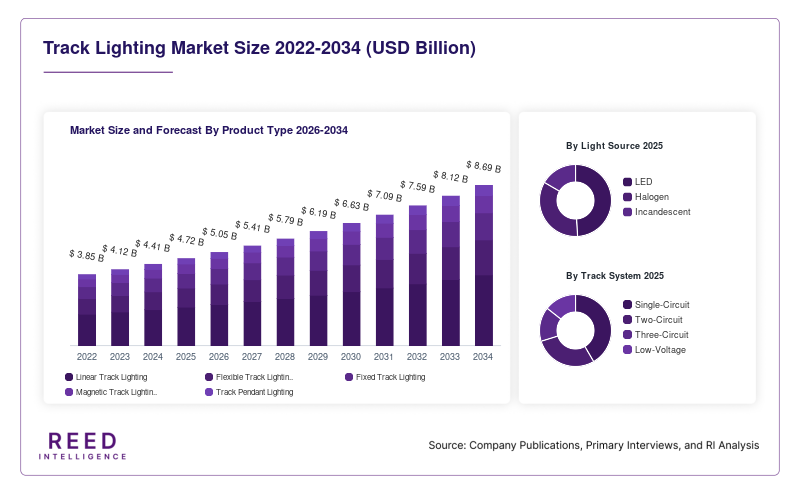
Linear track lighting represents the largest product category in the internal market model, accounting for 47.3% of the global market in 2025, while flexible track lighting holds 32.8% and fixed track lighting accounts for 19.9%. Flexible track lighting is modeled as the faster-expanding category, with its adoption supported by demand for repositionable fixtures and greater design flexibility.
In the internal market model, 3-circuit systems represent the largest track-system category because commercial environments frequently require multiple lighting functions or independently controlled groups of fixtures. Retail and hospitality installations can use separate circuits to create differentiated lighting scenes or operational zones.
Magnetic and low-voltage configurations are the fastest-growing segment in the internal model because they are well suited to compact, design-oriented installations where fixture positioning and visual integration matter.
By Application
Retail represents the largest application, accounting for approximately 36% of the 2025 market in the internal model, as adjustable lighting supports merchandise presentation and frequent store-layout changes. Hospitality accounts for approximately 18%, while residential applications represent 17% and office and commercial applications approximately 16%. Residential track lighting is modeled as the fastest-growing major application because connected lighting, interior-design flexibility and renovation activity broaden its use.
Retail is the largest application in the internal model. The mechanism is not simply the number of stores; it is the frequency with which retailers alter merchandise displays, customer pathways and visual merchandising. Track systems allow the lighting arrangement to follow these changes.
ERCO and Zumtobel both emphasize targeted illumination, flexible configurations and merchandise presentation in retail environments.
Hotels, restaurants and similar venues require lighting that can shift between functional, ambient and decorative roles. Track systems can combine spotlights, downlights and pendants while allowing fixtures to be repositioned.
Residential track lighting increasingly overlaps with smart-home lighting. Philips Hue's Perifo system demonstrates how rails can accommodate spotlights, linear modules and pendants while providing connected control.
By Light Source
LED-based track lighting represents the dominant light-source segment because of its combination of energy efficiency, longer operating life, controllability, and compatibility with modern lighting systems. The segment is expected to continue gaining share as older halogen and incandescent installations are replaced by LED-based systems.
By Track System
Three-circuit track systems represent the largest category in the internal model, accounting for approximately 38% of the 2025 market, supported by their ability to accommodate multiple lighting functions and independently controlled fixture groups. Magnetic and low-voltage systems account for approximately 15% but are modeled as the fastest-growing category, reflecting increasing demand for compact, modular and design-oriented lighting systems.
By Installation Type
Surface-mounted systems represent the largest installation category in the internal model because they can be deployed with comparatively limited ceiling modification, particularly in renovation projects. Suspended systems are positioned as the faster-growing installation format where flexible positioning and architectural appearance are important.
Regional Analysis
Asia-Pacific Track Lighting Market
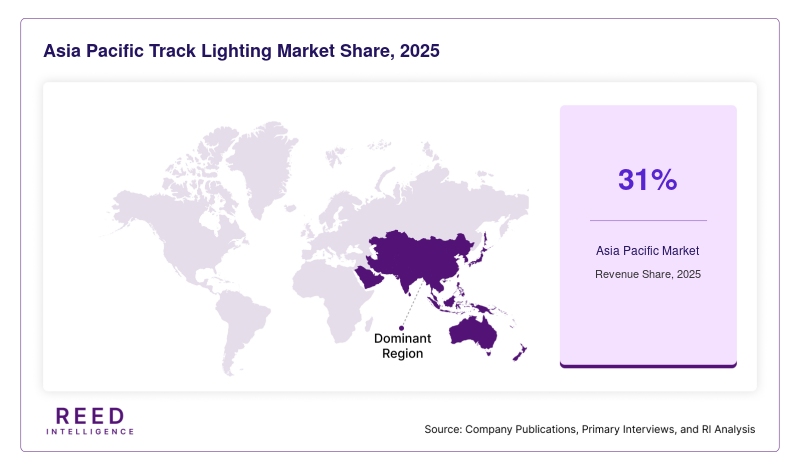
Asia-Pacific represents the largest regional market, accounting for approximately 31% of global revenue in 2025. It is also modeled as the fastest-growing region, with its share increasing to approximately 35.7% by 2034, supported by expanding commercial, residential, retail, and hospitality lighting applications.
The region's future growth is modeled around expansion of modern retail environments, hospitality projects, residential interior lighting and commercial refurbishment. Connected lighting also creates a route to higher-value systems because the track can become a platform for smart control rather than a standalone luminaire.
China, India, Japan, South Korea and Southeast Asian markets represent the key country groups within this analytical allocation. The customer base spans large retailers, commercial developers, hospitality operators, architects, electrical contractors and residential consumers.
North America Track Lighting Market
North America represents approximately 27% of the global Track Lighting Market in 2025, making it the second-largest regional market in the internal allocation. The region is supported by established demand across retail, hospitality, residential, and commercial applications, with future growth increasingly linked to LED replacement, retrofit projects, and smart lighting adoption.
Acuity Brands' Juno portfolio illustrates the depth of the North American track ecosystem, spanning line-voltage, low-voltage, multi-circuit, residential and commercial configurations. The company also provides adapter-based approaches for upgrading existing systems.
The purchasing environment favors products that can integrate with existing infrastructure because compatibility can reduce renovation disruption. LED integration and controls also support replacement demand as customers seek lower operating costs and greater controllability. The U.S. Department of Energy recognizes LED compatibility with dimming and automated control strategies as an efficiency advantage.
Europe Track Lighting Market
Europe accounts for approximately 24% of the global market in 2025, supported by demand for energy-efficient, architecturally integrated, and controllable lighting systems.
The regulatory environment is particularly relevant. The European Commission states that ecodesign requirements apply to lighting products placed on the EU market, while the EU's newer Ecodesign for Sustainable Products Regulation broadens the policy direction toward durability, repairability, resource efficiency and circularity.
This creates a purchasing mechanism favoring products that combine energy performance with longer service life and better resource characteristics. For track lighting, the effect can encourage LED-based systems and designs that permit fixture replacement or upgrading without discarding the complete infrastructure.
Latin America Track Lighting Market
Latin America is assigned a smaller starting share in the internal model but maintains slightly faster growth than the global market. The opportunity is primarily connected to modernization of commercial interiors, retail environments, hospitality projects and higher-quality residential lighting.
Track lighting is particularly relevant where customers need a relatively flexible solution without installing a dense permanent lighting grid. Retailers can reposition luminaires around merchandise, while hospitality operators can use the same infrastructure for different ambient and accent-lighting requirements.
The key commercial mechanism is therefore the combination of flexibility and LED efficiency rather than track lighting as a standalone design trend.
Middle East and Africa Track Lighting Market
The Middle East and Africa represent a smaller share of the global market but contain applications where track lighting's flexibility is particularly useful. Hospitality, luxury retail, cultural facilities, commercial interiors and architectural projects can require precise accent lighting and adjustable layouts.
The demand mechanism is therefore weighted toward project-based specification. High-quality optics, thermal performance, glare management, dimming and design flexibility can be more important than simply minimizing fixture cost.
Competitive Landscape
Competition is moving from basic track hardware toward complete lighting systems. Product differentiation increasingly occurs through LED performance, optics, fixture flexibility, controls, connectivity, application-specific light spectra and compatibility with installed infrastructure.
Signify has a broad professional-lighting position spanning LED products and connected lighting systems. Its 2025 annual report identifies offices, commercial buildings, shops and hospitality among professional customer segments and states that customers continued prioritizing efficiency, digitalization and lifecycle value.
Acuity Brands / Juno competes through breadth of track architectures, fixtures and accessories. Its portfolio covers one- and two-circuit systems, low-voltage products, integral LED products and retrofit adapters, creating a competitive advantage where customers need compatibility across different installations.
Top Companies
- Signify
- Acuity Brands
- ERCO
- LEDVANCE
- Zumtobel Group
- TRILUX
Recent Market Developments
LEDVANCE Expanded Its Track Lighting Portfolio Around Application-Specific Products
LEDVANCE's new Tracklight portfolio combines zoomable spotlights, replaceable reflectors, DALI variants and dedicated food-lighting products. The development matters because it moves competition toward configurable application performance rather than generic LED illumination.
The commercial implication is increased segmentation inside retail lighting: a single track platform can address merchandise, food, accent and general-lighting requirements.
ERCO Added Track Downlights to Extend Track Beyond Accent Lighting
ERCO introduced its Iku downlights for track in 2024, positioning them alongside spotlights to provide both general and accent lighting on the same infrastructure.
This is strategically important because it expands the role of track from a specialist accent-lighting system into a broader ceiling infrastructure. The development also supports office applications where layouts change over time.
ERCO's Recent Retail Projects Demonstrate Flexible Track as a Design Infrastructure
ERCO's Highsnobiety flagship-store project in Berlin used track-based LED lighting to support a retail environment characterized by changing presentations and different spatial requirements.
The significance is less about one individual installation and more about the specification logic: track lighting is being used as part of the architecture and merchandising strategy rather than treated as an interchangeable commodity fixture.
Signify's 2025 Results Highlight the Shift Toward Connected Professional Lighting
Signify reported that professional-lighting customers continued prioritizing efficiency, digitalization and lifecycle value in 2025, even as professional-lighting demand varied across regions.
For track lighting, this reinforces the commercial relevance of connected controls and lifecycle economics. It also indicates that the competitive environment is increasingly influenced by system capabilities rather than luminaire hardware alone.
Track Lighting Market Segments
By Product Type
- Linear Track Lighting
- Flexible Track Lighting
- Fixed Track Lighting
- Magnetic Track Lighting
- Track Pendant Lighting
By Light Source
- LED
- Halogen
- Incandescent
By Track System
- Single-Circuit
- Two-Circuit
- Three-Circuit
- Low-Voltage
By Installation Type
- Surface-Mounted
- Suspended
- Recessed
By Application
- Retail
- Hospitality
- Residential
- Office & Commercial
- Museums & Galleries
By Distribution Channel
- Direct Sales
- Specialty Lighting Stores
- Electrical Distributors
- Online Channels
By Region
- North America
- Europe
- APAC
- Middle East and Africa
- LATAM