Tractor Implements Market Size, Share & Demand Report By Implement Type (Tillage Equipment, Planting and Seeding Equipment, Irrigation and Crop Protection Equipment, Harvesting Support Equipment, Material Handling Implements), By Tractor Power Range (Below 40 HP, 40–100 HP, Above 100 HP), By Application (Land Preparation, Planting and Seeding, Irrigation and Crop Care, Harvesting Support, Transportation and Material Handling), By Region & Segment Forecasts, 2026–2034
USD 3950
Market Overview
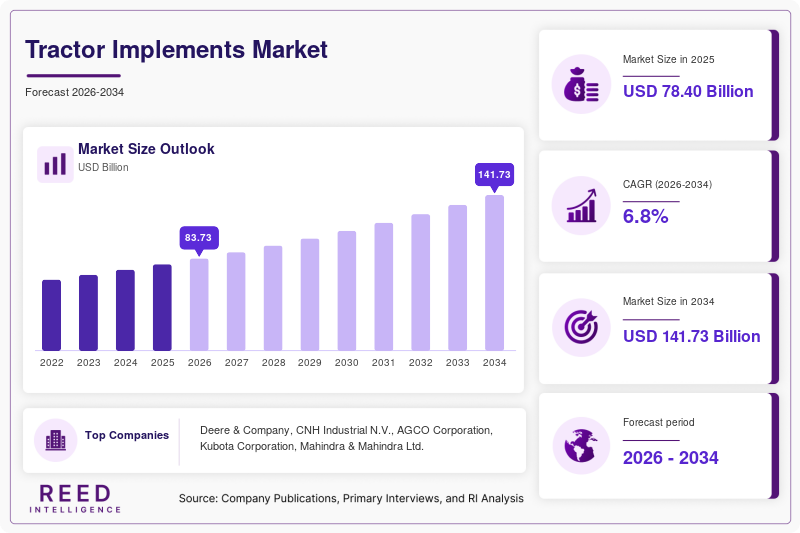
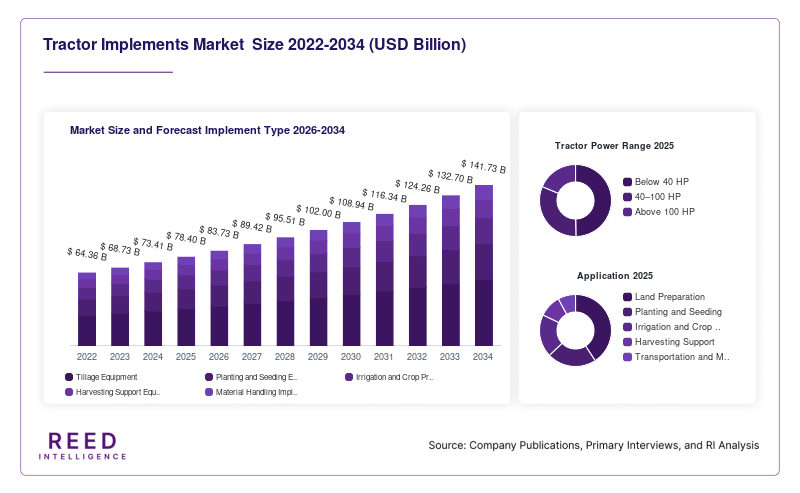
The global Tractor Implements Market size was valued at USD 78.4 billion in 2026 and is projected to reach USD 132.6 billion by 2034, expanding at a CAGR of 6.8% during the forecast period from 2026 to 2034. The market continues to evolve due to increasing mechanization in agriculture, rising labor shortages in farming communities, and the growing demand for precision farming equipment across developed and emerging economies. Tractor implements are essential attachments and tools that improve farming productivity, reduce manual labor, and support efficient land preparation, planting, harvesting, and irrigation activities. The increasing adoption of advanced farming practices has encouraged farmers to invest in technologically enhanced implements that improve yield quality while lowering operational costs.
Government support for agricultural modernization remains one of the major global factors supporting market expansion. Several countries have introduced subsidy programs, tax incentives, and financing schemes that enable farmers to purchase tractors and associated implements. The integration of GPS-enabled systems, smart sensors, and automation technologies into agricultural equipment is also reshaping industry dynamics. In addition, rising food demand due to global population growth has increased pressure on agricultural producers to improve efficiency, thereby strengthening demand for high-performance implements.
Key Highlights
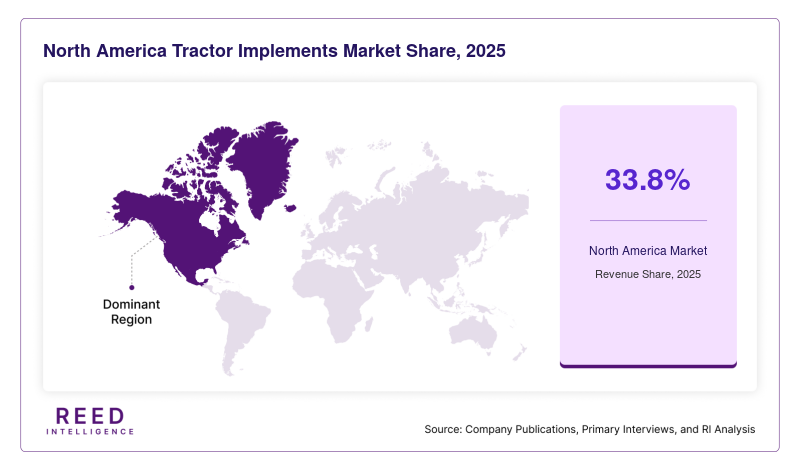
- North America dominated the market with a 33.8% share in 2025, while Asia Pacific is expected to grow at the fastest CAGR of 8.9% during 2026–2034.
- By implement type, tillage equipment accounted for the largest share of 36.4%, while precision planting implements are projected to grow at a CAGR of 9.7%.
- By tractor power range, the 40–100 HP category led with a 44.6% share, whereas above 100 HP tractors are expected to expand at a CAGR of 8.4%.
- By application, land preparation represented the largest share of 39.2%, while harvesting support applications are projected to grow at a CAGR of 9.1%.
- The United States remained the dominant country, with market values of USD 14.8 billion in 2024 and USD 15.9 billion in 2025.
Market Trends
Adoption of Precision Farming Equipment
The adoption of precision farming practices is becoming a defining trend within the Tractor Implements Market. Farmers are increasingly using GPS-guided implements, automated seed drills, variable-rate sprayers, and sensor-based tillage tools to improve productivity and reduce input waste. Precision agriculture enables operators to monitor field conditions more accurately and apply fertilizers, seeds, and pesticides with higher efficiency. This trend is particularly visible in North America and Europe, where commercial farms are integrating digital farming systems with advanced tractor attachments. Manufacturers are responding by developing smart implements capable of collecting field data and communicating with farm management software. The growing need to improve crop yield while controlling operational expenses is expected to sustain demand for precision-oriented tractor implements across both developed and emerging agricultural economies.
Growing Demand for Multi-Functional Implements
Farmers are increasingly preferring multi-functional tractor implements capable of performing several agricultural tasks using a single attachment system. Equipment such as combined tillage and seeding units, integrated harvesting tools, and hybrid spraying systems are gaining traction because they reduce equipment ownership costs and improve operational flexibility. This trend is particularly important for medium-sized farms seeking to maximize productivity with limited capital expenditure. Manufacturers are also introducing modular implements that allow farmers to switch between farming operations quickly. In regions with labor shortages and rising fuel prices, multi-functional equipment helps reduce operational time and fuel consumption. The demand for compact and versatile tractor attachments is expanding rapidly in Asia Pacific and Latin America, where smaller farms are seeking affordable mechanized solutions that improve efficiency without requiring large investments in multiple machines.
Market Drivers
Rising Agricultural Mechanization Across Developing Economies
The rapid growth of agricultural mechanization across developing countries is one of the strongest drivers supporting the Tractor Implements Market. Governments in countries such as India, China, Brazil, and Indonesia are encouraging farmers to adopt mechanized farming practices through subsidies and rural development initiatives. Increasing migration of labor from rural to urban areas has also created labor shortages in farming regions, making mechanized equipment more essential for agricultural productivity. Tractor implements reduce dependence on manual labor while improving operational speed and crop output. Small and medium-sized farmers are increasingly purchasing affordable implements such as cultivators, seed drills, and rotavators to improve land preparation and planting efficiency. The growing availability of low-interest agricultural financing and leasing programs is also making mechanized equipment more accessible to farmers in emerging markets.
Increasing Demand for Higher Crop Productivity
The rising global demand for food production is encouraging farmers to improve crop productivity through advanced agricultural practices. Tractor implements play a critical role in ensuring efficient planting, irrigation, harvesting, and soil preparation operations. With agricultural land availability declining in several regions, farmers are under pressure to maximize yield per hectare. This has increased investment in advanced implements capable of improving precision and reducing resource wastage. Commercial farming enterprises are increasingly adopting high-capacity implements that support large-scale operations and minimize downtime during critical agricultural seasons. In addition, climate variability and changing rainfall patterns have increased the need for efficient land management tools. Manufacturers are introducing technologically enhanced equipment with improved durability, automation, and fuel efficiency to help farmers maintain productivity under changing agricultural conditions.
Market Restraint
High Equipment Costs and Limited Accessibility for Small Farmers
The high initial cost of advanced tractor implements remains a significant restraint affecting overall market expansion. Many small-scale farmers in developing regions continue to face financial limitations that restrict their ability to purchase modern agricultural equipment. Precision-enabled implements equipped with GPS systems, automation technologies, and smart sensors often require substantial investment, making them difficult to afford for farmers with limited income stability. Maintenance costs, spare part expenses, and fuel requirements also increase the total ownership cost of advanced implements.
Limited access to financing and inadequate rural infrastructure further affect equipment adoption in certain low-income agricultural regions. Farmers operating on fragmented land holdings may hesitate to invest in high-capacity implements because the operational benefits may not justify the purchase cost. Seasonal farming income patterns also reduce purchasing flexibility among small agricultural businesses. In some markets, inadequate technical knowledge and limited after-sales service networks create additional operational challenges. As a result, many farmers continue to rely on conventional manual methods or low-cost machinery, slowing the penetration of technologically advanced tractor implements across price-sensitive rural economies.
Market Opportunities
Expansion of Smart Farming Technologies
The expansion of smart farming technologies presents strong growth opportunities for the Tractor Implements Market. The integration of artificial intelligence, automation, telematics, and IoT-enabled systems into agricultural equipment is transforming farm management practices. Smart implements can collect field data, monitor soil conditions, optimize planting depth, and improve fertilizer application accuracy. These capabilities help farmers reduce operational waste and improve crop quality. Agricultural technology providers are increasingly partnering with tractor manufacturers to develop connected farming ecosystems that support real-time monitoring and predictive maintenance.
Demand for data-driven agriculture is rising among commercial farming enterprises seeking to improve operational efficiency and sustainability. Smart farming adoption is expected to accelerate in Asia Pacific and Latin America as governments invest in digital agriculture initiatives. The growing availability of affordable sensors and cloud-based farm management platforms is also making precision technologies more accessible to medium-sized farms. Companies that develop user-friendly and cost-effective smart implements are expected to gain competitive advantages during the forecast period.
Growth Potential in Emerging Agricultural Economies
Emerging agricultural economies offer significant opportunities for manufacturers operating in the Tractor Implements Market. Countries across Africa, Southeast Asia, and parts of Latin America are witnessing increasing investment in agricultural modernization programs aimed at improving food security and rural productivity. Expanding rural populations and rising demand for domestically produced food products are encouraging governments to strengthen agricultural infrastructure and mechanization rates. International development organizations are also supporting farming modernization projects through financial assistance and technology transfer initiatives.
The adoption of compact tractors and low-cost implements is increasing among smallholder farmers seeking efficient alternatives to manual farming methods. Growing awareness regarding the long-term economic benefits of mechanization is encouraging farmers to invest in equipment that improves operational efficiency and reduces labor dependency. In addition, regional manufacturers are introducing affordable implements specifically designed for local crop patterns and field conditions. This localization strategy is expected to support stronger market penetration in underserved agricultural regions during the forecast period.
Segmental Analysis
By Implement Type
Tillage equipment accounted for the largest share of the Tractor Implements Market in 2024, representing 36.4% of total revenue. This segment includes plows, cultivators, harrows, and rotavators widely used for soil preparation and land management activities. Tillage implements remain essential for improving soil aeration, moisture retention, and crop productivity across various farming environments. The growing adoption of mechanized land preparation practices among commercial and medium-sized farms continues to support strong demand for tillage equipment. Farmers are increasingly investing in durable and fuel-efficient implements capable of operating under different soil conditions. Manufacturers are also introducing lightweight tillage systems that reduce tractor fuel consumption and improve operational efficiency. The rising focus on improving planting accuracy and reducing labor dependency further contributes to segment dominance across both developed and emerging agricultural markets.
Precision planting implements are projected to register the fastest CAGR of 9.7% during the forecast period due to increasing adoption of data-driven farming practices. These implements include automated seed drills, precision seeders, and smart planting systems designed to improve planting accuracy and crop spacing efficiency. Farmers are increasingly recognizing the benefits of precision planting technologies in reducing seed wastage and improving yield quality. The integration of GPS guidance systems and variable-rate technology is enhancing operational performance across large-scale farming operations. Demand for precision planting equipment is particularly strong in North America, Europe, and parts of Asia Pacific where advanced agricultural technologies are gaining widespread acceptance. Government support for precision agriculture adoption and rising awareness regarding sustainable farming methods are expected to strengthen growth opportunities for this segment over the coming years.
By Tractor Power Range
The 40–100 HP tractor category dominated the Tractor Implements Market in 2024 with a revenue share of 44.6%. Implements designed for this tractor range are widely used across medium-sized farms because they offer a balance between operational efficiency and affordability. Equipment within this category supports multiple farming activities including tillage, planting, spraying, and transportation. The popularity of medium-power tractors is particularly high in Asia Pacific and Latin America where mixed farming operations require versatile agricultural equipment. Farmers prefer implements compatible with 40–100 HP tractors because they provide sufficient power for diverse field conditions without significantly increasing fuel costs. Manufacturers are also expanding their product portfolios with modular implements tailored for medium-power tractors to address growing demand from small and medium-sized agricultural businesses.
Implements designed for above 100 HP tractors are expected to expand at a CAGR of 8.4% during the forecast period due to increasing demand from large-scale commercial farming operations. High-capacity tractors support advanced implements capable of handling extensive agricultural land areas with greater operational speed and productivity. Commercial farms in North America, Europe, and Brazil are increasingly investing in high-horsepower equipment to improve harvesting and planting efficiency while minimizing labor dependency. Technological advancements in engine performance, automation, and telematics are also supporting demand for large-scale farming equipment. Rising adoption of precision farming practices and the expansion of contract farming services are further contributing to growth in this segment. Manufacturers are focusing on developing heavy-duty implements with enhanced durability and compatibility with autonomous tractor systems.
By Application
Land preparation represented the largest application segment in the Tractor Implements Market in 2024, accounting for 39.2% of total market revenue. This segment includes activities such as plowing, harrowing, leveling, and soil conditioning that are essential for successful crop cultivation. The increasing need to improve soil fertility and optimize planting conditions continues to support strong demand for land preparation equipment across global agricultural markets. Farmers are increasingly using advanced tillage and soil management implements to reduce preparation time and improve crop productivity. Commercial agricultural enterprises are also investing in high-capacity equipment capable of handling extensive farming operations more efficiently. Growing awareness regarding soil conservation practices and sustainable farming methods has encouraged manufacturers to develop implements that minimize soil erosion while maintaining productivity.
Harvesting support applications are projected to record the fastest CAGR of 9.1% during the forecast period due to rising labor shortages and increasing demand for operational efficiency during harvesting seasons. Tractor implements used for harvesting support include balers, trailers, loaders, and crop collection equipment that help reduce crop losses and improve post-harvest handling. Farmers are increasingly investing in mechanized harvesting systems to manage larger cultivation areas within shorter timeframes. The adoption of harvesting support implements is particularly strong in regions with extensive commercial farming activities such as North America and Latin America. Manufacturers are introducing advanced equipment with automation capabilities and improved load management systems to address evolving agricultural requirements. Increasing export-oriented crop production and rising pressure to reduce harvesting delays are expected to further support segment growth.
Regional Analysis
North America
North America accounted for 33.8% of the global Tractor Implements Market in 2025 and continues to maintain a strong position due to advanced farming infrastructure and high agricultural mechanization rates. The regional market is projected to expand at a CAGR of 5.9% during the forecast period. Large-scale commercial farming operations and strong adoption of precision agriculture technologies continue to support equipment demand. Farmers across the region are increasingly investing in technologically integrated implements capable of improving productivity while reducing labor and fuel consumption. The replacement cycle for aging farming equipment is also contributing to stable market expansion.
The United States remains the dominant country within the North American market due to extensive commercial agriculture activities and strong government support for farming modernization. Increasing investments in precision farming technologies and autonomous equipment represent a unique growth factor supporting regional demand. Agricultural producers are adopting smart implements integrated with GPS guidance and data analytics systems to optimize field performance. In addition, rising demand for sustainable farming practices has encouraged farmers to invest in implements that minimize soil disruption and improve resource efficiency.
Europe
Europe represented 25.4% of the global Tractor Implements Market in 2025 and is expected to grow at a CAGR of 5.6% through 2034. The market is supported by strong agricultural equipment manufacturing capabilities and widespread adoption of technologically advanced farming machinery. Countries across Western Europe continue to invest in precision agriculture systems to improve operational efficiency and comply with environmental sustainability standards. The growing focus on reducing fuel consumption and carbon emissions has increased demand for lightweight and energy-efficient implements designed for modern farming applications.
Germany remains the leading country in the European market due to its strong agricultural machinery industry and advanced farming infrastructure. A unique growth factor in the country is the increasing adoption of sustainable farming equipment supported by environmental regulations and green financing programs. Farmers are investing in precision tillage and automated planting systems that reduce chemical usage and improve soil management. European manufacturers are also focusing on exporting advanced implements to neighboring markets, further strengthening regional production capabilities and innovation activities.
Asia Pacific
Asia Pacific held 22.1% of the global Tractor Implements Market in 2025 and is projected to record the fastest CAGR of 8.9% during the forecast period. Rapid agricultural mechanization and increasing government support for rural modernization are major factors driving regional growth. Countries across the region are witnessing rising demand for compact and affordable implements suitable for small and medium-sized farms. Expanding food demand due to population growth is encouraging farmers to improve productivity through mechanized agricultural operations. Manufacturers are also introducing cost-effective equipment specifically designed for regional farming conditions.
China remains the dominant country in the Asia Pacific market due to its large agricultural sector and expanding mechanization initiatives. Increasing investments in smart agriculture technologies represent a unique growth factor supporting equipment demand in the country. Government-backed subsidy programs and digital farming projects are encouraging farmers to adopt advanced implements integrated with automation and monitoring systems. India is also emerging as a strong growth market due to rising rural financing availability and increasing adoption of mechanized farming techniques among smallholder farmers.
Middle East & Africa
The Middle East & Africa region accounted for 9.3% of the global Tractor Implements Market in 2025 and is anticipated to grow at a CAGR of 6.4% during the forecast period. Increasing concerns regarding food security and water-efficient agriculture are supporting demand for mechanized farming equipment across several countries. Governments in the region are investing in agricultural development projects to improve domestic food production capacity and reduce dependence on imports. The adoption of irrigation-related implements and soil management tools is increasing steadily in commercial farming operations.
Saudi Arabia remains the dominant country in the regional market due to ongoing agricultural infrastructure investments and strong government initiatives aimed at improving domestic farming productivity. A unique growth factor supporting market expansion is the increasing adoption of water-efficient agricultural practices in arid farming environments. Farmers are investing in specialized implements that improve irrigation efficiency and support controlled farming operations. South Africa is also witnessing rising demand for harvesting and planting equipment due to the expansion of commercial farming activities.
Latin America
Latin America represented 9.4% of the global Tractor Implements Market in 2025 and is expected to expand at a CAGR of 6.7% through 2034. The regional market is supported by strong agricultural exports and increasing investment in mechanized farming practices. Large-scale cultivation of soybeans, corn, sugarcane, and coffee continues to generate demand for advanced tillage, planting, and harvesting implements. Farmers are increasingly adopting equipment that improves productivity while lowering operational costs. The expansion of agricultural exports has also encouraged producers to modernize farming infrastructure.
Brazil remains the leading country in the Latin American market due to its large agricultural production capacity and strong export-oriented farming sector. A unique growth factor supporting market growth is the increasing adoption of high-capacity implements for large commercial farms. Agricultural businesses are investing in advanced planting and harvesting systems to improve operational speed and reduce crop losses. Government-backed agricultural financing programs and rising investment in precision farming technologies are also contributing to stronger demand for tractor implements across the country.
Competitive Landscape
The Tractor Implements Market is characterized by the presence of several global and regional manufacturers competing through product innovation, strategic partnerships, and expansion into emerging agricultural markets. Companies are focusing on developing fuel-efficient, technologically advanced, and multifunctional implements to strengthen their competitive positions. Increasing investment in smart farming technologies and automation systems has intensified competition among major agricultural equipment manufacturers.
Deere & Company remains one of the leading players in the global market due to its extensive product portfolio, strong dealer network, and continuous investment in precision agriculture technologies. The company recently introduced upgraded smart tillage and planting systems integrated with advanced connectivity features to improve operational efficiency for commercial farmers. Other major companies are also expanding manufacturing facilities and distribution networks to strengthen their market presence in Asia Pacific and Latin America.
Key Players
- Deere & Company
- CNH Industrial N.V.
- AGCO Corporation
- Kubota Corporation
- Mahindra & Mahindra Ltd.
- CLAAS KGaA mbH
- Escorts Kubota Limited
- Yanmar Holdings Co., Ltd.
- SDF Group
- Iseki & Co., Ltd.
- Kuhn Group
- Lemken GmbH & Co. KG
- Maschio Gaspardo S.p.A.
- JCB Agriculture
- Tractors and Farm Equipment Limited
Recent Developments
- Deere & Company launched an upgraded precision planting implement platform in 2025 featuring AI-enabled seed placement monitoring and automated calibration capabilities.
- AGCO Corporation expanded its manufacturing operations in Brazil during 2025 to strengthen production capacity for tillage and harvesting support equipment targeting Latin American markets.
- Kubota Corporation introduced a new range of compact multifunctional tractor implements in 2024 designed specifically for small and medium-sized farms across Asia Pacific.
- Mahindra & Mahindra partnered with a digital agriculture technology provider in 2025 to integrate smart farm connectivity solutions into its advanced implement portfolio.
- CNH Industrial unveiled autonomous-compatible tillage equipment in 2024 to support precision farming operations and reduce labor dependency in commercial agriculture.
Tractor Implements Market Segments
Implement Type
- Tillage Equipment
- Planting and Seeding Equipment
- Irrigation and Crop Protection Equipment
- Harvesting Support Equipment
- Material Handling Implements
Tractor Power Range
- Below 40 HP
- 40–100 HP
- Above 100 HP
Application
- Land Preparation
- Planting and Seeding
- Irrigation and Crop Care
- Harvesting Support
- Transportation and Material Handling
By Region
- North America
- Europe
- APAC
- Middle East and Africa
- LATAM