Trade Promotion Management Software Market Size, Share & Trends Analysis Report By Component (Software, Services), By Deployment (Cloud-Based, On-Premise), By Application (Trade Promotion Planning, Trade Spend Management, Promotion Optimization, Claims & Settlement Management, Analytics & Reporting), By End User (Food & Beverages, Consumer Goods, Personal Care & Cosmetics, Household Products) Forecasts, 2026–2034
USD 3950
Trade Promotion Management Software Market Size
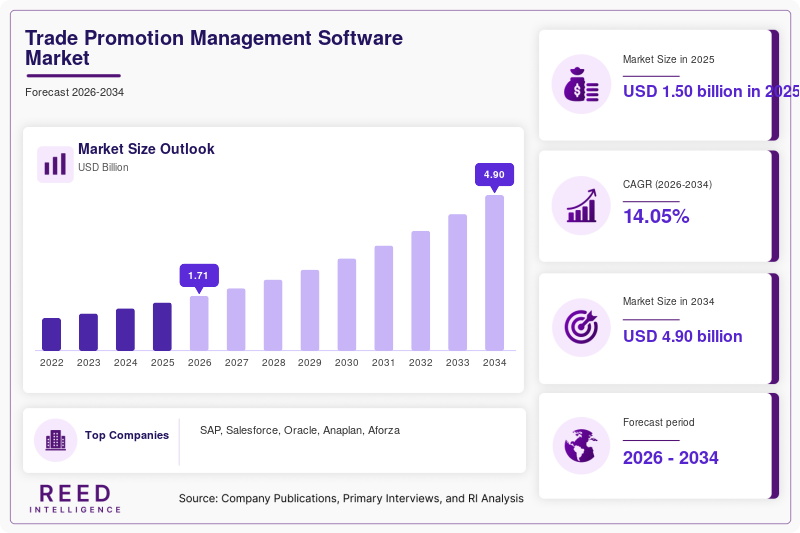
The global Trade Promotion Management Software Market size was valued at USD 1.50 billion in 2025 and is projected to grow from USD 1.71 billion in 2026 to USD 4.90 billion by 2034, registering a CAGR of 14.05% during the forecast period from 2026 to 2034.
Trade Promotion Management (TPM) software is moving from a budgeting and promotion-recording tool toward a broader revenue-growth management platform connecting trade planning, customer business planning, finance, demand, claims, execution, and analytics. The change is being driven by the scale of promotional investment in consumer packaged goods (CPG). Salesforce notes that consumer-goods manufacturers can spend 11%–27% of gross revenue on trade promotions, making promotional efficiency a material profitability issue.
The core commercial problem is fragmented information. Promotion plans may involve retailers, products, pricing, promotional funds, claims, sales forecasts, and actual performance. Salesforce's TPM data model connects promotions, tactics, funds, claims, customers, products, and account-level planning, while SAP links trade-promotion planning with customer business planning, finance, supply-chain processes, and settlement.
Cloud deployment is becoming the primary delivery model because large CPG organizations need centralized data and common workflows across brands, retailers, countries, and sales teams. AI is also becoming a product layer. Salesforce has introduced an AI-enabled Trade Promotion Management Agent, while SAP's 2026 product updates include AI-generated deal sheets, AI-assisted error handling, dynamic funds, and agentic AI assistance.
The market is therefore shifting from promotion administration to continuous trade-investment optimization, with vendors competing on forecasting, scenario planning, claims automation, retailer collaboration, data integration, and AI-assisted decision support.
Trade Promotion Management Software Market Drivers
High Trade-Promotion Spending Creates Demand for Spend Visibility
Trade promotions represent a substantial financial commitment for CPG manufacturers. Salesforce states that manufacturers can spend between 11% and 27% of gross revenue on trade promotions. This creates a direct requirement to understand where promotional funds are allocated, which retailers receive funding, what tactics are used, and whether the resulting sales justify the investment.
TPM platforms address this through promotion calendars, fund management, account-level P&L, claims, performance tracking, and post-event analysis. Salesforce allows users to allocate promotional funds, manage tactics and claims, and compare planned and actual promotion performance. SAP similarly provides budgeting, promotion planning, execution, settlement, and trade-management analytics.
The market mechanism is therefore tied directly to financial control: as promotional budgets become larger and more complex, companies require software that gives commercial and finance teams a common view of trade investment.
Increasing Need to Connect Trade, Demand and Finance Planning
Trade promotions influence demand, inventory, production, retailer orders, revenue, and profitability. Managing these elements separately can create inconsistencies between the promotion calendar and supply or financial plans.
Anaplan's Trade Promotion Management application connects trade, demand, and finance planning and supports real-time scenario modeling. Its consumer-products platform links revenue-growth management, trade promotion, portfolio planning, demand planning, and integrated business planning.
SAP is following a similar direction by connecting trade promotions with Cloud ERP Finance, demand planning, and supply-chain processes. Its July 2026 product update included promotion-level KPIs, dynamic funds, AI-generated deal sheets, and agentic AI assistance.
This integration creates demand for TPM systems that can operate as part of broader enterprise planning rather than as isolated sales applications.
AI Is Moving Into Promotion Planning and Optimization
AI is becoming an increasingly visible differentiator in TPM software. Salesforce's Trade Promotion Management Agent can generate account insights, recommend promotions, and assist with promotion creation and approval.
Aforza's Ava for TPM applies AI to annual trade planning, scenario modeling, in-year optimization, post-event analysis, accrual accuracy, deduction trends, and customer compliance.
SAP's 2026 roadmap similarly includes AI-generated deal sheets, AI-assisted error and change handling, and agentic AI assistance.
The commercial mechanism is a shift from manually reviewing historical promotion data toward systems that can identify exceptions, model scenarios, recommend actions, and automate repetitive workflows. Adoption will depend on data quality, explainability, user controls, and integration with ERP and retailer data.
Trade Promotion Management Software Market Restraints
Complex Data Integration and Implementation
TPM software depends on accurate customer, product, pricing, sales, inventory, finance, and point-of-sale information. Salesforce's TPM architecture includes customer and product master data and can integrate with ERP and POS systems through MuleSoft.
The implementation challenge is therefore broader than installing a standalone application. Organizations may need to standardize product hierarchies, retailer structures, promotional tactics, funds, claims, historical sales, and financial data before analytics can produce consistent results.
This increases implementation time and creates demand for integration services, data migration, workflow configuration, and change management. Smaller CPG companies may find the complexity difficult to justify unless their promotional activity is sufficiently large or frequent.
Difficult Promotion Attribution
Promotional performance is affected by pricing, seasonality, distribution, competitor actions, inventory availability, retailer execution, and changes in baseline demand. As a result, measuring the incremental effect of one promotion is not always straightforward.
Anaplan identifies promotion ROI measurement and attribution as persistent challenges, while its TPM platform uses scenario planning, forecasting, and analytics to improve decision-making.
This creates a product-development challenge for vendors. Software needs to distinguish baseline sales from promotional uplift and account for cannibalization, timing, retailer differences, and supply constraints. Poor attribution can reduce user confidence even when the underlying software has strong workflow capabilities.
Trade Promotion Management Software Market Opportunities
AI-Based Promotion Optimization
AI provides an opportunity to change TPM from a record-management platform into an active decision-support system. Salesforce's Trade Promotion Management Agent can assist with account insights and promotion recommendations, while Aforza's Ava interprets baseline shifts, uplift performance, accrual accuracy, deduction trends, and customer compliance.
The opportunity extends across pre-event and post-event workflows. Before a promotion, AI can compare scenarios and expected outcomes. During execution, it can identify deviations in spending or retailer performance. After the event, it can analyze actual results and feed those findings into subsequent plans.
Vendors that connect these capabilities with financial controls, demand planning, retailer data, and claims management can position TPM as part of a broader revenue-growth platform.
Expansion Across Emerging CPG and Retail Markets
TPM adoption can expand as CPG manufacturers operate across more retailers, channels, and geographic markets. Anaplan describes its platform as globally configurable, while SAP supports customer business planning and trade-management processes across consumer-product organizations.
Emerging markets create particular opportunities where manufacturers are expanding modern retail distribution and need consistent promotion planning across fragmented retailer networks.
Cloud deployment reduces the infrastructure requirement for regional operations and allows central commercial teams to standardize promotion processes while retaining country- or retailer-specific rules.
Segmental Analysis
By Component
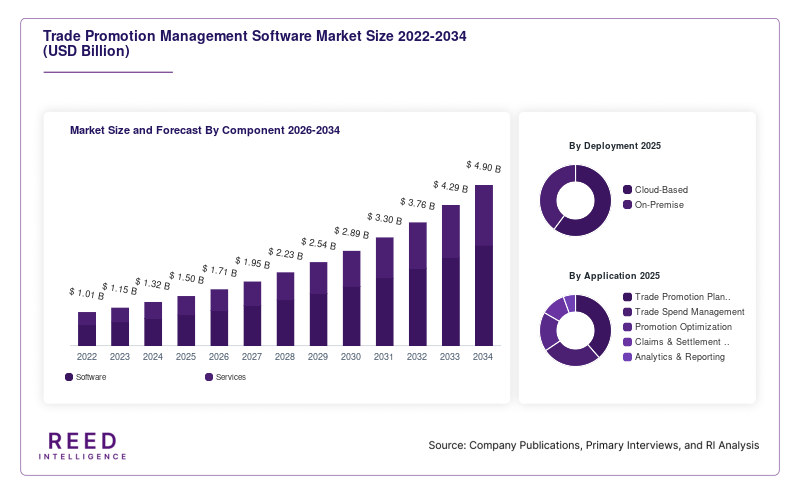
Software held approximately 78% of the global market in 2025, making it the dominant component. TPM software provides the central environment for promotion calendars, funds, budgets, account planning, claims, performance analysis, and workflow management.
Salesforce's TPM architecture covers promotions, tactics, funds, claims, customer and product master data, while SAP provides promotion planning, budgeting, customer business planning, execution, and settlement.
The software segment is projected to grow at approximately 14.6% CAGR through 2034, supported by cloud adoption, AI features, deeper ERP integration, and expansion into broader revenue-growth management.
Services represented approximately 22% of the market in 2025 and are projected to grow at approximately 11.8% CAGR. Services include implementation, integration, configuration, data migration, training, consulting, managed services, and support.
The need for these services is closely connected to the complexity of integrating TPM with ERP, POS, financial, demand-planning, and customer-data systems.
By Deployment
Cloud-based deployment accounted for approximately 82% of the market in 2025, making it the dominant deployment model. Cloud TPM allows CPG organizations to centralize promotional information across brands, markets, retailers, and sales teams.
SAP describes its trade-management platform as a configurable cloud solution, while Salesforce offers TPM as part of its cloud-based Consumer Goods platform.
Cloud-based TPM is projected to grow at approximately 15.0% CAGR, supported by centralized data, faster deployment, AI integration, remote access, and easier integration with other cloud enterprise applications.
On-premise deployment represented approximately 18% of the market in 2025 and is projected to grow at approximately 8.9% CAGR. Large organizations with legacy enterprise architectures may retain on-premise or hybrid environments because of existing ERP integrations, internal security requirements, and long-established data infrastructure.
By Application
Trade Promotion Planning held approximately 31% of the market in 2025, making it the dominant application. Planning functions include promotion calendars, customer plans, budgets, tactics, expected volume, revenue, and promotional costs.
Salesforce describes TPM as covering strategic planning, funds management, account planning, promotion planning, execution, and post-event analysis.
The segment is projected to grow at approximately 12.9% CAGR as companies replace spreadsheets and disconnected planning systems with centralized platforms.
Trade Spend Management represented approximately 24% of the market in 2025 and is projected to grow at approximately 14.0% CAGR. The segment focuses on controlling promotional funds, allocations, commitments, accruals, and actual spending.
SAP specifically provides fund allocation, spend-type configuration, approval workflows, and financial-liability controls within its trade-management solution.
By End User
Food & Beverages held approximately 36% of the market in 2025, making it the dominant end-user segment. The sector runs frequent promotions across supermarkets, convenience stores, wholesalers, foodservice operators, and other retail channels.
The high frequency of promotional activity increases the need for calendars, retailer-specific planning, trade funds, claims, and post-event analysis. Salesforce specifically positions TPM around grocery, mass retail, drug, and other high-promotion environments.
The segment is projected to grow at approximately 13.4% CAGR through 2034.
Consumer Goods accounted for approximately 27% of the market in 2025 and is projected to grow at approximately 14.0% CAGR. The category includes packaged consumer products with multi-retailer distribution and frequent pricing and promotional activity.
Regional Analysis
North America Trade Promotion Management Software Market
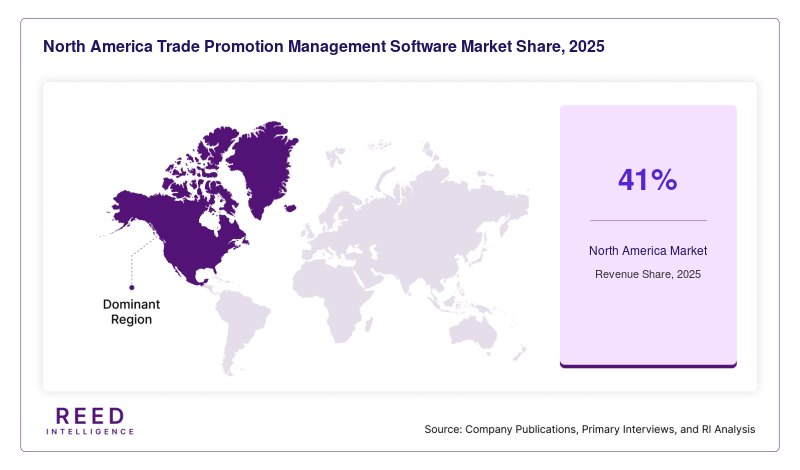
North America held approximately 41% of the global market in 2025, making it the dominant regional market. The region is projected to grow at approximately 13.2% CAGR through 2034.
The region's position is supported by a mature CPG industry, highly developed retail networks, substantial trade-promotion budgets, and widespread enterprise software adoption. Salesforce's TPM offering specifically targets manufacturers managing promotions with mass retailers, grocery chains, drugstores, and other retail partners.
North American CPG organizations also have established demand for integration between trade planning, finance, sales, demand forecasting, ERP, and POS systems. This makes integrated TPM particularly relevant.
AI adoption is strengthening the regional market. Salesforce is incorporating Agentforce into promotion planning, while Anaplan emphasizes AI-driven scenario modeling and connected planning across trade, demand, and finance.
The principal constraints are implementation complexity, integration costs, legacy-system migration, and the need to prove measurable ROI from increasingly sophisticated promotion-optimization tools.
Europe Trade Promotion Management Software Market
Europe represented approximately 29% of the global market in 2025 and is projected to grow at approximately 12.7% CAGR through 2034.
European CPG manufacturers operate across multiple national markets, currencies, retailer structures, languages, and commercial rules. This increases the value of configurable TPM platforms that can centralize promotion planning while supporting local market requirements.
SAP has a strong European enterprise-software presence and positions trade management within broader revenue-growth management and customer business planning. Its platform connects promotion planning with finance and supply-chain processes.
Cloud deployment and connected planning are important growth mechanisms as multinational CPG organizations seek common processes across countries. The key constraint is the complexity of integrating legacy ERP environments and harmonizing customer and product master data across markets.
APAC Trade Promotion Management Software Market
APAC represented approximately 18% of the global market in 2025 and is projected to be the fastest-growing region at approximately 17.0% CAGR through 2034.
The growth mechanism is linked to the expansion of modern retail, organized distribution, digital commerce, multinational CPG operations, and increasingly data-driven commercial planning. Manufacturers operating across multiple countries need systems capable of managing retailer-specific promotions, local price structures, promotional funds, and performance data.
Cloud deployment provides a practical route for organizations expanding across geographically dispersed markets because it reduces dependence on country-level infrastructure and supports centralized governance.
Aforza's expansion of AI-enabled TPM capabilities illustrates the broader move toward connected commercial systems, while Anaplan emphasizes globally configurable trade planning and integration with demand and financial planning.
The region's main constraints are varying retail structures, data quality, localization requirements, uneven enterprise-software maturity, and differences in digital infrastructure between countries.
Middle East and Africa Trade Promotion Management Software Market
Middle East and Africa accounted for approximately 5% of the global market in 2025 and is projected to grow at approximately 12.0% CAGR through 2034.
Demand is developing alongside modern retail expansion, multinational consumer-goods distribution, organized grocery, personal-care products, and digital commerce. As retailers and manufacturers manage larger assortments and more frequent promotions, centralized trade-spend management becomes more relevant.
Cloud-based deployment can reduce infrastructure requirements and allow multinational manufacturers to extend standardized promotion processes into regional operations.
The major constraints are fragmented retail structures, varying digital maturity, limited historical data in some markets, and differences in enterprise-software adoption.
LATAM Trade Promotion Management Software Market
LATAM represented approximately 7% of the global market in 2025 and is projected to grow at approximately 14.2% CAGR through 2034.
Brazil and Mexico provide important CPG and retail ecosystems, while other markets contribute through food, beverage, personal-care, household, and consumer-product distribution.
The commercial requirement is particularly relevant where manufacturers work with multiple retailers and distributors and need visibility into promotional funding, pricing, claims, and account-level performance.
Cloud-based platforms can support regional expansion without requiring each market to maintain extensive local infrastructure. The primary constraints include economic volatility, currency fluctuations, data-quality differences, and varying levels of retailer digitization.
Competitive Landscape
The Trade Promotion Management Software Market is becoming increasingly competitive as enterprise software providers, planning platforms, and specialist CPG technology companies converge around revenue-growth management.
SAP competes through integration between trade promotion management, customer business planning, finance, demand planning, and supply-chain processes. Its 2026 product updates include AI-generated deal sheets, AI-assisted error handling, dynamic funds, promotion-level KPIs, and agentic AI assistance.
Salesforce combines TPM with its Consumer Goods platform, providing promotion planning, fund management, claims, account P&L, and AI assistance. Its Trade Promotion Management Agent is designed to generate insights and assist with promotion recommendations and approvals.
Key Market Players
- SAP
- Salesforce
- Oracle
- Anaplan
- Aforza
- UpClear
- Vistex
- Visualfabriq
- CPGvision
- TELUS Consumer Goods
- Infor
- Comarch
Recent Market Developments
- 2026 – Salesforce's current TPM platform includes an AI-powered Trade Promotion Management Agent designed to generate account insights, recommend promotions, and assist with creating and sending promotions for approval.
- This development shifts competition toward AI-assisted commercial workflows and makes the TPM interface increasingly focused on recommendations rather than manual navigation.
- March 2026 – Aforza's Spring '26 release added enhancements across Trade Promotion Management, Retail Execution, Distributor Management, and its Ava Vertical AI. The company highlighted capabilities designed to reduce manual work and support decision-making across trade-planning workflows. The release strengthens the connection between trade planning and downstream retail execution, reducing the separation between what is planned centrally and what occurs in stores.
Trade Promotion Management Software Market Segments
By Component
- Software
- Services
By Deployment
- Cloud-Based
- On-Premise
By Application
- Trade Promotion Planning
- Trade Spend Management
- Promotion Optimization
- Claims & Settlement Management
- Analytics & Reporting
By End User
- Food & Beverages
- Consumer Goods
- Personal Care & Cosmetics
- Household Products
- Other Consumer Products
By Region
- North America
- Europe
- APAC
- Middle East and Africa
- LATAM