Traditional Chinese Medicine Market Size, Share & Trends Analysis Report By Product & Service Type (Chinese Patent Medicines, Herbal Medicines & Decoction Pieces, TCM Clinical Services, Acupuncture & Moxibustion, TCM Health & Wellness Products), By Application (Therapeutic Care, Preventive & Wellness Care, Beauty & Personal Care, Food & Nutraceuticals, Research & Diagnostics), By Distribution Channel (Hospitals & Clinics, TCM Pharmacies & Retail Stores, Online Channels, Wellness Centers, Others)
USD 3950
Traditional Chinese Medicine Market Size
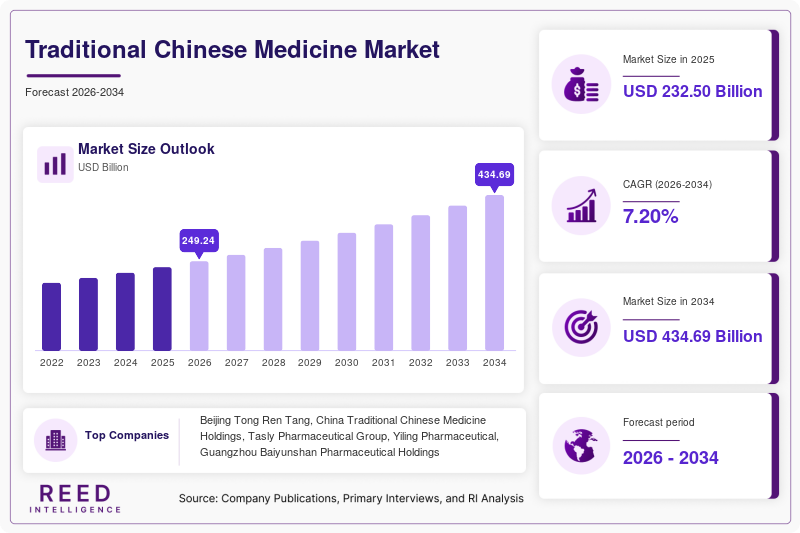
The global traditional chinese medicine market is valued at USD 232.50 Billion in 2025 and USD 249.24 Billion in 2026. The market is projected to reach USD 434.69 Billion by 2034, registering a 7.20% CAGR during the forecast period.
Traditional chinese medicine (TCM) is increasingly developing as a global healthcare, pharmaceutical, wellness and consumer-health ecosystem rather than remaining confined to conventional herbal preparations. The market encompasses Chinese patent medicines, herbal medicines and decoction pieces, acupuncture and moxibustion, clinical TCM services, dietary and wellness products, and related health offerings. The World Health Organization states that traditional medicine is used by billions of people worldwide and has positioned evidence generation, safety, regulation, health-system integration and innovation as central priorities under its Global Traditional Medicine Strategy 2025–2034.
China remains the industry's primary operating base. According to China's National Health Commission and National Administration of Traditional Chinese Medicine, TCM-related medical activity reached 1.82 billion consultations in 2025, while 96.26% of secondary and tertiary public general hospitals had established TCM clinical departments by the end of 2025. China's 2026–2030 TCM revitalization plan also targets a rise in TCM consultations as a proportion of national healthcare activity and calls for stronger research, industrial innovation and international expansion.
Traditional Chinese Medicine Market Drivers
Integration of TCM into formal healthcare systems is expanding its commercial addressable market
TCM is increasingly being incorporated into organized healthcare delivery rather than being confined to standalone traditional-medicine settings. China's 2026–2030 revitalization plan targets higher TCM participation in national and primary-care activity, while WHO's 2025–2034 strategy explicitly supports evidence-based integration of traditional, complementary and integrative medicine into national health systems.
This expands the addressable market across hospitals, community healthcare facilities, specialty clinics and multidisciplinary care. The mechanism also benefits manufacturers because greater institutional integration can increase demand for standardized formulations, reference materials, clinical evidence, practitioner training and regulated products.
As healthcare systems face ageing populations and rising chronic-disease burdens, TCM is being incorporated into broader approaches to prevention, rehabilitation, pain management and chronic-condition care. China's 2026 policy framework explicitly identifies population ageing and increasingly diverse health needs as factors shaping the next phase of TCM development.
Modernization of TCM manufacturing is increasing the commercial value of standardized products
China's March 2025 policy on TCM quality calls for stronger medicinal-resource monitoring, standardized cultivation, traceability, digital and intelligent manufacturing, improved national standards and faster review of innovative TCM products. It also encourages strategic mergers, industrial-chain integration and development of TCM-related health foods and other consumer products.
These measures directly affect the economics of the market. Standardized cultivation reduces variability in raw materials, digital manufacturing improves process control, and traceability strengthens confidence among hospitals, pharmacies, regulators and export partners. The transition also creates opportunities for companies that can convert traditional formulations into scalable, documented and quality-controlled commercial products.
NMPA approvals for Class 1.1 innovative TCM products demonstrate that development is increasingly extending into clinically evaluated, regulated formulations. In June 2025, NMPA approved innovative TCM Qifang Bitong Tablets from Beijing Yiling Pharmaceutical for persistent allergic rhinitis.
International acceptance and cross-border commercialization are broadening TCM demand
International growth is increasingly being pursued through product registrations, strategic distribution, localized packaging and digital commerce rather than through exports alone. WHO's current strategy identifies international cooperation, research, regulation, sustainability and appropriate integration of traditional medicine as major priorities.
At the company level, Laozhongyi, a Sinopharm Hanfang brand, entered a 2026 strategic partnership focused on digitalization and market adaptation for TCM herbal products in Southeast Asia and the Middle East. Guangzhou Baiyunshan has also reported new partnerships in Saudi Arabia, Nepal, Japan, South Korea and Malaysia as part of its overseas expansion program.
The commercial implication is a larger addressable market for standardized herbal medicines, Chinese patent medicines, wellness products and TCM-derived consumer health products, particularly where companies can meet local registration, labeling and evidence requirements.
Traditional Chinese Medicine Market Restraints
Evidence generation and regulatory harmonization remain uneven across markets
WHO's September 2026 research-priority agenda states that traditional, complementary and integrative medicine is used by billions of people but receives less than 1% of global health research funding. The organization identified evidence gaps as a constraint on regulation, safety, service delivery and financing decisions.
The issue is commercially significant because clinical evidence, manufacturing standards and product-registration requirements vary between jurisdictions. A formulation that is recognized as a traditional medicine in one market may require a different regulatory pathway in another market. Companies therefore face additional costs when adapting formulations, documentation, clinical evidence and claims for multiple countries.
Medicinal-resource quality, supply stability and sustainability affect production economics
TCM manufacturing depends on large volumes of plant-based medicinal materials whose quality can be influenced by species authenticity, cultivation conditions, processing, storage and supply-chain practices. China's 2025 TCM-quality policy specifically calls for stronger medicinal-resource databases, standardized cultivation, ecological production, traceability, price monitoring and supply reserves.
This increases the importance of vertically coordinated sourcing and supplier qualification. Producers serving regulated markets must increasingly document raw-material origin and quality while managing price volatility and the availability of medicinal species.
Traditional Chinese Medicine Market Opportunities
AI, digital diagnostics and data-enabled TCM modernization
Digital technology is opening new pathways for TCM product discovery, formulation management, consumer engagement and clinical workflow. China SXT Pharmaceuticals launched a strategic AI initiative in January 2026 to apply AI-driven analytics to TCM portfolio planning and market intelligence and to explore AI-supported clinic deployment.
The opportunity extends to digital patient intake, clinical decision support, formulation databases, personalized wellness plans, inventory forecasting and consumer education. As data infrastructure improves, TCM companies can use digital channels to connect traditional knowledge with modern consumer and healthcare interfaces.
TCM-derived consumer health, beauty and nutraceutical products
China's 2025 industrial policy explicitly encourages "TCM+" development, including health foods and food-medicine-homologous products, while companies are expanding into products that connect TCM ingredients with modern wellness and personal-care formats.
This creates an opportunity beyond conventional medicines. Herbal beverages, functional foods, supplements, topical formulations and beauty products can reach consumers through retail and e-commerce channels without requiring every interaction to occur through a healthcare provider.
Product & Service Type Analysis
Chinese Patent Medicines represent the largest product and service segment
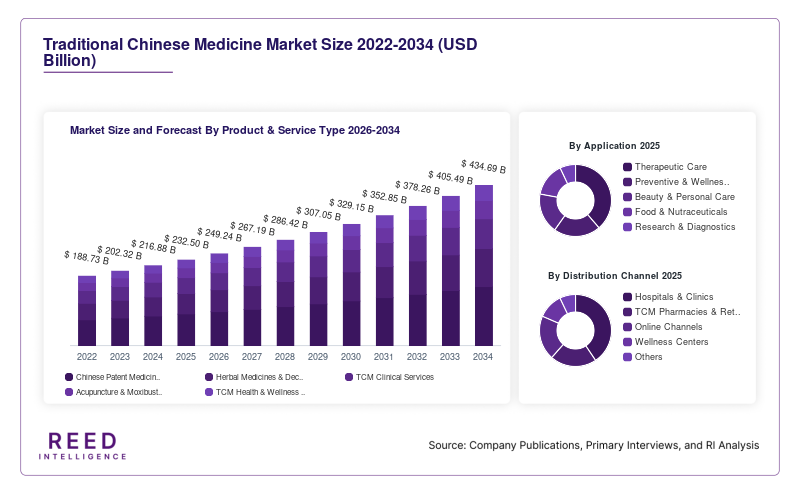
The chinese patent medicines segment accounts for 29% of the 2026 market, equivalent to USD 72.28 Billion, and is projected to reach 30% by 2034, equivalent to USD 127.74 Billion. The segment is projected to grow at a 7.38% CAGR.
Chinese patent medicines account for the largest share because they convert established TCM formulas into standardized finished dosage forms such as tablets, capsules, granules, pills and oral liquids. This format supports consistent manufacturing, packaging, distribution and retail sales.
The regulatory environment is also becoming more favorable to differentiated products. NMPA approved Yiling Pharmaceutical's Class 1.1 innovative TCM Qifang Bitong Tablets in June 2025, demonstrating continued development of modern finished TCM medicines with defined indications and clinical evidence.
Herbal Medicines & Decoction Pieces remain essential to traditional practice and clinical customization
The herbal medicines & decoction pieces segment represents 24% of the 2026 market, equivalent to USD 59.82 Billion, and reaches 22% by 2034, equivalent to USD 93.68 Billion. The segment is projected to grow at a 5.77% CAGR.
Herbal medicines and decoction pieces retain a central role because they preserve the customized formulation model of TCM and support practitioner-specific prescriptions. The segment includes dried medicinal materials, processed pieces and related prepared herbal forms supplied through hospitals, clinics and specialist pharmacies.
Application Analysis
Therapeutic Care represents the largest application
The Therapeutic Care segment represents 43% of the 2026 market, equivalent to USD 107.17 Billion, and reaches 40% by 2034, equivalent to USD 170.32 Billion. The segment is projected to grow at a 5.96% CAGR.
Therapeutic care remains the largest application because TCM is widely used for physician-led treatment, symptom management, rehabilitation and chronic-condition care. China's 2025 national data show that TCM is already integrated at substantial scale across hospitals and primary-care facilities.
Preventive & Wellness Care is the fastest-growing application
The preventive & wellness care segment accounts for 24% of the 2026 market, equivalent to USD 59.82 Billion, and increases to 27% by 2034, equivalent to USD 114.97 Billion. The segment is projected to grow at an 8.51% CAGR, making it the fastest-growing application.
Preventive and wellness care covers health maintenance, constitution-based management, lifestyle support, seasonal wellness, rehabilitation and non-acute health services. WHO's current traditional-medicine strategy recognizes traditional medicine's role in primary healthcare, healthy ageing and people-centred care.
Regional Analysis
APAC Traditional Chinese Medicine Market
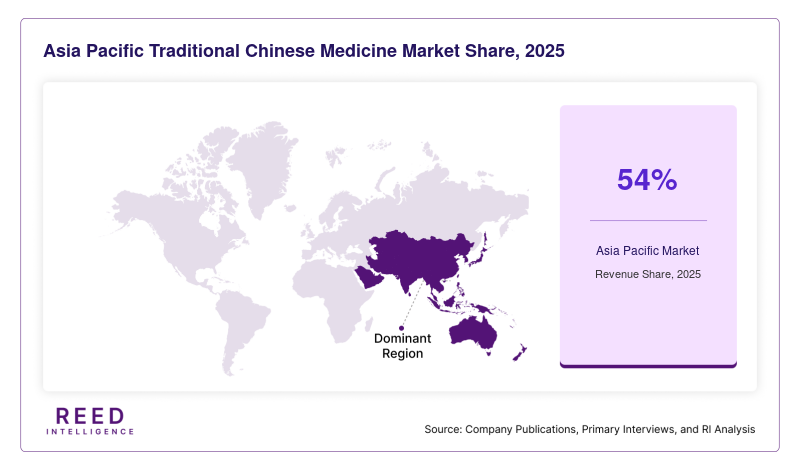
The APAC market represents 54% of the 2026 global market, equivalent to USD 134.59 Billion, and increases to 58% by 2034, equivalent to USD 246.96 Billion. The region is projected to grow at a 7.88% CAGR, the highest regional growth rate.
APAC represents the largest regional market because China remains the central ecosystem for TCM clinical services, manufacturing, research, raw-material cultivation and consumer adoption. China's 2026–2030 national plan sets specific targets for service expansion, research, industrial innovation and internationalization, while 2025 TCM consultations reached 1.82 billion.
North America Traditional Chinese Medicine Market
The north america market represents 16% of the 2026 market, equivalent to USD 39.88 Billion, and reaches 15% by 2034, equivalent to USD 63.87 Billion. The regional market is projected to grow at a 6.06% CAGR.
North America is a major market for acupuncture, herbal products, integrative medicine and TCM-oriented wellness services. The regional market is also influenced by increasing consumer familiarity with complementary health practices and the expansion of digital access to wellness products.
Europe Traditional Chinese Medicine Market
The Europe market accounts for 13% of the 2026 market, equivalent to USD 32.40 Billion, and reaches 11% by 2034, equivalent to USD 46.84 Billion. The market is projected to grow at a 4.71% CAGR.
Europe has a fragmented but established market for herbal products, acupuncture, complementary medicine and integrative healthcare. Market development is strongly influenced by country-specific health regulations, practitioner requirements and rules governing herbal medicinal products.
Middle East and Africa Traditional Chinese Medicine Market
The Middle East and Africa market is supported by demand for natural health products, wellness services and traditional therapies, with the UAE and Saudi Arabia becoming important channels for Asian traditional-medicine companies seeking overseas growth.
Laozhongyi's April 2026 agreement with CUBE specifically targeted expansion of its TCM herbal-product business into Southeast Asia and the Middle East, demonstrating increasing commercial activity in these markets.
LATAM Traditional Chinese Medicine Market
The LATAM market represents 11% of the 2026 market, equivalent to USD 27.42 Billion, and reaches 10% by 2034, equivalent to USD 42.58 Billion. The regional market is projected to grow at a 5.66% CAGR.
LATAM is developing through growing interest in botanical medicines, natural health products, complementary therapies and imported Asian wellness brands. The region also offers opportunities for TCM companies to develop partnerships with local distributors and healthcare providers.
Competitive Landscape
The Traditional Chinese Medicine market is highly fragmented across large pharmaceutical groups, heritage TCM companies, specialist herbal manufacturers, hospital-linked suppliers, clinic networks and consumer-health brands. Competitive differentiation increasingly depends on product standardization, clinical evidence, raw-material security, brand heritage, regulatory approvals, physician relationships, digital distribution and international registrations.
Tong Ren Tang maintains one of the strongest heritage-oriented TCM platforms, with finished Chinese medicines, overseas registrations and international distribution. In 2026, its subsidiaries obtained regulatory approvals for products in Macau and Hong Kong, demonstrating continued expansion of its geographically regulated product portfolio.
China Traditional Chinese Medicine Holdings operates across TCM manufacturing and related healthcare activities and continues to invest in research, production quality and the broader TCM industrial chain. Its 2025 annual-report disclosures show continued emphasis on TCM R&D, differentiated product development and industrial-chain construction.
Key Market Players
- Beijing Tong Ren Tang
- China Traditional Chinese Medicine Holdings
- Tasly Pharmaceutical Group
- Yiling Pharmaceutical
- Guangzhou Baiyunshan Pharmaceutical Holdings
- China Resources Sanjiu Medical & Pharmaceutical
- Jiangsu Kanion Pharmaceutical
- Guangzhou Pharmaceutical Holdings
- Tianjin Tasly
- China SXT Pharmaceuticals
- Shanghai Green Valley Pharmaceuticals
- Beijing Dongfang Yunjia Pharmaceutical
- Kingworld Medicines Group
- VEGAPHARMA / Specialist TCM Manufacturers
- Sinopharm Hanfang
Recent Developments
August 2026 – Tong Ren Tang Technologies expanded its regulated TCM product portfolio through new proprietary-medicine registrations in Hong Kong and Macau. In May 2026, its Hong Kong subsidiary received a registration certificate for Antelope Horn Powder Capsules, allowing the product to be sold in Hong Kong after approximately HK$1.83 million in cumulative R&D investment. In April 2026, its Macau subsidiary received registration for Jin Chai Shi Hu San, allowing sales in Macau after approximately HK$2 million of R&D investment. These registrations extend Tong Ren Tang's established formulations into additional regulated markets. Source: Tong Ren Tang Technologies / HKEX announcements.
June 2026 – Kingworld Medicines Group signed R&D and distribution MOUs for two Lingnan formula products. The company entered into cooperation with Dongguan City Chinese Medicine Hospital for the R&D, clinical research, regulatory registration and commercialization of Zizhu Leaf Cleansing Solution and Modified Gastrodia Brain-Health Formula. Kingworld is intended to receive exclusive distribution rights across Hong Kong, mainland China and cross-border e-commerce, connecting hospital-developed formulas with retail and digital channels. Source: Kingworld Medicines official announcement, June 2026.
Traditional Chinese Medicine Market Segments
By Product & Service Type
- Chinese Patent Medicines
- Herbal Medicines & Decoction Pieces
- TCM Clinical Services
- Acupuncture & Moxibustion
- TCM Health & Wellness Products
By Application
- Therapeutic Care
- Preventive & Wellness Care
- Beauty & Personal Care
- Food & Nutraceuticals
- Research & Diagnostics
By Distribution Channel
- Hospitals & Clinics
- TCM Pharmacies & Retail Stores
- Online Channels
- Wellness Centers
- Others
By Region
- North America
- Europe
- APAC
- Middle East and Africa
- LATAM