Train Exterior Lighting Market Size, Share & Demand Report By Type (LED Lighting, Halogen Lighting, Xenon Lighting, Smart Adaptive Lighting), By Application (Headlights, Marker Lights, Signal Lights, Emergency Lights), By Train Type (High-Speed Trains, Metro & Light Rail, Freight Trains, Passenger Trains), By Technology (Conventional Lighting, LED Technology, Smart Lighting Systems), By Region & Segment Forecasts, 2026–2034
USD 3950
Market Overview
The Train Exterior Lighting Market was valued at approximately USD 1.85 billion in 2026 and is projected to reach USD 3.42 billion by 2034, expanding at a CAGR of 7.9% during the forecast period (2026–2034). The market growth is primarily driven by increasing investments in railway infrastructure modernization and the expansion of high-speed rail networks globally. Governments and private operators are prioritizing safety, visibility, and energy efficiency, which has accelerated the adoption of advanced lighting technologies in train exteriors.
A key global factor supporting the market is the transition toward energy-efficient lighting systems, particularly LED-based solutions. These technologies offer extended lifespan, reduced maintenance costs, and improved illumination performance compared to conventional lighting systems, making them highly suitable for modern rail applications.
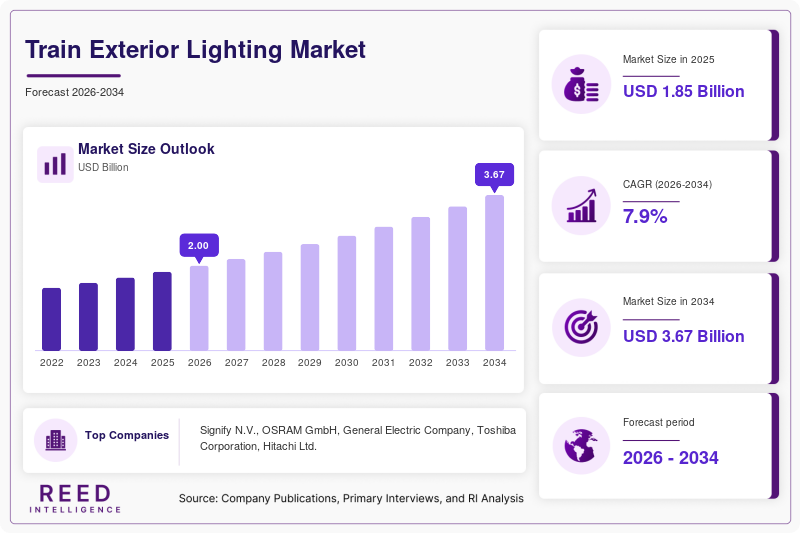
Key Highlights:
- Asia Pacific dominated the market with a share of 38.6% in 2025, while the region is also expected to register the fastest CAGR of 8.6% during the forecast period.
- By type, LED lighting emerged as the leading subsegment with a share of 61.4% in 2025, whereas smart adaptive lighting is anticipated to grow fastest at a CAGR of 9.3%.
- By application, headlights accounted for the largest share of 34.2% in 2025, while signal and marker lights are projected to grow at a CAGR of 8.8%.
- China, the dominant country, recorded market values of USD 420 million in 2024 and USD 455 million in 2025.
Market Trends
Adoption of Smart and Adaptive Lighting Systems
The integration of smart lighting technologies is emerging as a significant trend in the Train Exterior Lighting Market. Advanced systems equipped with sensors and automation capabilities allow real-time adjustment of brightness and beam direction based on environmental conditions such as fog, tunnels, or night operations. This improves operational safety while optimizing energy consumption. Additionally, smart diagnostics enable predictive maintenance, reducing downtime and lifecycle costs. As railway operators focus on digital transformation, adaptive lighting solutions are becoming integral to next-generation rolling stock.
Increasing Preference for Aerodynamic and Integrated Lighting Designs
Manufacturers are shifting toward sleek, integrated lighting systems that align with modern train designs. Exterior lighting is no longer treated as a standalone component but as part of the overall aerodynamic structure of trains. Integrated lighting improves airflow efficiency, reduces drag, and enhances aesthetic appeal, especially in high-speed trains. This trend is further supported by advancements in compact LED modules, which allow seamless embedding into train bodies. As high-speed rail networks expand, the demand for such design-oriented lighting solutions is expected to grow steadily.
Market Drivers
Expansion of High-Speed Rail Networks
The rapid expansion of high-speed rail networks across emerging and developed economies is a key driver of the Train Exterior Lighting Market. High-speed trains require advanced lighting systems for enhanced visibility and safety at elevated speeds. Exterior lighting plays a critical role in signaling, navigation, and hazard detection. As countries invest in next-generation rail infrastructure, the demand for durable and high-performance lighting systems continues to rise.
Increasing Emphasis on Passenger and Operational Safety
Safety remains a primary concern in railway operations, leading to increased adoption of advanced exterior lighting systems. Proper illumination improves visibility for train operators and ensures clear signaling for other rail traffic. Marker lights, headlights, and emergency lighting systems contribute significantly to accident prevention. Regulatory authorities across various regions are implementing stringent safety standards, which further drives the adoption of technologically advanced lighting solutions.
Market Restraint
High Initial Installation and Retrofitting Costs
The high cost associated with the installation and retrofitting of advanced exterior lighting systems poses a significant challenge to market growth. Modern lighting solutions, especially LED and smart systems, require substantial upfront investment in hardware, integration, and system upgrades. For older rolling stock, retrofitting can be complex and expensive, often involving structural modifications and compatibility adjustments. Small and mid-sized railway operators may face budget constraints, limiting their ability to adopt advanced lighting technologies. Additionally, the cost of skilled labor and maintenance further adds to the overall expenditure, making cost optimization a critical concern for stakeholders.
Market Opportunities
Growing Demand for Sustainable Rail Solutions
The increasing focus on sustainability presents a significant opportunity for the Train Exterior Lighting Market. Energy-efficient lighting solutions such as LEDs reduce power consumption and carbon emissions, aligning with global sustainability goals. Railway operators are actively seeking eco-friendly technologies to improve operational efficiency and reduce environmental impact. This trend is expected to drive the adoption of advanced lighting systems across both new and existing rail networks.
Integration with Smart Rail Ecosystems
The emergence of smart rail ecosystems offers new growth avenues for exterior lighting systems. Integration with IoT-enabled platforms allows real-time monitoring and control of lighting systems, enhancing operational efficiency. Smart lighting can be connected to centralized control systems, enabling data-driven decision-making and predictive maintenance. As railways increasingly adopt digital technologies, the demand for connected lighting solutions is expected to rise significantly.
Segmental Analysis
By Type
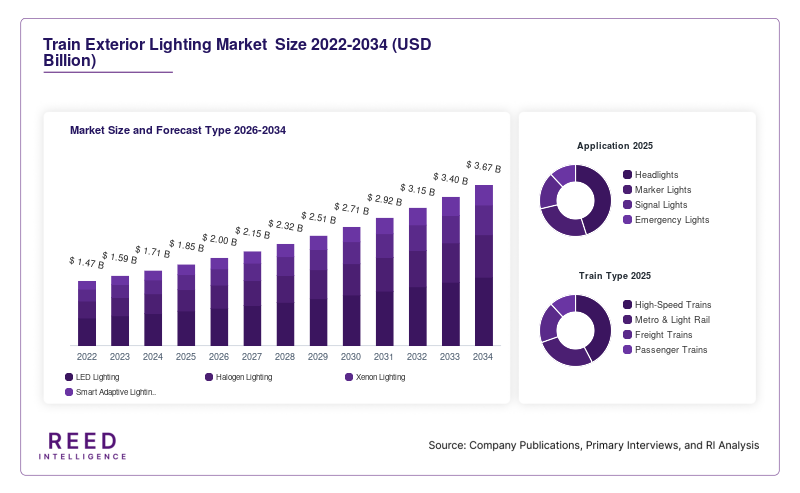
LED lighting dominated the Train Exterior Lighting Market with a share of 61.4% in 2025 due to its energy efficiency, durability, and low maintenance requirements. The widespread adoption of LED technology across railway systems has significantly contributed to its leading position.
Smart adaptive lighting is expected to grow at the fastest CAGR of 9.3% during the forecast period. Its ability to adjust lighting conditions based on environmental factors enhances safety and operational efficiency.
By Application
Headlights accounted for the largest share of 34.2% in 2025, driven by their critical role in ensuring visibility and safety during train operations. High-performance headlights are essential for both passenger and freight trains.
Signal and marker lights are projected to grow at a CAGR of 8.8%, supported by increasing emphasis on safety and communication within rail networks.
By Train Type
High-speed trains held the dominant share of 42.5% in 2025 due to the increasing deployment of advanced lighting systems in these trains. Their operational requirements demand high-performance and reliable lighting solutions.
Metro and light rail systems are expected to grow at a CAGR of 8.5%, driven by urbanization and the expansion of public transit networks.
By Technology
Conventional lighting systems accounted for a significant share in 2025 due to their presence in older train fleets. However, they are gradually being replaced by advanced solutions.
LED-based technology is projected to grow at the fastest rate, with a CAGR of 8.9%, owing to its efficiency and long operational life.
Regional Analysis
North America
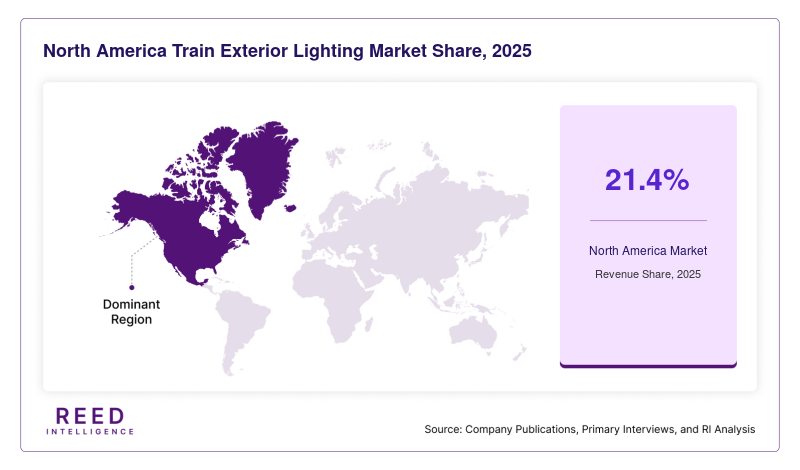
North America accounted for 21.4% of the Train Exterior Lighting Market share in 2025 and is expected to grow at a CAGR of 6.8% during the forecast period. The region’s growth is supported by ongoing upgrades to aging railway infrastructure and the adoption of advanced technologies in freight and passenger trains.
The United States dominated the regional market due to its extensive freight rail network. Increased investments in safety enhancements and modernization programs have driven the demand for advanced exterior lighting systems.
Europe
Europe held a 24.7% market share in 2025 and is projected to expand at a CAGR of 7.2% from 2026 to 2034. The region’s focus on high-speed rail development and stringent safety regulations contributes to steady market growth.
Germany emerged as the leading country, driven by its advanced railway infrastructure and emphasis on technological innovation. The adoption of energy-efficient lighting systems is a key factor supporting growth in the region.
Asia Pacific
Asia Pacific dominated the Train Exterior Lighting Market with a 38.6% share in 2025 and is expected to register the fastest CAGR of 8.6% during the forecast period. Rapid urbanization and large-scale investments in railway expansion are key growth factors.
China led the regional market due to its extensive high-speed rail network. Government initiatives aimed at infrastructure development and modernization continue to drive demand for advanced lighting systems.
Middle East & Africa
The Middle East & Africa region accounted for 8.1% of the market share in 2025 and is anticipated to grow at a CAGR of 7.5% during the forecast period. Increasing investments in rail infrastructure and urban transit systems support market growth.
The United Arab Emirates dominated the region, driven by ongoing rail projects and the adoption of modern technologies in transportation systems.
Latin America
Latin America held a 7.2% market share in 2025 and is expected to grow at a CAGR of 6.9% from 2026 to 2034. The region’s growth is supported by gradual improvements in railway infrastructure and increasing demand for efficient transportation systems.
Brazil led the regional market due to its expanding rail network and investments in modernization projects, which have boosted the adoption of advanced exterior lighting systems.
Competitive Landscape
The Train Exterior Lighting Market is moderately fragmented, with several global and regional players competing based on technology innovation and product quality. Leading companies are focusing on developing energy-efficient and smart lighting solutions to strengthen their market position.
A key market leader, Signify N.V., has recently introduced advanced LED-based railway lighting systems with integrated smart control features, enhancing operational efficiency and safety. Other prominent players are investing in research and development to introduce innovative solutions tailored to evolving railway requirements.
Strategic collaborations, product launches, and expansion into emerging markets are common strategies adopted by market participants to gain a competitive edge.
Key Players List
- Signify N.V.
- OSRAM GmbH
- General Electric Company
- Toshiba Corporation
- Hitachi Ltd.
- Koito Manufacturing Co., Ltd.
- Stanley Electric Co., Ltd.
- Wabtec Corporation
- Alstom SA
- Siemens Mobility
- HELLA GmbH & Co. KGaA
- Cree Lighting
- Zumtobel Group
- Dialight plc
- Federal-Mogul LLC
Recent Developments
- 2025: Signify N.V. launched a new range of smart railway lighting systems with enhanced energy efficiency.
- 2024: OSRAM GmbH introduced advanced LED modules designed for high-speed train applications.
- 2025: Siemens Mobility integrated smart lighting solutions into its next-generation train platforms.
- 2024: Wabtec Corporation expanded its product portfolio with innovative exterior lighting systems.
- 2025: Alstom SA collaborated with technology providers to enhance lighting efficiency in modern trains.
Train Exterior Lighting Market Segments
Type
- LED Lighting
- Halogen Lighting
- Xenon Lighting
- Smart Adaptive Lighting
Application
- Headlights
- Marker Lights
- Signal Lights
- Emergency Lights
Train Type
- High-Speed Trains
- Metro & Light Rail
- Freight Trains
- Passenger Trains
Technology
- Conventional Lighting
- LED Technology
- Smart Lighting Systems
By Region
- North America
- Europe
- APAC
- Middle East and Africa
- LATAM