Transcranial Doppler Ultrasound Market Size, Share & Demand Report By Product Type (Standalone Transcranial Doppler Systems, Portable/Handheld Doppler Devices, Integrated Imaging Systems), By Application (Stroke Diagnosis and Monitoring, Traumatic Brain Injury Assessment, Cerebral Blood Flow Monitoring, Emboli Detection), By End-Use (Hospitals, Diagnostic Centers, Ambulatory Surgical Centers, Research Institutes) By Region & Segment Forecasts, 2025–2034
USD 3950
Market Overview
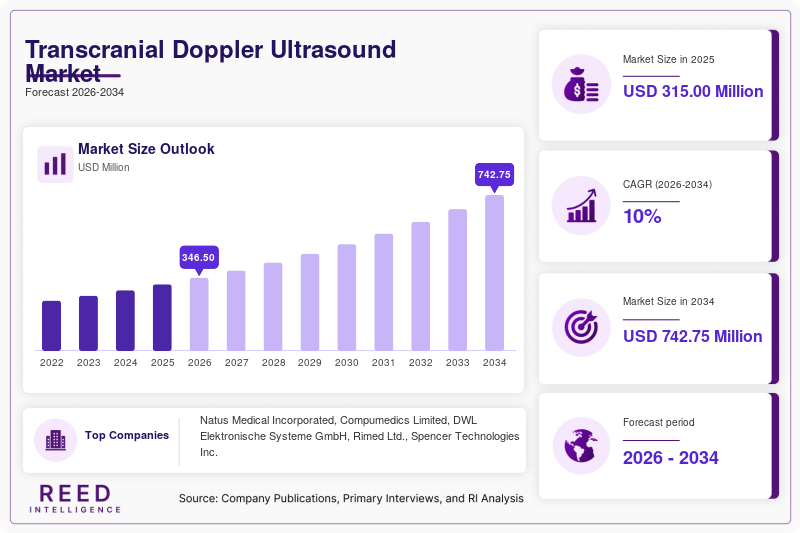
The global Transcranial Doppler Ultrasound Market size was valued at USD 315 million in 2025 and is projected to reach USD 742 million by 2034, expanding at a CAGR of 10.0% during the forecast period (2025–2034). The market is witnessing steady growth due to the increasing prevalence of neurological disorders and the rising demand for non-invasive diagnostic imaging techniques. Transcranial Doppler (TCD) ultrasound is widely used for assessing cerebral blood flow velocity, making it a critical tool in stroke diagnosis, traumatic brain injury monitoring, and neurocritical care.
A key global factor supporting the growth of the Transcranial Doppler Ultrasound Market is the increasing burden of cerebrovascular diseases, particularly stroke, which requires early detection and continuous monitoring. The growing emphasis on preventive healthcare and real-time diagnostic solutions has led to higher adoption of TCD devices in hospitals and specialized neurological centers.
Key Highlights:
- North America dominated the market with a 36% share in 2025, while Asia Pacific is expected to grow at the fastest CAGR of 11.8% during 2025–2034.
- By product type, portable TCD devices held the largest share at 44%, while wearable/headset-based TCD systems are projected to grow at a CAGR of 12.6%.
- By application, stroke diagnosis led the segment, whereas traumatic brain injury monitoring is expected to grow at a CAGR of 11.9%.
- The U.S. market was valued at USD 105 million in 2025 and is estimated to reach USD 115 million in 2026, driven by increasing adoption in neurocritical care units.
Market Trends
Shift Toward Portable and Wearable TCD Devices
The Transcranial Doppler Ultrasound Market is increasingly moving toward compact, portable, and wearable solutions. These devices enable bedside monitoring and continuous assessment of cerebral blood flow, making them highly suitable for intensive care units and emergency settings. Wearable TCD systems, including headset-based designs, allow clinicians to monitor patients without restricting mobility, enhancing patient comfort and operational efficiency.
Integration with AI and Advanced Data Analytics
The integration of artificial intelligence and advanced analytics is transforming TCD diagnostics. Modern devices are equipped with automated signal processing and interpretation capabilities, reducing operator dependency and improving diagnostic accuracy. AI-driven systems can identify abnormal blood flow patterns and provide real-time alerts, supporting faster clinical decision-making. This trend is expected to enhance the value proposition of TCD devices and drive their adoption across healthcare facilities.
Market Drivers
Increasing Incidence of Neurological Disorders
The rising prevalence of neurological conditions such as stroke, cerebral vasospasm, and traumatic brain injuries is a major driver of the Transcranial Doppler Ultrasound Market. These conditions require continuous monitoring of cerebral blood flow, which TCD devices can provide non-invasively. The growing aging population further contributes to the increasing incidence of such disorders, supporting market growth.
Demand for Non-Invasive and Real-Time Diagnostics
Healthcare providers are increasingly adopting non-invasive diagnostic technologies that offer real-time insights. TCD ultrasound meets this requirement by enabling continuous monitoring without the need for invasive procedures. This reduces patient risk and improves clinical outcomes, making it a preferred choice in neurocritical care settings.
Market Restraint
Operator Dependency and Limited Standardization
A significant challenge in the Transcranial Doppler Ultrasound Market is the high level of operator dependency associated with TCD procedures. Accurate measurement and interpretation of cerebral blood flow require specialized training and expertise. Variability in operator skills can lead to inconsistent results, affecting diagnostic reliability.
Additionally, the lack of standardized protocols across healthcare facilities poses a challenge to widespread adoption. Differences in measurement techniques and interpretation criteria can create inconsistencies in clinical outcomes. Limited awareness and training opportunities in certain regions further restrict the effective use of TCD devices. These factors collectively act as barriers to the growth of the market, particularly in developing healthcare systems.
Market Opportunities
Expansion in Emerging Healthcare Markets
Emerging economies present significant growth opportunities for the Transcranial Doppler Ultrasound Market. Increasing healthcare investments, improving infrastructure, and rising awareness of neurological disorders are driving demand for advanced diagnostic technologies. The adoption of cost-effective TCD devices in these regions can significantly expand market reach.
Integration with Telemedicine and Remote Monitoring
The integration of TCD devices with telemedicine platforms offers new growth avenues. Remote monitoring capabilities enable healthcare providers to assess patients’ cerebral blood flow in real time, even in remote locations. This is particularly beneficial for stroke management and post-surgical care, where continuous monitoring is essential. The growing adoption of digital health solutions is expected to drive demand for connected TCD systems.
Segmental Analysis
By Product Type
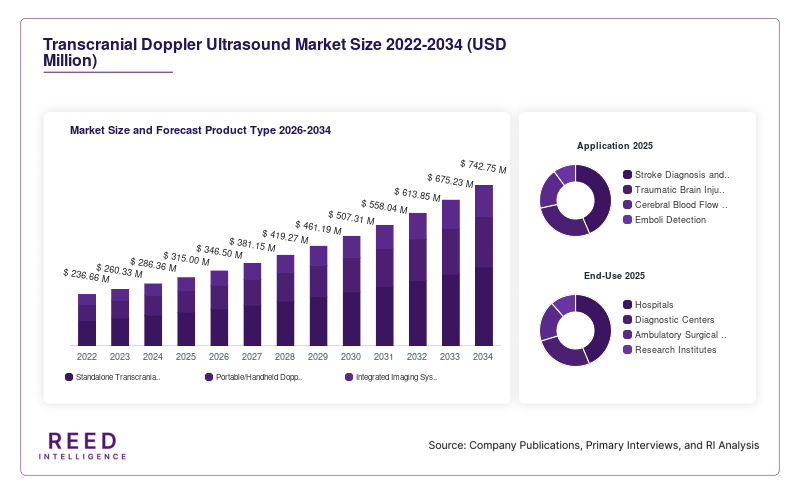
Portable TCD devices dominated the Transcranial Doppler Ultrasound Market in 2025, accounting for 44% of the total share. These devices are widely used due to their convenience, ease of use, and ability to provide real-time monitoring at the bedside. Their portability makes them suitable for emergency and critical care settings.
Wearable/headset-based TCD systems are expected to grow at the fastest CAGR of 12.6% during the forecast period. The growth factor is the increasing demand for continuous monitoring solutions that enhance patient comfort and enable long-term observation.
By Application
Stroke diagnosis held the largest share of 41% in 2025, reflecting the critical role of TCD devices in detecting and monitoring cerebrovascular conditions. Early diagnosis and continuous monitoring are essential for effective stroke management.
Traumatic brain injury monitoring is projected to grow at a CAGR of 11.9%, driven by the increasing incidence of head injuries and the need for real-time monitoring. The growth factor is the ability of TCD devices to provide continuous insights into cerebral blood flow, supporting better clinical outcomes.
By End-Use
Hospitals accounted for the largest share of 49% in 2025, as they are the primary users of TCD devices for diagnostic and monitoring purposes. The availability of skilled professionals and advanced infrastructure supports their adoption in hospital settings.
Specialty clinics are expected to grow at the fastest CAGR of 11.2%, driven by the increasing demand for specialized neurological care. The growth factor is the rising number of clinics focusing on neurodiagnostics and outpatient care.
By Technology
Conventional Doppler systems dominated the market with a 52% share in 2025 due to their established use and reliability in clinical settings.
Digital and AI-integrated systems are expected to grow at a CAGR of 12.8%, supported by advancements in technology. The growth factor is the ability of these systems to enhance diagnostic accuracy and reduce operator dependency.
Regional Analysis
North America
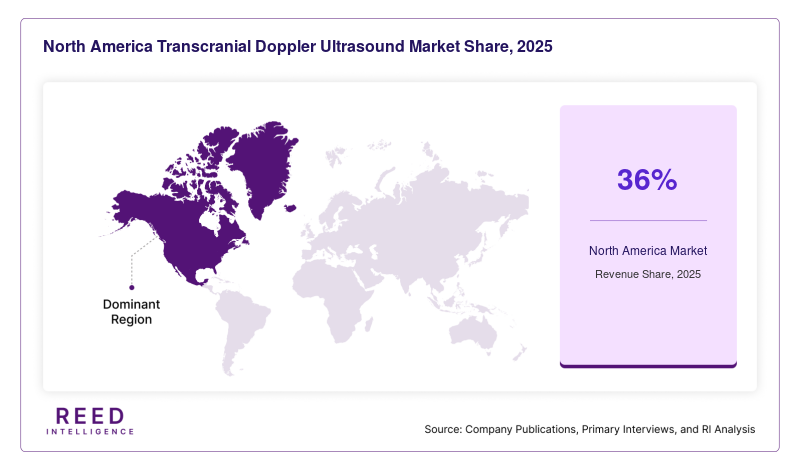
North America accounted for 36% of the Transcranial Doppler Ultrasound Market share in 2025 and is expected to grow at a CAGR of 9.5% during the forecast period. The region’s growth is driven by advanced healthcare infrastructure and high adoption of diagnostic technologies. The presence of well-established hospitals and neurocritical care units has facilitated the widespread use of TCD devices.
The United States dominated the regional market due to its strong focus on neurological research and clinical innovation. A key growth factor is the integration of TCD devices in stroke management protocols, enabling early diagnosis and continuous monitoring. This has improved patient outcomes and increased the demand for TCD systems in the country.
Europe
Europe held a 28% share of the Transcranial Doppler Ultrasound Market in 2025 and is projected to grow at a CAGR of 9.8%. The region benefits from increasing healthcare expenditure and a growing emphasis on early diagnosis of neurological conditions. The adoption of advanced imaging technologies has supported market growth.
Germany emerged as the dominant country in Europe, driven by its strong healthcare system and focus on medical innovation. The growth factor lies in the increasing use of TCD devices in research and clinical applications, particularly in monitoring cerebral blood flow in patients with neurological disorders.
Asia Pacific
Asia Pacific accounted for 21% of the market share in 2025 and is anticipated to register the fastest CAGR of 11.8% during 2025–2034. Rapid urbanization, rising healthcare investments, and increasing awareness of neurological diseases are key factors driving growth in the region.
China led the regional market due to its large population and expanding healthcare infrastructure. The growth factor is the increasing adoption of diagnostic technologies in hospitals and clinics, supported by government initiatives to improve healthcare access.
Middle East & Africa
The Middle East & Africa region held an 8% share of the Transcranial Doppler Ultrasound Market in 2025 and is expected to grow at a CAGR of 10.2%. The market is gradually expanding due to improving healthcare facilities and rising awareness of neurological conditions.
The United Arab Emirates dominated the region, driven by its advanced healthcare infrastructure and investment in medical technologies. A key growth factor is the adoption of modern diagnostic equipment in hospitals, supporting the use of TCD devices.
Latin America
Latin America accounted for 7% of the market share in 2025 and is projected to grow at a CAGR of 9.6%. The region’s growth is supported by increasing healthcare spending and rising demand for diagnostic services.
Brazil emerged as the dominant country in the region, driven by its expanding healthcare sector. The growth factor lies in the increasing focus on improving diagnostic capabilities, which has led to higher adoption of TCD devices.
Competitive Landscape
The Transcranial Doppler Ultrasound Market is moderately consolidated, with key players focusing on technological advancements and product innovation. Companies are investing in research and development to enhance device accuracy and usability.
Compumedics Limited is recognized as a market leader, offering a wide range of TCD systems with advanced features. The company recently introduced an AI-enabled TCD device that improves diagnostic efficiency and reduces operator dependency.
Other major players such as DWL Elektronische Systeme GmbH, Natus Medical Incorporated, and Viasonix Ltd. are actively expanding their product portfolios. Strategic collaborations and partnerships with healthcare providers are also common, enabling companies to strengthen their market presence. The competitive environment remains dynamic, with ongoing innovation driving growth in the market.
Key Players List
- Compumedics Limited
- DWL Elektronische Systeme GmbH
- Natus Medical Incorporated
- Viasonix Ltd.
- Rimed Ltd.
- Neural Analytics Inc.
- Atys Medical
- Cadwell Industries, Inc.
- EMS Biomedical
- Delica Medical Equipment
- Shenzhen Delica Medical Equipment Co., Ltd.
- Neurosoft LLC
- Nicolet (Natus)
- Multigon Industries Inc.
- Spacelabs Healthcare
Recent Developments
- Compumedics Limited launched an AI-enabled TCD system for enhanced diagnostic accuracy in 2024.
- Neural Analytics Inc. introduced a portable TCD device designed for emergency stroke assessment.
- DWL Elektronische Systeme GmbH expanded its product portfolio with advanced digital Doppler systems.
- Viasonix Ltd. developed a wearable TCD monitoring solution for continuous patient assessment.
- Natus Medical Incorporated enhanced its neurodiagnostic product line with improved TCD integration features.
Transcranial Doppler Ultrasound Market Segments
Product Type
- Standalone Transcranial Doppler Systems
- Portable/Handheld Doppler Devices
- Integrated Imaging Systems
Application
- Stroke Diagnosis and Monitoring
- Traumatic Brain Injury Assessment
- Cerebral Blood Flow Monitoring
- Emboli Detection
End-Use
- Hospitals
- Diagnostic Centers
- Ambulatory Surgical Centers
- Research Institutes
Distribution Channel
- Direct Sales
- Distributors and Wholesalers
- Online Medical Equipment Platforms
By Region
- North America
- Europe
- APAC
- Middle East and Africa
- LATAM