Transcutaneous Oximetry System Market Size, Share & Demand Report By Product Type (Tabletop Systems, Portable Systems), By Application (Peripheral Vascular Disease Diagnosis, Wound Healing Monitoring, Plastic Surgery, Others), By End-Use (Hospitals, Clinics, Home Care Settings), By Technology (Electrochemical Sensors, Optical Sensors), By Region & Segment Forecasts, 2025–2034
USD 3950
Market Overview
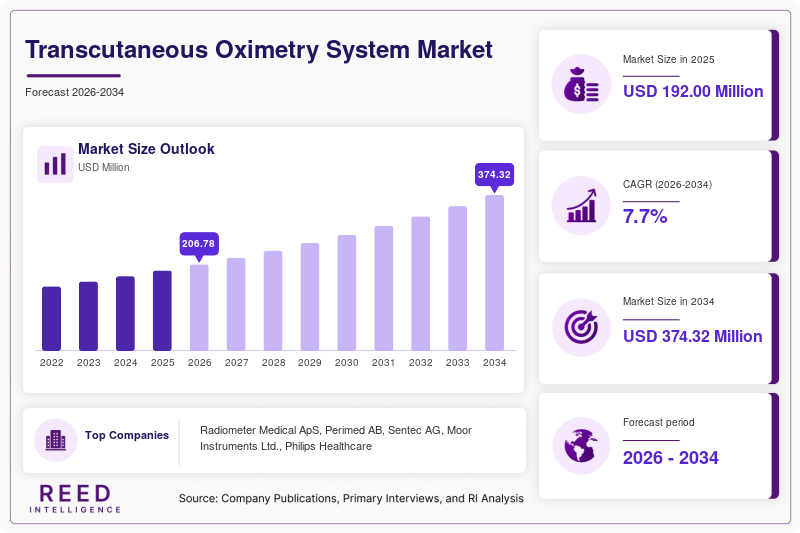
The Transcutaneous Oximetry System Market size was estimated at USD 192 million in 2025 and is projected to reach approximately USD 374 million by 2034, growing at a CAGR of 7.7% from 2025 to 2034. This steady growth reflects increasing demand for non-invasive diagnostic technologies across vascular care, wound management, and critical care settings.
One of the key global factors supporting the growth of the Transcutaneous Oximetry System Market is the rising adoption of non-invasive monitoring techniques in modern healthcare systems. Healthcare providers are focusing on minimizing procedural risks and improving patient comfort while maintaining diagnostic accuracy. Transcutaneous oximetry systems enable continuous measurement of tissue oxygenation without invasive procedures, making them suitable for both acute and chronic care applications. This transition toward safer diagnostic practices is encouraging adoption across hospitals, outpatient clinics, and ambulatory care centers.
Key Highlights:
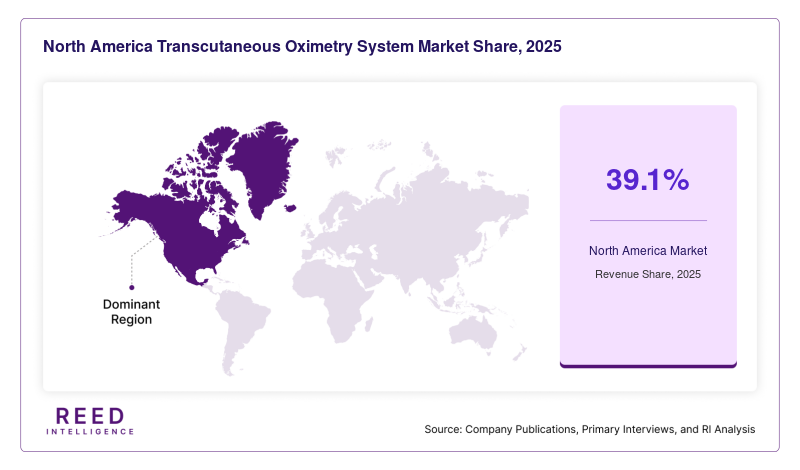
- North America held a dominant 39.1% share in 2025, while Asia Pacific is projected to grow at the fastest CAGR of 9.4% during the forecast period.
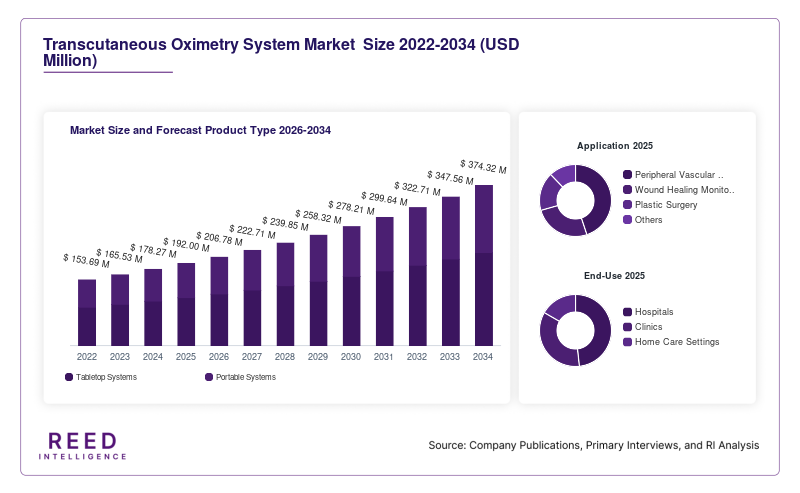
- By product type, Tabletop Systems led with 55.8% share, while Portable Systems are expected to expand at a CAGR of 8.8%.
- By application, Peripheral Vascular Disease Diagnosis dominated with 42.3% share, whereas Wound Healing Monitoring is anticipated to grow at a CAGR of 9.1%.
- The United States remained the leading country, with market values of USD 64 million in 2024 and USD 69 million in 2025.
Market Trends
Expansion of Remote Monitoring and Telehealth Integration
The Transcutaneous Oximetry System Market is witnessing a growing trend toward integration with remote patient monitoring and telehealth systems. Healthcare providers are increasingly adopting connected medical devices that allow real-time transmission of patient data to clinicians. Transcutaneous oximetry systems are being integrated with digital health platforms to support continuous monitoring of patients with chronic vascular conditions. This trend is improving clinical workflows, enabling timely intervention, and reducing hospital readmissions. The increasing penetration of telehealth services is expected to further support this trend across developed and emerging economies.
Shift Toward Compact and User-Friendly Device Design
Manufacturers are focusing on developing compact and user-friendly transcutaneous oximetry systems to enhance usability across diverse healthcare settings. Portable and handheld devices are gaining traction due to their convenience in bedside monitoring and outpatient care. These systems are designed with simplified interfaces and improved sensor attachment mechanisms, making them accessible to a broader range of healthcare professionals. This trend is particularly relevant in decentralized healthcare environments where mobility and ease of use are critical.
Market Drivers
Increasing Incidence of Peripheral Arterial and Diabetic Conditions
The rising prevalence of peripheral arterial disease and diabetes is a major driver of the Transcutaneous Oximetry System Market. These conditions often lead to impaired tissue oxygenation, requiring regular monitoring for effective management. Transcutaneous oximetry systems play a crucial role in evaluating tissue viability and guiding treatment decisions. The growing patient population with chronic vascular disorders is directly contributing to increased demand for these systems.
Growing Adoption in Wound Care Management
The expanding use of transcutaneous oximetry systems in wound care management is significantly driving market growth. Chronic wounds, including diabetic foot ulcers and pressure ulcers, require continuous assessment of tissue oxygen levels. Transcutaneous oximetry provides valuable insights into wound healing potential, enabling healthcare providers to tailor treatment strategies. As the global burden of chronic wounds increases, the demand for reliable monitoring tools is expected to rise.
Market Restraints
Limited Accessibility in Low-Resource Healthcare Settings
Limited accessibility of advanced transcutaneous oximetry systems in low-resource healthcare settings remains a key challenge for the market. The high initial investment required for these systems, along with ongoing maintenance costs, restricts adoption in smaller healthcare facilities. In many developing regions, budget constraints and limited healthcare infrastructure hinder the widespread use of advanced diagnostic technologies.
Additionally, the availability of alternative diagnostic methods at lower costs further limits market penetration. Healthcare providers in resource-constrained settings often prioritize essential medical equipment over specialized monitoring systems. The lack of skilled personnel to operate these devices also contributes to limited adoption. Addressing these challenges through cost-effective product development and training initiatives will be essential for expanding market reach.
Market Opportunities
Growth in Home-Based Healthcare Monitoring
The increasing demand for home-based healthcare services presents a significant opportunity for the Transcutaneous Oximetry System Market. Patients with chronic conditions are increasingly opting for home monitoring solutions to reduce hospital visits and manage their health more effectively. Portable transcutaneous oximetry systems enable continuous monitoring of tissue oxygenation in home settings, supporting better disease management. This shift toward home healthcare is expected to drive demand for compact and easy-to-use devices.
Technological Advancements in Sensor Innovation
Ongoing advancements in sensor technology offer substantial growth opportunities for the market. The development of more sensitive and accurate sensors is enhancing the performance of transcutaneous oximetry systems. Innovations such as improved calibration techniques and integration with artificial intelligence are enabling more precise diagnostics. These advancements are expanding the scope of applications and improving the overall efficiency of these systems, creating new growth avenues for market players.
Segmental Analysis
By Product Type
Tabletop systems dominated the Transcutaneous Oximetry System Market in 2024, accounting for 55.8% of total market share. These systems were widely used in hospital settings due to their high accuracy and ability to provide continuous monitoring. Their advanced features and reliability made them suitable for complex clinical applications.
Portable systems will grow at a CAGR of 8.8% during the forecast period, driven by increasing demand for point-of-care diagnostics. Their compact design and ease of use make them ideal for outpatient and home healthcare settings.
By Application
Peripheral vascular disease diagnosis held the largest share in 2024, contributing 42.3% to the market. The high prevalence of vascular conditions and need for accurate diagnostic tools supported this dominance.
Wound healing monitoring is projected to expand at a CAGR of 9.1%, driven by the increasing incidence of chronic wounds. These systems enable clinicians to assess tissue oxygenation, improving treatment outcomes.
By End-Use
Hospitals accounted for the largest share in 2024, representing 49.2% of the market. The availability of advanced infrastructure and skilled professionals supported the adoption of transcutaneous oximetry systems.
Home care settings will grow at a CAGR of 9.3%, driven by rising demand for remote monitoring solutions and increasing preference for home-based healthcare.
By Technology
Electrochemical sensors dominated the market in 2024 with a 53.1% share. These sensors provided reliable and cost-effective measurement of tissue oxygenation.
Optical sensors are expected to grow at a CAGR of 8.6%, driven by advancements in sensor technology and improved accuracy.
Regional Analysis
North America
North America accounted for 39.1% of the Transcutaneous Oximetry System Market share in 2025, reflecting strong adoption of advanced diagnostic technologies. The region will grow at a CAGR of 7.0% from 2025 to 2034. The presence of established healthcare infrastructure and favorable reimbursement frameworks supported market expansion.
The United States dominated the regional market due to increasing demand for early diagnosis of vascular conditions. The country’s strong focus on preventive healthcare and widespread availability of specialized medical facilities contributed to sustained market growth.
Europe
Europe held 26.8% of the market share in 2025 and will expand at a CAGR of 6.8% during the forecast period. The region’s growth is supported by well-developed healthcare systems and increasing adoption of non-invasive diagnostic methods.
Germany emerged as the leading country, driven by its strong healthcare infrastructure and emphasis on medical technology innovation. The growing elderly population also contributed to increased demand for transcutaneous oximetry systems.
Asia Pacific
Asia Pacific represented 22.4% of the Transcutaneous Oximetry System Market in 2025 and is projected to grow at the fastest CAGR of 9.4%. Rapid economic development and increasing healthcare investments are driving market expansion in the region.
China dominated the regional market due to large patient population and expanding healthcare infrastructure. Government initiatives aimed at improving diagnostic capabilities further supported market growth.
Middle East & Africa
The Middle East & Africa accounted for 5.9% of the market share in 2025 and will grow at a CAGR of 6.4%. Increasing healthcare expenditure and gradual adoption of advanced diagnostic tools are contributing to market development.
The United Arab Emirates led the region, supported by investments in healthcare modernization and adoption of innovative medical technologies in private healthcare facilities.
Latin America
Latin America held 5.8% of the Transcutaneous Oximetry System Market share in 2025 and is expected to grow at a CAGR of 6.6%. Improving healthcare access and increasing awareness of chronic disease management are supporting growth.
Brazil dominated the regional market due to its large population and expanding healthcare infrastructure. Government initiatives aimed at improving healthcare services further contributed to market expansion.
Competitive Landscape
The Transcutaneous Oximetry System Market is characterized by moderate competition, with key players focusing on innovation, product development, and strategic collaborations. Companies are investing in advanced sensor technologies and digital integration to enhance device performance and expand their product portfolios.
Radiometer Medical ApS is a prominent market leader, known for its advanced diagnostic solutions. The company recently introduced an upgraded transcutaneous monitoring system featuring enhanced sensor accuracy and improved connectivity with digital healthcare platforms.
Other leading players such as Perimed AB, Sentec AG, and Moor Instruments Ltd. are focusing on expanding their global presence through partnerships and distribution agreements. Continuous innovation and the development of portable devices remain key strategies adopted by market participants to strengthen their competitive position.
Key Players
- Radiometer Medical ApS
- Perimed AB
- Sentec AG
- Moor Instruments Ltd.
- Philips Healthcare
- Medtronic plc
- GE HealthCare Technologies Inc.
- Masimo Corporation
- Nihon Kohden Corporation
- Drägerwerk AG & Co. KGaA
Recent Developments
- In 2024, manufacturers introduced portable transcutaneous oximetry systems with wireless connectivity for remote monitoring.
- In 2023, new sensor technologies were developed to improve measurement accuracy in low-perfusion conditions.
- In 2024, companies expanded their distribution networks in Asia Pacific to strengthen market presence.
- In 2023, integration of software platforms enabled real-time data tracking and analysis.
- In 2025, market players focused on developing cost-effective solutions to enhance adoption in emerging markets.
Transcutaneous Oximetry System Market Segments
Product Type
- Tabletop Systems
- Portable Systems
Application
- Peripheral Vascular Disease Diagnosis
- Wound Healing Monitoring
- Plastic Surgery
- Others
End-Use
- Hospitals
- Clinics
- Home Care Settings
Technology
- Electrochemical Sensors
- Optical Sensors
By Region
- North America
- Europe
- APAC
- Middle East and Africa
- LATAM