Transdermal Adhesive Market Size, Share Demand Report By Product Type (Acrylic-based, Silicone-based, Hydrocolloid, Others), By Application (Drug Delivery Devices, Wound Care, Medical Tapes, Others), By End User (Hospitals, Home Care Settings, Pharmaceutical Companies) & Segment Forecasts, 2026–2034
USD 3950
Transdermal Adhesive Market Size
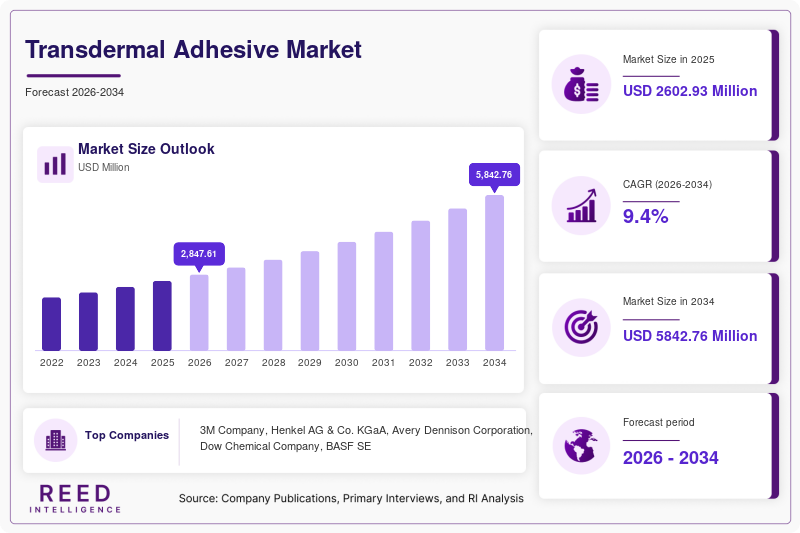
Transdermal Adhesive market size is projected at USD 2,847.6 million in 2026 and is expected to hit USD 5,847.5 million by 2034 with a CAGR of 9.4% during the forecast period. The increasing demand for advanced drug delivery systems, wound care products, and medical tapes, coupled with the growing prevalence of chronic diseases and the need for patient-friendly medical adhesives, underpins market expansion. This report delivers a comprehensive analysis of the Transdermal Adhesive market, including segmentation by type and application, competitive dynamics, and regional growth patterns, equipping stakeholders with critical intelligence. The Transdermal Adhesive market continues to demonstrate strong growth potential, fueled by the expansion of the pharmaceutical and medical device industries, the increasing focus on patient comfort and compliance, and continuous innovation in adhesive technology.
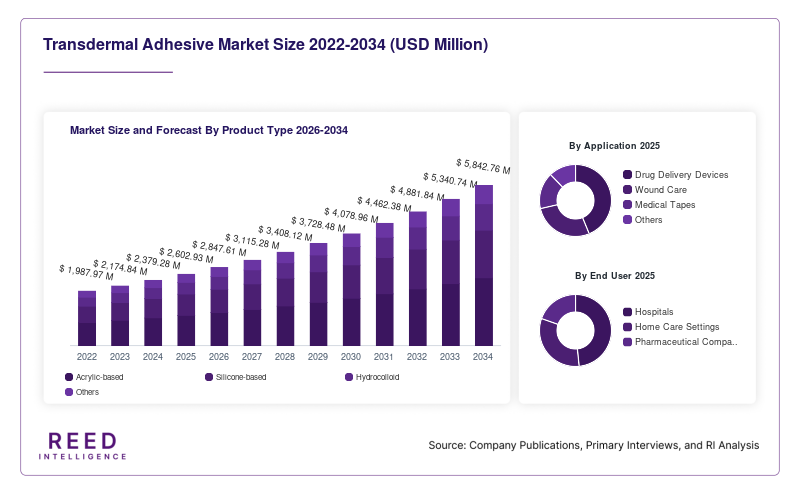
Transdermal adhesives are specialized medical adhesives designed to adhere to the skin for extended periods, enabling the delivery of drugs through the skin, securing wound dressings, and attaching medical devices. These adhesives must be biocompatible, gentle on the skin, and provide reliable adhesion. The global production volume of transdermal adhesives exceeded 150,000 metric tons in 2025, reflecting a 9% increase from 2023, driven by the growing demand for transdermal drug delivery systems and advanced wound care. Adoption patterns reveal that the Acrylic-based type dominates the market, accounting for 42% of total demand, followed by Silicone-based at 30%, Hydrocolloid at 18%, and Others at 10%. The Transdermal Adhesive market's trajectory is closely linked to the growth of the global drug delivery market, which is projected to reach USD 1.5 trillion by 2028, and the increasing need for effective and patient-centric medical solutions.
Transdermal Adhesive Market Trends
Development of Skin-Friendly and Breathable Adhesives
The Transdermal Adhesive market is witnessing a significant trend toward the development of skin-friendly and breathable adhesives, driven by the need for improved patient comfort, reduced skin irritation, and extended wear time. The revenue from advanced skin-friendly adhesives grew to USD 950 million in 2025, a year-on-year increase of 15%, as 40% of new product launches in 2025 specified enhanced breathability and biocompatibility. Adoption rates of advanced adhesives in drug delivery patches reached 35%, with this figure projected to exceed 60% by 2030. The Transdermal Adhesive market's trend toward skin-friendliness is reinforced by the need for better patient adherence, the increasing focus on patient experience, and the continuous innovation in polymer and adhesive chemistry.
Growing Focus on Biodegradable and Sustainable Adhesives
The increasing focus on biodegradable and sustainable adhesives is a major trend shaping the Transdermal Adhesive market, with the development of adhesives derived from renewable sources and designed for reduced environmental impact. The market has seen a 20% increase in the demand for sustainable adhesives since 2022, with 25% of new product developments in 2025 featuring bio-based or biodegradable materials. The use of eco-friendly adhesives in disposable medical devices has also gained significant traction. The Transdermal Adhesive market's trend toward sustainability is reinforced by the growing environmental awareness, the increasing regulatory pressure for sustainable healthcare products, and the continuous innovation in green materials and manufacturing processes.
Transdermal Adhesive Market Drivers
The Transdermal Adhesive market's expansion is primarily driven by the increasing demand for advanced drug delivery systems, with the global transdermal drug delivery market valued at USD 40 billion in 2025 and growing at a rapid pace. The need for effective and convenient drug administration methods that improve patient compliance has been a major driver, with transdermal patches offering a non-invasive alternative. The rising prevalence of chronic diseases such as pain, cardiovascular conditions, and hormonal disorders has also fueled market growth. Additionally, the growing demand for advanced wound care products has spurred demand. The Transdermal Adhesive market's growth is further reinforced by the continuous improvement in adhesive technology, leading to better performance and safety.
Transdermal Adhesive Market Restraints
Despite favorable growth prospects, the Transdermal Adhesive market faces significant constraints, primarily related to the potential for skin irritation and allergic reactions, which can limit the use of certain adhesive formulations. The high cost of advanced silicone and hydrocolloid adhesives compared to standard acrylics can also be a limitation. The Transdermal Adhesive market's growth is also tempered by the challenge of ensuring strong adhesion while maintaining skin compatibility and the complexity of developing adhesives for specific drug delivery applications.
Transdermal Adhesive Market Opportunities
The Transdermal Adhesive market presents significant opportunities in the rapidly expanding market for wearable drug delivery devices and biosensors, where adhesives are a critical component. The development of adhesives for smart patches with integrated electronics is expected to grow at a CAGR of 12% through 2034. Emerging opportunities also exist in the use of transdermal adhesives for cosmetic and aesthetic applications. The Transdermal Adhesive market's opportunity profile is further enhanced by the growing trend of home healthcare and the increasing demand for patient-friendly medical devices.
Challenges in Transdermal Adhesive Market
The Transdermal Adhesive market faces persistent challenges related to the need for continuous innovation to balance adhesion, skin compatibility, and drug delivery performance. The complexity of formulating adhesives that are compatible with various drugs and skin types can also be a challenge. The market is also contending with the challenge of ensuring long-term stability and shelf life of adhesive products. Additionally, the Transdermal Adhesive market is challenged by the need to address the regulatory requirements for medical adhesive applications.
Transdermal Adhesive Market Segmentation
The Transdermal Adhesive market is segmented by Type and Application to provide a comprehensive market perspective. By Type, Acrylic-based dominates with a 42% market share, driven by its cost-effectiveness and versatility. The Application segment is led by Drug Delivery Devices, which accounts for 40% of the market, followed by Wound Care at 30%, Medical Tapes at 20%, and Others at 10%.
By Type
Acrylic-based represent the largest segment in the Transdermal Adhesive market, commanding a 42% share, with production exceeding 63,000 metric tons in 2025. These are characterized by their strong adhesion, cost-effectiveness, and versatility. Technical specifications include peel strength, shear strength, and skin compatibility. The Transdermal Adhesive market's Acrylic segment is driven by its use in a wide range of medical applications.
Silicone-based capture a 30% share of the Transdermal Adhesive market, with production of 45,000 metric tons in 2025. These are characterized by their gentle adhesion, biocompatibility, and breathability, making them ideal for sensitive skin and long-term wear. Technical specifications include tack, adhesion, and moisture vapor transmission rate. The Transdermal Adhesive market's Silicone segment is driven by its use in advanced wound care and drug delivery.
Hydrocolloid represent 18% of the Transdermal Adhesive market, with production of 27,000 metric tons in 2025. These are characterized by their moisture-absorbing properties and use in wound care. Technical specifications include absorbency, adhesion, and gel formation. The Transdermal Adhesive market's Hydrocolloid segment is driven by its use in ostomy and wound dressings.
Others comprise the remainder of the Transdermal Adhesive market, accounting for 10% of total production, with 15,000 metric tons in 2025. This includes polyurethane and natural rubber-based adhesives. The Transdermal Adhesive market's Others segment is driven by niche and specialized applications.
By Application
Drug Delivery Devices dominates the Transdermal Adhesive market, accounting for 40% of sales, representing 60,000 metric tons in 2025. This segment includes use in transdermal patches for pain, hormone, and nicotine delivery. Usage penetration exceeds 30% in the sector. The Transdermal Adhesive market's Drug Delivery segment is characterized by its focus on precise drug release and patient compliance.
Wound Care accounts for 30% of the Transdermal Adhesive market, with sales of 45,000 metric tons in 2025. This segment encompasses use in advanced wound dressings, ostomy products, and surgical tapes. The segment is growing at a robust CAGR, driven by the increasing prevalence of chronic wounds. The Transdermal Adhesive market's Wound Care segment is characterized by its focus on moisture management and wound protection.
Medical Tapes represents 20% of the Transdermal Adhesive market, with sales of 30,000 metric tons in 2025. This segment includes use in surgical tapes, diagnostic patches, and device fixation. The segment is growing at a steady rate. The Transdermal Adhesive market's Medical Tapes segment is characterized by its focus on secure fixation and ease of removal.
Others comprises the remainder of the Transdermal Adhesive market, accounting for 10% of total sales, with 15,000 metric tons in 2025. This includes use in cosmetic patches, biosensors, and other applications. The segment is projected to grow at a significant CAGR through 2034. The Transdermal Adhesive market's Others segment is characterized by its diverse and evolving applications.
Transdermal Adhesive Market Regional Outlook
North America Transdermal Adhesive Market
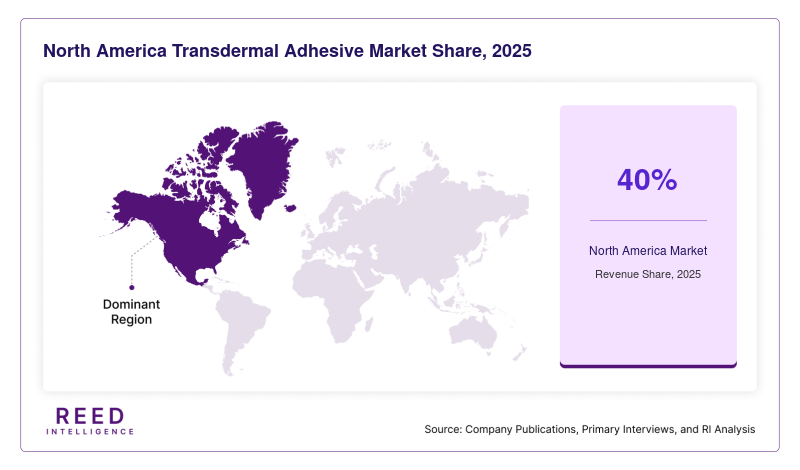
Leads the Transdermal Adhesive market, commanding a 40% share, with a revenue of USD 1,139.0 million in 2025. The United States is the primary driver, accounting for 85% of regional demand, driven by the strong pharmaceutical and medical device industries, high healthcare spending, and focus on advanced wound care. The North American Transdermal Adhesive market is characterized by its focus on innovation and premium products.
Europe Transdermal Adhesive Market
Represents the second-largest market, capturing a 30% share with a revenue of USD 854.3 million in 2025. The UK, Germany, and France are the primary drivers, collectively accounting for 60% of regional demand, driven by a strong medical technology sector, high awareness of advanced wound care, and robust pharmaceutical R&D. The Transdermal Adhesive market in Europe is characterized by its focus on quality and regulatory compliance.
Asia-Pacific Transdermal Adhesive Market
Accounts for 22% of the global Transdermal Adhesive market, with a revenue of USD 626.5 million in 2025. China, Japan, and India are the primary drivers, together accounting for 70% of egional demand, driven by the large population, growing healthcare infrastructure, and expanding pharmaceutical industry. The Asia-Pacific Transdermal Adhesive market is projected to grow at the fastest CAGR of 11% through 2034.
Middle East & Africa and Latin America Transdermal Adhesive Market
Together account for the remaining 8% of the Transdermal Adhesive market, with the UAE leading the Middle East market and Brazil leading the Latin American market. Both regions are projected to grow at CAGRs exceeding 10%, driven by improving healthcare access and growing medical device markets.
Top players in Transdermal Adhesive Market
- 3M Company
- Henkel AG & Co. KGaA
- Avery Dennison Corporation
- Dow Chemical Company
- BASF SE
- Scapa Group plc
- Adhesives Research, Inc.
- Mitsubishi Chemical Corporation
- Nitto Denko Corporation
- Lohmann GmbH & Co. KG
- Elkem ASA
- Wacker Chemie AG
- Chemence, Inc.
- Bostik (Arkema)
- H.B. Fuller Company
3M Company
3M Company holds a dominant position in the Transdermal Adhesive market, with an estimated 18% global market share, particularly strong in the North American and European medical and drug delivery segments. The company's portfolio of transdermal adhesives is widely recognized for its quality, innovation, and skin compatibility. 3M's market leadership is reinforced by its significant R&D investment, its extensive technology platform, and its strong relationships with pharmaceutical and medical device companies. 3M commands over 20% of the North American market and 15% of the European market, positioning it as a key player in the Transdermal Adhesive market.
Henkel AG & Co. KGaA
Henkel AG is a leading player in the Transdermal Adhesive market, commanding approximately 14% of the global market share through its comprehensive portfolio of adhesive technologies. The company's expertise in adhesive chemistry and its focus on healthcare applications have solidified its position. Henkel's transdermal adhesives are known for their reliability, performance, and skin-friendliness. The company's commitment to innovation and its strong presence in the European and Asian markets have enhanced its competitive advantage.
Avery Dennison Corporation holds a significant 10% market share, with particular strength in the medical tapes and drug delivery segments. Dow Chemical Company is a major player in the specialty materials market, holding an 8% share.
Recent Developments in Transdermal Adhesive Market
- 2025: 3M launched a new line of skin-friendly silicone adhesives for sensitive skin applications in drug delivery and wound care.
- 2025: Henkel introduced a new bio-based transdermal adhesive derived from renewable sources, targeting the growing demand for sustainable medical products.
Transdermal Adhesive Market Segments
By Product Type
- Acrylic-based
- Silicone-based
- Hydrocolloid
- Others
By Application
- Drug Delivery Devices
- Wound Care
- Medical Tapes
- Others
By End User
- Hospitals
- Home Care Settings
- Pharmaceutical Companies
By Region
- North America
- Europe
- APAC
- Middle East and Africa
- LATAM