Transducer for Fetal Heart Rate Market Size, Share & Demand Report By Product Type (Ultrasound Transducers, Doppler Transducers, Wireless Fetal Heart Rate Transducers), By Application (Hospital-Based Fetal Monitoring, Homecare Fetal Monitoring, Prenatal Diagnostic Centers), By End User (Hospitals, Specialty Maternity Clinics, Ambulatory Surgical Centers, Diagnostic Centers) By Region & Segment Forecasts, 2026–2034
USD 3950
Market Overview
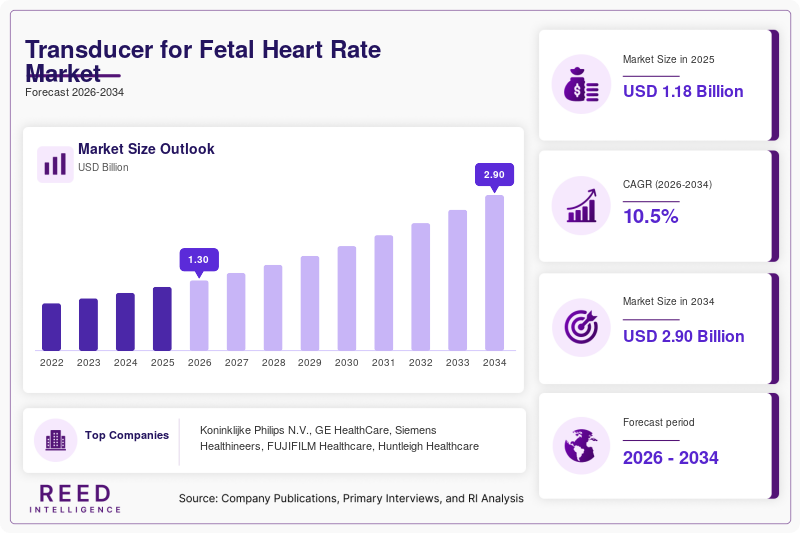
The global Transducer for Fetal Heart Rate Market was valued at USD 1.18 billion in 2026 and is projected to reach USD 2.63 billion by 2034, expanding at a CAGR of 10.5% during the forecast period from 2026 to 2034. The market continues to gain momentum due to the growing focus on maternal healthcare, rising awareness regarding prenatal monitoring, and the increasing adoption of advanced fetal monitoring technologies across hospitals and maternity clinics. Fetal heart rate transducers are widely used during pregnancy and labor to monitor fetal well-being and detect potential complications at an early stage. Growing investments in healthcare infrastructure across developing economies have also supported the wider deployment of these monitoring systems.
The increasing prevalence of high-risk pregnancies has emerged as a major global factor driving market expansion. Rising maternal age, obesity, diabetes, hypertension, and multiple pregnancies have increased the demand for continuous fetal monitoring solutions in both developed and emerging economies. Healthcare providers are increasingly integrating wireless and portable transducers into obstetric care to improve patient comfort and enhance monitoring accuracy. In addition, improvements in ultrasound sensing technology and digital signal processing have enhanced diagnostic efficiency, further supporting product adoption.
Key Highlights
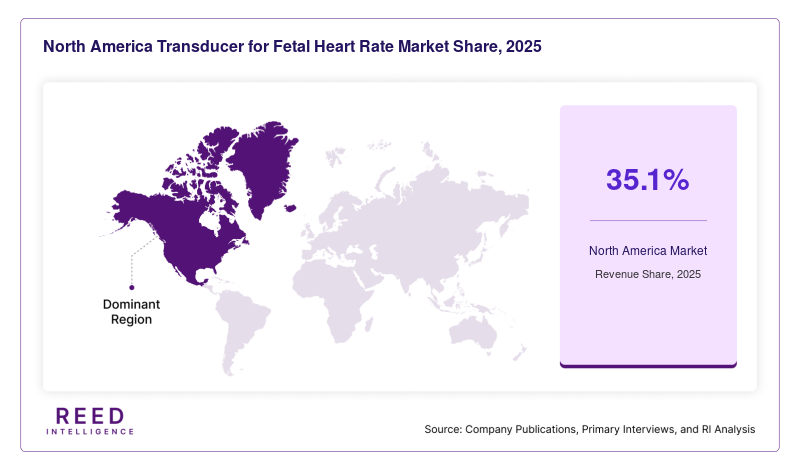
- North America dominated the market with a 35.1% share in 2025.
- Asia Pacific is expected to grow at the fastest CAGR of 11.8% during 2026–2034.
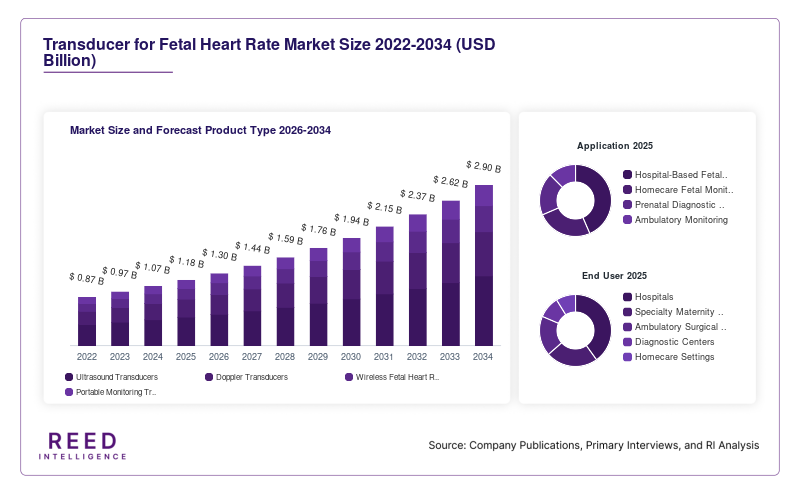
- By product type, ultrasound transducers accounted for the largest share of 47.3%.
- while wireless fetal heart rate transducers are projected to grow at a CAGR of 12.6%.
- By application, hospital-based fetal monitoring led with a 52.4% share.
- whereas homecare fetal monitoring is expected to expand at a CAGR of 13.1%.
- The United States remained the dominant country, with market values of USD 312 million in 2024 and USD 346 million in 2025.
Market Trends
Integration of Wireless and Portable Monitoring Technologies
The Transducer for Fetal Heart Rate Market is witnessing significant growth in wireless and portable monitoring technologies. Healthcare facilities are increasingly shifting from conventional wired systems toward compact and wearable fetal monitoring devices that improve patient mobility and clinical workflow efficiency. Wireless transducers reduce cable complexity during labor monitoring and allow healthcare professionals to conduct remote observation with improved flexibility. The trend is particularly visible in urban hospitals and private maternity centers where patient comfort and real-time monitoring have become critical priorities. Manufacturers are focusing on lightweight sensors, rechargeable systems, and Bluetooth-enabled connectivity to enhance device usability. The integration of cloud-based monitoring platforms is also enabling obstetricians to access fetal health data remotely, creating additional demand for digitally connected fetal heart rate monitoring solutions.
Expansion of Home-Based Prenatal Monitoring Services
The increasing acceptance of remote maternal healthcare is creating a strong trend toward home-based prenatal monitoring services. Pregnant women are becoming more aware of the benefits of regular fetal monitoring, especially in high-risk pregnancies that require continuous observation. Portable fetal heart rate transducers designed for home use are gaining traction among healthcare providers aiming to reduce hospital visits while maintaining clinical supervision. Telehealth expansion has further accelerated this trend, allowing physicians to review fetal data through connected healthcare platforms. In several developing countries, healthcare systems are investing in mobile prenatal care programs to improve maternal outcomes in rural communities. This shift toward decentralized monitoring is encouraging manufacturers to develop user-friendly transducers with simplified interfaces, mobile integration, and enhanced data accuracy.
Market Drivers
Increasing Incidence of High-Risk Pregnancies
The rising incidence of high-risk pregnancies is a major factor driving the Transducer for Fetal Heart Rate Market. Conditions such as gestational diabetes, hypertension, obesity, and delayed pregnancies have increased the need for advanced fetal monitoring systems worldwide. Healthcare professionals rely on fetal heart rate transducers to assess fetal distress, oxygen supply, and heart rhythm abnormalities during pregnancy and labor. The growing number of cesarean deliveries and premature births has also increased demand for continuous monitoring technologies. Hospitals are investing in upgraded fetal monitoring equipment to improve neonatal outcomes and reduce delivery-related complications. In emerging economies, government-led maternal healthcare programs are further supporting the adoption of fetal heart rate monitoring systems across public healthcare institutions.
Technological Advancements in Ultrasound and Sensor Systems
Continuous advancements in ultrasound technology and sensor performance are contributing significantly to market growth. Modern fetal heart rate transducers now offer improved signal clarity, enhanced sensitivity, and reduced interference during monitoring procedures. Manufacturers are integrating artificial intelligence algorithms and automated analytics to support faster clinical decision-making. The introduction of waterproof, wireless, and wearable transducers has improved patient convenience and expanded product applications in labor and delivery units. Healthcare facilities are increasingly preferring systems that integrate with electronic medical records and hospital monitoring networks. Furthermore, the availability of portable battery-operated devices has enabled wider adoption in ambulatory settings and rural healthcare facilities. These innovations are supporting higher accuracy levels and operational efficiency, encouraging healthcare providers to modernize fetal monitoring infrastructure.
Market Restraint
High Equipment Costs and Limited Access in Low-Income Regions
The high cost associated with advanced fetal heart rate transducers remains a key restraint affecting market growth. Modern wireless and digitally integrated monitoring systems require substantial investment, which limits adoption among smaller healthcare facilities and clinics with restricted budgets. In low-income and underdeveloped regions, many maternity centers continue to rely on conventional monitoring equipment due to affordability concerns. Maintenance costs, calibration requirements, and the need for trained professionals further increase operational expenses for healthcare providers. Limited reimbursement support in several countries also discourages hospitals from adopting premium fetal monitoring systems. In rural healthcare environments, infrastructure limitations such as inconsistent electricity supply and weak digital connectivity reduce the practical deployment of advanced transducers. These challenges create a gap between technologically advanced healthcare institutions and resource-constrained medical facilities, slowing the pace of market penetration in developing economies.
Market Opportunities
Growth Potential in Emerging Healthcare Markets
Emerging economies present substantial opportunities for the Transducer for Fetal Heart Rate Market due to improving healthcare infrastructure and increasing maternal care awareness. Countries across Asia Pacific, Latin America, and parts of Africa are expanding public healthcare investments to reduce maternal and neonatal mortality rates. Governments are supporting prenatal screening initiatives and strengthening rural healthcare networks, creating favorable conditions for fetal monitoring equipment adoption. Private healthcare providers are also establishing specialized maternity hospitals equipped with modern monitoring technologies. Rising healthcare insurance coverage and increasing middle-class spending on maternal care are expected to contribute to stronger product demand. Manufacturers entering these regions with cost-effective and portable monitoring systems are likely to gain competitive advantages in the coming years.
Rising Adoption of Telemedicine and Remote Pregnancy Monitoring
The rapid expansion of telemedicine services is creating new opportunities for advanced fetal heart rate transducers. Remote pregnancy monitoring programs are becoming increasingly important in regions facing shortages of obstetric specialists or healthcare accessibility challenges. Connected fetal monitoring systems allow healthcare providers to monitor fetal activity and maternal health without requiring frequent hospital visits. This approach improves convenience for pregnant women while supporting early detection of complications. Technology companies and medical device manufacturers are collaborating to develop integrated digital platforms that combine fetal monitoring sensors with smartphone applications and cloud-based analytics. The increasing penetration of internet connectivity and mobile health services is expected to accelerate the adoption of home-based fetal monitoring devices, particularly among high-risk pregnancy populations.
Segmental Analysis
By Product Type
Ultrasound transducers accounted for the largest share of the Transducer for Fetal Heart Rate Market in 2024, representing 47.3% of total revenue. These devices are widely used in hospitals and maternity clinics due to their ability to provide accurate fetal heart rate monitoring during pregnancy and labor. Healthcare providers prefer ultrasound-based systems because they deliver reliable real-time fetal assessment without invasive procedures. The widespread availability of conventional ultrasound monitoring equipment in both developed and developing countries has further strengthened the segment’s market position. Manufacturers are continuously improving signal processing capabilities and ergonomic design features to enhance usability and monitoring precision. In addition, the integration of digital interfaces and automated recording systems has increased adoption among healthcare institutions focused on improving obstetric care quality.
Wireless fetal heart rate transducers are expected to register the fastest CAGR of 12.6% during the forecast period. These systems are gaining popularity due to their portability, reduced cable dependency, and improved patient mobility during labor monitoring. Hospitals are increasingly adopting wireless solutions to improve workflow efficiency and minimize patient discomfort associated with traditional wired systems. The growth of remote healthcare services and home-based pregnancy monitoring is also accelerating demand for portable wireless devices. Manufacturers are investing in Bluetooth-enabled connectivity, rechargeable battery systems, and cloud integration to strengthen product functionality. Rising demand for continuous monitoring in high-risk pregnancies and increasing adoption of telemedicine platforms are expected to support further expansion of the wireless transducer segment.
By Application
Hospital-based fetal monitoring emerged as the dominant application segment in 2024, accounting for 52.4% of the global market share. Hospitals remain the primary centers for prenatal care, labor management, and emergency obstetric services, leading to strong demand for fetal heart rate transducers. Advanced monitoring equipment is widely utilized in labor and delivery rooms to assess fetal health and detect complications during childbirth. Large healthcare institutions are investing in integrated fetal monitoring systems connected to centralized patient data networks to improve clinical workflow and record management. The increasing number of high-risk pregnancies and rising cesarean delivery rates are also contributing to sustained demand for hospital-based monitoring solutions. Furthermore, regulatory standards emphasizing maternal safety continue to encourage hospitals to upgrade fetal monitoring infrastructure.
Homecare fetal monitoring is projected to witness the fastest CAGR of 13.1% between 2026 and 2034. The growing adoption of telehealth services and remote patient management solutions is significantly supporting this segment’s expansion. Pregnant women, especially those with high-risk conditions, are increasingly opting for home-based fetal monitoring systems to reduce hospital visits while maintaining regular medical supervision. Manufacturers are introducing user-friendly portable devices equipped with smartphone connectivity and cloud-based reporting functions to improve accessibility. Rising awareness regarding prenatal health and increasing demand for personalized maternal care are also driving segment growth. In developing regions, healthcare providers are utilizing home monitoring technologies to extend prenatal care services to rural and underserved populations.
By End User
Hospitals accounted for the largest share of the Transducer for Fetal Heart Rate Market in 2024, contributing 49.6% of overall revenue. The segment benefits from the high volume of childbirth procedures conducted in hospital settings and the availability of advanced diagnostic infrastructure. Hospitals require continuous fetal monitoring systems to manage labor complications and improve neonatal outcomes. The increasing prevalence of high-risk pregnancies has encouraged healthcare institutions to adopt advanced fetal heart rate transducers capable of providing accurate and continuous monitoring. Large hospitals are also integrating fetal monitoring systems with electronic health records and centralized monitoring stations to enhance operational efficiency. Strong procurement capabilities and higher healthcare budgets further support the dominance of hospitals within the overall market.
Ambulatory surgical centers and specialty maternity clinics are anticipated to record the fastest CAGR of 11.9% during the forecast period. The increasing preference for specialized maternal healthcare services and shorter patient waiting times is supporting growth in these facilities. Specialty maternity centers are investing in portable and wireless fetal monitoring devices to improve patient experience and optimize space utilization. The expansion of private healthcare infrastructure in emerging economies is also creating favorable opportunities for this segment. Rising demand for personalized prenatal care and minimally invasive monitoring solutions continues to influence purchasing decisions among specialty healthcare providers. Furthermore, advancements in compact monitoring technologies are enabling smaller facilities to adopt high-performance fetal heart rate transducer systems.
Regional Analysis
North America
North America accounted for 35.1% of the global Transducer for Fetal Heart Rate Market share in 2025 and is expected to maintain a stable growth trajectory with a projected CAGR of 9.8% during the forecast period. The region benefits from well-established healthcare infrastructure, strong reimbursement systems, and high awareness regarding prenatal health monitoring. Hospitals and maternity care centers across the United States and Canada are rapidly adopting advanced wireless monitoring technologies to improve patient management and clinical efficiency. The presence of major medical device manufacturers and growing investments in maternal healthcare innovation continue to support market development.
The United States remains the dominant contributor to the regional market due to its large number of annual births and high adoption of technologically advanced fetal monitoring systems. Increasing cases of high-risk pregnancies associated with obesity and delayed motherhood are supporting continuous demand for fetal heart rate transducers. The country also benefits from strong regulatory oversight and favorable healthcare spending patterns. In addition, rising adoption of home-based pregnancy monitoring and telehealth solutions is creating new opportunities for portable fetal transducer manufacturers across the United States healthcare industry.
Europe
Europe represented 27.6% of the global Transducer for Fetal Heart Rate Market in 2025 and is anticipated to expand at a CAGR of 9.4% between 2026 and 2034. The region is characterized by strong public healthcare systems, growing prenatal screening awareness, and increasing use of digital healthcare technologies. Countries across Western Europe are investing in modern labor and delivery equipment to improve maternal and neonatal outcomes. Hospitals are integrating advanced fetal monitoring systems with centralized patient data platforms to enhance workflow management and clinical decision-making.
Germany continues to dominate the European market due to its advanced healthcare infrastructure and strong medical device manufacturing sector. The country has a high adoption rate of digital obstetric monitoring systems across hospitals and specialty maternity clinics. Increasing focus on reducing pregnancy-related complications and improving prenatal diagnosis has further strengthened product demand. Additionally, the growing use of remote healthcare services in Germany is encouraging manufacturers to introduce portable and connected fetal heart rate monitoring devices suitable for both hospital and homecare settings.
Asia Pacific
Asia Pacific held 23.4% of the global market share in 2025 and is projected to record the fastest CAGR of 11.8% during the forecast period. Rapid urbanization, expanding healthcare infrastructure, and rising birth rates in several countries are creating strong demand for fetal monitoring technologies. Governments across the region are implementing maternal healthcare improvement programs aimed at reducing infant mortality and enhancing prenatal care access. The increasing number of private maternity hospitals and diagnostic centers is also supporting adoption of advanced fetal heart rate transducers.
China remains the leading country within the Asia Pacific market due to its large patient population and expanding healthcare modernization initiatives. The country is witnessing growing demand for technologically advanced obstetric monitoring systems in urban healthcare facilities. Increasing healthcare expenditure and rising awareness regarding prenatal diagnostics are supporting market growth. Furthermore, the expansion of telemedicine services in rural provinces is encouraging the deployment of portable fetal monitoring devices capable of remote connectivity and continuous maternal health assessment.
Middle East & Africa
The Middle East & Africa region accounted for 7.1% of the global Transducer for Fetal Heart Rate Market in 2025 and is expected to grow at a CAGR of 8.7% through 2034. Improving healthcare infrastructure and increasing government investment in maternal care programs are contributing to regional market development. Several countries are expanding hospital networks and upgrading maternity care facilities to improve prenatal monitoring capabilities. International healthcare organizations are also supporting awareness campaigns focused on reducing maternal and neonatal mortality rates across underserved populations.
Saudi Arabia remains the dominant country in the regional market due to rising healthcare spending and ongoing modernization of public healthcare infrastructure. The country is investing heavily in advanced medical technologies as part of broader healthcare transformation initiatives. Growing demand for quality maternal care services and increasing establishment of specialized women’s hospitals are supporting the adoption of fetal heart rate transducers. In addition, the integration of digital healthcare solutions and remote monitoring technologies is improving prenatal care accessibility across semi-urban and remote communities.
Latin America
Latin America captured 6.8% of the global market share in 2025 and is projected to expand at a CAGR of 8.9% during the forecast period. The region is benefiting from increasing healthcare awareness, gradual improvement in medical infrastructure, and expanding access to maternal healthcare services. Public and private healthcare providers are investing in prenatal diagnostic technologies to improve pregnancy monitoring and reduce complications during childbirth. The market is also gaining support from rising healthcare insurance coverage and growing demand for modern obstetric equipment.
Brazil dominates the Latin American market due to its large healthcare sector and growing focus on maternal health improvement programs. Increasing birth rates and rising awareness regarding prenatal screening are contributing to stronger demand for fetal monitoring devices. The country has witnessed growing investments in private maternity hospitals equipped with advanced fetal heart rate monitoring technologies. Additionally, government-led healthcare expansion initiatives targeting rural and underserved populations are creating favorable opportunities for portable and cost-effective transducer systems.
Competitive Landscape
The Transducer for Fetal Heart Rate Market is moderately consolidated, with several global and regional medical device manufacturers competing through technological innovation, product quality, and strategic partnerships. Companies are focusing on wireless monitoring capabilities, portability, and integration with digital healthcare systems to strengthen market positioning. Product development strategies are increasingly centered on improving patient comfort, signal accuracy, and remote monitoring efficiency.
Koninklijke Philips N.V. remains one of the leading companies in the market due to its broad portfolio of maternal and fetal monitoring systems and strong global distribution network. The company continues to invest in connected healthcare solutions and advanced ultrasound monitoring technologies. GE HealthCare, Siemens Healthineers, FUJIFILM Healthcare, and Huntleigh Healthcare are also key participants expanding their fetal monitoring product portfolios.
Recent competitive developments include collaborations between medical device companies and telehealth providers to develop integrated prenatal monitoring platforms. Several manufacturers have also launched compact wireless fetal monitoring transducers designed for homecare applications. In addition, market participants are increasing investments in emerging economies to strengthen distribution capabilities and improve access to advanced maternal healthcare technologies.
Key Players
- Koninklijke Philips N.V.
- GE HealthCare
- Siemens Healthineers
- FUJIFILM Healthcare
- Huntleigh Healthcare
- Natus Medical Incorporated
- MedGyn Products Inc.
- EDAN Instruments Inc.
- Bionet Co. Ltd.
- CooperSurgical Inc.
- Neoventa Medical AB
- ArjoHuntleigh
- Analogic Corporation
- Shenzhen Bestman Instrument Co. Ltd.
- Spacelabs Healthcare
Recent Developments
- In February 2026, GE HealthCare introduced a wireless fetal monitoring transducer with enhanced mobility support and cloud-based monitoring integration for maternity hospitals.
- In July 2025, Koninklijke Philips N.V. expanded its maternal healthcare portfolio through the launch of a compact fetal heart monitoring solution designed for remote prenatal care applications.
- In October 2025, Siemens Healthineers partnered with regional healthcare providers in Asia Pacific to improve access to advanced fetal monitoring technologies in rural healthcare facilities.
- In March 2026, Mindray Medical International Limited announced the development of AI-assisted fetal monitoring software integrated with next-generation transducer systems for improved clinical analysis.
Transducer for Fetal Heart Rate Market Segments
Product Type
- Ultrasound Transducers
- Doppler Transducers
- Wireless Fetal Heart Rate Transducers
- Portable Monitoring Transducers
Application
- Hospital-Based Fetal Monitoring
- Homecare Fetal Monitoring
- Prenatal Diagnostic Centers
- Ambulatory Monitoring
End User
- Hospitals
- Specialty Maternity Clinics
- Ambulatory Surgical Centers
- Diagnostic Centers
- Homecare Settings
By Region
- North America
- Europe
- APAC
- Middle East and Africa
- LATAM