Transfer Agency Services Market Size, Share & Trends Analysis Report by Service Type, Deployment Mode, Organization Size, End User, and Region, Forecasts, 2026–2034
USD 3950
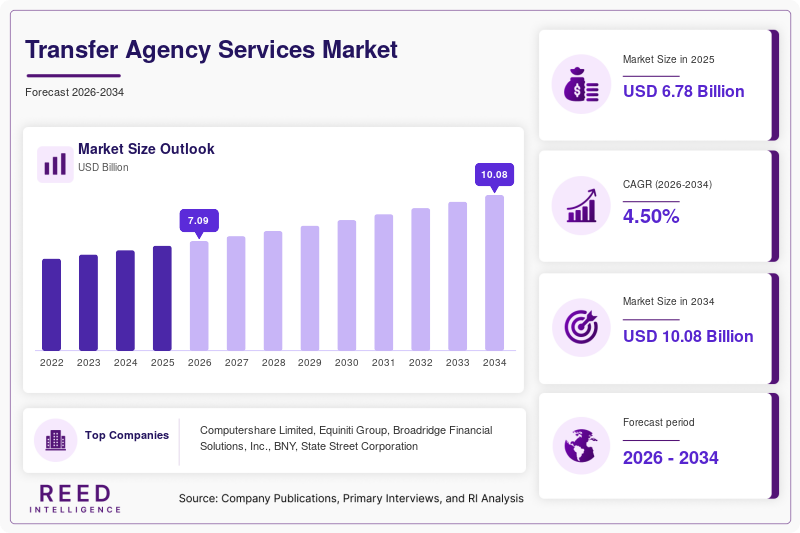
Transfer Agency Services Market Size
Transfer Agency Services Market Drivers
The growth and diversification of investment funds, listed companies, and private investment structures increase the need for accurate investor recordkeeping and transaction administration. Transfer agents support account maintenance, ownership changes, distributions, investor communications, and reporting across different types of securities and fund structures.
Financial institutions and corporate issuers must maintain reliable ownership records and comply with applicable reporting, disclosure, and investor-protection requirements. Transfer agency providers help clients administer investor information, maintain transaction records, process corporate actions, and support regulatory obligations across relevant jurisdictions.
Shareholder portals, electronic communications, digital documentation, and automated transaction processing are changing how transfer agency services are delivered. Digital capabilities can reduce manual processing, improve access to investor information, and help providers handle high transaction volumes while maintaining appropriate controls.
The expansion of exchange-traded funds, alternative investment funds, and other specialized investment structures creates demand for transfer agency capabilities tailored to different ownership arrangements, transaction workflows, and investor eligibility requirements. Providers with adaptable systems can support a wider range of fund structures and servicing needs.
Transfer Agency Services Market Restraints
Transfer agents maintain sensitive shareholder identities, account information, tax documentation, and transaction records. Protecting this information requires secure infrastructure, access controls, monitoring, disaster recovery, and appropriate data governance. Security incidents can create financial, legal, and reputational consequences.
Developing and maintaining transfer agency platforms requires ongoing investment in software, cybersecurity, regulatory compliance, data management, and operational controls. Smaller providers may face challenges funding these capabilities while competing with established service providers.
Transfer agency operations often interact with custody, fund accounting, banking, payment, and corporate reporting systems. Integrating legacy infrastructure with modern digital platforms can require complex data migration, testing, and process redesign, increasing implementation time and operational risk.
Cross-border transactions can involve different market practices, tax requirements, documentation standards, settlement processes, and investor identification rules. Providers must adapt their processes to applicable local requirements while maintaining consistent service quality across markets.
Transfer Agency Services Market Opportunities
Digital investor interfaces, automated workflows, and blockchain-enabled fund infrastructure create opportunities to modernize ownership records and investor servicing. Providers can develop capabilities that support traditional securities alongside tokenized investment products, subject to applicable legal and regulatory requirements.
Private equity, private credit, interval funds, and other alternative investment structures can require specialized investor onboarding, ownership records, subscription processing, and distribution administration. Transfer agents can expand services for asset managers seeking scalable operating infrastructure.
Combining transfer agency with fund administration, custody, corporate actions, investor communications, and reporting can help providers deliver more coordinated services. Integrations may also reduce duplicate data entry and improve visibility across the investment lifecycle.
Developing capital markets, digital financial infrastructure, and changing securities administration requirements may create opportunities for transfer agency providers. Local partnerships, regulatory expertise, and technology adapted to regional requirements can support market access.
Transfer Agency Services Market Segmental Analysis
By Service Type
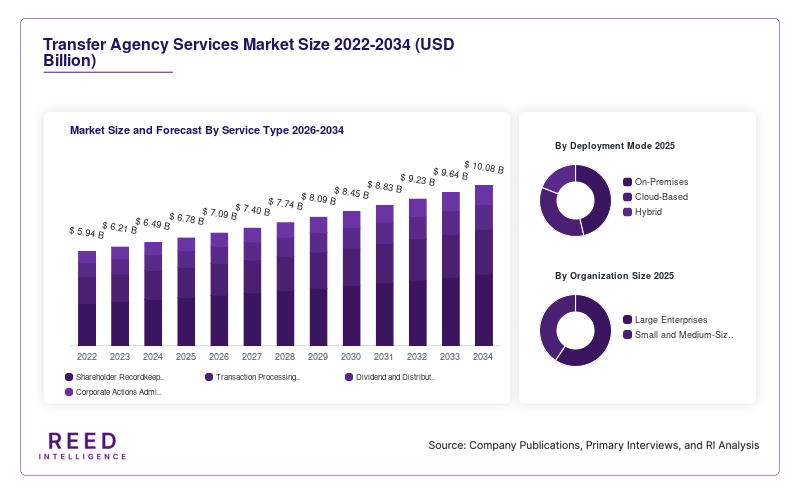
Shareholder recordkeeping and register maintenance form a core transfer agency function, involving the maintenance of ownership records and account information. Transaction processing supports share transfers, account updates, and other ownership-related changes. Dividend and distribution processing helps issuers and funds administer payments, while corporate actions services support events such as stock splits, rights offerings, and other changes affecting securities holders.
Investor communications, reporting, onboarding, and compliance-related services complement these functions. Demand across service categories depends on the complexity of the client’s ownership structure, transaction volumes, investor base, and regulatory requirements. The dominant service segment and fastest-growing service category cannot be established reliably without comparable market-share and forecast-CAGR data for each service.
By Deployment Mode
On-premises platforms allow institutions to maintain greater direct control over infrastructure and data environments, while cloud-based systems can provide scalable capacity, remote access, and more flexible technology deployment. Hybrid models combine selected cloud capabilities with systems retained within an institution’s existing environment.
The deployment decision depends on security policies, data governance, integration requirements, operating costs, and the provider’s technology strategy. Cloud-based and hybrid approaches may offer opportunities for digital modernization, but their relative growth rates require quantitative confirmation. No comparable deployment-specific share or CAGR data has been verified for this report.
By Organization Size
Large enterprises generally require transfer agency systems capable of supporting substantial shareholder registers, high transaction volumes, complex corporate actions, and multiple reporting obligations. They may also require integration with enterprise finance, investor relations, compliance, and governance platforms.
Small and medium-sized enterprises may seek outsourced administration and technology-enabled services that reduce the need to maintain specialized internal infrastructure. Their requirements can differ according to ownership complexity, funding structure, and shareholder count. A verified dataset is needed to determine the dominant organization-size segment and the fastest-growing category.
By End User
Publicly listed companies use transfer agents to maintain shareholder records, process ownership changes, support corporate actions, and administer shareholder communications. Mutual funds and exchange-traded funds require investor account administration and transaction processing, while alternative investment funds may require more specialized onboarding, subscription, redemption, and distribution workflows.
Private companies may use transfer agency services to administer ownership registers and changes associated with equity issuance or private investment activity. Financial institutions and asset managers can require coordinated transfer agency and fund servicing across multiple products. The leading end-user segment and fastest-growing end-user category require comparable market-share and CAGR estimates that are not available in the supplied market inputs.
Transfer Agency Services Market Competitive Landscape
The transfer agency services market includes specialist transfer agents, global financial services firms, securities servicing providers, fund administrators, and technology-enabled service companies. Competition is based on operational accuracy, regulatory expertise, transaction-processing capacity, data security, digital investor experience, geographic reach, and the ability to support complex fund structures.
Providers are investing in automation, integrated servicing platforms, digital shareholder communications, and capabilities for alternative and tokenized funds. The ability to combine traditional administration with adaptable technology is becoming an important area of differentiation. Providers also compete through client service, business continuity, implementation expertise, and the reliability of their investor recordkeeping systems.
Key Market Players
- Computershare Limited
- Equiniti Group
- Broadridge Financial Solutions, Inc.
- BNY
- State Street Corporation
- SEI Investments Company
- Deutsche Börse Group (Clearstream)
- J.P. Morgan
- Citibank
- Apex Group
Transfer Agency Services Market Recent Developments
- July, 2026 - BNY launches Digital Transfer Agency capabilities BNY announced the launch of its Digital Transfer Agency capabilities to support digitally native funds alongside traditional investment funds. The offering is designed to support fund servicing across multiple jurisdictions and blockchains, integrating transfer agency with broader distribution and custody capabilities. The announcement identifies BNY Investments Dreyfus, Baillie Gifford, and BlackRock among the first issuers. This development illustrates the expansion of transfer agency services into digital fund structures.
- June, 2026 - SEI expands SEC-registered transfer agency services SEI announced the introduction of SEI Transfer Agency and Registry Services, Inc., expanding its capabilities to support traditional and alternative asset managers offering SEC-registered, retail-distributed funds. The service uses technology from Envision Financial Systems and includes investor recordkeeping, transaction processing, digital interfaces, business-process automation, and reporting. The expansion includes support for selected semi-liquid alternative investment structures.
Transfer Agency Services Market Segments
By Service Type
- Shareholder Recordkeeping and Register Maintenance
- Transaction Processing and Ownership Transfers
- Dividend and Distribution Processing
- Corporate Actions Administration
By Deployment Mode
- On-Premises
- Cloud-Based
- Hybrid
By Organization Size
- Large Enterprises
- Small and Medium-Sized Enterprises
By End User
- Publicly Listed Companies
- Mutual Funds and Exchange-Traded Funds
- Alternative Investment Funds
- Private Companies
By Region
- North America
- Europe
- APAC
- Middle East and Africa
- LATAM