Transparent Wood Market Size, Share & Demand Report By Type (Natural Transparent Wood, Composite Transparent Wood), By Application (Building Materials, Solar Panel Substrates, Automotive Components, Electronics), By End-Use Industry (Construction, Electronics, Automotive, Energy), By Distribution Channel (Direct Sales, Online Channels) & Segment Forecasts, 2025–2034
USD 3950
Market Overview
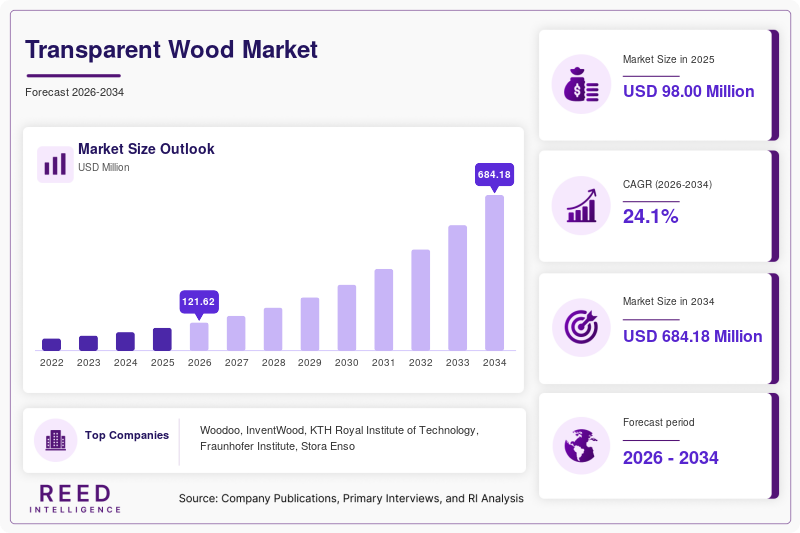
The global Transparent Wood Market size was valued at approximately USD 98 million in 2025 and is projected to reach around USD 685 million by 2034, expanding at a CAGR of 24.1% during the forecast period (2025–2034). Transparent wood, a novel bio-based material engineered by removing lignin and infusing polymers, has gained increasing attention due to its unique combination of strength, transparency, and sustainability.
A major global factor supporting market growth is the increasing emphasis on sustainable construction materials and carbon-neutral alternatives. Transparent wood offers a renewable substitute for glass and plastics, aligning with environmental regulations and green building initiatives worldwide. Its superior insulation properties and lightweight nature further contribute to its adoption in energy-efficient buildings and advanced electronics.
Key Highlights
- North America dominated the market with a share of 34% in 2025, while Asia Pacific is expected to register the fastest CAGR of 26.8% during the forecast period.
- By application, building materials emerged as the leading subsegment with a 42% share, while solar panel substrates are projected to grow fastest at a CAGR of 27.5%.
- By end-use, construction led the market, whereas electronics is anticipated to be the fastest-growing segment with a CAGR of 26.9%.
- The United States recorded market values of USD 28 million in 2025 and is expected to reach USD 34 million in 2026.
Market Trends
Integration in Energy-Efficient Building Materials
Transparent wood is increasingly being incorporated into energy-efficient building systems. Its thermal insulation properties, combined with optical transparency, make it suitable for windows, facades, and skylights. The material enables natural light penetration while reducing heat transfer, supporting energy conservation in residential and commercial buildings. As green construction standards tighten globally, architects and developers are adopting transparent wood to meet sustainability targets.
Advancements in Functional and Smart Materials
Another notable trend shaping the Transparent Wood Market is the development of functional variants, including smart transparent wood with embedded sensors or electrochromic properties. These innovations allow the material to change transparency levels or integrate with smart building systems. Research institutions and manufacturers are focusing on enhancing durability, scalability, and optical performance, which is expected to expand its applications in electronics and wearable devices.
Market Drivers
Rising Demand for Sustainable and Renewable Materials
The growing global focus on sustainability has significantly driven demand in the Transparent Wood Market. Industries are shifting toward renewable materials that reduce carbon footprints and environmental impact. Transparent wood, derived from natural timber and processed with eco-friendly techniques, aligns well with these goals. Governments and regulatory bodies are also promoting bio-based materials, further accelerating adoption across multiple sectors.
Increasing Application in Advanced Electronics and Solar Technologies
The expanding use of transparent wood in advanced electronics and solar energy systems is another key driver. Its ability to diffuse light efficiently makes it an ideal candidate for solar panel substrates, enhancing energy absorption. Additionally, its lightweight and durable characteristics are supporting its integration into next-generation electronic devices. As innovation continues in these sectors, demand for transparent wood is expected to grow steadily.
Market Restraint
High Production Costs and Limited Commercial Scalability
One of the primary challenges in the Transparent Wood Market is the high cost associated with production and limited large-scale manufacturing capabilities. The process of removing lignin and impregnating polymers requires specialized equipment and precise conditions, resulting in elevated production costs compared to traditional materials like glass or plastics.
Furthermore, scalability remains a concern as most production is still in the research or pilot stage. The lack of standardized manufacturing processes and supply chain limitations restrict widespread commercial adoption. These factors may slow market penetration, particularly in cost-sensitive industries.
Market Opportunities
Expansion in Smart Windows and Green Architecture
The growing demand for smart windows presents a significant opportunity for the Transparent Wood Market. As urbanization increases, there is rising interest in materials that improve energy efficiency while maintaining aesthetic appeal. Transparent wood can be engineered to offer adjustable transparency and enhanced insulation, making it suitable for modern architectural designs.
Emerging Applications in Automotive Lightweight Materials
The automotive sector is exploring lightweight materials to improve fuel efficiency and reduce emissions. Transparent wood offers a unique combination of strength and reduced weight, making it a potential alternative for certain components. As electric vehicle production increases, manufacturers are likely to invest in innovative materials, creating new growth avenues for the market.
Segmental Analysis
By Type
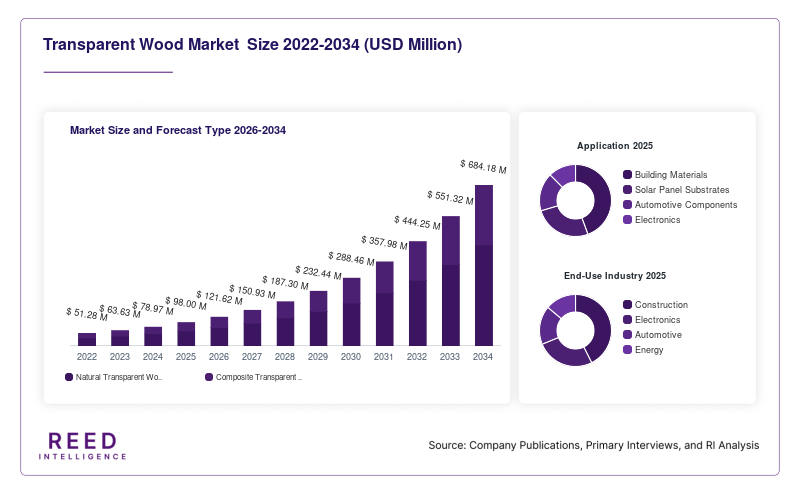
The composite-based transparent wood segment dominated the market in 2025, accounting for approximately 61% of the total share. This dominance is attributed to its enhanced mechanical strength and improved optical clarity compared to natural variants. Composite transparent wood is widely used in construction and electronics due to its durability and versatility.
The natural transparent wood segment is expected to grow at the fastest CAGR of 25.7% during the forecast period. This growth will be driven by increasing demand for fully bio-based materials with minimal synthetic content. As sustainability becomes a priority, manufacturers are likely to invest in refining natural transparent wood production processes.
By Application
Building materials emerged as the leading application segment, holding a 42% share in 2025. Transparent wood is increasingly used in windows, facades, and structural elements due to its insulation properties and aesthetic appeal. The construction industry’s focus on energy efficiency has further supported this segment’s dominance.
Solar panel substrates are projected to be the fastest-growing application, with a CAGR of 27.5%. Transparent wood’s ability to diffuse light enhances solar energy absorption, making it a suitable material for next-generation solar panels. Ongoing research in renewable energy technologies will further boost this segment.
By End-Use Industry
The construction sector dominated the Transparent Wood Market in 2025, accounting for 48% of the total share. The material’s ability to combine transparency with structural strength has made it a preferred choice in modern architecture.
The electronics industry is anticipated to grow at the fastest CAGR of 26.9% during the forecast period. Transparent wood is being explored for use in displays, touch panels, and flexible devices. Its lightweight and durable characteristics are expected to drive adoption in this segment.
By Distribution Channel
Direct sales accounted for the largest share of 67% in 2025, as manufacturers primarily supply transparent wood to industrial clients and research institutions. This channel allows for customized solutions and direct collaboration between producers and end-users.
Online distribution channels are expected to grow at a CAGR of 24.6% during the forecast period. Increasing digitalization and the expansion of e-commerce platforms are enabling manufacturers to reach a broader customer base. This trend is particularly relevant for small-scale buyers and research organizations.
Regional Analysis
North America
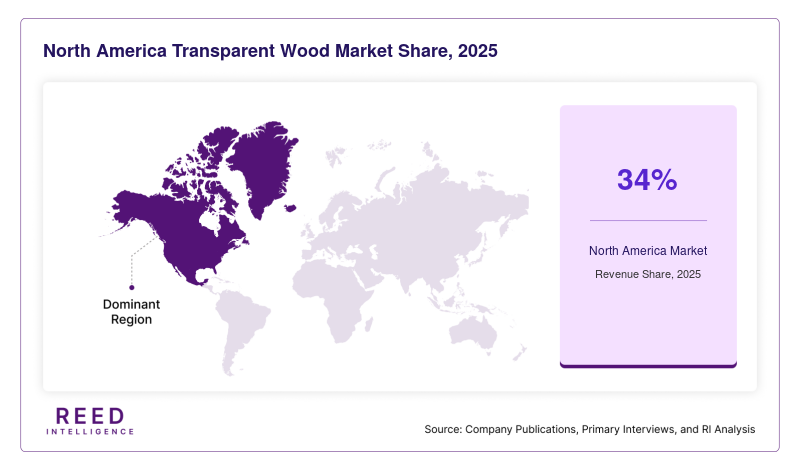
North America accounted for 34% of the Transparent Wood Market share in 2025 and is expected to grow at a CAGR of 23.2% during the forecast period. The region’s growth is driven by strong research and development activities and early adoption of advanced materials in construction and electronics.
The United States dominated the regional market due to its well-established innovation ecosystem. The presence of leading research institutions and startups focusing on bio-based materials has supported market expansion. Additionally, increasing demand for energy-efficient buildings has contributed to the adoption of transparent wood in architectural applications.
Europe
Europe held a 27% share of the Transparent Wood Market in 2025 and is projected to grow at a CAGR of 22.8% through 2034. The region’s focus on sustainability and strict environmental regulations has accelerated the use of eco-friendly materials.
Germany emerged as the dominant country in Europe, driven by its strong manufacturing base and emphasis on green technologies. The country’s construction sector is increasingly integrating sustainable materials, supporting the adoption of transparent wood in building applications.
Asia Pacific
Asia Pacific represented 22% of the market share in 2025 and is expected to witness the fastest growth at a CAGR of 26.8% during the forecast period. Rapid urbanization and industrialization are key factors driving demand in the region.
China led the regional market due to its large-scale construction activities and growing focus on renewable materials. Government initiatives promoting sustainable infrastructure have further supported the adoption of transparent wood in various applications.
Middle East & Africa
The Middle East & Africa accounted for 9% of the market share in 2025 and is projected to grow at a CAGR of 21.5% during the forecast period. The region is gradually adopting advanced materials in construction to support infrastructure development.
The United Arab Emirates dominated the region, driven by its focus on innovative architectural designs and smart city projects. Transparent wood is being explored for its aesthetic and functional benefits in modern construction.
Latin America
Latin America held an 8% share of the Transparent Wood Market in 2025 and is expected to grow at a CAGR of 20.9% through 2034. Increasing awareness of sustainable materials is supporting market growth in the region.
Brazil emerged as the dominant country due to its abundant natural resources and growing construction sector. The use of transparent wood aligns with the country’s focus on sustainable development and eco-friendly building practices.
Competitive Landscape
The Transparent Wood Market is characterized by a mix of research-driven companies and emerging startups focusing on material innovation. Key players are investing in product development, strategic partnerships, and pilot-scale production to strengthen their market presence.
Among these, Woodoo stands out as a leading company due to its advanced material engineering capabilities. The company recently introduced a new generation of transparent wood with enhanced durability and scalability, aimed at commercial construction applications.
Other companies are focusing on expanding their production capacities and exploring new applications in electronics and renewable energy. The competitive landscape is expected to intensify as more players enter the market and technological advancements accelerate commercialization.
Key Players List
- Woodoo
- InventWood
- KTH Royal Institute of Technology
- Fraunhofer Institute
- Stora Enso
- UPM-Kymmene Corporation
- Nippon Paper Industries
- Sumitomo Forestry
- American Process Inc.
- Green Science Alliance
- Merck Group
- Arkema S.A.
- BASF SE
- Covestro AG
- Toray Industries
Recent Developments
- In 2025, Woodoo expanded its production facility to support commercial-scale manufacturing of transparent wood.
- InventWood announced advancements in lignin removal techniques to improve optical clarity.
- Stora Enso initiated research collaborations focused on sustainable material innovation.
- BASF SE explored polymer integration technologies to enhance material performance.
- Covestro AG developed new resin formulations tailored for transparent wood applications.
Transparent Wood Market Segments
Type
- Natural Transparent Wood
- Composite Transparent Wood
Application
- Building Materials
- Solar Panel Substrates
- Automotive Components
- Electronics
End-Use Industry
- Construction
- Electronics
- Automotive
- Energy
Distribution Channel
- Direct Sales
- Online Channels
By Region
- North America
- Europe
- APAC
- Middle East and Africa
- LATAM