Transseptal Access System Market Size, Share Demand Report By Product Type (Transseptal Sheaths, Needles, Dilators, Guidewires, By Application (Atrial Fibrillation Ablation, Mitral Valve Procedures, Left Atrial Appendage Closure), By End Use (Hospitals, Specialty Cardiac Centers), By Procedure Guidance (Fluoroscopy Guided, Echocardiography Assisted), By Region & Segment Forecasts, 2026–2034
USD 3950
Market Overview
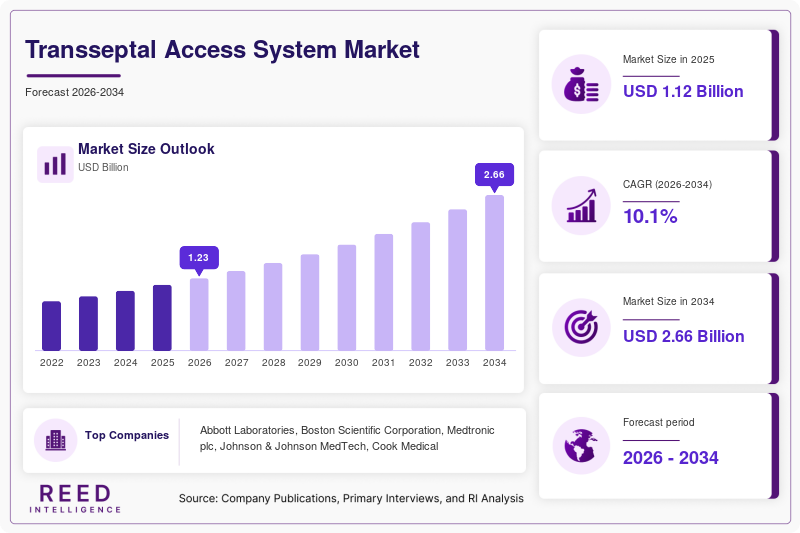
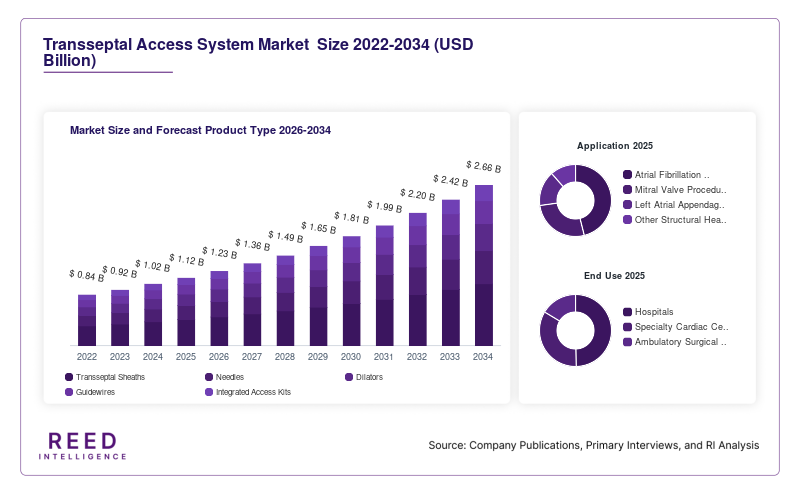
The Transseptal Access System Market size was valued at USD 1.12 billion in 2026 and is projected to reach USD 2.41 billion by 2034, expanding at a CAGR of 10.1% during 2026–2034. The market is growing steadily due to the increasing global burden of atrial fibrillation, structural heart disease, and minimally invasive electrophysiology procedures. Rising preference for catheter-based interventions has created sustained demand for precise and safe transseptal access systems used in left atrial procedures.
Healthcare systems worldwide have also invested in advanced cardiac care infrastructure, which has supported the adoption of transseptal sheaths, needles, dilators, guidewires, and integrated access kits. In addition, growing awareness regarding early treatment of rhythm disorders and expanding reimbursement frameworks have improved procedure volumes.
Key Highlights
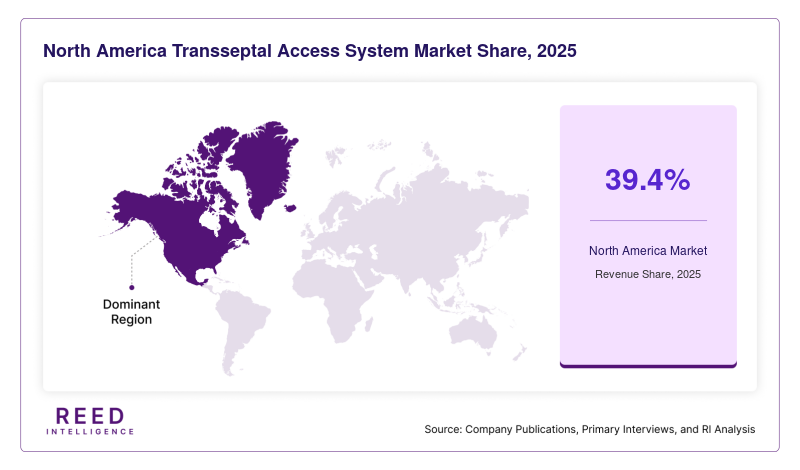
- North America dominated the global market with 39.4% share in 2025.
- Asia Pacific is expected to register the fastest CAGR of 12.8% during 2026–2034.
- By product type, Transseptal Sheaths led with 34.6% share in 2025.
- By product type, Integrated Access Kits will be the fastest-growing subsegment at 12.9% CAGR.
- By application, Atrial Fibrillation Ablation held the largest share of 42.3% in 2025.
- By application, Left Atrial Appendage Closure is projected to grow at 13.2% CAGR.
- By end use, Hospitals accounted for 58.7% share in 2025.
- By end use, Specialty Cardiac Centers will expand at 11.7% CAGR.
- The U.S. market was valued at USD 356.4 million in 2024 and USD 382.8 million in 2025.
Market Trends
Integration of Imaging-Compatible Access Systems
Manufacturers are introducing transseptal access devices compatible with fluoroscopy, intracardiac echocardiography, and 3D mapping systems. These products help physicians improve puncture precision, reduce complications, and shorten procedure times. This trend is reshaping product design and hospital purchasing decisions.
Shift Toward Single-Use Sterile Kits
Demand for pre-packaged sterile single-use kits has increased across electrophysiology labs. These kits simplify workflow, reduce setup time, and support infection control protocols. Hospitals are increasingly selecting bundled systems to standardize procedural outcomes.
Market Drivers
Growing Volume of Electrophysiology Procedures
The increasing prevalence of arrhythmias, especially atrial fibrillation, has raised the number of ablation procedures globally. Since transseptal access is a core procedural step, rising intervention volumes continue to support the Transseptal Access System Market.
Preference for Minimally Invasive Structural Heart Procedures
Many structural heart therapies now rely on catheter-based access rather than open surgery. Procedures such as mitral valve repair and left atrial appendage closure require dependable septal access, boosting product demand.
Market Restraint
Procedure Complexity and Training Requirements
Transseptal puncture requires physician expertise and careful imaging guidance. In facilities with limited skilled operators, adoption remains slower, especially in emerging healthcare markets.
Market Opportunities
Expansion in Ambulatory Cardiac Facilities
Advanced outpatient cardiac centers are increasing their role in low-risk interventions. This creates opportunities for compact and workflow-efficient transseptal systems tailored for ambulatory settings.
Development of Smart Navigation Devices
Manufacturers are investing in pressure-sensing needles, steerable sheaths, and sensor-enabled access tools. These innovations are expected to improve procedural confidence and create premium market segments.
Segmental Analysis
By Product Type
Transseptal Sheaths: Transseptal sheaths accounted for the largest share of 34.6% in 2025 because they are used in nearly every septal access procedure and are available across multiple configurations.
Integrated Access Kits: Integrated access kits will grow at the fastest 12.9% CAGR through 2034. Their growth will be driven by demand for standardized procedural packs that reduce preparation time and inventory complexity.
By Application
Atrial Fibrillation Ablation: Atrial fibrillation ablation held 42.3% share in 2025. High global case volumes and repeat procedure needs supported segment leadership.
Left Atrial Appendage Closure: Left atrial appendage closure will grow at 13.2% CAGR during the forecast period. Increasing use of stroke-prevention implants for patients unsuitable for anticoagulants will support demand.
By End Use
Hospitals:Hospitals represented 58.7% share in 2025 due to high patient inflow, broad reimbursement access, and availability of hybrid cath labs.
Specialty Cardiac Centers: Specialty cardiac centers will expand at 11.7% CAGR through 2034. Their growth will stem from focused expertise, faster scheduling, and rising preference for dedicated arrhythmia treatment centers.
By Procedure Guidance
Fluoroscopy-Guided Systems: Fluoroscopy-guided systems held 61.5% share in 2025 because they remain widely installed across hospitals globally.
Echocardiography-Assisted Systems: Echocardiography-assisted systems will grow at 11.4% CAGR due to rising preference for improved visualization and lower complication risk.
Regional Analysis
North America
North America held 39.4% market share in 2025. The region will grow at a 9.4% CAGR through 2034. The United States remained the dominant country due to strong adoption of robotic electrophysiology labs and high procedural reimbursement levels, which supported continued device utilization.
Europe
Europe accounted for 27.1% share in 2025. The region will expand at a 9.1% CAGR during the forecast period. Germany led the regional market because of its advanced hospital networks and broad access to catheter-based arrhythmia treatment programs.
Asia Pacific
Asia Pacific represented 21.8% share in 2025. The region will register the fastest 12.8% CAGR by 2034. China will remain the dominant country as rapid investment in tertiary hospitals and growing urban cardiovascular care demand increase procedure capacity.
Middle East & Africa
Middle East & Africa captured 6.2% share in 2025. The region will grow at 8.3% CAGR through 2034. Saudi Arabia led demand due to expanding specialty hospitals and national investment in advanced cardiac intervention services.
Latin America
Latin America held 5.5% share in 2025. The region will progress at 8.7% CAGR over the forecast timeline. Brazil dominated the region owing to its large private healthcare sector and increasing availability of electrophysiology centers.
Competitive Landscape
The Transseptal Access System Market remains moderately consolidated, with multinational cardiovascular device companies competing through product innovation, physician training, and regional expansion. Leading participants focus on steerable sheath technology, improved puncture needles, and bundled procedure kits. Partnerships with electrophysiology centers are increasingly common to improve adoption.
Abbott Laboratories remained a market leader due to its broad structural heart portfolio and strong global distribution. In 2025, the company expanded physician education programs focused on left-heart access workflows. Boston Scientific Corporation continued to strengthen its electrophysiology ecosystem with integrated procedural solutions. Medtronic plc leveraged its cardiac rhythm management presence to cross-sell access devices. Johnson & Johnson MedTech expanded mapping-compatible accessory offerings. Cook Medical maintained relevance through specialized needles and access components.
Competition is expected to intensify as companies introduce imaging-integrated and next-generation steerable products tailored for high-volume cardiac centers.
Key Players List
- Abbott Laboratories
- Boston Scientific Corporation
- Medtronic plc
- Johnson & Johnson MedTech
- Cook Medical
- Teleflex Incorporated
- Merit Medical Systems
- Baylis Medical Technologies
- B. Braun SE
- Terumo Corporation
- Oscor Inc.
- Lepu Medical Technology
- MicroPort Scientific Corporation
- Cardinal Health
- Biotronik SE & Co. KG
Recent Developments
- In 2025, Abbott Laboratories expanded training centers for advanced septal access procedures in North America.
- Boston Scientific launched a refined steerable sheath platform for complex left atrial interventions.
- Medtronic entered partnerships with cardiac centers to support workflow integration programs.
- Cook Medical introduced upgraded puncture needle designs for improved tactile control.
- Several Asia Pacific manufacturers expanded domestic production capacity to reduce supply dependence.
Transseptal Access System Market Segments
Product Type
- Transseptal Sheaths
- Needles
- Dilators
- Guidewires
- Integrated Access Kits
Application
- Atrial Fibrillation Ablation
- Mitral Valve Procedures
- Left Atrial Appendage Closure
- Other Structural Heart Procedures
End Use
- Hospitals
- Specialty Cardiac Centers
- Ambulatory Surgical Centers
Procedure Guidance
- Fluoroscopy Guided
- Echocardiography Assisted
- Hybrid Navigation Guided
By Region
- North America
- Europe
- APAC
- Middle East and Africa
- LATAM